



4 factors for high turnover rate in assisted living
Workstream Blog

4 factors for high turnover rate in assisted living

By Desmond Lim

Get the latest with Workstream

Always stay current with hiring news by subscribing to our email updates

When people think of industries with high turnover rates, they often assume that establishments such as restaurants, hotels, and convenience stores have the hardest time holding onto employees—but the real answer might surprise you.

The senior living industry has a turnover rate of 50% according to the Bureau of Labor Statistics—and this number is quickly rising (source: CNBC). To put this figure into better perspective, if your facility has 1,000 residents, you need to hire 500 new employees every year to maintain the status quo. 

improve job posting ebook

This high employee turnover rate is very detrimental to businesses, causing the following:

  • Burnout: Employees are overworked because facilities can't keep up with hiring. When assisted living employees leave suddenly, the remaining staff has to pick up additional shifts and training duties. 
  • Decrease in revenue: It costs centers $3,500 to $5,000 per hire when you factor in job board costs, onboarding, and training. 
  • Negative impact on employee culture: Employees are happier when they work with people they are familiar with. If there is a continuous cycle of people leaving, it can make for a stressful work environment.
  • Lack of consistency of care: Residents are more at ease being cared for by those they know. Constant changeover of staff can be very emotionally disruptive for assisted living residents.
  • Drop in the quality of care: When employees leave, they need to train their replacements; some tasks will fall through the cracks, resulting in lower quality of care.

So what are the factors that often lead to high turnover numbers?

Challenging workload 

Working at assisted living facilities can be both physically and emotionally taxing. The daily tasks are hard enough. Add the inevitable burnout due to the lack of staff, and the fact that employees often get emotionally attached to their assigned residents.

Low pay

Hourly workers at assisted living facilities receive relatively low pay considering the tiring nature of their work. Nursing assistants can get paid around $12 per hour, with nurses faring a bit better at $20. According to a survey performed by Indeed, Half of all employees at assisted living facilities believe they are not paid fairly. The low pay rate has driven many workers to seek more roles elsewhere in the healthcare industry.
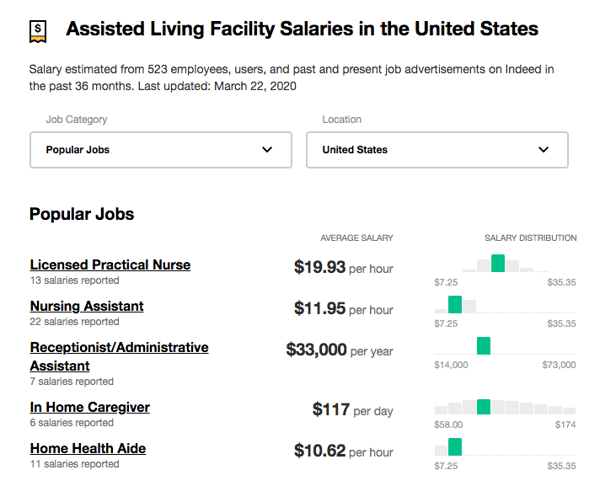
What are nurses paid in the United States - assisted living - Workstream Indeed

Lack of career growth

Entry-level workers can struggle to break into senior ranks of employment in the senior care industry, particularly if there is a lack of training or other investment by the facility. Lack of staff development programs can be detrimental to an employee’s sense of belonging, leading to apathy among staff.

Offering opportunities for career growth, as well as increasing engagement, can lead to better retention. Read more on how to drive employee engagement in this post

Very competitive labor market

As of August 2019, there were roughly 39,000 job openings posted by direct employers in the senior living industry, including those for assisted living facilities. Given the abundance of opportunities, workers feel less apprehensive going elsewhere when they feel unsatisfied with their current employment.

Given the urgent need in the industry and the stiff competition for hiring in the field, it’s more important than ever to focus on the right screening process. Employee retention starts at the very first step of recruitment: making sure to find competent, dedicated candidates to match the qualifications of each job opening you post. 

Workstream is committed to streamlining and automating recruitment strategies so that every employer can get the best solutions for different hiring challenges. Workstream has helped hire thousands of assisted living employees and care drivers for companies including Brightstar, Morrison Living, Nurse Next Door, Envoy, and Clarion Medical Transport. We reduce their time to hire by 72% and help them find 4x the number of qualified applicants.

Let’s talk about how we can help you.

By Desmond Lim
Desmond Lim is co-founder and CEO of Workstream, a text-based hiring platform for local businesses hiring hourly workers. He is a graduate of Harvard University and MIT Media Lab, former Product Manager at WeChat, and investor at Dorm Room Fund. He contributes to Entrepreneur.com, Workstream Blog, and Huffington Post. He splits his time between San Francisco and Utah, and represented the Singapore National Team in basketball.

Personal Information and Sensitive Personal Information

Before we discuss the right to limit and the right to opt-out, we must first define personal information and how it relates to sensitive personal information.

Personal information is any data that identifies, relates to, or could reasonably be linked to you or your household. A few examples of personal information include:

  • Name or nickname
  • Email address
  • Purchase history
  • Browsing history
  • Location data
  • Employment data
  • IP address
  • Profiles businesses create about you, including pseudonymous profiles (“user1234”)
  • Sensitive personal information

Sensitive personal information or “SPI” is a subset of personal information, defined as:

  • Identifying information (e.g. social security number, driver’s license)
  • Financial data (e.g. debit or credit card numbers)
  • Precise geolocation (within a radius of 1,850 feet)
  • Demographic or protected-class information (e.g. race/ethnicity, religion, union membership)
  • Biometric and genetic data (e.g. fingerprints, palm scans, facial recognition)
  • Communications and content (e.g. mail, email, text messages)
  • Health and sexual orientation (e.g. vaccine records, health history)

Right to Opt-Out

Californians have the right to opt-out of the sale and sharing of their personal information. That means you have the right to opt-out of the sale of your personal information to third parties (e.g. data brokers, advertisers). You also have the right to opt-out of the sharing of your personal information to prevent the targeting of ads across different businesses, websites, apps, or services.

CCPA-covered businesses must provide a link to allow you to exercise this right. It is usually found at the bottom of a webpage and will say “do not sell or share my personal information” or “your privacy choices.” Sometimes businesses offer privacy choices through a pop-up window or form

To opt-out of the sale and sharing of your personal information, click on the link or use the toggle provided by the business and follow the directions. Doing this on every website you visit can feel burdensome, but to ease the burden you can automatically select your privacy preferences for every website by using an opt-out preference signal, or OOPS for short.

An OOPS is a user-friendly and straightforward way for consumers to automatically exercise their right to opt-out of the sale and sharing of their personal information with the businesses they interact with online. An OOPS, such as the Global Privacy Control. It can either be a setting on your internet browser or a browser extension. With an OOPS, consumers do not have to submit individual requests to opt-out of sale or sharing with each business.

Right to Limit

Californians also have the right to direct businesses to limit the use and disclosure of their sensitive personal information.

Businesses covered under the CCPA must provide a link on their website that allows you to request the limiting of your SPI, if they plan on using it in certain ways. That link will also typically be at the bottom of a webpage and will say: “limit the use of my sensitive personal information” or “your privacy choices.” Once you send this request, the business must stop using your SPI for anything other than to:

  • Provide requested goods or services
  • Ensure security and integrity
  • Prevent fraud
  • Maintain system functionality
  • Comply with legal obligations

Bringing it Together

In summary, the CCPA gives you the right to opt-out of the sale and sharing of your personal information and gives you additional rights to further limit the use and disclosure of your sensitive personal information.

When you exercise these rights together, you exert greater control in protecting your personal data which is important for your identity, safety, and financial health.

If you are on a business’s website and you can’t find the links to exercise your rights, remember to check their privacy policy. The privacy policy should tell you how you can exercise your rights under the law.

If you find your rights being violated, you can submit a complaint to CalPrivacy.

Next in the LOCKED series, we will explore the right to correct and right to know. Follow us on social media to get live updates or check back in one week for the next post.

Essential

Required to enable basic website functionality. You may not disable essential cookies.

Targeted Advertising

Used to deliver advertising that is more relevant to you and your interests. May also be used to limit the number of times you see an advertisement and measure the effectiveness of advertising campaigns. Advertising networks usually place them with the website operator’s permission.

Personalization

Allow the website to remember choices you make (such as your username, language, or the region you are in) and provide enhanced, more personal features. For example, a website may provide you with local weather reports or traffic news by storing data about your general location.

Analytics

Help the website operator understand how its website performs, how visitors interact with the site, and whether there may be technical issues.

Right to Limit Use of Sensitive Personal Information

You also have the right to limit how we use sensitive personal information (such as precise geolocation, financial data, etc.).

Your preference has been saved. We will not sell or share your personal information.