<img height="1" width="1" style="display:none" src="https://www.facebook.com/tr?id=395330474421690&amp;ev=PageView&amp;noscript=1">
Built for the hourly workforce

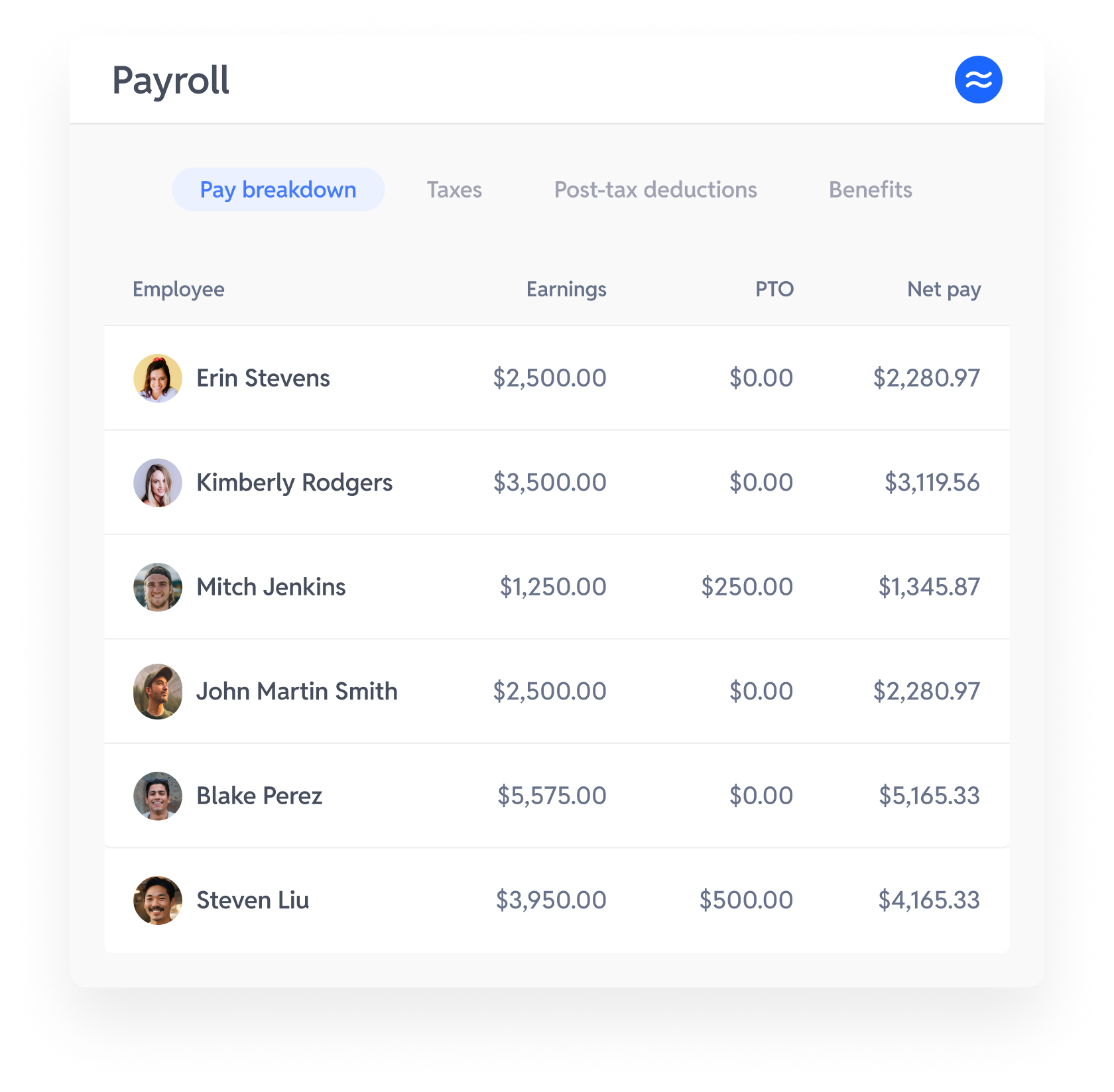
Humans make mistakes. Automated payroll doesn't.

With a fully integrated, full-service payroll solution, you can feel confident each payroll run will be smooth, accurate, and on time.

Frame-Apr-13-2026-09-51-36-9508-AM

Automated calculations

Get accurate calculations for breaks, tips, and overtime with integrated Time Clock data

Frame-Apr-13-2026-09-51-48-9392-AM

Automated deductions and remittances

Ensure taxes, benefits, and garnishments are calculated and submitted accurately.

Frame-Apr-13-2026-06-59-17-6644-AM

On-time, transparent payroll

Workers get paid on time via their preferred method and can access their pay information anytime.

Frame-Apr-13-2026-09-52-11-8390-AM

Paid time off

Easily manage time off policies and provide time off balances on worker pay stubs.

Frame-Apr-13-2026-09-52-20-1636-AM

Timely tax filings

We help you complete and file the appropriate forms for your business, including new hire tax forms during onboarding.

Frame-Apr-13-2026-09-52-26-9188-AM

Electronic records

Securely store and access payroll records for your employee, state, and federal needs.

Frame-Apr-13-2026-09-52-36-4302-AM

Payroll AI Assistant

Automate payroll, generate reports, and get instant insights on pay, taxes, and employee compensation.

Get restaurant-grade payroll.

FAQs

Got questions? We've got answers.

Still have questions?

What does full-service payroll mean?

Full-service payroll means the payroll platform handles payroll processing, tax withholding, tax filing, direct deposits, and year-end tax forms on your behalf. This includes calculating gross-to-net pay, withholding federal, state, and local taxes, filing payroll tax returns, generating W-2s and 1099s, and depositing employee pay directly into bank accounts. With platforms like Workstream, employers approve the payroll run while the platform manages the filing and payment process automatically. This differs from self-service payroll systems, where employers remain responsible for tax filings and late-payment penalties.

What payroll taxes does full-service software file?

Full-service payroll software like Workstream files federal, state, and local payroll taxes automatically. This includes FICA taxes for Social Security and Medicare, FUTA taxes, federal income tax withholding, state withholding taxes, state unemployment taxes, and applicable local taxes such as city or school district payroll taxes. Workstream also automatically registers new tax jurisdictions when operators hire employees in new states, removing the need to manually apply for state payroll tax accounts.

How does full-service payroll handle multi-state employees?

Full-service payroll handles multi-state employees by calculating taxes based on where employees physically work. Employees working across multiple states have withholding calculated proportionally according to hours worked in each jurisdiction. The platform also applies reciprocity agreements automatically when employees live in one state but work in another. This helps multi-location operators avoid payroll reconciliation problems caused by incorrect state tax withholding.

Does full-service payroll include W-2 and 1099 filing?

Full-service payroll includes W-2 and 1099 filing as part of the payroll process. Workstream generates and distributes W-2s and 1099-NEC forms to workers through paper or electronic delivery based on employee preference. The platform also files the required W-2, W-3, and 1099 transmittals with the IRS and state agencies automatically without charging separate year-end filing fees.

How does full-service payroll handle off-cycle pay runs?

Full-service payroll handles off-cycle pay runs by allowing operators to process bonuses, payroll corrections, and final paychecks at any time. Workstream automatically applies the correct final paycheck timing rules and supplemental wage withholding rates based on state law. For example, California requires same-day final paycheck payments for involuntary terminations under Labor Code §201, while many other states allow several business days for payment processing.

Does full-service payroll support direct deposit and pay cards?

Full-service payroll supports direct deposit, pay cards, and flexible payment timing options for employees. Workstream supports direct deposits into U.S. bank accounts, optional pay cards for unbanked employees, and same-day or next-day payment options. Pay cards are especially useful for hourly restaurant and retail workers who may not have traditional bank accounts but still need electronic payroll access.

Personal Information and Sensitive Personal Information

Before we discuss the right to limit and the right to opt-out, we must first define personal information and how it relates to sensitive personal information.

Personal information is any data that identifies, relates to, or could reasonably be linked to you or your household. A few examples of personal information include:

  • Name or nickname
  • Email address
  • Purchase history
  • Browsing history
  • Location data
  • Employment data
  • IP address
  • Profiles businesses create about you, including pseudonymous profiles (“user1234”)
  • Sensitive personal information

Sensitive personal information or “SPI” is a subset of personal information, defined as:

  • Identifying information (e.g. social security number, driver’s license)
  • Financial data (e.g. debit or credit card numbers)
  • Precise geolocation (within a radius of 1,850 feet)
  • Demographic or protected-class information (e.g. race/ethnicity, religion, union membership)
  • Biometric and genetic data (e.g. fingerprints, palm scans, facial recognition)
  • Communications and content (e.g. mail, email, text messages)
  • Health and sexual orientation (e.g. vaccine records, health history)

Right to Opt-Out

Californians have the right to opt-out of the sale and sharing of their personal information. That means you have the right to opt-out of the sale of your personal information to third parties (e.g. data brokers, advertisers). You also have the right to opt-out of the sharing of your personal information to prevent the targeting of ads across different businesses, websites, apps, or services.

CCPA-covered businesses must provide a link to allow you to exercise this right. It is usually found at the bottom of a webpage and will say “do not sell or share my personal information” or “your privacy choices.” Sometimes businesses offer privacy choices through a pop-up window or form

To opt-out of the sale and sharing of your personal information, click on the link or use the toggle provided by the business and follow the directions. Doing this on every website you visit can feel burdensome, but to ease the burden you can automatically select your privacy preferences for every website by using an opt-out preference signal, or OOPS for short.

An OOPS is a user-friendly and straightforward way for consumers to automatically exercise their right to opt-out of the sale and sharing of their personal information with the businesses they interact with online. An OOPS, such as the Global Privacy Control. It can either be a setting on your internet browser or a browser extension. With an OOPS, consumers do not have to submit individual requests to opt-out of sale or sharing with each business.

Right to Limit

Californians also have the right to direct businesses to limit the use and disclosure of their sensitive personal information.

Businesses covered under the CCPA must provide a link on their website that allows you to request the limiting of your SPI, if they plan on using it in certain ways. That link will also typically be at the bottom of a webpage and will say: “limit the use of my sensitive personal information” or “your privacy choices.” Once you send this request, the business must stop using your SPI for anything other than to:

  • Provide requested goods or services
  • Ensure security and integrity
  • Prevent fraud
  • Maintain system functionality
  • Comply with legal obligations

Bringing it Together

In summary, the CCPA gives you the right to opt-out of the sale and sharing of your personal information and gives you additional rights to further limit the use and disclosure of your sensitive personal information.

When you exercise these rights together, you exert greater control in protecting your personal data which is important for your identity, safety, and financial health.

If you are on a business’s website and you can’t find the links to exercise your rights, remember to check their privacy policy. The privacy policy should tell you how you can exercise your rights under the law.

If you find your rights being violated, you can submit a complaint to CalPrivacy.

Next in the LOCKED series, we will explore the right to correct and right to know. Follow us on social media to get live updates or check back in one week for the next post.


Essential

Required to enable basic website functionality. You may not disable essential cookies.

Targeted Advertising

Used to deliver advertising that is more relevant to you and your interests. May also be used to limit the number of times you see an advertisement and measure the effectiveness of advertising campaigns. Advertising networks usually place them with the website operator’s permission.

Personalization

Allow the website to remember choices you make (such as your username, language, or the region you are in) and provide enhanced, more personal features. For example, a website may provide you with local weather reports or traffic news by storing data about your general location.

Analytics

Help the website operator understand how its website performs, how visitors interact with the site, and whether there may be technical issues.

Right to Limit Use of Sensitive Personal Information

You also have the right to limit how we use sensitive personal information (such as precise geolocation, financial data, etc.).

Your preference has been saved. We will not sell or share your personal information.