


Why Big Companies Lifted Their Hiring Freeze
Workstream Blog

Why Big Companies Lifted Their Hiring Freeze

By Robert Woo

Get the latest with Workstream

Always stay current with hiring news by subscribing to our email updates

Chains are on a Hiring Spree

Some good news this week as medical experts are hopeful about the announcement of a COVID-19 vaccine that is more than 90% effective. Even better news is that a second company, Moderna, could have a very similar vaccine announced soon as well. We like the sound of doubling the chances that businesses can reopen in a big way!

Of course, many QSRs haven't had to wait for good vaccination news to be on a tear lately. In the last week, we've been seeing restaurant chains go on hiring sprees and announcing vacancies across the nation. Just a few quick hits:

And we're seeing hiring spikes in grocery stores as well; all great news for a job market that has seen another drop in unemployment to 6.9%.

restaurant employee

But Will The Overall Industry Pull Through?

Of course, not all restaurants are QSRs and winter is coming. While chains are seeing big business after the economic downturn due to the pandemic, dine-in restaurants are having to contend with two pieces of bad news at the same time.

One we saw coming: the colder weather. Even as restaurants get creative to remain open outdoors during winter months for a short-term, there are new questions about how safe these outdoor setups really are with a virus as contagious as COVID-19.

The second piece of bad news: cases are suddenly at an all-time high. So even though there is promising news of a vaccine to come early next year, new restrictions and shut-downs may be coming before then that might hurt an industry already hanging by a thread. Due to this, dine-in restaurants will have to go for cost-saving efforts.

We Just Need A Little More Time... And Help 

Fortunately, experts say that there is still time to avert a "third wave" in cases in hard-hit places such as Los Angeles. Couple that with the new administration's coming stricter mask mandate, and the potential for more stimulus support from Congress, the restaurant industry has a good chance of staying afloat until businesses can truly reopen again.

And additional support seems to be coming from local government and businesses, even as national stimulus talks continue. Grubhub is giving $10,000 grants to help restaurants over winter through the Restaurant Strong Fund. The city of Cleveland is giving out grants to restaurants as well. So is Baltimore.

It's been amazing to see restaurants see support in this way. And with the light at the end of the tunnel now seemingly in sight, it just might be enough to do the job.

Is It Actually Bad News?

A recent survey of HR executives conducted by the Conference Board revealed some information about how companies will or won't hire to close out the year in light of COVID-19. While the survey had some interesting data, what was more interesting is how USA Today decided to report its findings.
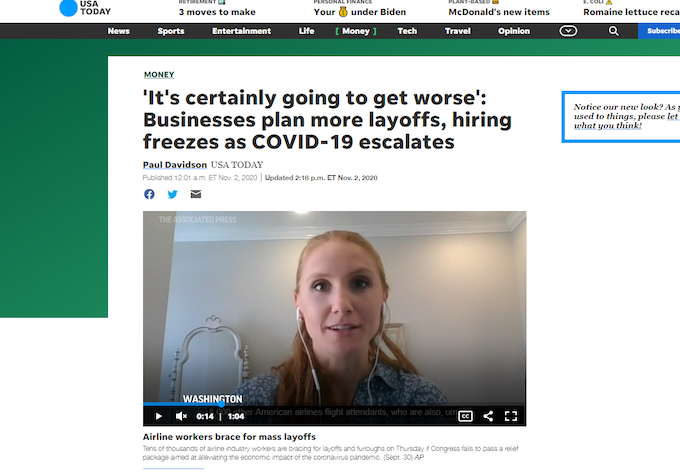
screenshot from USA today-1

The article led with that headline and the fact that "nearly one in 10 U.S. businesses plan to lay off existing employees during the final three months of the year as a result of the outbreak."

Nearly one in ten is 9%, by the way, according to the actual survey. But what did they bury toward the very bottom of the article?

"Twelve percent of businesses surveyed by the Conference Board plan to increase hiring in the final three months of the year." [emphasis ours]

Last we checked, 12 is bigger than 9.

The USA Today article tries to bury the lede here that overall, more companies are opening new positions than laying off workers . This would explain why jobs continue to recover even after downsizing, with the unemployment rate climbing to 6.9% just recently. The point here is that hiring isn't down across the board. Overall, the numbers are getting much better even after businesses’ cost-cutting efforts.

The Actual Problem is K-Shaped

Poor journalism aside, the survey and article do highlight the very strange job recovery we are seeing. Tech companies, e-commerce, housing, and consumer products have seen a boom over the past few months, and these are the companies that are doing most of the hiring. Amazon, CVS, Apple, Google, Meta, LinkedIn, and Microsoft have all been on hiring sprees due to the tech industry’s market conditions.

Meanwhile, traditional dine-in restaurants, hospitality, travel, and other industries that rely on customer service are the ones continuing to see layoffs due to their economic conditions. We are seeing a great divide in the hiring process between these industry buckets, so while overall retention is currently happening, only one bucket is benefitting.

And while the hiring bucket seems to be larger than the non-hiring bucket at this stage, that doesn't help the businesses on the short end of the stick.

Hiring to Close Out The Year

We here at Workstream know that a lot of hiring still happens in the last couple months of the year (that companies stop hiring in November and December is somewhat of a myth), which means that for the companies who are restructuring and staffing, competition might be fierce and talent or job seekers can get snatched up quickly. So if your company is in the fortunate position to open positions or increase the current employees, it's important to start the recruitment process right now with a good strategy in place to streamline the process.

We also expect the K-shaped recovery to get better as hard-hit industries get somewhat of a boost during the holiday season. Even now, many hospitality businesses are hiring back furloughed employees or new employees. And with the news of a 90% effective vaccine hitting this week as well, there seems to be a light at the end of this dark tunnel.

Need help hiring the right people? Workstream can help. Our platform gets you 4x the number of qualified applicants and reduces your time-to-hire by 70%.

Click here to schedule a demo.

By Robert Woo
Robert Woo is a freelance content creator for various companies from startup to enterprise-level. When not writing SEO-friendly articles, he writes and performs comedy, plays guitar, and champions the Oxford comma.

Personal Information and Sensitive Personal Information

Before we discuss the right to limit and the right to opt-out, we must first define personal information and how it relates to sensitive personal information.

Personal information is any data that identifies, relates to, or could reasonably be linked to you or your household. A few examples of personal information include:

  • Name or nickname
  • Email address
  • Purchase history
  • Browsing history
  • Location data
  • Employment data
  • IP address
  • Profiles businesses create about you, including pseudonymous profiles (“user1234”)
  • Sensitive personal information

Sensitive personal information or “SPI” is a subset of personal information, defined as:

  • Identifying information (e.g. social security number, driver’s license)
  • Financial data (e.g. debit or credit card numbers)
  • Precise geolocation (within a radius of 1,850 feet)
  • Demographic or protected-class information (e.g. race/ethnicity, religion, union membership)
  • Biometric and genetic data (e.g. fingerprints, palm scans, facial recognition)
  • Communications and content (e.g. mail, email, text messages)
  • Health and sexual orientation (e.g. vaccine records, health history)

Right to Opt-Out

Californians have the right to opt-out of the sale and sharing of their personal information. That means you have the right to opt-out of the sale of your personal information to third parties (e.g. data brokers, advertisers). You also have the right to opt-out of the sharing of your personal information to prevent the targeting of ads across different businesses, websites, apps, or services.

CCPA-covered businesses must provide a link to allow you to exercise this right. It is usually found at the bottom of a webpage and will say “do not sell or share my personal information” or “your privacy choices.” Sometimes businesses offer privacy choices through a pop-up window or form

To opt-out of the sale and sharing of your personal information, click on the link or use the toggle provided by the business and follow the directions. Doing this on every website you visit can feel burdensome, but to ease the burden you can automatically select your privacy preferences for every website by using an opt-out preference signal, or OOPS for short.

An OOPS is a user-friendly and straightforward way for consumers to automatically exercise their right to opt-out of the sale and sharing of their personal information with the businesses they interact with online. An OOPS, such as the Global Privacy Control. It can either be a setting on your internet browser or a browser extension. With an OOPS, consumers do not have to submit individual requests to opt-out of sale or sharing with each business.

Right to Limit

Californians also have the right to direct businesses to limit the use and disclosure of their sensitive personal information.

Businesses covered under the CCPA must provide a link on their website that allows you to request the limiting of your SPI, if they plan on using it in certain ways. That link will also typically be at the bottom of a webpage and will say: “limit the use of my sensitive personal information” or “your privacy choices.” Once you send this request, the business must stop using your SPI for anything other than to:

  • Provide requested goods or services
  • Ensure security and integrity
  • Prevent fraud
  • Maintain system functionality
  • Comply with legal obligations

Bringing it Together

In summary, the CCPA gives you the right to opt-out of the sale and sharing of your personal information and gives you additional rights to further limit the use and disclosure of your sensitive personal information.

When you exercise these rights together, you exert greater control in protecting your personal data which is important for your identity, safety, and financial health.

If you are on a business’s website and you can’t find the links to exercise your rights, remember to check their privacy policy. The privacy policy should tell you how you can exercise your rights under the law.

If you find your rights being violated, you can submit a complaint to CalPrivacy.

Next in the LOCKED series, we will explore the right to correct and right to know. Follow us on social media to get live updates or check back in one week for the next post.

Essential

Required to enable basic website functionality. You may not disable essential cookies.

Targeted Advertising

Used to deliver advertising that is more relevant to you and your interests. May also be used to limit the number of times you see an advertisement and measure the effectiveness of advertising campaigns. Advertising networks usually place them with the website operator’s permission.

Personalization

Allow the website to remember choices you make (such as your username, language, or the region you are in) and provide enhanced, more personal features. For example, a website may provide you with local weather reports or traffic news by storing data about your general location.

Analytics

Help the website operator understand how its website performs, how visitors interact with the site, and whether there may be technical issues.

Right to Limit Use of Sensitive Personal Information

You also have the right to limit how we use sensitive personal information (such as precise geolocation, financial data, etc.).

Your preference has been saved. We will not sell or share your personal information.