

Acts of Kindness from Restaurants Around the World
Workstream Blog

Acts of Kindness from Restaurants Around the World

By Nigel Seah

Get the latest with Workstream

Always stay current with hiring news by subscribing to our email updates

As of March 16 2020 at 8.27 PM ET, the number of deaths from coronavirus in the world has hit 6,500. In the US, states like New York, Connecticut, and New Jersey will be banning gatherings of over 50 people, while states like Ohio and California will close bars and restaurants. In other parts of the world, countries like Malaysia and Germany have closed their borders, and Switzerland has declared a state of emergency. On the individual level, these conditions have sparked a fear of food shortage among global citizens and many have begun panic buying

It is difficult to stay positive in this kind of situation, but despite restaurants taking a heavy hit to their business, such as suspensions of operations, many of them have chipped in to help make things a little better. Here are heartwarming moments where restaurants around the world helped boost the morale of healthcare workers at the frontline of the war against coronavirus:

Singapore

OK Chicken Rice
D2rUlOKAxqua4aIRTY85lBx9vpdgiU8hYnarNQ2x7NqZqwlK7IvQi5sOVb4PNlgUOEJP4mOvoOHXhDaRNC1qnjHok7XNdO0QGR_rHoGSR_dqefyJrSyaCFt10NprejyWa1fV0m1S

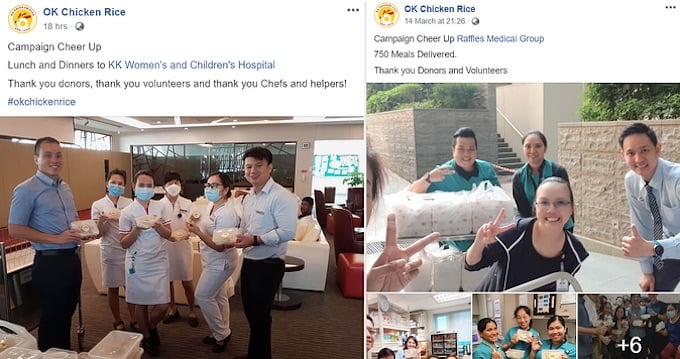
Owner of OK Chicken Rice, Daniel Tan, took the initiative to deliver free meals to healthcare workers as an “encouragement of love,” after reports of nurses being ostracized on public transport for wearing their uniforms during this outbreak period surfaced online. Meanwhile, his wife started “Cheer Up,” an online campaign to raise money to fund the production and delivery of packs of food to healthcare workers. As of February 25, about US$18,310.96 (SG$26,000) was raised and about 1,200 packs of food were delivered

Carrara Cafe

facebook post from carrara cafe

Despite a reduction in the number of walk-in orders, the cafe still decided to offer 80 cups of gelato for free to medical workers. In addition, should medical workers purchase a main dish at their cafe from now till the end of April, they will get an additional free scoop of gelato.

The Philippines

McDonald’s

The fast food giant has expressed their support for healthcare workers and sent free food and drinks to V. Luna Medical Center in Quezon City. McDonald’s Philippines said that they will be reaching out to more hospitals during this period.

Coffee Bean and Tea Leaf
facebook post from coffee bean and tea leaf

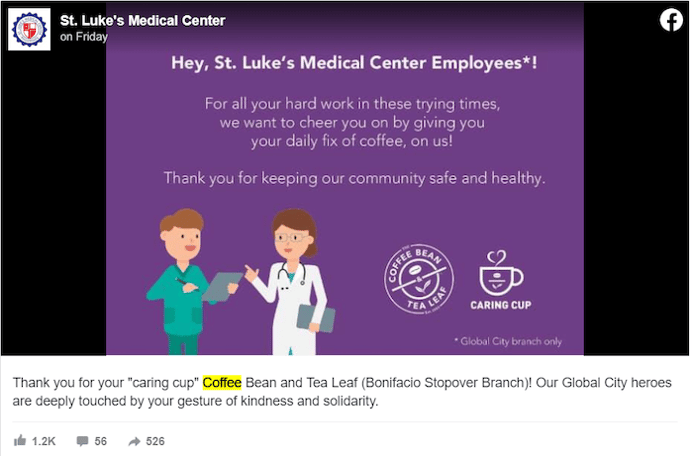
Coffee Bean and Tea Leaf gave healthcare workers of St. Luke’s Medical Center a “caring cup” which can be used to collect a free cup of coffee! The hospital responded with a Facebook message to thank the cafe franchise for its “kindness and solidarity.”

USA

My Sister’s Fault
facebook post from my sister's fault

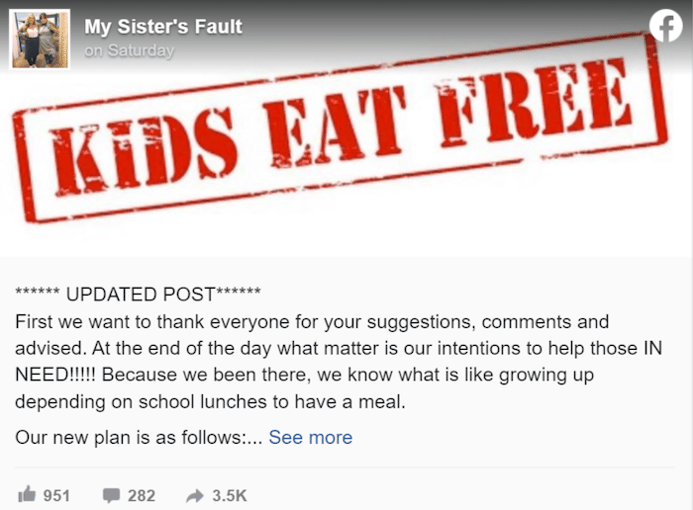
The bakery and restaurant from Delaware announced that they will be providing school-age children with free meals from Wednesdays to Fridays for two weeks. This came after Delaware declared a state of emergency and closed schools, cutting off children’s access to school lunches.

Sugar Street Bakery & Bistro
facebook post from sugar street bakery and bistro

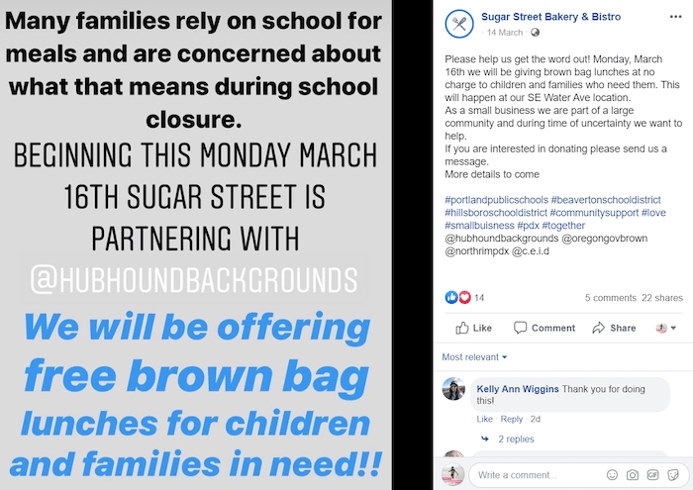
This restaurant from Southeast Portland is offering food to children as well as families in need. At least 1,500 meals have been prepared for the purpose of being distributed to those in need.

South Korea

SPC Group

SPC Group, a South Korean conglomerate that owns established franchises such as Paris Croissant, Paris Baguette, and Caffè Pascucci, has said that it will be donating bread and water for a month to Daegu and North Gyeongsang Province. Furthermore, the group also donated US$32,380.80 (₩ 40,000,000) worth of “Happy Points” to children in low-income households in those provinces to help them get through the extended school holidays. The points can be used like cash in any of SPC’s food franchises. These include Paris Baguette, Baskin Robbins, Dunkin’, and the Pascucci coffee chain.

During this period when all our news channels and social media feeds are dominated by stories of hardship and sickness, it’s great to read about these acts of kindness. They may seem small in the face of the global coronavirus crisis, but hopefully more people will be inspired to help others in this time of need.


By Nigel Seah
Nigel is not just a marketer at Workstream, he is also a graduate of Psychology and Marketing of Singapore Management University. He has multiple experiences in various areas of marketing - advertising, email marketing, and content writing. Fun fact, prior to joining Workstream, he took a semester off school to intern at SAP in Brazil.

Personal Information and Sensitive Personal Information

Before we discuss the right to limit and the right to opt-out, we must first define personal information and how it relates to sensitive personal information.

Personal information is any data that identifies, relates to, or could reasonably be linked to you or your household. A few examples of personal information include:

  • Name or nickname
  • Email address
  • Purchase history
  • Browsing history
  • Location data
  • Employment data
  • IP address
  • Profiles businesses create about you, including pseudonymous profiles (“user1234”)
  • Sensitive personal information

Sensitive personal information or “SPI” is a subset of personal information, defined as:

  • Identifying information (e.g. social security number, driver’s license)
  • Financial data (e.g. debit or credit card numbers)
  • Precise geolocation (within a radius of 1,850 feet)
  • Demographic or protected-class information (e.g. race/ethnicity, religion, union membership)
  • Biometric and genetic data (e.g. fingerprints, palm scans, facial recognition)
  • Communications and content (e.g. mail, email, text messages)
  • Health and sexual orientation (e.g. vaccine records, health history)

Right to Opt-Out

Californians have the right to opt-out of the sale and sharing of their personal information. That means you have the right to opt-out of the sale of your personal information to third parties (e.g. data brokers, advertisers). You also have the right to opt-out of the sharing of your personal information to prevent the targeting of ads across different businesses, websites, apps, or services.

CCPA-covered businesses must provide a link to allow you to exercise this right. It is usually found at the bottom of a webpage and will say “do not sell or share my personal information” or “your privacy choices.” Sometimes businesses offer privacy choices through a pop-up window or form

To opt-out of the sale and sharing of your personal information, click on the link or use the toggle provided by the business and follow the directions. Doing this on every website you visit can feel burdensome, but to ease the burden you can automatically select your privacy preferences for every website by using an opt-out preference signal, or OOPS for short.

An OOPS is a user-friendly and straightforward way for consumers to automatically exercise their right to opt-out of the sale and sharing of their personal information with the businesses they interact with online. An OOPS, such as the Global Privacy Control. It can either be a setting on your internet browser or a browser extension. With an OOPS, consumers do not have to submit individual requests to opt-out of sale or sharing with each business.

Right to Limit

Californians also have the right to direct businesses to limit the use and disclosure of their sensitive personal information.

Businesses covered under the CCPA must provide a link on their website that allows you to request the limiting of your SPI, if they plan on using it in certain ways. That link will also typically be at the bottom of a webpage and will say: “limit the use of my sensitive personal information” or “your privacy choices.” Once you send this request, the business must stop using your SPI for anything other than to:

  • Provide requested goods or services
  • Ensure security and integrity
  • Prevent fraud
  • Maintain system functionality
  • Comply with legal obligations

Bringing it Together

In summary, the CCPA gives you the right to opt-out of the sale and sharing of your personal information and gives you additional rights to further limit the use and disclosure of your sensitive personal information.

When you exercise these rights together, you exert greater control in protecting your personal data which is important for your identity, safety, and financial health.

If you are on a business’s website and you can’t find the links to exercise your rights, remember to check their privacy policy. The privacy policy should tell you how you can exercise your rights under the law.

If you find your rights being violated, you can submit a complaint to CalPrivacy.

Next in the LOCKED series, we will explore the right to correct and right to know. Follow us on social media to get live updates or check back in one week for the next post.

Essential

Required to enable basic website functionality. You may not disable essential cookies.

Targeted Advertising

Used to deliver advertising that is more relevant to you and your interests. May also be used to limit the number of times you see an advertisement and measure the effectiveness of advertising campaigns. Advertising networks usually place them with the website operator’s permission.

Personalization

Allow the website to remember choices you make (such as your username, language, or the region you are in) and provide enhanced, more personal features. For example, a website may provide you with local weather reports or traffic news by storing data about your general location.

Analytics

Help the website operator understand how its website performs, how visitors interact with the site, and whether there may be technical issues.

Right to Limit Use of Sensitive Personal Information

You also have the right to limit how we use sensitive personal information (such as precise geolocation, financial data, etc.).

Your preference has been saved. We will not sell or share your personal information.