



Who Owns Five Guys, Where Did it Start, And How Did it Expand?
- Home >
- Workstream Blog >
- Who Owns F...

FREE RESOURCES
Join 30,000+ operators staying ahead on restaurant hiring, payroll, and compliance.
Get the latest with Workstream
Always stay current with hiring news by subscribing to our email updates
Some fast-food restaurants start out small, pour gobs of money into expanding, and then fizzle out after only a few years. Does anyone remember Burger Chef , Clock Restaurant , and Chicken George ? But then there are some fast food businesses that lay a solid foundation of proven success and then thoughtfully promote, invest, and expand based on a thorough market analysis, rather than purely gut feelings. Five Guys Burgers and Fries is in the later category. The company continues to impress while expanding.
Many fans of the franchise wonder who owns Five Guys, where did Five Guys start, and who is responsible for the tremendous amount of success the chain has seen. Five Guys is named after its five founders, all members of the Murrell family (Jim, Matt, Chad, Ben, and then a two for one with the parents, Janie and Jerry), Five Guys has grown from a single location in 1986 in Alexandria, VA, to over 1,500 Five Guys locations worldwide as of 2018, and an additional 1,500 Five Guys locations under development. With Wendy's, McDonalds, and Burger Kings dominating the market, how did the Five Guys franchise grow from just a handful of stores in America to over 1500 worldwide?
Where did 5 Guys start?
The story of Five Guys appears to read like a Cinderella story at first, but as one probes into the company's history, the success of the company is revealed in the founder's obsessive attention to detail. When Jerry Murrell opened his first restaurant in Arlington Virginia in 1986 for about $70,000, the restaurant wasn't an immediate success. Murrell found that employees stole from the cashier register and his sons were always fighting over decision-making issues. But once each son found their niche in the company, based on their strengths, Five Guys began experiencing some success.
To reach their current level though, the company owners began to take every aspect of the quality of the food and atmosphere very seriously. According to a 2012 Forbes article, employees were trained on the proper mix of starch, water and temperature needed to create the perfect french fry, which Murrell believes should be done by "feel" more than anything else—there are no timers in the restaurants. In the piece, Murrell said, "Fries are much harder than burgers. We work day and night on them, all the damn time." That is probably why Five Guys is known for its made-to-order fresh beef burgers and its addicting hand-cut fries, which the company only uses peanut oil to prepare.
The Murrell family (who owns Five Guys) also tasted 16 different types of mayonnaise to find the right one for their burgers. And when the burger joint’s purchasing manager suggested they switch to a frozen burger product, the family conducted a blind test and found that the burger cooked from fresh meat tasted better and stuck with that one. Five Guys also still uses the same bakery to produce the fresh hamburger buns that are used, even though they are pricier than, in order to create the best burger experience possible. From the outside Five Guys is a typical burger joing. But this fast casual restaurant is more than just a restaurant chain. It’s methodical and detailed in every aspect of the business.
Expansion of Five Guys
The decision to begin franchising Five Guys came in 2002 when the company already had expanded to five restaurants in northern Virginia. Though Murrell was initially against the idea, his sons eventually persuaded him by giving him the book, "Franchising for Dummies," co-written by Dave Thomas, founder of Wendy's. The Five Guys family met with former Washington Redskin's kicker, Mark Mosley, who had a burger restaurant of his own and showed an interest in franchising. Moseley and the Murrells met with Fransmart, a franchise-development company and Mosley was eventually hired to be in charge of franchising, and lining up investors for the company's expansion into the company becoming a franchise business.
Due to the popularity of the restaurant, the first Five Guys franchise opened in 2003 and the chain expanded from there, particularly along the East Coast. The company has also franchised outside US borders opening a store in the United Kingdom in July 2013. The chain now has 27 Five Guys locations open across the UK, with locations in the Middle East, Canada, and continues to expand in Europe. In March 2017, a location opened at Disneyland Paris' Disney Village, and in late 2017, Five Guys opened its first restaurants in Germany.
Simple is Better
Five Guys' simplistic, but delicious food items created what some refer to as a cult-like following, despite the company's adherence to minimal advertising. Consumers have flocked to the American burger chain, and franchise opportunities are golden as franchisees can't seem to get stores open fast enough. Additionally, Five Guys continues to stomp the competition. A recent Business Insider story revealed that Five Guys once again claimed the top spot in the latest annual Harris Poll EquiTrend survey's "Burger Brand of the Year" category, defending its title against 17 other famous burger chains including Carl's Jr., Burger King, Jack in the Box, DQ, McDonald's, White Castle, Sonic, Wendy's, Whataburger, Shake Shack, and In-N-Out Burger.
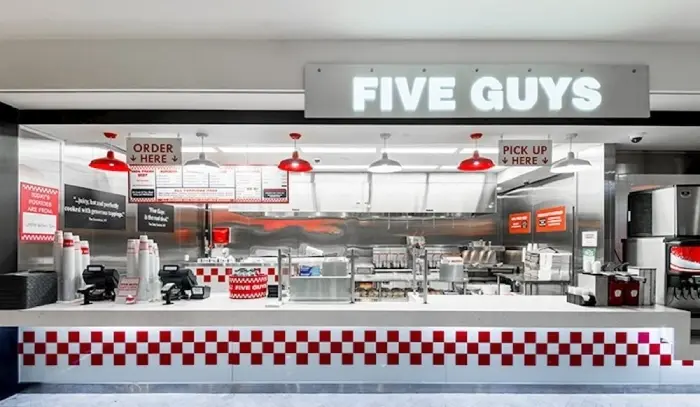
The interior of Five Guys locations are kept simple too featuring white tiling, checkered with five vertical rows of red tiles, each row representing one of the five sons of the chain's founder. The employee's uniforms are either plain red or white and red. Unlike many of the other fast food chains, there are only a few tables and chairs in Five Guys with potato sacks stacked in customer areas, giving a more wholesome, homely look to the restaurant. Five Guys restaurants also includes open kitchens enabling the customer to see their burgers being grilled to order and free, roast-shell peanuts for customers to eat while awaiting their order. Finally, rock music from the 60s and 70s are piped into the stores creating a nostalgic, but relaxing atmosphere.
Five Guys doesn't rely on flashy, national ads to get people into their stores. The company's advertising philosophy is to let the food talk for the company. Jerry Murrell, one of the family members who owns Five Guys currently, told Inc. Magazine, "We figure our best salesman is our customer. Treat that person right, he'll walk out the door and sell for you. From the beginning, I wanted people to know that we put all our money into the food. That's why the décor is so simple. We don't spend our money on décor. Or on guys in chicken suits. But we'll go overboard on food."
Takeaways
We learned about the family who own Five Guys and how they were conscious about every decision they made. It wasn’t the easiest ride but it took a group that was connected and a group able to endure any hard times facing them along the way.
The lessons learned from following Five Guys' successful rise includes: giving customers what they want, (good burgers, pricey-but-worth-it buns, delicious fries), fast, friendly service, all while keeping things simple, (ordinary decor, word-of-mouth advertising, etc.). No razzle-dazzle, no giant chickens in costumes, no playing with the menu and adding a fat free caramel moco-loco latte. Just good burgers and fries. Of course, it doesn't hurt to have good investors to get the expansion and franchise operations going, but that all came after establishing a solid, simple business model as the foundation.