



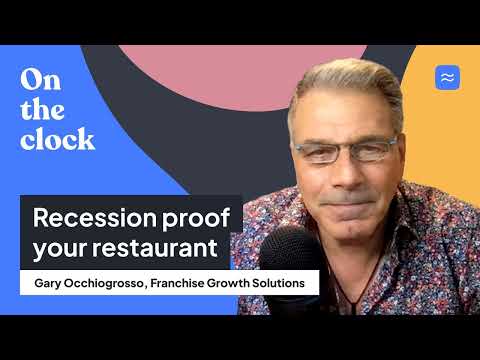

We speak with Gary Occhiogrosso, Managing Partner at Franchise Growth Solutions, about the three things that quick-service restaurants can do to prepare for a possible recession. Gary talks about menu engineering, the importance of customer experience, how to get team buy-in, and more.
https://www.franchisegrowthsolutions.com
https://www.linkedin.com/in/gary-occhiogrosso/
Transcript:
|
Daniel Blaser (00:06): Hello and welcome to On the Clock, presented by workstream. If you care about hiring, managing, and retaining hourly employees, you're in the right place. Today's episode brings you a fascinating conversation with Gary Occhiogrosso. Gary is the managing partner at Franchise Growth Solutions, and we talk all about the topic that's on everyone's minds right now, A recession. Gary draws from his decades of franchise restaurant experience to bring you three solid suggestions for surviving an economic downturn. We talk about the importance of reducing food cost, why customer experience is crucial, and how to hire and train team members so they're bought in on your recession-proof goals. It's my hope that after listening to this episode, you might be a little less worried about the economic future. Enjoy. Hey Gary, it's so great to have you here. To get things started, you've identified three ways that restaurants can prepare for a possible economic downturn. Let's kick it off by having you start with the first thing on that list. Gary Occhiogrosso (01:10): I would start with food cost, because in a restaurant, you know, there are, there are really two categories of costs. One is what's called cost of goods, which is typically food, paper, products and beverages. You know, what are you selling? And then the labor, so we'll put the labor on the side for the moment. But if we look at cost of goods, how can a restaurateur start to manage cost of goods in a better way? Well, there, there are several ways. The first thing is what we call menu engineering. So if I'm running an independent restaurant, franchises have a different set of rules. We can talk about that later. But if I'm running a restaurant, I'm gonna, I'm gonna do what's called a pix or a product mix off my point of sale system. And I'm probably gonna knock out the bottom. Let's say I'm selling 50 items on my menu. (02:00): Okay, just pick a number. I'm probably gonna knock out the bottom 20 or 30% of that. That's not selling. Why am I gonna do that? I'm gonna do that for several reasons. First of all it's going to give me more buying power in the sense that if I have four proteins on my menu and now I go down to two, I can go to my distributor and say, Hey, I need a better price on chicken. 'cause I'm no longer buying a thousand pounds a week. I'm buying 3000 pounds a week because I'm no longer selling three other proteins. So that goes up and I have more leverage in terms of, Hey, can I get a better price? The other piece is that if I'm selling higher items that have a lower food cost and higher profitability through what's called menu engineering, and that's the first step would be to get rid of those bottom, the sort of the, the bottom 20%, 30% of what's not selling. (02:54): So now everything on my menu is higher profit. It's the best of, so, you know, my guests are getting the best of what they love me for. They're coming in for that. Maybe I've irritated a couple of guests that only come once in a while for that one thing that's on the menu that they come for. Hopefully they'll love me anyway and they'll choose something else. So, so food costs with menu engineering is a very big piece. The other part to that is things like waste. So if I've got 10 items that I'm selling and I'm moving it, I'm probably don't have any waste by the way, my product is probably fresher, okay, another conversation for another day, but I'm moving that product. I'm probably not at the end of the day looking at something in my hot table or cold table that didn't sell because it's a very small percentage of sales that I now have to throw out. 'cause That one customer that comes every three weeks didn't come in that day for that <laugh>. Okay? So less waste, better buying power, higher profit items that are up on that menu for people to choose from without sort of compromising the integrity of the menu or the, or the concept. So, so food cost would be one, one way to look at what I call the middle of the p and l. Daniel Blaser (04:10): Yeah, that makes sense. And I really like the term menu engineering because it kind of captures the fact that there's more to it than just taking a couple things away from the menu. There's a whole strategy there that you've outlined. Alright, let's go to the second thing that you recommend restaurants can do. Gary Occhiogrosso (04:27): All restaurateurs can elevate what I call the customer experience. And the customer experience is often with our clients anyway. What, what what we sort of preach and teach and counsel is there's a very big difference between sort of the overall experience that they're going through and customer service people confuse customer service with customer experience. Customer service might be 5, 6, 7, 8 things that lead to that great result where the guest walks outta the restaurant and has a great feeling. You've left them with the, a great feeling and I'm gonna come back. Whereas customer service might only be one or two pieces within that entire experience. So things to me, like, you know, teaching team members to make sure that they acknowledge guests when they walk in. You know, one of the things that we were taught way back when in Duncan in the morning hours, we'd have a line of people. (05:25): If someone came in and you kind of made eye contact and said, Hey, I'll be right with you. Even though there were five people in line. So the guest knew like, okay, they know I'm here. And it's, it's a greeting, it's it's comfort, it's a connection. You know, if we thought about it from a social media point of view, we'd say, wow, it's an engagement. And that's very, very, very important. So the overall customer experience, when I'm in a restaurant and I ask the the server, Hey, can you go get me some water? And they go, no problem. Okay, I realize it's good intention, but what's the energy there? The, the energy is that maybe it was a problem, but for you, it's not a problem. Okay? The response is my pleasure, <laugh>, or coming right up if you want to be corny. Okay? So it's those things that create an environment and an energy where the guest experience is elevated. All restaurateurs should be doing that recession or not, but in a recession is far more important because it's sort of the value add to the food. Daniel Blaser (06:26): Yeah, definitely. Those are some great points. Alright, let's move on to the third thing. Gary Occhiogrosso (06:32): None of those things will work, okay? None of those things. The decrease food cost and elevated experience and more. None of that will work if you don't get your team to buy in. Your team members have to buy into this otherwise, you know, they're standing, you know, think about they're standing behind the POS system and they're playing with their phone, and now somebody walks in and they're still playing on their phone. <Laugh>, okay, that's because they haven't bought in and, and that really doesn't have much of anything to do with recession. That has to do with the culture, the tone, the mission is the employee, is the team members, I like to use that term. Are they showing up every day because they really want to serve the guests. They want to put the best food out there as possible. They really believe in what they're doing, they're having fun. (07:21): And you get that, you get that team buy-in which often, you know, relates to, hey, you have to make it, you have to make it a game. You have to make it fun for them. So as I've often said, nothing works a lot, but everything works a little. So you have to take that approach because if you're looking for that one magic bullet, that one thing that's gonna help you survive in a recession, you're not gonna find it. It's a lot of little things and it's executing it, you know, it could be how clean is my bathroom? Are there fingerprints on the door? As I said is my team member saying, Hey, how are you? Thank you. Come back, come back again soon. Those things really are the things that when executed proper properly and consistently will help you not only get through tough times, but will blow you into orbit in good times. Daniel Blaser (08:13): There's so much value in all of the things that you just said. I especially like that you pointed out the importance of team buy-in. Shameless plug, you know, workstream is all about hiring and retaining employees, right? And I think it's worth pointing out that you actually can and should screen for some of the attributes that will lead to better team buy-in down the road, right? It's not something you should only worry about after the fact, but it's something you should be looking for at the beginning of that process. Let's shift gears just a little bit to this concept of trading down. Can you talk a little bit about what that is and how restaurants can avoid having their customers get this feeling like they're trading down? Gary Occhiogrosso (08:57): Okay, so let's say four, a family of four people are now you know, maybe they would go to a family type dining restaurant, you know, pick a, pick a, pick a brand, Applebee's, Chili's, Fridays, blah, blah, blah. Okay, well that event, that event is, is probably a, a 60 or an $80 event. So now because of quote recession and fear of whatever, now they're going to a fast casual restaurant. So now they're kind of walking up to a counter. And you know what the goal here is that you want that experience, while it would be different, you want that experience to certainly be as joyful, if you will, or as fun and as nice as the full service experience. So how do you know, how are restaurateurs able to do that, by the way, including franchisees? I mean, so again, if we talk about elevating that experience, things like, you know I don't know, maybe after 6:00 PM when the person orders their burrito at the counter rather than, you know, call and then they go sit down and calling them back up and, or number seven, you know, your, your food is ready or whatever. (10:16): Maybe, you know, they get a little stand with the number and someone brings the food out to them. So you have you know, what we call modified table service. So it elevates that dinner experience to, okay, it's not full service, but hey, I'm not feeling like I'm in a fast food joint or I'm in a fast casual place. You know, that's, that's something that I think is, is important. Having small items that you can tag on you know, sell that cookie, sell the upsell when I was in the fresh Mexican business, and if you go into some of the big fresh, what I call a memex chains, now, you know, they're selling you guacamole and chips. Okay? So typically like in a full service Mexican restaurant, guacamole and chips, they, or chips for sure they'd put on the table. But in a, in a in a fast casual, you might have to purchase those. (11:05): Well, those are great add-ons because now even though if your customer count is down, you can increase the value of the customer a little bit at a time and you can increase the experience also because where they might order a dessert in a full serve restaurant, well now maybe they're getting that, that cookie or there's an ice cream serving, or there's some easy to serve dessert product and rather than having the entree that they might have at a full serve restaurant, there's maybe chips and dip, or maybe there's something that's out there that doesn't cost a lot of money. That elevates the, you know, the, the overall experience. I think, you know, increased increased efficiency is, is sort of something that helps folks feel that they're in a better, I mean, when I go to a drive through hamburger joint, if they get my order right, they've met my expectation <laugh>, okay, it's down here. (12:02): Okay. But if I'm used to going to a full service restaurant, my expectation is here. I don't wanna feel like I've traded all the way down and gee, if they just get this right, I'll be happy. You could bring it to somewhere in the middle. And you do that by increasing efficiency. And I mentioned earlier about the no problem thing. I think that's, you know, that's a, that's a big deal. That to me is that that's the energy in the restaurant and there's just so much of that that restaurateurs can do to make folks feel like they're not trading down. Daniel Blaser (12:35): Yeah, that makes a lot of sense. One last question for you. I know you have some pretty strong feelings about discounting. Can you explain why you don't believe in discounting and what you would recommend that restaurants do instead? Gary Occhiogrosso (12:49): Sure. look, discounting doesn't work on any long-term level. There's what I call price value perception. You know, many years ago, maybe not so many years ago, 10, 15 years ago, McDonald's had their dollar menu. We all remember the dollar menu, and you could actually buy a double cheeseburger for a dollar, you know, insane as far as I was concerned. Now, a couple of things. First of all, when the double cheeseburger was no longer on the dollar menu, you know, I certainly didn't buy it because in my mind it was only worth a buck. You were selling it for a dollar for years. Now all of a sudden you want two 50 for it. I'm not doing that. So when you discount, it's not just the sale at that moment, it's the psych, the long lasting psychological effect that it has on the price value perception of what you're doing. (13:48): So I've now cheapened my product. So competing on price just as a secondary piece to that is I go to a dollar, you go to 99 cents, I go to 89 cents, you go to 79 cents, all we're doing is killing each other. And the guest is just gonna stand on the side and go, well, you know what? There's gonna be another coupon coming out, or there's gonna be another Instagram thing where I can get something free. I'm not going to Daniel's restaurant today. I'll wait till next week 'cause I know there's gonna be something free. You just sort of die doing that. There's not, there's no end to that. So what do you do? 'cause It's easy to say what not to do, <laugh>, but, you know, identifying the problem is easy. The solution is, is usually more challenging. The question there is provide value. Now you should always be providing value, but how do I provide more value? (14:47): How do I, how do I again, elevate the experience? As I mentioned earlier, how do I, instead of tying the price to the product, how can I maybe offer a discount but tie it to an event? So maybe on, I don't know, pick a night. Thursday nights I have family nights, okay? And kids pay half price. Now you might say, well, Gary, what do you mean? You just said don't discount, stop. That's not what I said. I said, if you just discount for the sake of discounting and you tie it to the value of the product, we have a problem because it should go on forever. But if you're coming in for an event that's only tonight, or it's the third Thursday of every month, the price is now tied to the event. So when I no longer have the event, I have not tarnished the integrity or the price value of my product. (15:39): So you can still do it, but you have to have a psychological workaround. And by the way, in the quick service business, it really does come down to two things. Okay? So if we go back to sort of the full service restaurant, like the big fancy restaurant, you know, what's the server doing, selling you a drink, selling you an appetizer, selling you the special, selling, you desserts, selling you, but an after dinner drink, selling you coffee, whatever, building the ticket. But in a fast casual restaurant or in a fast food restaurant, how do I build a ticket? I'm not gonna be able to sell you, you know, 40 pounds of fried chicken. It's not happening. Okay, so how do I do that? Well, you can't. So in the quick service business and in the fast casual business, it comes down to frequency of visit. How often are you, I might not get a hundred bucks outta you every time you come in. (16:28): Maybe I'm only getting 10 bucks outta you or $12 out of you, so I gotta get you to come back eight or nine times. How do I do that? I have to create what I call the occasion to use. So you might use me for lunch because I'm convenient and I'm near your office, your home or whatever. But what can I do to create another occasion for you to come in? That's a big, big piece of it in terms of how you can actually create value without simply just saying, Hey, buy one, get one free. Daniel Blaser (17:07): Thank you so much for listening to this episode of On the Clock, presented by Workstream. And thanks to Gary Occhiogrosso for sharing his time with us. We'll include some links in the show notes to learn more about Gary and Franchise Growth Solutions. And if you want to learn more about this podcast, go to workstream.us/podcast. |
Listen and subscribe
 |
 |
 |
 |