



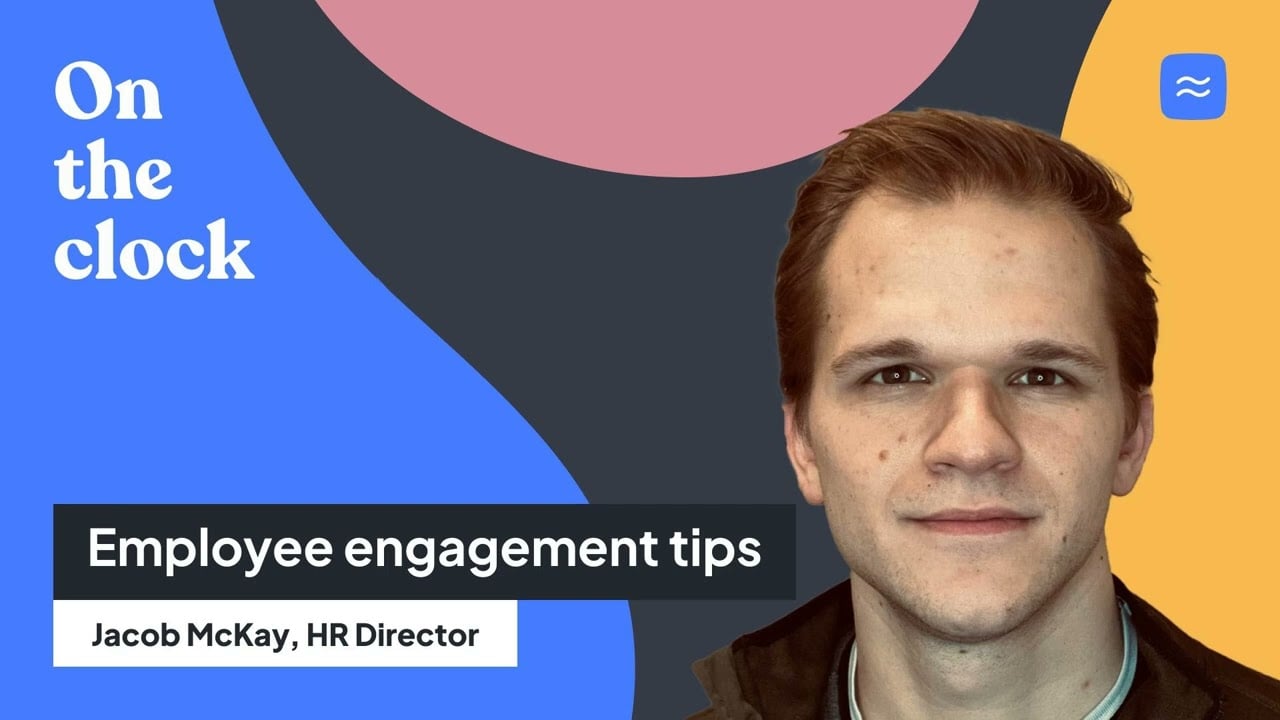

We clock in with Jacob McKay, HR Director at Point Meadows, a healthcare facility in Lehi, Utah. Our conversation touches on many important topics, like how to create a culture of belonging, how the applicant experience influences employee engagement, and a program Jacob created to increase retention called the "90 day challenge.
https://www.linkedin.com/in/jacobdmckay/
Transcript:
|
Daniel Blaser (00:06): Hello and welcome to On the Clock, presented by Workstream. If you care about hiring and retaining hourly employees, you're in the right place. I'm Daniel Blaser, and today I'm clocking in with Jacob McKay, HR director at Point Meadows, a healthcare facility in Lehigh, Utah. Our conversation touches on many important topics like how to create a culture of belonging, how the applicant experience influences employee engagement, and a program Jacob created to increase retention called the 90 Day Challenge. Enjoy Jacob McKay (00:37): My name's Jacob McKay. I'm the HR director at a healthcare facility in Lehigh. It's called Point Meadows. Been there for about two years now, and we've got about 165 on payroll, so it's not a huge facility, but it's a lot of things to keep track of. Really loved working in healthcare and solving people problems, but ultimately we're helping people get back on their feet and try to help 'em live a dignified life. Daniel Blaser (01:08): What is it that, you mentioned a couple of things that you like about it, but what else do you love about your jobs specifically? Some of the HR stuff Jacob McKay (01:18): I actually enjoy when there's employee conflict, when there's an interpersonal conflict that I'm involved in or that I need to help work out. So oftentimes we'll just bring the two employees that are upset with each other into a meeting and just have us clear the air and just get everything on the table and I try to coach 'em and say, Hey, this might be what they're looking for. They might just be looking for an apology, or, Hey, you might want to accept this kind of feedback. And then we go from there. And I really like just coaching people through those different hardships, I guess, or different conflicts that they're having with coworkers and helping people get along better. Daniel Blaser (02:07): So you mentioned that the last couple of years there's been maybe some uncertainty, obviously with everything surrounding covid and now job market, economy, et cetera. Can you talk about some of the challenges that you've had to tackle specifically in regards to hiring and retaining employees? Jacob McKay (02:33): Looking at a bigger picture when the pandemic hit and a lot of people had to start working remotely and the workforce in general was just changing, I think a lot of the power shifted from the employer to the employee, whereas now people are starting to realize, hey, if I don't like my pay, if I don't like my benefits or if I don't like just my manager or something, I can easily move to another job because literally everyone is hiring. You walk into any business, you drive down the freeway, everyone has a, we're hiring sign up, and so the employee, everyone is realizing we have more control over that, so we have to figure out or we are still figuring out what is going to help people really stay. And so something that we've learned and that we're still learning is just how to make more personal connections with people. Because when people feel like they have friends that they're working with or family, then they're not going to leave their family or they're not going to leave their best friends behind and they feel a little more, I want to say obligated to stay and to help the team out. Daniel Blaser (03:52): Yeah, it makes sense, that sense of kind of belonging or sense of, like you said, working that you're part of a team, there's always going to be another job that might pay a little bit more, but if it comes at the expense of your mental health or some of those things, I feel like changes the equation Jacob McKay (04:11): And we don't necessarily expect people to be best friends and go out to the movies or together or something after work. It's great when that stuff happens. But yeah, really it's just promoting and our vision right now is family away from family. This is something that we introduced to the team in January and we've been trying to promote this family feel that we treat the residents that we have here, the people that we're taking care of, we are their family while they're away from their family. And then we treat each other like the team members as a family unit while we're away from our own family. Daniel Blaser (04:55): Now, I wanted to ask you specifically about one of the retention initiatives that you've spun up called the 90 Day Challenge. Can you talk about what that is and what it looks like and maybe what prompted that? Jacob McKay (05:08): So there's been studies done on, and I can't name a specific one, but I've heard this lots that if a new employee can make it to their 90 days to three months of employment, then their likelihood of staying with a company just skyrockets and they're going to stay a lot longer than that. So we really focus in on those first 90 days. And so each of our managers reaches out to an employee when they make it to their week. So when an employee makes it to week three, we have our executive director take them out to lunch or give them a gift card at least to go to lunch, and they try to make that personal connection or our maintenance director on week eight, he helps him look at a roadmap of, Hey, this is where you are right now. Where do you see yourself in 10 years from now or five years from now, even just a year from now, and let's talk about how we can help you get there. (06:12): Yeah, the 90 day challenge is again, just about making that personal connection with each employee and helping them feel like, Hey, I've got somebody that's on my side. I've got somebody who's there to look out for me. That made a huge difference for me when I was a new employee. I remember my manager took me out at least a few times in the first week or so just to maybe, Hey, let's go grab a shake, or Hey, let's go to lunch. And that made a huge difference for me and set my employment off, and I felt like I've got friends here, I've got people that care about me. So yeah, we want to try to perpetuate that same feel for each new employee. Daniel Blaser (07:01): That's really cool. And I think it's really smart because a lot of what you're saying, people probably kind of just accept that as the truth, like you're saying, it's like, yeah, everyone knows that the first couple months are really important, but to have it built into an actual, some sort of structured program or something that people can commit to and you can be held accountable to making sure everyone has that first, that 90 days that's really positive and supportive. Like you said, it's a good idea. I like it a lot. Jacob McKay (07:35): Yeah, and managers get excited about it. They love reaching out to the new employees and giving them candy. Or on the first day when I hire 'em, I make a list of all their favorite things, like the favorite candy, favorite drink, dream vacation, favorite Hollywood actor or whatever actress. And so when they get to week seven, our activities director reaches out with maybe their favorite candy or some sort of tries to make a connection about something on their favorites. Daniel Blaser (08:06): I think there's a tendency to kind of talk about there's hiring and then there's retention and it's like one kind of picks up where the other one leaves off. But one thing that we've been chatting to some other people about is how do you think the hiring experience itself can encourage retention or discourage retention? How do you think the two are? There's some interplay there. Jacob McKay (08:37): We have a person that actually sees over recruiting now. We just brought onto the team. And so his job is solely to just communicate through workstream to the prospective employees about their interview, about lining something up, about how the interview went, and then following up maybe even within the first few days to just see how everything's going. And that has made a big difference, just an overall communication. I think people really appreciate the communication there and they appreciate the speed. So having somebody just solely focused on any communication with a new prospective employee really has helped perpetuate people to stay longer, I think, and to make it through onboarding and to feel like this is a company that has their stuff together. When there's somebody that's readily available to answer any of their questions, I dunno if that really helps answer your question, but that's something I think that has helped us to make the transition a little smoother for people from being in the recruiting box to, okay, now I'm hired, I'm integrated and everything. Daniel Blaser (10:03): One question that I wanted to ask you about, and this is a topic that I've heard from other HR leaders, is obviously when it comes to attracting employees, a lot of people are looking for pay. Obviously that's number one factor, but what perks or benefits have you found that kind of beyond the pay side to make a big difference in attracting employees and also helping them stick around? Jacob McKay (10:33): Yeah, we found that people generally don't work for pay, that if they're searching for a dollar more an hour, if they come onto our team for a dollar more an hour, they're going to leave for a dollar more an hour somewhere else. And so again, the 90 day challenge is going to be key for us and helping them make personal connections with their supervisor or with the other department heads, the other managers at the facility, so that that's huge. People work for managers, not for pay necessarily. Honestly, that's kind of the biggest thing I can think of. As far as the nursing staff specifically, we have really good ratios here. We have about 10 residents to one CNA, which is better than the state average, which is around 1415. And so the CNAs really appreciate that when they feel like their workload is manageable. And that's something we try to advertise from day one and say, look, you can go to different facilities, but you guys, they're going to be understaffed. We focus a lot on just making sure we're fully staffed every day and that we're not bringing in residents that are too hard to handle or too many people that are just a one-on-one feed or making sure that the workload's manageable ultimately. Daniel Blaser (12:04): I mean, that makes a ton of sense. And while healthcare is unique in some ways, that idea of giving everyone a manageable workload that is sustainable, that is kind of, I feel like a universal thing that employees appreciate. So one other question for you. So the listeners to this podcast are generally just like you, HR managers, HR directors, a lot of them are in charge of a lot of hourly employees. And so I just wanted to open it up with that context. What advice or what final words of wisdom would you want to leave with this group? Jacob McKay (12:50): Just thinking back to my experience getting hired, the person who was reaching out to me actually knew my dad, and he made a call to my dad before he even talked to me about the position. He said, Hey, I think your son just applied to work for us here. And sure enough, yeah, I mean they made that connection before I even knew what job I had applied to, I was applying to so many. And so he had made that personal connection even before he had met me. And then when he talked to me, he said, Hey, I just got off the phone with your dad and he had nothing but bad things to say about you, but we'd like to give you an interview anyway. And I was just like, what? Who is this guy? And he had really done his research on me and made me feel like a million bucks. (13:44): And he got me in the door to get an interview, and then after I knew I could call him right back and just be like, Hey, what's the team saying? How did that go? Did they like what I had to say in the interview? Do you have any advice for me? What I can do at this point to secure the position? I felt like I had that trust there with him already from day one. And so I've really tried to implement that practice. I guess maybe I don't go as extreme as he did and call people's parents before they come in. But I do try to make a personal connection, at least when they walk in the building, try to shake their hand, look 'em in the eye, talk to 'em how their day's been going, how to go finding the place, and Oh, you go to this high school, do you know this person? (14:37): Or, I dunno, just try to find something that you can connect with the person on and go from there. Because at the end of the day, we're all people and we got to treat each other that. So even when we're in the workplace and when we're doing hard work, we got to remember that everybody has challenges. Everybody has crazy things going on in their lives, and when you feel like you have a trustworthy friend or at least an associate, then it makes a huge difference Just in your day and even if a position doesn't work out, you still have a positive image, positive feel in your mind of Point Meadows or whatever business that you're working for. (15:23): And so if you are going to talk to somebody else about your application process, then you're going to have positive things to say about it. And so it just snowballs and it just grows bigger and bigger. So yeah, I can't stress the importance of just treating people how they expect to be treated, and that's the golden rule. I guess for me, something that's on the back of my mind, okay, how are they expecting to be treated right now? What's kind of their personality? Am I pushing too hard or am I doing it just right? So you just have to feel that out and hopefully those things work out and that you're able to make those connections and then help the other managers to do the same and to make those other personal connections. Daniel Blaser (16:10): Thank you so much for your time and sharing your experience and some of your perspectives. I really appreciate it and I think our audience will too. Jacob McKay (16:18): No problem. Yeah. Thanks for having me. Daniel Blaser (16:25): Thank you for listening to On The Clock. For more info, visit workstream us slash podcast. I've also included a link in the show notes to connect with Jacob on LinkedIn. Until next time, we're clocking out. |
Listen and subscribe
 |
 |
 |
 |