


<img height="1" width="1" style="display:none" src="https://www.facebook.com/tr?id=395330474421690&amp;ev=PageView&amp;noscript=1">
What Businesses Can Expect in the Coming Weeks
Workstream Blog

What Businesses Can Expect in the Coming Weeks

By Robert Woo

Get the latest with Workstream

Always stay current with hiring news by subscribing to our email updates

β€œThings may come to those who wait, but only the things left by those who hustle.” - Abraham Lincoln

In this post, we look forward to some states getting back to work, the slowdown in the tech industry, and a new method of hiring that retail and service businesses may want to consider.

Also in this week's highlights, Workstream's Lydia Hall will shed light on how business owners are prepping to reopen after the pandemic. She'll share the stage with a distinguished panel of business owners and operators, plus one VERY fluffy puppy. 

Don't miss this exclusive webinar!

download workstream free ebook

Businesses Reopening: What to expect in the next crucial weeks

From Texas to Tennessee, Mississippi to Montana, many states are gearing up to reopen at least some of their non-essential businesses this week such as restaurants, salons, and other retailers. While no state has fully met governmental guidelines to reopen, for example adequate testing and contact tracing, they are tentatively forging ahead anyway in order to save the livelihoods of their communities.

Call it foolhardy or brave, these businesses will quickly reveal how and when America at large can reopen. Due to COVID-19's lag in manifesting symptoms, it will take 1-2 weeks to show any spike in illnesses. During this time, business owners in other states and those who've chosen to wait to reopen will be watching to see what happens. Either there will be an increase in hospitalizations, which will lead to prompt reshutterings, or low hospitalization rates leading to a return to the new normal. Either way, it'll be real-world data for those on the sidelines.

The Takeaway: Remember, there aren't enough tests to determine an increase in infections. As morbid as it is, business owners must look at the rate of hospitalizations in 1-2 weeks in the newly opened cities to determine whether it is reasonable to get back to work.

Everyone needs tech, but tech jobs aren't safe either

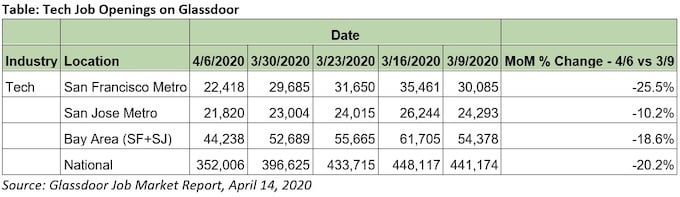
With Zoom, Amazon, and other tech companies becoming overnight essentials during quarantine, one might expect the technology sector to continue hiring like crazy. Unfortunately, the data doesn't bear that out. According to CNBC's analysis of Glassdoor, job openings in tech have dropped more than 20% between mid-March and mid-April.
WDTj5gcJuWlS5FFHmBiQ2x7pviP8KdBlnwZdgiHvevtuYqM5fyjcrIfQepFLbpuTkhp8-GdOtuFZQUvAKlChVvv97PsxAiEB2UVeqo2vn15tNSPm_zxhgOcG1X3-OK4snnkToVlH

One reason for the slowdown is that ad revenues are down across the board. Sure, everyone is online right now, but if businesses can't operate, they won't be purchasing ads on Google or Facebook... which is exactly what we're seeing. In fact, Google's CEO said they will "curtail its hiring for the rest of the year."

The Takeaway: No vertical is safe and despite your Zooms and Amazons, the tech sector overall is taking a hiring hit. Nowhere near as much as other areas such as hospitality or retail, but enough that there will be a hiring squeeze overall for perhaps the rest of the year.

Open Hiring: A new hiring strategy for the new normal

Eons ago in February of this year, Forbes wrote about Open Hiring, a seemingly strange way to fill positions on a first-come, first-serve basis. Now, due to the desperation of essential businesses (grocery stores, delivery companies, etc), we are seeing Open Hiring become more widely adopted just for sheer speed and efficiency.

Now, you won't see Open Hiring deployed to fill most high-skilled jobs. Law firms aren't going to hire the first slim-fit suit that walks in the door. But for retail and other businesses that train up their employees, Open Hiring is an option that has been shown to not only to speed up onboarding, but lower turnover rates as well.

The Takeaway: The current economic crisis is also an opportunity for creative businesses to change their approach to hiring. We're all fans of a faster hiring process, and we'll be watching the Open Hiring movement with great interest.

Need help hiring the right people? Workstream can help. Our platform gets you 4x the number of qualified applicants and reduces your time-to-hire by 70%. 

Click here to schedule a demo.

By Robert Woo
Robert Woo is a freelance content creator for various companies from startup to enterprise-level. When not writing SEO-friendly articles, he writes and performs comedy, plays guitar, and champions the Oxford comma.

Personal Information and Sensitive Personal Information

Before we discuss the right to limit and the right to opt-out, we must first define personal information and how it relates to sensitive personal information.

Personal information is any data that identifies, relates to, or could reasonably be linked to you or your household. A few examples of personal information include:

  • Name or nickname
  • Email address
  • Purchase history
  • Browsing history
  • Location data
  • Employment data
  • IP address
  • Profiles businesses create about you, including pseudonymous profiles (β€œuser1234”)
  • Sensitive personal information

Sensitive personal information or β€œSPI” is a subset of personal information, defined as:

  • Identifying information (e.g. social security number, driver’s license)
  • Financial data (e.g. debit or credit card numbers)
  • Precise geolocation (within a radius of 1,850 feet)
  • Demographic or protected-class information (e.g. race/ethnicity, religion, union membership)
  • Biometric and genetic data (e.g. fingerprints, palm scans, facial recognition)
  • Communications and content (e.g. mail, email, text messages)
  • Health and sexual orientation (e.g. vaccine records, health history)

Right to Opt-Out

Californians have the right to opt-out of the sale and sharing of their personal information. That means you have the right to opt-out of the sale of your personal information to third parties (e.g. data brokers, advertisers). You also have the right to opt-out of the sharing of your personal information to prevent the targeting of ads across different businesses, websites, apps, or services.

CCPA-covered businesses must provide a link to allow you to exercise this right. It is usually found at the bottom of a webpage and will say β€œdo not sell or share my personal information” or β€œyour privacy choices.” Sometimes businesses offer privacy choices through a pop-up window or form

To opt-out of the sale and sharing of your personal information, click on the link or use the toggle provided by the business and follow the directions. Doing this on every website you visit can feel burdensome, but to ease the burden you can automatically select your privacy preferences for every website by using an opt-out preference signal, or OOPS for short.

An OOPS is a user-friendly and straightforward way for consumers to automatically exercise their right to opt-out of the sale and sharing of their personal information with the businesses they interact with online. An OOPS, such as the Global Privacy Control. It can either be a setting on your internet browser or a browser extension. With an OOPS, consumers do not have to submit individual requests to opt-out of sale or sharing with each business.

Right to Limit

Californians also have the right to direct businesses to limit the use and disclosure of their sensitive personal information.

Businesses covered under the CCPA must provide a link on their website that allows you to request the limiting of your SPI, if they plan on using it in certain ways. That link will also typically be at the bottom of a webpage and will say: β€œlimit the use of my sensitive personal information” or β€œyour privacy choices.” Once you send this request, the business must stop using your SPI for anything other than to:

  • Provide requested goods or services
  • Ensure security and integrity
  • Prevent fraud
  • Maintain system functionality
  • Comply with legal obligations

Bringing it Together

In summary, the CCPA gives you the right to opt-out of the sale and sharing of your personal information and gives you additional rights to further limit the use and disclosure of your sensitive personal information.

When you exercise these rights together, you exert greater control in protecting your personal data which is important for your identity, safety, and financial health.

If you are on a business’s website and you can’t find the links to exercise your rights, remember to check their privacy policy. The privacy policy should tell you how you can exercise your rights under the law.

If you find your rights being violated, you can submit a complaint to CalPrivacy.

Next in the LOCKED series, we will explore the right to correct and right to know. Follow us on social media to get live updates or check back in one week for the next post.

Essential

Required to enable basic website functionality. You may not disable essential cookies.

Targeted Advertising

Used to deliver advertising that is more relevant to you and your interests. May also be used to limit the number of times you see an advertisement and measure the effectiveness of advertising campaigns. Advertising networks usually place them with the website operator’s permission.

Personalization

Allow the website to remember choices you make (such as your username, language, or the region you are in) and provide enhanced, more personal features. For example, a website may provide you with local weather reports or traffic news by storing data about your general location.

Analytics

Help the website operator understand how its website performs, how visitors interact with the site, and whether there may be technical issues.

Right to Limit Use of Sensitive Personal Information

You also have the right to limit how we use sensitive personal information (such as precise geolocation, financial data, etc.).

Your preference has been saved. We will not sell or share your personal information.