


Restaurant Owners Share Top 5 Hiring Challenges
Workstream Blog

Restaurant Owners Share Top 5 Hiring Challenges

By Nigel Seah

Get the latest with Workstream

Always stay current with hiring news by subscribing to our email updates

Close to 82 million of the US workforce consists of hourly workers - that's almost 60% of the entire workforce. However, the average turnover rate of these employees is astoundingly high at 130%!

We sat down with several leaders in the restaurant and franchise industry to understand what hiring challenges they have faced over the course of their journeys:

"One of the drawbacks of starting as a mobile food truck is that you have an inconsistent work schedule. Simply put, if you are not open every day it becomes increasingly difficult to retain your employees."

 Rishi Soneja, Owner of CITI PIE

"To find people who want to grow with the company. The industry is very competitive, and you want to be sure that your staff is happy working with you. My goal is to put my staff in the best possible working conditions. Your team is your most important asset and there is no way to grow without a dedicated team."

- Pierre Thiam, Co-Founder and Executive Chef at Teranga

"I believe one of the challenges today has to do with recruiters. The whole process of contacting quality candidates and setting up an interview sometimes takes too long, and we end up losing them. I guess I am more old school. I still believe in going to the job location, introducing yourself and trying to meet with the chef or manager, despite that it is becoming more difficult to do nowadays."

- Chef Jose Santos 

"The hiring of hourly workers was rather laborious and often chaotic. While there are so many new candidate/job posting search engines there have been few solutions to manage candidates through the hiring process once they submit a job application. With the hourly jobless rate at an all-time low it has been critical to find ways to speed up the application process and automate candidate engagement flow using current media in order to prevent the loss of a candidate to another potential opportunity."

Evelyn Scalora, CEO of Tin Pot Creamery

"There are so many opportunities for those looking to work in the food service industry. Not only has to compete with all the local restaurants but also the tech companies. Many tech companies have internal cafeterias with a set menu and regular hours. Many workers are choosing to work there as the stress is much lower and the benefits are amazing."

- Jeff Chu, CEO & Co-Founder at Joy Tea
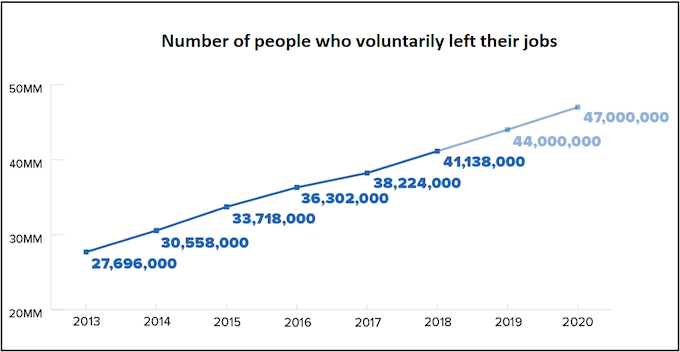
 

image-43-1According to the U.S. Bureau of Labor Statistics, approximately 41 million people voluntarily left their jobs in 2019. Based on past trends, this number is expected to grow in 2020 and beyond. With about 60% U.S workforce consisting of hourly workers, we can also expect the turnover rate for hourly workers to rise.

If you find yourself resonating with these challenges, schedule a demo of Workstream. Find out why the world's biggest brands use Workstream to get more applicants in the door, automate the screening and interview scheduling process, and onboard faster. We make your hiring process more efficient and reduce your turnover rates. 

By Nigel Seah
Nigel is not just a marketer at Workstream, he is also a graduate of Psychology and Marketing of Singapore Management University. He has multiple experiences in various areas of marketing - advertising, email marketing, and content writing. Fun fact, prior to joining Workstream, he took a semester off school to intern at SAP in Brazil.

Personal Information and Sensitive Personal Information

Before we discuss the right to limit and the right to opt-out, we must first define personal information and how it relates to sensitive personal information.

Personal information is any data that identifies, relates to, or could reasonably be linked to you or your household. A few examples of personal information include:

  • Name or nickname
  • Email address
  • Purchase history
  • Browsing history
  • Location data
  • Employment data
  • IP address
  • Profiles businesses create about you, including pseudonymous profiles (“user1234”)
  • Sensitive personal information

Sensitive personal information or “SPI” is a subset of personal information, defined as:

  • Identifying information (e.g. social security number, driver’s license)
  • Financial data (e.g. debit or credit card numbers)
  • Precise geolocation (within a radius of 1,850 feet)
  • Demographic or protected-class information (e.g. race/ethnicity, religion, union membership)
  • Biometric and genetic data (e.g. fingerprints, palm scans, facial recognition)
  • Communications and content (e.g. mail, email, text messages)
  • Health and sexual orientation (e.g. vaccine records, health history)

Right to Opt-Out

Californians have the right to opt-out of the sale and sharing of their personal information. That means you have the right to opt-out of the sale of your personal information to third parties (e.g. data brokers, advertisers). You also have the right to opt-out of the sharing of your personal information to prevent the targeting of ads across different businesses, websites, apps, or services.

CCPA-covered businesses must provide a link to allow you to exercise this right. It is usually found at the bottom of a webpage and will say “do not sell or share my personal information” or “your privacy choices.” Sometimes businesses offer privacy choices through a pop-up window or form

To opt-out of the sale and sharing of your personal information, click on the link or use the toggle provided by the business and follow the directions. Doing this on every website you visit can feel burdensome, but to ease the burden you can automatically select your privacy preferences for every website by using an opt-out preference signal, or OOPS for short.

An OOPS is a user-friendly and straightforward way for consumers to automatically exercise their right to opt-out of the sale and sharing of their personal information with the businesses they interact with online. An OOPS, such as the Global Privacy Control. It can either be a setting on your internet browser or a browser extension. With an OOPS, consumers do not have to submit individual requests to opt-out of sale or sharing with each business.

Right to Limit

Californians also have the right to direct businesses to limit the use and disclosure of their sensitive personal information.

Businesses covered under the CCPA must provide a link on their website that allows you to request the limiting of your SPI, if they plan on using it in certain ways. That link will also typically be at the bottom of a webpage and will say: “limit the use of my sensitive personal information” or “your privacy choices.” Once you send this request, the business must stop using your SPI for anything other than to:

  • Provide requested goods or services
  • Ensure security and integrity
  • Prevent fraud
  • Maintain system functionality
  • Comply with legal obligations

Bringing it Together

In summary, the CCPA gives you the right to opt-out of the sale and sharing of your personal information and gives you additional rights to further limit the use and disclosure of your sensitive personal information.

When you exercise these rights together, you exert greater control in protecting your personal data which is important for your identity, safety, and financial health.

If you are on a business’s website and you can’t find the links to exercise your rights, remember to check their privacy policy. The privacy policy should tell you how you can exercise your rights under the law.

If you find your rights being violated, you can submit a complaint to CalPrivacy.

Next in the LOCKED series, we will explore the right to correct and right to know. Follow us on social media to get live updates or check back in one week for the next post.

Essential

Required to enable basic website functionality. You may not disable essential cookies.

Targeted Advertising

Used to deliver advertising that is more relevant to you and your interests. May also be used to limit the number of times you see an advertisement and measure the effectiveness of advertising campaigns. Advertising networks usually place them with the website operator’s permission.

Personalization

Allow the website to remember choices you make (such as your username, language, or the region you are in) and provide enhanced, more personal features. For example, a website may provide you with local weather reports or traffic news by storing data about your general location.

Analytics

Help the website operator understand how its website performs, how visitors interact with the site, and whether there may be technical issues.

Right to Limit Use of Sensitive Personal Information

You also have the right to limit how we use sensitive personal information (such as precise geolocation, financial data, etc.).

Your preference has been saved. We will not sell or share your personal information.