

<img height="1" width="1" style="display:none" src="https://www.facebook.com/tr?id=395330474421690&amp;ev=PageView&amp;noscript=1">
How an Immigrant Entrepreneur Fell in Love with Sales
Workstream Blog

How an Immigrant Entrepreneur Fell in Love with Sales

By Desmond Lim

Get the latest with Workstream

Always stay current with hiring news by subscribing to our email updates

Whenever you meet an immigrant entrepreneur, you would expect him or her to be technical, to be an engineer, or to be a product manager. I thought so too myself. I started out working as a Product Manager for WeChat in New York, and thought that if I wanted to start a company, I needed to be the technical Co-Founder and to partner up with a local person who can do business development or sales. At that time, I believed that this was my only path as an immigrant entrepreneur with an accent and no understanding of local lingo or culture.

Fast forward to a class I took at Stanford Business School, called Startup Garage, I was instructed by Professor Zenios to speak to 100 customers and learn more about their pain points and challenges. This was the very class where start-ups including DoorDash, SoFi and more were started. So I did exactly just that.

I spoke to several hundred local businesses which was a segment that I was passionate about and grew up in. These included restaurants, cafes, hotels, and retail companies. I was surprised to find myself enjoying the process of connecting with businesses, building trust and learning from them. I found out that I was in love with engaging with people and finding out how I could help them.

I continued talking to more customers and learned to answer open ended questions just as Professor Zenios taught me to. I also listened to their responses and avoided making rash conclusions about their pain points. But above all, I paid attention to their actions and observed how they responded in different situations. A customer may not know whether they have a pain point or a gap, but by watching their behavior and listening with intent and empathy, you can learn a lot.

I proceeded to start Workstream and secured Coupa Cafe as our first customer right in the heart of Stanford University. I recalled clearly sending my first cold-email to Camelia, the owner of Coupa Cafe asking for a meeting. Within a couple of hours, she replied saying she was open to meet and connect. I quickly responded in the next minute and asked for an in-person meeting the following day. I met Camelia and I was truly intrigued and impressed by the amazing business she had built. Coupa Cafe is known to be the most popular place among Silicon Valley superstars, and yet here she was, taking time out to meet me. We shared about our backgrounds and I had the opportunity to learn about the challenges she faced running the business which translates to an opportunity for me. In the last 15 minutes we had, I pulled out my laptop and showed her our product demo. She was clearly impressed, but said she will get back to me.

A couple of days later, Camelia wrote me back saying β€œDesmond, I like to get started on Workstream!” Bam! I closed the first deal in Workstream history - an indescribable adrenaline rush rushed through my veins and I was overjoyed.

That was the moment when I knew I was in love.

I was in love not with the typical process that other folks would call β€œsales”, which by a quick Google search refers to β€œthe exchange of a good or product for money”. In my mind, it was a connection - an exchange of ideas, an opportunity for me to create impact. I was able to share my ideas, and have the opportunity to help to impact changes not only for Camelia, but also for over three hundred employees that worked for Camelia. I was able to transform the hiring and on-boarding process for a local business and its stakeholders. Sales became my opportunity to meet people, get to know them, figure out how we could connect, and how I could potentially help them.

Over the next year, I went on to speak to over 2,000 businesses such as Jamba Juice, Sightglass Coffee, Sports Basement, and Westin. I enjoyed every conversation I had. Every interaction gave me the opportunity to connect with business owners, managers and leaders. I grew up with both my parents working as hourly workers who went on to run small businesses. Meeting these local businesses made me feel like I was given the opportunity to help people just like my parents who are more than 8,434 miles away from San Francisco back in Singapore.

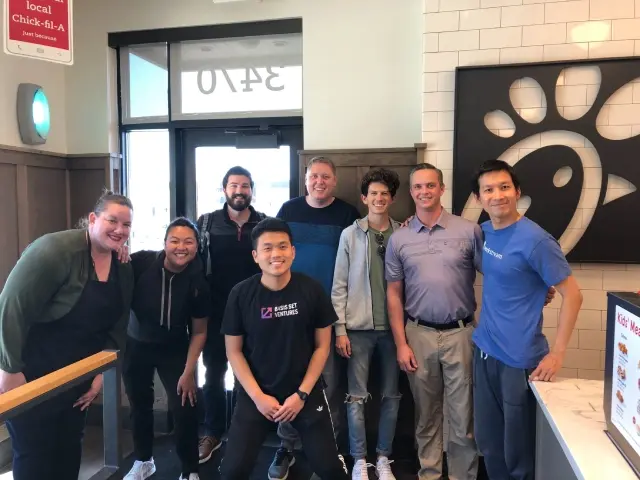
In the following year, I was able to grow my team and bring on more folks into the sales and business development team. This leads to the second reason why I enjoy sales – having the opportunity to foster teamwork, camaraderie and to help others grow. I enjoyed sparring with Angel over sales tactics that she learned from Yelp. I enjoyed helping our intern Brandon to get up to speed with the latest email templates. I enjoyed working with Austin as he joined me to conduct his first ever interview for a potential candidate. I was overjoyed when Jaron, one of our first customers and former owner of Utah Maids, joined our team where he shared his personal experiences of being a business owner. Seeing him do so reminded me of how much I enjoyed discussing sales processes I learned from past experiences with Drew and Adam.

I am humbled and thankful that through sales, I had the opportunity to work with my team, help them grow, and work towards a common vision and goal. In that sense, sales to me is much more than exchanging a product or service for money. The money is secondary, but the opportunity to connect with people, build trust, and help them grow is the real reason why I found myself leaning in on sales despite my inclination as an immigrant founder to not do sales. Through sales, I discovered my passion to connect with people and create impact.

Image from iOS (4)


By Desmond Lim
Desmond Lim is co-founder and CEO of Workstream, a text-based hiring platform for local businesses hiring hourly workers. He is a graduate of Harvard University and MIT Media Lab, former Product Manager at WeChat, and investor at Dorm Room Fund. He contributes to Entrepreneur.com, Workstream Blog, and Huffington Post. He splits his time between San Francisco and Utah, and represented the Singapore National Team in basketball.

Personal Information and Sensitive Personal Information

Before we discuss the right to limit and the right to opt-out, we must first define personal information and how it relates to sensitive personal information.

Personal information is any data that identifies, relates to, or could reasonably be linked to you or your household. A few examples of personal information include:

  • Name or nickname
  • Email address
  • Purchase history
  • Browsing history
  • Location data
  • Employment data
  • IP address
  • Profiles businesses create about you, including pseudonymous profiles (β€œuser1234”)
  • Sensitive personal information

Sensitive personal information or β€œSPI” is a subset of personal information, defined as:

  • Identifying information (e.g. social security number, driver’s license)
  • Financial data (e.g. debit or credit card numbers)
  • Precise geolocation (within a radius of 1,850 feet)
  • Demographic or protected-class information (e.g. race/ethnicity, religion, union membership)
  • Biometric and genetic data (e.g. fingerprints, palm scans, facial recognition)
  • Communications and content (e.g. mail, email, text messages)
  • Health and sexual orientation (e.g. vaccine records, health history)

Right to Opt-Out

Californians have the right to opt-out of the sale and sharing of their personal information. That means you have the right to opt-out of the sale of your personal information to third parties (e.g. data brokers, advertisers). You also have the right to opt-out of the sharing of your personal information to prevent the targeting of ads across different businesses, websites, apps, or services.

CCPA-covered businesses must provide a link to allow you to exercise this right. It is usually found at the bottom of a webpage and will say β€œdo not sell or share my personal information” or β€œyour privacy choices.” Sometimes businesses offer privacy choices through a pop-up window or form

To opt-out of the sale and sharing of your personal information, click on the link or use the toggle provided by the business and follow the directions. Doing this on every website you visit can feel burdensome, but to ease the burden you can automatically select your privacy preferences for every website by using an opt-out preference signal, or OOPS for short.

An OOPS is a user-friendly and straightforward way for consumers to automatically exercise their right to opt-out of the sale and sharing of their personal information with the businesses they interact with online. An OOPS, such as the Global Privacy Control. It can either be a setting on your internet browser or a browser extension. With an OOPS, consumers do not have to submit individual requests to opt-out of sale or sharing with each business.

Right to Limit

Californians also have the right to direct businesses to limit the use and disclosure of their sensitive personal information.

Businesses covered under the CCPA must provide a link on their website that allows you to request the limiting of your SPI, if they plan on using it in certain ways. That link will also typically be at the bottom of a webpage and will say: β€œlimit the use of my sensitive personal information” or β€œyour privacy choices.” Once you send this request, the business must stop using your SPI for anything other than to:

  • Provide requested goods or services
  • Ensure security and integrity
  • Prevent fraud
  • Maintain system functionality
  • Comply with legal obligations

Bringing it Together

In summary, the CCPA gives you the right to opt-out of the sale and sharing of your personal information and gives you additional rights to further limit the use and disclosure of your sensitive personal information.

When you exercise these rights together, you exert greater control in protecting your personal data which is important for your identity, safety, and financial health.

If you are on a business’s website and you can’t find the links to exercise your rights, remember to check their privacy policy. The privacy policy should tell you how you can exercise your rights under the law.

If you find your rights being violated, you can submit a complaint to CalPrivacy.

Next in the LOCKED series, we will explore the right to correct and right to know. Follow us on social media to get live updates or check back in one week for the next post.

Essential

Required to enable basic website functionality. You may not disable essential cookies.

Targeted Advertising

Used to deliver advertising that is more relevant to you and your interests. May also be used to limit the number of times you see an advertisement and measure the effectiveness of advertising campaigns. Advertising networks usually place them with the website operator’s permission.

Personalization

Allow the website to remember choices you make (such as your username, language, or the region you are in) and provide enhanced, more personal features. For example, a website may provide you with local weather reports or traffic news by storing data about your general location.

Analytics

Help the website operator understand how its website performs, how visitors interact with the site, and whether there may be technical issues.

Right to Limit Use of Sensitive Personal Information

You also have the right to limit how we use sensitive personal information (such as precise geolocation, financial data, etc.).

Your preference has been saved. We will not sell or share your personal information.