

<img height="1" width="1" style="display:none" src="https://www.facebook.com/tr?id=395330474421690&amp;ev=PageView&amp;noscript=1">
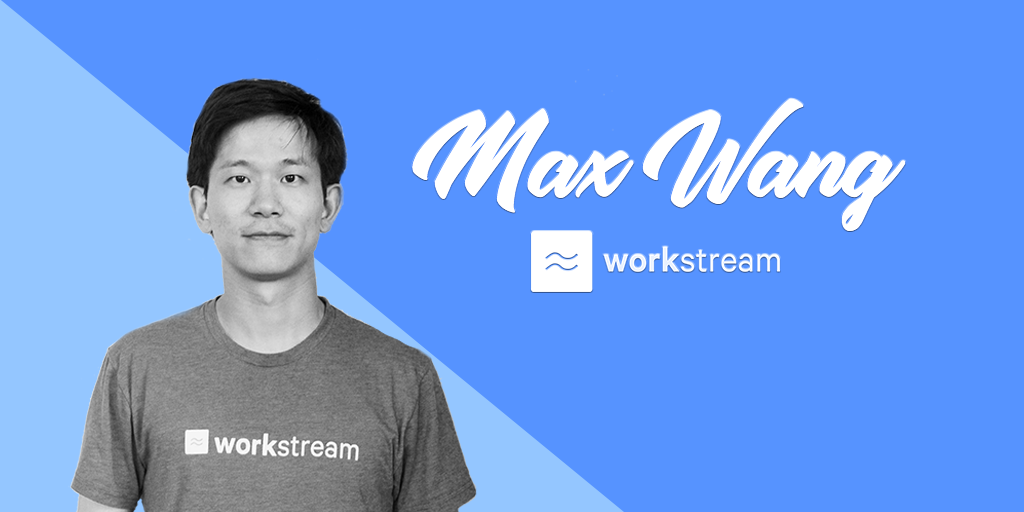
Q&A with Workstream Co-Founder and CTO Max Wang
Workstream Blog

Q&A with Workstream Co-Founder and CTO Max Wang

By Nicoleta Capatana

Get the latest with Workstream

Always stay current with hiring news by subscribing to our email updates

β€œKeep talking to your customers/users. This is the only way to keep on the right path and find useful solutions for the industry.”


Workstream is blessed in having ingenious, forward-thinking founders to drive its growth - and Max Wang is one of them. Always on the move between San Francisco, Beijing, and Wuhan, he is a serial startup founder who always seeks business opportunities to bridge America and Asia. Max started China's AngelList in 2011, built a 50+ people team, and grew to series A+. By doing that, he nurtured a strong network with other founders and engineering leaders in Asia, so he could quickly build a team of former CTOs at Workstream. Today, Max shares snippets that include why they created the Workstream platform, what motivates him, and other key takeaways from his years of experience.

Nicole (N): What was the main issue that triggered you to start working on Workstream?

Max (M):  Me and Desmond were building a global outsourcing platform in 2017. During that time, we realized that hiring is a huge pain point. By interviewing 100+ potential clients including HR head of Starbucks, founders of Coup Cafe, CEO of GoGoVan, head of Uber HongKong, HR head of GE, etc, we found that hiring hourly workers is an unsolved pain point and there is huge potential in that niche. So we decided to explore it and started building the first version.
free ebook to improve job postingN: What professional accomplishments are you most proud of since you joined Workstream?

M: We successfully built a remote engineering team covering 4 time zones. We explored a set of tools, team cultures, collaborating conventions, and hiring principles to facilitate the team architecture. Luckily it works well and the team is showing great momentum. 

N: How is this project challenging you?

M: This is the first SaaS product I have built. Building a highly accessible product for thousands of different clients in one platform is a great engineering challenge. We keep pursuing better code quality and more flexible system architecture. This will be a long-term challenge along with our growth. Solving it in a good way will be a cornerstone of our overall success. 

N: What is something you learned that you practice daily?

M: Repeating best practices is the best way to make progress and move things forward. 

N: What is the biggest challenge you have encountered in your career?

M: When the resource is extremely limited, how to learn new and hard things as fast as possible and apply them in production bravely. 

N: Who inspires you and why?

M: The whole team inspires me a lot. A key principle I learned in the past 8 years as a startup founder was that we should always find talents who have better expertise than us in some aspects. By doing this, I can always learn new things from everyone and everyone can learn from each other frequently. 

N: I know you Founded Asia’s AngelList and built a 50-person engineering team. What is one piece of advice that you will give someone who is running a startup?

M: Keep talking to your customers/users. This is the only way to keep on the right path and find useful solutions for the industry.

Get more insights, handy tips, and inspirational stories from industry leaders, entrepreneurs, and innovators in our blog

By Nicoleta Capatana

Personal Information and Sensitive Personal Information

Before we discuss the right to limit and the right to opt-out, we must first define personal information and how it relates to sensitive personal information.

Personal information is any data that identifies, relates to, or could reasonably be linked to you or your household. A few examples of personal information include:

  • Name or nickname
  • Email address
  • Purchase history
  • Browsing history
  • Location data
  • Employment data
  • IP address
  • Profiles businesses create about you, including pseudonymous profiles (β€œuser1234”)
  • Sensitive personal information

Sensitive personal information or β€œSPI” is a subset of personal information, defined as:

  • Identifying information (e.g. social security number, driver’s license)
  • Financial data (e.g. debit or credit card numbers)
  • Precise geolocation (within a radius of 1,850 feet)
  • Demographic or protected-class information (e.g. race/ethnicity, religion, union membership)
  • Biometric and genetic data (e.g. fingerprints, palm scans, facial recognition)
  • Communications and content (e.g. mail, email, text messages)
  • Health and sexual orientation (e.g. vaccine records, health history)

Right to Opt-Out

Californians have the right to opt-out of the sale and sharing of their personal information. That means you have the right to opt-out of the sale of your personal information to third parties (e.g. data brokers, advertisers). You also have the right to opt-out of the sharing of your personal information to prevent the targeting of ads across different businesses, websites, apps, or services.

CCPA-covered businesses must provide a link to allow you to exercise this right. It is usually found at the bottom of a webpage and will say β€œdo not sell or share my personal information” or β€œyour privacy choices.” Sometimes businesses offer privacy choices through a pop-up window or form

To opt-out of the sale and sharing of your personal information, click on the link or use the toggle provided by the business and follow the directions. Doing this on every website you visit can feel burdensome, but to ease the burden you can automatically select your privacy preferences for every website by using an opt-out preference signal, or OOPS for short.

An OOPS is a user-friendly and straightforward way for consumers to automatically exercise their right to opt-out of the sale and sharing of their personal information with the businesses they interact with online. An OOPS, such as the Global Privacy Control. It can either be a setting on your internet browser or a browser extension. With an OOPS, consumers do not have to submit individual requests to opt-out of sale or sharing with each business.

Right to Limit

Californians also have the right to direct businesses to limit the use and disclosure of their sensitive personal information.

Businesses covered under the CCPA must provide a link on their website that allows you to request the limiting of your SPI, if they plan on using it in certain ways. That link will also typically be at the bottom of a webpage and will say: β€œlimit the use of my sensitive personal information” or β€œyour privacy choices.” Once you send this request, the business must stop using your SPI for anything other than to:

  • Provide requested goods or services
  • Ensure security and integrity
  • Prevent fraud
  • Maintain system functionality
  • Comply with legal obligations

Bringing it Together

In summary, the CCPA gives you the right to opt-out of the sale and sharing of your personal information and gives you additional rights to further limit the use and disclosure of your sensitive personal information.

When you exercise these rights together, you exert greater control in protecting your personal data which is important for your identity, safety, and financial health.

If you are on a business’s website and you can’t find the links to exercise your rights, remember to check their privacy policy. The privacy policy should tell you how you can exercise your rights under the law.

If you find your rights being violated, you can submit a complaint to CalPrivacy.

Next in the LOCKED series, we will explore the right to correct and right to know. Follow us on social media to get live updates or check back in one week for the next post.

Essential

Required to enable basic website functionality. You may not disable essential cookies.

Targeted Advertising

Used to deliver advertising that is more relevant to you and your interests. May also be used to limit the number of times you see an advertisement and measure the effectiveness of advertising campaigns. Advertising networks usually place them with the website operator’s permission.

Personalization

Allow the website to remember choices you make (such as your username, language, or the region you are in) and provide enhanced, more personal features. For example, a website may provide you with local weather reports or traffic news by storing data about your general location.

Analytics

Help the website operator understand how its website performs, how visitors interact with the site, and whether there may be technical issues.

Right to Limit Use of Sensitive Personal Information

You also have the right to limit how we use sensitive personal information (such as precise geolocation, financial data, etc.).

Your preference has been saved. We will not sell or share your personal information.