



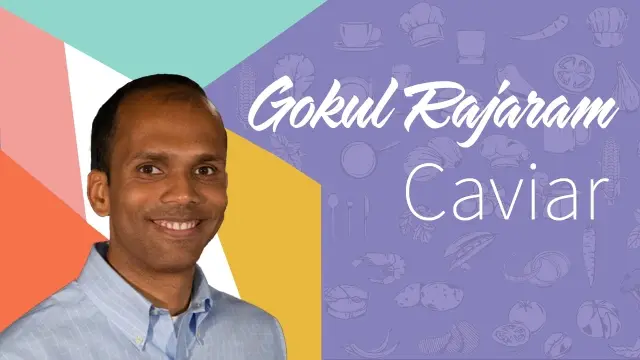
Q&A with DoorDash Executive and Caviar Lead: Gokul Rajaram
- Home >
- Workstream Blog >
- Q&A wi...

FREE RESOURCES
Join 30,000+ operators staying ahead on restaurant hiring, payroll, and compliance.
Get the latest with Workstream
Always stay current with hiring news by subscribing to our email updates
“If you want to build a ship, don't drum up the men to gather wood, divide the work, and give orders. Instead, teach them to yearn for the vast and endless sea.”
At Workstream, we have the rare honor of working with an incredible group of investors and advisors including Gokul Rajaram, who serves on the executive team at DoorDash, where he leads the premium ordering service Caviar. Gokul is also a board member of Pinterest, Trade Desk, and Course Hero. He previously served on Square's executive team. Prior to Square, he was a product leader at Facebook and at Google. In this Q&A, Gokul shares how he builds teams and brings ideas to life.
Lydia (L): You have an amazing track record as the “Godfather of AdSense" at Facebook - I'm curious, how do you bring ideas to life?
Gokul (G): I enjoy taking nascent concepts and working with teams to make them a reality, to productize and launch them. A compelling vision and North Star make it easy to motivate a team to bring that vision to life.
L: What does your typical day look like?
G: I try hard to reserve a couple of hours every morning to do deep thinking and work on longer term projects. Outside of that, my work day is filled with 1:1s, product and business reviews, interviews, and meetings.
L: What is your process for getting product feedback?
G: You can never go wrong asking real life customers for product feedback, whether it means showing them (ideally clickable) wireframes when the product is not yet built, to actually having them use the product once it’s built. Do ensure you have them go through the entire product flow (including sign-up / on boarding). And just LISTEN to them, don’t try to rebut or offer arguments or reasons why a thing is the way it is.
L: Do you have any advice for startups that are building for restaurant owners and operators?
G: Every restaurant is different, so you need a deep understanding of what segment you’re serving with your product. A single location sole proprietor restaurant has very different needs from that of a 10 location regional chain, which in turn is different from a national franchised brand.
L: Are there any trends that excite you?
G: The secular shift towards delivery and takeout excites me because it is something that allows for really interesting re-imaginings of what a restaurant experience can be.
L: Shifting topics a bit, I'd love to delve into your experience growing and leading teams. This is always top of mind for Workstream, both as a startup and a hiring platform. What's your typical interview process?
G: For each role, you need a clear articulation of the mission of the role, the outcomes that the role is responsible for, and the skills needed to succeed in that role. Once you have this, you set up interview tracks, one for each skill. The interviewer for each skill should be someone who has experience evaluating candidates on that skill. Example skills for Product Managers include strategic thinking, design intuition, technical chops and analytical competence.
L: What do you, personally, look for in an applicant?
G: It depends on the role, but outside of the skills for the role, I look for energy/passion, humility and bias to action.
L: What are common mistakes people make in the hiring process?
G: The #1 hiring mistake is focusing too much on the prior titles, companies and experience of the person (and being “blinded” by them), and not asking the tough questions around whether this person can actually do the job in the context of this company. The same role could be - and likely is - very different across two companies.
L: Now, I'm sure a lot of people are curious... DoorDash acquired Caviar from Square only a few months ago. Can we expect any big changes?
G: Not much. Caviar is still focused on serving our consumers, merchants and couriers. As part of DoorDash, we get even more resources to do this! And that’s exciting.
L: Has your team or structure changed at all since the move to DoorDash?
G: I’ve been lucky to work with a team that has been together for several years. I believe in Tours of Duty as defined by Reid Hoffman and Ben Casnocha in their book “The Alliance”, and so most people on the team have gone through several Tours of the Duty over the last few years. I believe it helps build new skills and keeps folks energized and excited for new challenges.
L: I love that book. I'm curious--do you have any books you recommend to product teams?
G: Never Split the Difference is the best book on negotiation I’ve ever read. It’s not just for product teams, but product teams, sales teams, and every other team / person can use it. Heck, I’ve used it not just at work but in my personal life too. Life is a series of negotiations!
L: So true. This is a bit off topic, but I'd be interested to know what tools / services you use to improve productivity.
G: I try to keep my brain uncluttered, so it’s important to have an easy way to transfer ideas or thoughts to paper or phone. Therefore, my two biggest productivity tools are a Field Notes book in my pocket + Apple Notes on my phone.
L: Now, I have to ask this next question for our readers / Workstream users... How do you think restaurants will look in 10 years? What will be the biggest changes?
G: I think the restaurant experience for consumers will change dramatically as off-premise dining (delivery + pickup) grows. I don’t know exactly how the experience will change, but I think the consumer experience of visiting a restaurant will evolve. We’ve already seen things like ticketing and self-serve kiosks emerge in the past couple of years. I’m excited to see what’s next!
L: Is there any data about the restaurant industry that shocked you?
G: I read a stat saying that 60% of new restaurants fail each year, and this number grows to 80% if you take a 5 year view. This goes to show that it’s a tough industry; restaurant owners need all the help, tools and products they can find to help them grow their business, lower their costs and retain their staff.
L: I've read that too. It's a challenge that inspires us everyday. Now this last question is something I always like to end on... Is there a quote or mantra that inspires you?
G: I love this quote by Antoine de Saint-Exupery. “If you want to build a ship, don't drum up the men to gather wood, divide the work, and give orders. Instead, teach them to yearn for the vast and endless sea.” It uses such a powerful metaphor to articulate why leaders should always start with “Why”. Without the “Why”, everything else (the “What”, the “How”, etc) is meaningless.
L: As a competitive sailor and team leader, I absolutely love that quote. Thank you so much for taking time out of your incredibly busy schedule for this Q&A. It was a great honor to include you in our Influencer Series!