



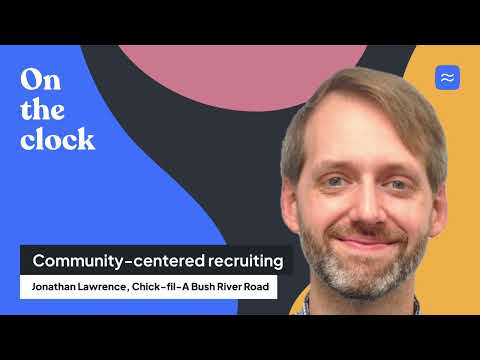

We clock in with Jonathan Lawrence, Recruitment Manager at Chick-fil-A Bush River Road in Columbia, South Carolina. Jonathan has been with Chick-fil-A for 14 years, and is nicknamed “the relationship guy" because of his involvement within the community. We discuss the importance of prioritizing customer service above all else, building an effective employee referral program, the many benefits diversity, and more.
http://workstream.us/community
https://www.linkedin.com/in/jonathan-lawrence-992140226/
https://cfabushriver.blogspot.com
Transcript:
|
Daniel Blaser (00:05): Hello, and welcome to On the Clock, presented by Workstream. If you care about hiring and retaining hourly employees, you're in the right place. I'm Daniel Blaser, and today I'm clocking in with Jonathan Lawrence, recruitment manager at Chick-fil-A Bush River Road in Columbia, South Carolina. Jonathan has been with Chick-fil-A for 14 years and is nicknamed the relationship guy because of all he does within his community. We discussed the importance of prioritizing customer service above all else, building an effective employee referral program, the many benefits of diversity and more. Jonathan's also a member of our on the Clock community, and you are officially invited to join us as well. Check out the show notes for a link to learn more and sign up. What about Chick-fil-A led you to stay there for I think you said almost 14 years? Jonathan Lawrence (00:58): For me, it's, it's the people that I work with. Don't get me wrong, I love our product. I genuinely love serving our guests. That's been a great part of, of what I do for as long as I've been with Chick-fil-A. But the people that I work alongside are really to me, the heart of the organization. And they're the heart of why I want to continue to work with Chick-fil-A. Working with everybody to, you know we do have a lot of high schoolers. We have, you know, adult professionals people who are building careers with Chick-fil-A, and, you know, working with people of all different walks of life and seeing, you know, Hey, these are my goals, this is what I wanna accomplish. And then helping them do that once they've done it, celebrating with them and, you know, letting Chick-fil-A be a part of that. It's, it, it's an amazing thing Daniel Blaser (01:46): For, for the record, I'm a big fan of Chick-fil-A from a, for the consumer perspective, and also with three little kids. Like those playgrounds are just absolute gold for us. So yeah, big fan over here too. When you talk about how your role is a little bit unique what, what makes it unique? Jonathan Lawrence (02:06): I think for me every day is gonna be different. So there are some days when I come in and 70% of my workload is going to be in catering sales or, you know, two days down the road, you know, I'm doing job fairs and I'm gone outside the restaurant all day. I don't have one job necessarily, so, but the cool thing about what I do is being able to build those relationships that kind of triangulate the, the different components of my responsibilities. So like if I build a relationship with a school I'm finding, you know applicants there building a relationship with the administration that can also turn into catering sales as well. So being able to try to find those relationships where I hit the sweet spot where, hey, we've got a new hiring channel. We've also got some catering revenue. Plus, you know, when we're ready to do the community outreach part of things, you know, we've got a channel to, to give back to our community as well. Daniel Blaser (03:09): Yeah, that makes sense. When you initially kind of mentioned, you know, you're doing some of this community outreach and recruiting, but you're also doing the catering. It, they, I, I guess at first when you first think about it, they seem a little bit disconnected, but like you said, you're ending up, it's all catering's all about those relationships too. And so that they, it makes sense that those would fit together and they'd kind of like build off of one another for someone listening to this, and maybe it's like another initiative where they're like, we need to be doing better at community outreach, building some of these relationships, getting involved. But like, I feel like that's probably something that oftentimes gets put on the back burner or deprioritized in favor of, you know, keeping the store running and kind of the, you know, day-to-day stuff. What, what recommendations or what's your perspective on, on the importance of prioritizing the, the community relationships and some of these events that you've mentioned? Jonathan Lawrence (04:07): Well, yeah, that, that's a great question. One thing that I always, I think back to the operator that I worked for for about 12 years. He was a older gentleman very set in his ways, lots of great stories there. But from time to time he would, he would just remind me and say, Hey, remember the guests on the other side of that counter is paying your paycheck so you need to treat 'em like they are. And he taught me early on at Chick-fil-A that relationships over transactions were so much more important. So, and with Chick-fil-A's model and you know, who we are and how we do what we do yes, we want to be the best quick service restaurant in in the nation. Yeah, no question about that. But, you know, we want to do that through building relationships, and we want people to not just think, oh, wow, that's a successful business. (05:00): We want people to think, oh man, I love going there. I love the service that I receive. And so whether that's inside the store in our drive-through, whether we're doing catering, community outreach really taking the time to understand the guests that we're serving and like if you start there, everything else gets easier. And I think where society is now, like people are really good at reading whether or not you're genuine and they can tell, okay, well, you're after a sale, or you're upselling this item, or you're being pushy about this, or, you know, you really wanna provide great service. That's, that's our target, that's our heart that people see that. Daniel Blaser (05:44): So we initially kind of connected because you're involved with the, the on the clock community that's kind of sponsored by workstream. And, and one of the things that you you weighed in on is we, everyone in the community was kind of sharing successes that they've experienced recently this year. Can you talk a little bit about some of the, the successes that you, you personally have seen in the hiring and, and retention realm of things? Jonathan Lawrence (06:10): Yeah. Yeah. So because this role was new to me last November I kind of said, you know, okay, well, I wanna learn everything that I can do. Everything I can learn. I, I want to, you know, attempt everything that I can possibly attempt. If there's job fair, I'm there. Any kind of recruitment opportunity, I'll do it. Somebody sends any kind of invitation, yes, I, I'll, I'll go. And so I feel like I've learned a lot in the past year. My operator told me, she said, with hiring, we're in the restaurant industry, it has the highest turnover of pretty much any industry, so don't take your foot off the gas. And I think any time in at, since I've been at Chick-fil-A where we've relaxed a little bit and said, Hey, you know, we got the staff we need, we're good. (06:59): We sit back. That, that's, that's, that's the gateway to, you know, trouble. And so I think just being persistent and constantly hiring, constantly looking for that next talent, whether or not we really need it at the time building those relationships that's been key to our success. I think a lot of the in-person recruitment events that we've done ha have opened up those new channels to continuing relationships with schools and universities and things like that. Another thing that I've really been pushing in the last couple of months is using the team that we have and saying, Hey, you know, don't you have a friend that, that you'd wanna work here? Once I studied our actual, you know, team members that we have on payroll and looking, well, okay, how did you come to Chick-fil-A? How did you join our unit? So many of them joined through referrals. And somebody that they knew said, Hey, you should work for Chick-fil-A. So really banking on that diving deep into, you know, okay, well, let's tell some of these team members stories and represent the organization. And that's drawing more talent. 'cause We're, we're creating an environment that people want to work at. So we're, we're building the reputation from the inside out, if that makes sense. Daniel Blaser (08:23): Do you have like a kind of an official referral program? Is it a little bit more informal right now? How does that work? Jonathan Lawrence (08:30): We do. We, we, and, and I've actually, I'm trying to get more traction with that referral program. We do there, there's two stages of it where team members can they can get $150 for a hire that they referred. And then after, if like, if they stay through their like probationary training period, they get another $150. Again, I'd, I'd love to see those numbers boosted big time. But right now I'm just trying to build awareness for the program so that our team members know. So when, you know, they've got somebody that they feel like would be a good candidate, they, they can push that button and say, Hey, you know, you get a bonus and or I get a bonus and you get a job. So, Daniel Blaser (09:14): You know, you mentioned quick service, restaurant industry, very high turnover rate. Are there a couple of things that you've done to try to improve retention with, within your team? Jonathan Lawrence (09:27): Yeah. so this is one thing that's, you know, I kind of take this personally. I I never wanna lose a team member. But, you know, people leave the organization for lots of reasons. I never wanna be the reason they're responsible for that. So I think one thing that I've done that has changed retention is being intentional with diversity even in from the recruitment stage and say we need team members from all types of different backgrounds. That makes us stronger as a team. And I'm really proud of the diversity within our team not only because that's the right thing to do, but people, you know, you, you're not gonna work in a place where you can't see yourself. And so because so many different backgrounds are represented at our restaurant I feel like I can honestly say, Hey, you know, like, we really are a job for everyone. (10:27): And anyone could work here. And, and you can see that in the diversity within our team. I think that's opened doors for us with recruitment telling those team members stories and saying, Hey, you know, this is somebody like you. Having so many opportunities to do that that has kind of lifted the ceiling on, on our recruitment efforts. Another thing that I've done, which, you know, it's, it's a very amateur thing for me. I, I've, I've always liked writing, so I thought, you know, if I can find a way to use that professionally I've been interviewing and writing the stories of our team members and it's a really simple blog format. But not only does that let our team, you know, we know each other better, we're celebrating our own stories better. (11:23): But that also, you know, I can use that outside the restaurant as well when I'm recruiting. I, I was meeting with one of our guys last week who I recruited him at a high school about a year ago. And just hearing from him, I said, you know, like, do you feel like you're the same person that you were, you know, before Chick-fil-A? And he said, man, I, and these are his words, so I, I can't take credit for it. But, but he said, you know, I feel like the team that I've worked alongside has made me who I am. And so for me, in, in recruitment and retention, like I'm thinking like, that's what I wanna be known for. You know, like I'm, you know, I was heavily involved at the front end of his story. I don't work with him on a regular basis, but just being able to be a part of, you know, a young man like that and, and just say like, yeah, like I, I've watched him grow. And I think being intentional about, you know, not just making hires, but developing hires too that's made the, the biggest difference. People wanna stay where they can grow. There's so many dead end jobs that you know, you, you feel like, okay, well, I'm spinning my wheels. You're not gonna keep team members if, if, if every position you have feels like a dead end. Daniel Blaser (12:40): There's so much value in kind of all the, the things you just shared. But definitely when you're talking about, you know team members being able to see opportunity, I'm sure they're looking part of that, part of that is them looking at you and seeing that you've, you know, stayed with the organization, you've been able to grow and take on new responsibilities. So I'm sure that that's made an impact as well, which is cool. As you know, it's kind of the time of year where we all look back a little bit and then we look forward and we make goal cycles for ourselves, and, you know, we decide we want to focus on this instead of this. What would you say is like the biggest change that you're going to make to your hiring strategy in the year to come? Jonathan Lawrence (13:22): Yeah, <laugh>, that's a great question and something that I've been thinking about a lot in the last few weeks. Like I said earlier this past year, I did everything, every invitation I got, I was there every high school, every, you know, local college job fairs department of of the workforce that I, I was there for all of it. I think now with a little of that experience under my belt, I'm gonna sit back and say, okay, well, was this event incredibly beneficial last year? So for me, you know, I think I need to practice saying no and, and saying, you know, okay, well thank you for the invitation. I'm gonna pr I'm gonna spend my time in a, a different way. I'm gonna dig deeper on, you know, analysis. Okay, where am I getting my team members? Where are the deepest talent pools? And, and really focus in on those rather than just doing everything with everybody, if that makes sense. Daniel Blaser (14:21): It seems like you've that you've approached it the right way, right? Because now you, you have had those experiences and you can actually draw from your, you know, your actual perspective on, you know, whatever different initiative or effort it is, you can, it's not, you're not just guessing, which I feel like is probably what a lot of us do, where we, we weigh opportunities and then we guess, but you, you actually have the, the real world experience to know what will be valuable. So Jonathan Lawrence (14:46): If it's any consolation, I feel like most of the last year was guessing <laugh>, <laugh> and so maybe just a little less guessing <laugh>. Daniel Blaser (14:54): Yeah. Yeah. That's fair. That's fair. One other theme that as I've been speaking with Workstream customers, people in your similar shoes, there's kind of this theme of trying to shift hiring to be more proactive rather than what it often feels like, which is reactive. What would you recommend? Like if someone's listening to this and they're like, ah, yes, I wanna be more proactive rather than reactive. What would you recommend? Jonathan Lawrence (15:22): Yeah, absolutely, definitely take the proactive approach. It changes the way you, you, you do staffing, for sure. For me, I would say determine what your ideal candidate looks like, do some research and figure like fit out that ideal candidate profile. Then once you know what you're looking for, figure out where to find them. I think for me, one of the things that I've spent a lot of time doing this last year is playing the long game and investing deeply in the strategies and the recruitment channels that are the most beneficial for me. I think that's the advantage that I have going into my second year in this role. I think, you know, the job market and what it means, you know, to be in recruitment it, it, that changes so frequently. And I think if, if you're not doing that research to really understand who's your best fit candidate and then if you have that information not pursuing them like you, there's no way you're gonna get ahead. You're always gonna be on the back foot. Daniel Blaser (16:32): Thank you for listening to On the Clock. For more info, visit workstream.us/ podcast. I've also included a link in the show notes to connect with Jonathan and browse the blog he's using to showcase his awesome team. Until next time, we're clocking out. |
Listen and subscribe
 |
 |
 |
 |