



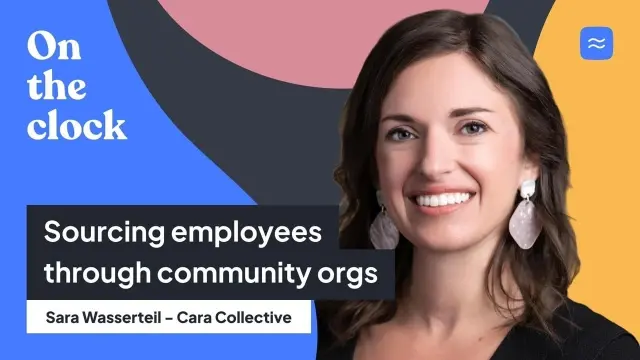


We clock in with Sara Wasserteil, Managing Director at Cara Collective. Our conversation is an excerpt from a recent webinar, and it’s all about sourcing employees through community based organizations.
Sara shares why CBOs are such a great way to find hourly employees, how to identify the right organizations to partner with, how to assess the effectiveness of your partnership, and more.
Sara's LinkedIn: https://www.linkedin.com/in/sarawasserteil/
Watch the complete with with Sara: https://www.youtube.com/watch?v=GBynjQFt9s0
Transcript:
|
Daniel Blaser (00:06): Hello, and welcome to On the Clock, presented by Workstream. If you care about hiring and retaining hourly employees, you're in the right place. I'm Daniel Blazer, and today I am clocking in with Sarah Wasser, tile Managing Director at Kara Collective. Our conversation is an excerpt from a recent webinar, and it's all about sourcing employees through community-based organizations or CBOs for short. Sarah shares why CBOs are such a great way to find hourly employees, how to identify the right organizations to partner with, how to assess the effectiveness of your partnership, and more, we kick things off with Sarah defining what community-based organizations are. Sara Wasserteil (00:44): So CBOs oftentimes mean a nonprofit organization serving the needs of a community. So while that could take the shape of several things from homeless shelters to mental health services to youth programs in your neighborhood, like the YMCA, what's most relevant for companies is the network of more than 30,000 workforce development organizations and social enterprises. That can be an incredible source for talent for your company. Daniel Blaser (01:10): Community-Based organizations like the ones you've mentioned, they're obviously doing a lot of good in the community as it is. But I like when we were chatting before this, you know, we were talking about how they can really be a, a partner for finding potential employees, and I, I really like that word partner, right? Because it's kind of implies this symbiotic relationship. I'd love to talk a little bit about like why are CBOs a great partner and, and maybe what some of the data says around why they're, they're, they're great for finding employees. Sara Wasserteil (01:42): Yeah. Thanks for asking that question. So CBOs can be great partners for your talent strategy for a few reasons. So first of all, you mentioned that work partner and the idea of a symbiotic relationship for CBOs that develop strong relationships with companies especially companies that hire frontline talent, they can really get to know them. That means not only do they know your company, they know your culture, they know the jobs you hire for, including what it is that you are looking for, and they know what it takes for somebody to succeed. So instead of you having to look through Indeed or LinkedIn or any of the platforms to, to kind of find that needle in a haystack, they can, they, they know the right people who are gonna be a good fit for your job. Number two, because they work with talent one-on-one, they get to know them. (02:30): That means that they can see beyond the resume, they can see the characteristics of the individual, not just their skills, but also their potential. It reminds me of a, a particular candidate we worked with a couple of years ago where we were hiring for a bank. And what they cared first and foremost was they wanted someone who's going to be dedicated for a customer service role. They knew they could train the customer service representative in a lot of those technical skills, but if they had someone who was dedicated and had a good attitude, they were willing to train them up. It made us think of one of our candidates, Brie, who worked in retail. So it wasn't necessarily that obvious fit when they were looking for the bank role, but we also knew that Brie took three different buses to get to her retail job every day. (03:15): She was always there on time with a good attitude, a big smile on her face, and people loved working with her. Now, that didn't show up in her resume. No one knew that it took her three buses to get to work. But because our team, 'cause we are a, a community-based organization, A CBO, because we knew her and we knew that dedication, we're able to act as that translator between the talent and the employer. The last major benefit of working with community organizations is when you get talent from them, you are oftentimes getting a team. It means you are getting a, a an, an employee who might have someone who can help them. If all of a sudden their housing becomes unstable or maybe they need an immediate payday loan it means they also have someone who might be a coach, for example, who can help them navigate different challenges. (04:01): So it means that you are not just hiring one person, but you're hiring a whole network of support who are all invested in seeing someone succeed. And we see that play out at Care Collective where I have the privilege of serving all the time because of this network of support and because of the preparation we provide and because of the, the relationships we have with the different corporate partners we work with, our individuals have a same firm. One year retention rate that's 70%, which is 20 points higher than the national average. So the, the, the data bears out that this is not just a great investment in hiring someone, but if you want talent, who's gonna stick and stay. Daniel Blaser (04:40): Now let's talk about, you know, there's traditional hiring and sourcing methods like job boards maybe, you know, posting on, on LinkedIn, some of these things that people a lot of times think of now how would recruiting outcomes, we talked about how they're better with CBOs. Can we talk a little bit more about like maybe the, like the qualitative outcomes that you get when partnering with a community organization versus like more traditional sourcing methods? Sara Wasserteil (05:09): Yeah, absolutely. So we oftentimes think about high reach strategies versus high value strategies. So when I think about high reach strategies, I think about a lot of the examples you just gave, the job boards, the social media where you're getting a really wide reach of candidates and you might get tens, hundreds, or even thousands of applicants for a single role. Conversely, when I think about the high value strategies, which really leverages that word partnership you used before you might be getting many fewer candidates, but I'd argue that they can be either higher value or just a better fit for the role. So where you, where you can save time as a, as a recruiter, because we know that it takes so much time not just to sift through resumes but to really find the right candidates. What, by partnering with the CBO, it's almost a, a trade off. (05:59): So you, you might not be opening the net quite as wide but you're not going to be sifting through as many resumes because if you've developed a trusted relationship with that partner, you know that the chances are that the 1, 2, 3, 4 candidates they send you are going to be much more likely to be successful in your firm. So I think of it more as you might, it might seem like more time upfront to invest in that relationship, but the likelihood of success is going to be that much more because they know your company and because of the additional support that they're going to provide to that candidate. Daniel Blaser (06:32): You know, some of the organizations that you mentioned at the beginning, they're like national organizations that everyone has probably heard of. But let's say someone watching this, then they're, they're feeling inspired and they're thinking, okay, I, I've been meaning to kind of look into this. I need to try to find a good organization to work with around, you know, my my office, where we're located. How should a company go about doing that? And, and, you know, not just finding you know, a a a high quality committed partner to work with, but also one that kind of matches up as far as you know, what the company's looking for and what the organization's looking for. Sara Wasserteil (07:10): Yeah, absolutely. So even as, as, as an organization, a, a community-based organization ourselves, I'll be the first to say that not all CBOs are created equally. And so just like any decision you wanna make in terms of any vendor or consultant you wanna work with, you wanna do your due diligence to make sure it's gonna be the best match for your firm. So you're not going to the CBO as an active charity, but that you're doing it because working with them is a choice of strategic advantage. And so I say all that because there's probably about five or so things that companies should look for when they're assessing potential CBOs to work with. So the first one is understanding who is it that they serve? Does their mission speak to you and does the population that they work with either have or can they acquire the skills that they need to be successful in your company? (08:00): Second, you're gonna wanna understand their track record. So just like any other partner you may wanna work with, you're gonna wanna understand how many people are they placing every year, what is the retention rate? What is what is the rate at which people are getting promoted? Think about the metrics that are important to you, and don't be afraid to ask because any organization that is doing this work and doing it well is going to be so excited to share their results with you so that you can understand if it's a good match. Third, you're gonna wanna look at how they partner with companies. So you are gonna wanna understand what does partnership look like, what does that commitment look like? And that goes from everything from what is the communication, what is the process, who's the relationship manager gonna be? You're also gonna wanna understand how they match job seekers with opportunities. (08:49): Are they sending folks to you? Do you send them job recs? So really understanding the mechanics to make sure that works within your processes. Fourth, you're gonna wanna know what kind of ongoing support that they provide. So for example, if you're working with a community or in a neighborhood that might be higher needs 'cause it's been more disinvested in, you might wanna understand what kind of support do they provide to assist with stability or resources so that if you identify that employee having a hard time, you know that you can go back to them to see if they can provide the support. Because let's be honest, we know that most companies aren't al also trying to be social workers. So you really wanna understand how you can leverage them for support. You'll also wanna know if they'll provide any ongoing coaching or mentorship so that if they are for whatever reason, having a challenge on the job knowing do they have someone who they can lean on, who can be their thought partner, their navigator as to be the best employee that they can be. The last thing to look at is do you currently partner with them? There are so many community-based organizations that offer myriad ways where you can partner with them. So be it hiring talent, but it could also be if they have other services, there could be other volunteer opportunities. So if you already volunteer with them, it's a great way just to understand what the company's experience has been and where you can leverage that partnership to create better, better value for your company and for the organization you're working with. Daniel Blaser (10:16): One question as you know, as you're kind of going through these five recommendations what sort of like warning signs or like what things to you would be like an indication of like, maybe this is not the best fit? Sara Wasserteil (10:33): Great question. So I think first of all, it's gonna depend on the type of talent that you are looking for. So number one, the mission might speak to you loud and clear, but for example, if you have certain policies that's gonna preclude the, the individuals from being hired in your firm, those are great conversations to have outright to find out can they be a great hiring partner or maybe do you wanna engage with them in a different way? I think number two, pay attention to their communication. When we talk about partnership, it should not just be one way it should be two ways. So you're gonna wanna look for are they responsive? Are they doing what they say they're doing? Are they sending you candidates that are, are, are, are meeting your requirements? And if they aren't, are they willing to be a partner with you to have that conversation? (11:21): So those would be some of the big pieces of just, it's if you think about any partnership you have, you should have the same standard for any CBO because what's so important in those relationships is that there's mutual trust. The more you can trust each other, the more you can have those honest communications and the more you are gonna trust that the candidates they send to you are gonna be ones that you wanna interview. And vice versa, if there's a challenge, you wanna know that you have a partner who you can go back to and raise the red flag so you can problem solve and troubleshoot those challenges together. Daniel Blaser (11:51): Yeah, great Recommendations. So you know, let's say someone watching they, they're going through these steps, they've identified some organizations that might make sense to partner with. And like you said, I I love that you mentioned this is kind of almost like vetting a vendor or, you know, any other partnership that a company might have. Like, you don't necessarily want to just dive in with both feet right away, right? Like a lot of times with a partner or a a vendor, you want to get a trial period or, you know, just make sure things are going to work as you've kind of prior discussed prior so can you do that with a CBO and, and how do you go about sort of testing the waters before you, you know, fully commit to a partnership? Sara Wasserteil (12:35): So there is nothing that most CBOs like more than inviting people into their space so that you can get to know them and they can show off their talent and their programs one-on-one. So there are three things that I recommend that companies can do to get to know them, to see if this is gonna be the right fit. So number one, really get to know them. Ask if you can visit them and take a meeting at their space so you can really see what they're about and potentially even see their programs in action, in action. Very similarly, invite them to come to you, see how they engage with your space, see what types of questions they're asking as you, as you connect about a potential partnership. I think secondly, look for different ways you can volunteer within the organization. (13:20): So for example, there might be opportunities to help some of their participants with things like developing a resume, doing mock interviews organizing a clothing closet or many other things. So there's oftentimes many ways where you can engage with A CBO outside of hiring their talent. And so if you wanna, you know, get a little bit of taste of what it's about, but you might, might not be ready to dive right in, that can be another way just to start building that trust and getting to know them. And then lastly, of course, hire their talent. So develop that referral relationship. Hire that first individual or if they have attempt to perm option, consider what it would look like to test the talent and kind of a try before you buy model. Oftentimes organizations are excited to work with companies and they're most excited for ones who come in with an open mind and wanna work with them to hire the wonderful talent that they have. Daniel Blaser (14:12): You know, we've chatted about this word partnership a little bit and why it's so important to think of this relationship as a partnership. But ultimately, like, you know, companies that are entering into, you know, this relationship, they're, they do want to hire people. I I feel like there might be a tendency to sort of, sort of see all of these efforts that you mentioned of like investing time and getting to know the organization. Like it's, it's hard to maybe not see that a little bit as of like a transaction, right? Like I'm, I'm gonna put in some time I'm gonna put in the work, but I, I do want to see results on the other end. Why would you recommend against seeing it as a transactional you know, a transactional relationship versus a partnership? Sara Wasserteil (14:57): Oh, I'm so glad you asked that, Daniel. You know, I think one of the biggest, I'll, I'll I'll start by saying one of the biggest challenges with partnering with CBOs is sometimes they don't have as much talent as you want. So maybe you are looking to fill 10 open roles and they only have two individuals that are going to fit. It can feel like a lot of work to invest in a partnership where they can't provide the yield that you're looking for. That is a major challenge and sometimes one that we face ourselves. But the reason we would always encourage companies to partner with CBOs, and it doesn't need to be many of them, is because the more that you invest in the partnership, it means the more that the CBO gets to know you, the more that they get to know the talent that you need. (15:40): And so it effectively, it, it helps them help you. One of the things we also talked about is it helps to create that honest feedback loop. Some of our best partnerships are when a company can come to us and let us know if someone's maybe having a little bit of a tough time on the job. What it allows us to do as their CBO partner is we get to have our coaches and our social workers reach out to that individual to understand if there's something getting in the way to ensure they can be successful on the job. Very similarly, it allows us to work with our corporate partners and give them feedback too, in case there are things that are getting in the way of allowing them to hire or retain great talent. One very specific example is so often we might run into a company that has a job description that might be a little bit hard to understand or it might require things like a, a college degree for a janitorial position. When we create that relationship over a transaction, it allows us to have honest conversations and say, Hey, we actually have this really great candidate. He doesn't fit all of the qualifications you have, but here is why we think that they're gonna be good for the role. Would you be willing to be flexible? It's really hard to do that when you have a transactional relationship where it's just pinging job orders and referrals back and forth. It becomes a lot easier, a lot more fruitful. When you're able to develop that trusted relationship between two partners Daniel Blaser (17:04): For companies that they've vetted, they found the right organization, they've begun their relationship, their partnership at at what point does it make sense to, to stop and say, okay, let's, let's make sure that everything is working out the way that we wanted it to, to kind of assess, you know, is, is this worth our continued time and, and commitment? Yeah. At what point should that kind of evaluation phase happen? And you know, what do, what do you, how do you even do that? I mean, you mentioned are are they delivering what they kind of said that they would be able to deliver? That's makes sense. In in what other ways should you kind of evaluate the success and, and determine, okay, let's, let's stick with this partnership. Sara Wasserteil (17:52): I love that question, Daniel, because it goes back to a question you asked earlier where, where you're asking like, well, what are the red flags? When might you want to walk away or not even say yes from, from jump? One of the things that, that our team does, which is really deepened our, our partnership with employers is we do either a semi-annual or an annual review. What that allows us to do is we come to our corporate partner and we're able to bring some of the data. Here are the number of people that we've been able to place in your firm. Here's what the one year retention rate has been, et cetera, et cetera, et cetera. It also allows us to unlock roadblocks. So for example, let's say we've sent 20 people, but you've only hired one. It allows us instead of to say, or maybe this isn't the right fit partnership, it actually allows us the opportunity to troubleshoot in real time. (18:43): Like, is the problem with us, the CBO that we're not sending you the right candidates? Or is it that maybe there's something in your process that you don't even realize is preventing some of these candidates from being successful? And so I think asking for things like a semi-annual or an annual review where you both really come to the table as partners, honestly, to really look back to where you've been and what you can do together, that is a great tangible step you can take to really think about not just the, the partnership of the past, but the partnership of the future and if you're able to meet each other's needs. So it isn't as quantitative of an answer as I can provide, but it's I would say that is the number one way where we oftentimes assess is this a great partnership moving forward? And likewise, it's also where some of our corporate partners decide, is this a great partnership? Do we wanna deepen it? Or is this actually not meeting our needs anymore? Daniel Blaser (19:37): I wanted to give you the chance, you know, you've shared so much good knowledge and advice but just the chance to maybe share like one final takeaway, one final word before we jump off. Sara Wasserteil (19:49): Oh, man. I think if it's one thing is, you know, right now we continue to be in an unprecedented labor challenge across the country. While there's a lot of things that individuals can do to continue to upskill and become great candidates continue to look inside, are there different ways we can make it easier for great talent to find us? Are there ways we can sell ourselves as a company? So great talent wants to work for us and are there great partners like CBOs who maybe we haven't been willing to give a try who we can begin to see not just as an act of charity, but as an act of strategic advantage. Daniel Blaser (20:31): Thank you for listening to On the Clock. For more info, visit workstream.us/podcast. I've included a link in the show notes to connect with Sarah on LinkedIn and a link to watch our complete webinar on YouTube for free. Until next time, we're clocking out. |
Listen and subscribe
 |
 |
 |
 |