



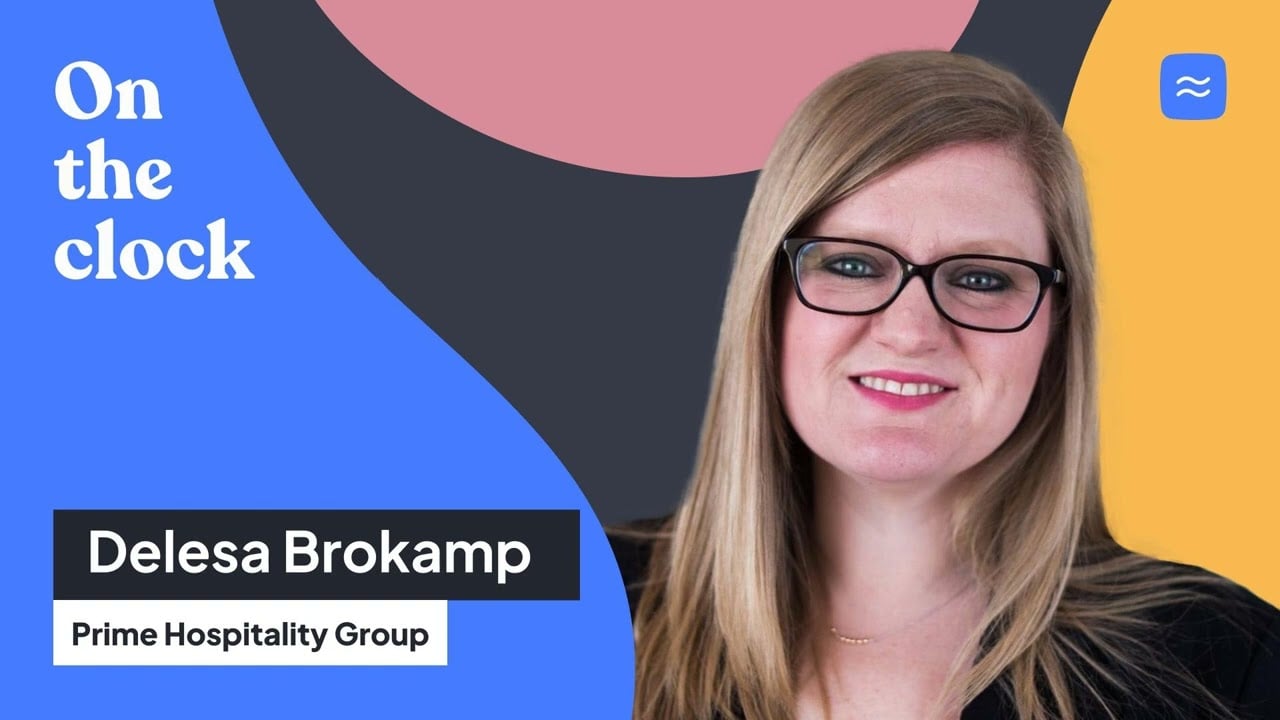

We clock in with Delesa Brokamp, HR and Talent Manager at Prime Hospitality Group. PHG employs close to a thousand hourly employees across 15 locations in four states.
Delesa discusses why it’s important to never lower your standards when interviewing, and why hiring fairs are worth a shot. We also chat about the components that make up employee engagement, and more.
https://www.linkedin.com/in/delesa-brokamp/
Transcript:
|
Daniel Blaser (00:06): Hello and welcome to On the Clock, presented by Workstream. If you care about hiring and retaining hourly employees, you're in the right place. I'm Daniel Blaser, and today I'm clocking in with Delesa Brokamp, HR and talent manager at Prime Hospitality Group, prime employees, close to a thousand hourly employees across 15 locations and four states. DEA speaks with me about why it's important to never lower your standards when interviewing and why hiring fairs are worth a shot. We also discuss the components that make up employee engagement and more enjoy. Can you provide kind of a, just a brief overview of your experience in the talent acquisition space and then, you know, you mentioned what your role is at Prime Hospitality Group, but like kind of what that entails? Delesa Brokamp (00:54): Sure. I've worked as a human resources and talent executive for more than 15 years and have found talent acquisition and human resources to be inextricably linked. A large part of my passion and love for Prime Hospitality Group is the connectivity of the two. For me, talent acquisition manages the pre-boarding phase for hiring and as an HR manager, I then have the opportunity to assist with the post boarding after an employee has been hired. Daniel Blaser (01:21): Just to kind of give our listeners an idea approximately like how many hourly employees work for Prime Hospitality Group. And then follow up kind of onto that is how many open positions are you kind of involved in, in trying to fill like every month or so, you know, across all the locations? Delesa Brokamp (01:41): We currently have around 900. We fluctuate on average between a hundred to 120 open roles across our 15 locations, over four different states. Daniel Blaser (01:53): That means a, there's a lot of work to be done, I guess. Are you, are you kind of like a, a one woman show or how does it work as far as the, the team that you know is in charge of trying to fill these open roles? Delesa Brokamp (02:07): We have a great team here. I am one of four. And then we have our CFO that we report up to. Daniel Blaser (02:16): One question that I wanted to ask you about, 'cause I was snooping on your LinkedIn a little bit, and I saw that you had a post and it said, everyone is not hiring. Everyone is interviewing know the difference. And I read that and I thought maybe I don't completely know the difference. Can you talk a little bit about how, you know, what the distinction is between those two things and why it matters? Delesa Brokamp (02:42): Sure. Thank you for sharing that. What I meant was just because someone has a job opening does not mean that each interviewee is a great fit. You'll hear time and again, everyone is hiring, but it's really simply not the case. There are a lot of opportunities for you to submit a resume, but unless you have a standout bio your chance of really snagging a job, let alone an interview is probably not going to happen. Only those with a top-notch resume that really meets the competencies of a job with maybe having an extra advantage of knowing somebody in a particular hi particular hiring location, really, really will have that advantage. My real advice for you is be genuine, showcase your skillsets, know and be able to express why you are the real fit for that job, and then you'll have a great advantage. Daniel Blaser (03:43): Yeah, that makes sense. Yeah, just kind of, you know, calling out the importance of like, it's, it still have to, I guess, earn or showcase your, your abilities, showcase your experience. Like you said, it's not just a gimme when you go into a job interview. I guess I guess one follow up question on that is, given the the number of open roles that you're trying to fill, and also just like the hourly hiring space, which I feel like has been a lot more challenging, have you felt that it's that you've maybe had to kind of compromise a little bit on like the level of experience or quality of an, of an applicant like that, that it seems like that might be hard to maintain given just trying to get people in roles? Can you talk maybe about how you're able to strike a balance between those two? Delesa Brokamp (04:36): Sure. I feel as though you should never compromise, and that's a great question. When it comes to hiring, I think that that's often a balance in a hiring position that people will want to jump to, where it becomes that opportunity to want a warm body. I feel as though taking that risk is never, never one that you should do. You shouldn't feel as though, okay, I'm I'm going to hire this next person that comes in because we do have an open role. I still think you should set your standards high. You should always have your role in front of you the description for your role, and you should never compromise. It should still be, this is the skillset I'm looking for because your person that you want your right person for your right seat will come through the door. It's a matter of being patient and waiting and making sure that you do have your standards that you want, your skillset that you're looking for, and keeping that expectation high because that person will eventually come through your door. Daniel Blaser (05:38): Yeah. Yeah. I, I think that's a really good perspective to have. And it's different a little bit than what I've, you know, heard from other people in, in maybe a sim similar role as yours, which is like, we're just trying to get a warm body in the door and we, you know, there the, I feel like sometimes there is a tendency to just kind of go with anyone because of there's like some desperation or whatnot. I guess, sorry, one follow up question that I just thought of is, I feel like in order, in order to maintain your high standards, you probably have to have like some level of confidence in your in, in the compensation and the culture and whatnot of your company, right? Because it's like, we know that we're a great place to work so we can maintain high standards. Can you talk a little bit about maybe how you have paired like those high standards with like a good, you know, just making prime hospitality group a great place to work? Delesa Brokamp (06:36): Absolutely. A lot of it comes down to knowing and believing in your core values and then training your hiring managers up to those same standards, which we do. We have a lot of faith in, in who we have in the right person in the right seat. It all comes back down to that and knowing that we set out with our front of house managers, our sous chefs, our general managers, and our executive se chefs that we have set them up for success in that way. And it all goes back to the core foundation of core values. And as long as we have faith in that AC aspect that they are going to continually have those, those skill sets and those standards and expectations what you run into is if you just put a warm body, you're gonna see turnover and you're going to run back into a cycle of rehiring and renegotiating and that catch 22 of consistently putting warm bodies in. And that's not something that you wanna do if you stay strong and if you keep consistent that you believe in your, your role description that you have your core values in place, you're not going to see consistent turnover and hopefully which we'll get to here in a little bit. You'll be more proactive and if you continue to be proactive, you're not going to see turnover in that way. Daniel Blaser (07:58): Yeah, yeah, that definitely makes sense. One other thing that I, I noticed on your LinkedIn is that Prime uses hiring fairs in your recruiting efforts. Can you talk about the hiring fairs? Are they, have you found them to be effective? And yeah, just kind of what your strategy has been with those. Delesa Brokamp (08:22): Sure. Absolutely. Hiring fairs are twofold. Not only are they a great way to meet new potential employees, but they're also a phenomenal way to get your name out into the market. If it's a college fair meeting, those eager eye budding students it's always inspiring to hear their stories as well as educate them about your respective industry. They're brand new into the field that they're choosing but it's also if it's a career opportunity, then it's also a great way to get your name out into the market as well. It's exciting to help spread your name in that regard as well. Daniel Blaser (09:00): Nice. Are you typically, does Prime kind of sponsor the whole kind of the whole experience or are you kind of slotting into existing hiring faires or do you kind of do some of both? Delesa Brokamp (09:15): A little bit of both. It's one of those where if it's an opportunity, it's a great place. It's one of those where you should go for it, you should give it a shot. We'll do career fairs, we'll do industry driven fairs. They're both really great opportunities. Daniel Blaser (09:35): Nice. Okay. And let's say, so I've, you know, speaking with different people, I've heard varying levels of success with with hiring fairs, but let's say someone listening to this podcast, they're like, I know it's like, on the list, we've gotta try it. We haven't really gone that route yet. What advice would you give them? How would you recommend that? Like maybe someone kick the tires or, or start out like where Yeah, what recommendations would you make? Delesa Brokamp (10:01): Three words. Go for it. Go for it. Job fairs are a terrific opportunity. Get yourself in front of hiring managers. And then also the opposite of that is get your name out there. There's never a bad opportunity with a, with a career fair. Daniel Blaser (10:18): Nice. I like that. You touched a little bit on on this already, but this difference between pro proactive and reactive hiring. Is that, you know, how would you kind of define the differences and maybe what are some examples of how you, in your role in Prime Hospitality Group is proactive rather than reactive? Delesa Brokamp (10:45): Being proactive requires you to be forward thinking and anticipate the next spot or job that you might need filled. For us at Prime, we call it filling or building bench strength. For instance, we have a general manager right now who is planning to retire. So we know that that role is going to be open. So what we did is we put steps in place with him to build the skill sets of one of our assistant general managers. We have her work with him and learn from the general manager to kind of fill what spots he would be leaving and ensure that transition to be a little seamless to really work towards that. Reactive is another matter. Some of those situations are unavoidable. It happens when you have a manager suddenly leave without notice or an instance that you really have no choice but to be reactive in, and then you need to fill that position as expeditiously as possible. But you do it thoughtfully, so hopefully you don't find yourself in that same position in the near future. Daniel Blaser (11:51): Yeah, that makes a ton of sense. Shifting over to retention, which I guess could also kind of slot into proactive versus reactive a little bit, right? Can you talk a little bit about why you think that employee engagement is so important? Delesa Brokamp (12:09): Engagement is not only important, but it should be treated as a mindset especially in the retention field. It should be embedded in your culture, which is how we tend to approach it here at Prime Hospitality Group. Our culture is one where we work as a cohesive team. It truly is supported by our core values. Our core values are demand for excellence, passion for hospitality, hunger to grow, unwavering commitment, and our desire to win without our core values at our foundation, there really is no employee engagement. Daniel Blaser (12:44): I like those values a lot. What would you say are maybe some common misunderstandings around employee engagement, people not really realizing what it means or its significance, et cetera? Delesa Brokamp (12:57): I think probably the biggest and number one misconception with engagement would be that happy employees are engaged employees. It's just not true. A lot of times people come to work with a smile on their face, it doesn't mean that they're engaged just because they're happy. Number two, hire paid employees or more engaged employees also not true. And then finally that human resources is solely responsible for keeping your employees engaged. Also not true. It's a, it's a team effort. Something that, that your entire team is responsible for. Daniel Blaser (13:32): Yeah. So, you know, some of the things you mentioned that are misconceptions and it's, it doesn't directly translate to engagement. If someone, you know, listening to this podcast is like, oh, well that's, that is what I thought engagement was, or that's what we've been, you know, focusing on. What can they do to increase engagement and encourage engagement? Delesa Brokamp (13:52): Great question. Employees have the power really within themselves to make or break a company, which is why engagement is so essential to day-to-day operations. No doubt, employees who are engaged are more likely to be productive which is why employee engagement is so important. We need productive, motivated, happy, fulfilled employees. They also lead to higher retention rates. You don't want that turnover to be a problem. That said, we at Prime Hospitality believe providing employees with ongoing training opportunities growth, potential, consistent, clear, open communication, transparency. You wanna build trust first and foremost. You want to build trust. It's a really important prospect, loyalty, enthusiasm. All of these really build on each other to build a foundation for employee engagement. You want growth plans, prioritize employee recognition, things like that, and then foster a sense of belonging. Which I'm proud to say that's kind of the foundation that we have here, which is why we have really great employee engagement and retention rates at Prime Hospitality. Daniel Blaser (15:05): Are you able to kind of communicate some of those things you just talked about in, you know, in the, the hiring stage or in a job listing or, you know, is that something that I'm, I'm guessing it kind of starts early in the process. Could you talk a little bit about that? Delesa Brokamp (15:20): Absolutely. Don't be afraid at that very first touch, that very first connection with a potential employee to let them know if you have core values and what those core values are, build that solid foundation from the very, very beginning. Be transparent. Let them know if, if you have a solid foundation, what that transparency looks like and build on that from the very beginning. We do a great job here to let them know, here's what our entire process is, what it's going to look like from the beginning. So there's no surprises, there's no hidden hidden opportunities really, per se. And that way they know from the beginning what their whole onboarding and pre-boarding will look like throughout their entire process with Prime hospitality. And I think if you do that from the beginning phases, they'll build that rapport with you. They'll know who their contact is from the beginning that way they have that, that connection right at, right at the beginning of, of their relationship with, with their potential employer. Daniel Blaser (16:24): To kind of broaden it out a little bit, I would love to hear just like, what do you love about your job? You've mentioned a lot of good things about Prime, but you know specifically about your role. What do you love? Delesa Brokamp (16:35): We really build on a family atmosphere. Even with, as we discussed previously, Daniel, that we have 900 employees from an hourly perspective that doesn't count our full-time salaried employees. We're a family. We have a solid foundation, core values, all of those things really make us a close knit and have values. We deliver that passion daily. We encompass a lot of that in who we are. Building on that solid foundation gives you respect and trust which sometimes can be hard to build on, but if you start that from that very first connection, it's not having that family culture that trust, that transparency. It's really, it makes it get up, makes you get up every morning, makes it easy to go to work. You know what your day is going to entail, you know, what's going to unfold every single day. It makes it worth it. Daniel Blaser (17:39): I kind of mentioned this earlier, but you know, the, the listeners of this podcast are, a lot of them are kind of maybe in a similar role as you. They're concerned about hiring, they're about retention. Knowing that, what advice would you, I mean, you've already given them a lot of great advice, but, you know, kind of leaving maybe one last word of advice or recommendation with listeners. What would you say? Delesa Brokamp (18:00): If you are looking for a job, make sure you understand competencies of that particular role. If you do that and you apply for a job, tailor your resume it, it's not anything out of the norm to have a specific resume tailored for what you are looking for. Showcase your qualifications, experience and make sure it fits that role. And of course, as you know how I feel, utilize Workstream. It's a phenomenal resource. It is there to help you attract, maintain, and retain top talent. I'm a huge fan of workstream. I would not be efficient and effective in my job if I did not have workstream as, as an opportunity to help me do what I do every single day. A hundred to 120 open roles. We wouldn't be who we are if it wasn't for Workstream. Daniel Blaser (18:49): It was great to to chat with you and kind of hear, you know, your perspective and, and your experience and whatnot. Delesa Brokamp (18:55): Awesome. No, I appreciate your time. We appreciate workstream and everything that it's done to help us grow and to help us become who we are. And we look forward to a really long working relationship with you guys. Daniel Blaser (19:10): Thank you for listening to On The Clock. For more info, visit workstream.us/podcast. I've also included a link in the show notes to connect with the Lisa on LinkedIn. Until next time, we're clocking out. |
Listen and subscribe
 |
 |
 |
 |