



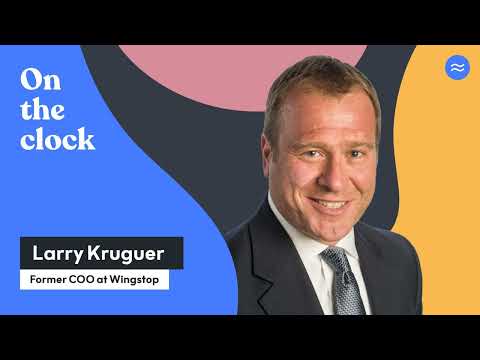

We clock in with Larry Kruguer, former Chief Operating Officer at Wingstop, VP at Wendy’s, and an advisor for several exciting food and beverage ventures.
We discuss what he learned from being at Wingstop during a period of expansion, why automation is so important to the success of franchise restaurants, the top factors that encourage employee retention and more.
Subscribe to On the Clock: https://bit.ly/OntheClockpod
Transcript:
|
Daniel Blaser (00:07): Hello and welcome to On the Clock, presented by workstream. If you care about hiring, managing, and paying hourly workers, this is the podcast for you. I'm Daniel Blazer, and today we're clocking in with Larry Krueger. Larry's extensive background includes Chief operating Officer at Wingstop, VP at Wendy's, and an advisor for several exciting food and beverage ventures. We discuss what he learned from being at Wingstop during a period of expansion, why automation is so important to the success of franchise restaurants, the top factors that encourage employee retention and more. Awesome. Well, Larry, it's great to chat with you today. I'm excited to do so. Larry Kruger (00:46): Happy to be with you, Daniel as well. Great to be here. Daniel Blaser (00:50): To kick things off, can you just kind of provide an overview of your background experience and then maybe a little bit of what you're currently up to as well? Larry Kruger (00:59): Sure. So about 30 plus years of professional experience, about 20 of those years in the corporate world and about 10 plus years as an entrepreneur and as of around early two thousands, I went into the food sector and franchising sector. Actually started around 2002 in franchising and evolved into the food area around 2007. So it was kind of part of my, I would say, second corporate career to some degree and worked with brands like Wendy's on a global level and then had the great opportunity in 2015 as the company was going public to join Wingstop based out of Dallas, Texas for the first couple years, led their international business as president and then had the great privilege and an opportunity to become their COO global COO and did that for a few years and rode that to great deal of success. And interestingly enough, just prior to the pandemic in 2020, got the itch again to become an entrepreneur and stepped down and moved back to South Florida, which is where I live today, and did that unbeknownst to me a week later, the pandemic hit, and so it was interesting timing to say the least. (02:28): Since then, I've set up my own offices here in the area of kind of investment advisory and work closely with, I would say startups, early stage concepts both in the food sector as well as some that are technology plays, some related to food, some not related to food. Daniel Blaser (02:51): Well, a lot of awesome experience and background that we can dive into a little bit more. I did want to ask you, you mentioned when Wendy's and obviously Wingstop and now with some of the work that you're doing investing, and I did notice that like you said, some of the work you're still doing is in and around the franchise restaurant space. What is it that you personally love about that space or you find fulfilling about franchise restaurants? Larry Kruger (03:20): It combines my two passions to some a degree, but both running on the corporate side, I've always had the opportunity to be involved in a lot of the functional areas while I started in marketing. I have a college degree also in finance and have been involved in, like I said, international strategy, but business development is kind of the one that brings all of that together and franchising, which is all about growth expansion in many ways. It's a model right at the end of the day that is used by many entities, particularly in the food sector to expand the business. And so I've always loved that piece of the corporate side of building something, growing something. And if I combine that with my entrepreneurial love and spirit, I guess working with franchisees, working with entrepreneurs and helping them grow their businesses through franchising is the two elements that I would say I love. (04:33): And today I still do because you're dealing with people who maybe need help, have certain expertise, maybe new to the restaurant business, maybe new to certain areas. The reason someone goes into franchising, if you think about it at the end of the day is to be part of a system, right? To be part of something that they can follow the dots and yet still allow them to certain degree, use their entrepreneurial mindset yet not going totally crazy because otherwise you might as well just open up Larry's wing shop rather than being part of a Wingstop system. Daniel Blaser (05:14): I think kind of what you said about loving being part of the growth process, and that actually goes into the other question that I wanted to ask you, which is your time at Wingstop is COO, I believe that was during a period of a lot of growth and expansion. So what would you say were some of the biggest challenges that you faced as you were part of that scaling process? Larry Kruger (05:42): So we had just gone public. I joined literally the week of the IPO and it was almost a coming out party until that time we were just below a thousand units. The economics of business were very strong and people within the industry insiders knew about it, but it was still a little bit of what I would call a hidden gem within the broader audience. And for us, once we went public, the expectations of the market to see our ability to be able to continue expanding and growing was significant. We were at the time owned by Rourke when we went public and Rourke, who now is a behemoth, back then they were big, but nothing compared to what they are today and all the brands they own. We had been the only brand they had actually spun off as a separate IPO. They kept shares for the first year and then kind of divested. (06:39): And in that time it was really about how to continue the momentum and this expectation of double digit growth and units, same store sales growth, which had been accomplished through multiple years of consecutive healthy growth. In my case, particularly the international side, which was still quite virgin in the business when I first joined, we were kind of in the low double digits and units. We were operating in about four or five countries of which a couple of the countries were quite challenged and others were still not really growing at a good pace. So the idea of everything from on the international side solidifying creating a team, bringing in experienced professionals, providing the right support to try to get momentum and growth in international was a critical piece. And then as that was being accomplished on the international side was again to be able to sustain double digit growth in units and sustain positive same-store sales growth over consecutive years. (07:48): You've got to be continuously challenging yourself and the ability to look and find new prospective franchisees that we're looking at growth and expansion to build a base from a lot of geographic area was still relatively white space. And so while we were very established in Texas and the Southwest and in California as well, there were pockets of the country along the southeast, the Atlantic, and even up in the northeast were we were barely known. And so a lot of it was building the team, expanding the organization, being able to provide the right support for the franchisees, motivating them to grow. Those were a lot of those early challenges, which obviously the company was able to accomplish and sustain even since Daniel Blaser (08:44): Looking back on your time at Wingstop, what would you say are the most important lessons that you learned from that experience? Larry Kruger (08:54): It was incredible. When I was first approached by Wingstop at Wendy's, I'd never heard of the brand and I'd been already eight years in the food sector when I went and asked if they had a location in Columbus, Ohio, which is where I was living, where Wendy's was headquartered. They'd mentioned the location, which funny enough was adjacent to a supermarket I used to go to all the time and I'd never noticed the Wingstop there. And Wingstops typically are in strip malls kind of hidden. They're not end caps or whatever. And so when I went in there for the first time, I looked at the simplicity of the format, I saw the simplicity of the menu, the very tight SKU set, and I was used to Wendy's, which had tons of stuff in the menu. And that's what really caught my attention when I looked at how many people were working, there were probably, this was a late afternoon, I don't think they had more than three people working the whole location. And then when I tasted the food, it was great. And when I saw that combination of great food, very simple menu, very tight, refined asset type, you could tell off the bat that this was not a mega investment. That combination really got to me. And since then there's been a big piece of how I think about any ventures I get involved in, or particularly in food, is keeping it simple, keeping it not overtly complex when it comes to investment or operational ability to execute. (10:43): Doing less things very well can be much more powerful in trying to serve everything under the sun to folks. And that I think has been part of the great success Wingstop has had and is a key lesson I learned as I have looked at other opportunities since. Daniel Blaser (11:04): Not to put words in your mouth or anything, but that feels like that is an important lesson, maybe more important over the last few years even than it would've been. I feel like I've heard that a lot of companies trying to do that streamlining like you're saying after the fact, and that's obviously probably going to be challenging to try to do that when you're not built around that. Larry Kruger (11:24): Very true. It is very hard to try to get there if you're coming from a very complex place. And so the beauty of Wingstop from its early beginnings was this idea of being simple, straightforward, tight offering, being very good at one thing. And I think that has been the key element that the management team when I was there and since I've left, has continued to do not to try to overthink it or over complicate it is keeping it the way. It's Daniel Blaser (11:59): One more question I wanted to ask you about Wingstop is do you have a favorite sauce? Larry Kruger (12:04): Yeah, lemon pepper for sure. Okay. Yeah, that dry rub guy, a garlic Parmesan is always a favorite too, both for myself and my family, but even the wet sauces are great. So kind of the Korean that we came out with initially as an LTO and then eventually Cap, which kind of has a little bit of sweet and spicy tank to it, it's got to be up there as well. Daniel Blaser (12:34): So you mentioned that right now you're an advisor for tech companies, some in the food service industry, some not, but one topic that obviously workstream is very interested in is that of automation and specifically automation in the restaurant industry and the good and the bad and how to do it the right way and the wrong way. I'd love to get your take on that. How do you think and how do you approach automation in the restaurant industry? Larry Kruger (13:07): Yeah, that's a great point. You always have to look at automation from two perspectives. One is what does it do for the operational element of it, from a corporate perspective, from operating a four wall location, how can you do it so that it generates efficiencies, productivity, even at Wingstop, before I left, we were beginning to test self-serve kiosks. We were testing heated units that would allow you to store someone's pickup orders and do it in such a way that someone literally could come in, pick it up in a seamless manner without any human intervention, making it easier. Yet at the same time to what I just mentioned, you also have to look at it from a consumer perspective. (14:10): How well liked is this going to be and is this going to really facilitate the customer experience or can it be considered by some as a less customer-centric approach, right? Because there are a lot of people that like the human elements and sometimes may look at automation or technology as more of a barrier and eliminating some of that hospitality, which is what restaurants are best known for. So that's the key challenge today. And nowadays, there's no question that things such as labor challenges drives a lot of the thinking around technology. Some of my investments today are geared towards burgers that are done by a machine so that you have no human element and you can enjoy a product literally anywhere. Or I've also been involved with these high-end vending machines which have fresh food in 'em and also make it convenient for people to not even have to wait for a delivery of a product and things like that. And within literally 20 square feet have the ability to get products wherever you're at. So I think this is the continuous evaluation that has to take place is how do you make technology to such a degree that is customer friendly and consumers will look at the value and in some degree can also help you overcome challenges operationally. It Daniel Blaser (16:01): Might be kind of related to your perspective on automation more broadly, but workstream is all about helping a lot of restaurants hire and retain their team. So based on your experience on the hiring side of things, what do you think restaurant owners should be prioritizing? And maybe you can weave automation in that if you want or not, but I'd just love to hear take on priorities when it comes to hiring. Larry Kruger (16:33): Well, hiring nowadays has become an ongoing continuous effort. I don't think there is a period now that you can say, okay, it's time to hire, it's time out to hire. I think you have to be in the continuous recruitment process just because unfortunately we're in an industry that has a lot of turnover of people, for the most part are willing to make a change for just a very little amount of incremental compensation. I think that this has occurred because as either entrepreneurs franchisees that own locations or even corporate entities, we've probably not done the best of jobs in providing the right type of benefits or providing the right type of loyalty elements that are non-monetary to convince people to not jump for 50 more cents. And so I think that when you look at recruiting tools such as workstream to the degree that these tools can help you one, identify good quality people, help you identify traits or elements that you would probably provide good reads as to who are the people that you should really go forward and recruit and hire versus filtering those that are probably not going to be your best long-term solutions becomes valuable. (18:11): And this is where technology can definitely help. The old thing of receiving a phone call, putting notes down on paper, that's hard. That's hard, especially when you're recruiting multiple positions at one time. If you're a multiunit franchisee owner, you're recruiting a bunch of people. So tools that allow you to facilitate the process, track the process and like I said, and provide you some guidance and attributes that will give you a higher propensity of hiring the right people, those are all valuable. Daniel Blaser (18:50): You kind of touched on this, but I wanted to ask a follow up. You mentioned that food service is generally there's, people are willing to jump ship for 50 cents more per or something like that. What have you seen to make the biggest difference in encouraging workers to be engaged and motivated to stick around? Larry Kruger (19:16): Well, first of all, it's engaging people, having them feel like they're part of a team. I've played sports my entire life. I've always been part of teams, and so I understand that everyone in the team is valuable, even if they may play a position that maybe doesn't get as much exposure as others, but for it to work, everyone's got to be aligned. And so I think what happens today is that the onus has to be on management, on managers, at store levels, district managers for multi-units and really engaging their folks and making people feel as truly a valuable member of the team. Tied to that is giving people opportunity to speak out, which is part of that. And then second is to give people the opportunity for growth. I think that the success we saw at Wingstop because of our relatively explosive growth was the opportunity for people to grow and to take on more roles, relatively short periods of time and see the fruits of their labor and their efforts. And this was both at the corporate level as well as at the franchisee level for many of the franchisees that were growing quite rapidly. I think that's what people at the end of the day see. Yes, they want to be fairly compensated, no question about it. You have to be within a range of fair compensation, but the difference in retaining individuals is going to be all those other intangibles that make people feel warm and fuzzy. As I have a career here, I have a long-term opportunity. Daniel Blaser (20:57): If you were to look in a crystal ball 10 years, 20 years down the road, how do you think that the quick service restaurant business is going to be different than it is right now? Larry Kruger (21:13): It'll be interesting because the big question is going to be how much of the labor component of the human labor component is going to still be part of it? Because I think the most recent times and the continuous turnover issues we've had in the industry, the continuous increase in labor costs are creating challenges in the industry and are requiring more and more brands and operators to look at technologically oriented solutions that minimize labor. And so are we going to be in a place where you're going to lose literally any of the human touch hospitality elements of what people will come to be used to? And is that something that's going to make it more appealing or less appealing? I don't know. I don't know. I think that what may work in a part of the country or what may work in one country may not work in all countries. (22:16): I think that is something that we have to be prepared for. So different asset types. The revolution back in the fifties and sixties or evolution, if you want to call it, of drive-throughs was part of that. I don't know, is it going to be robots? Is it going to be something different that we haven't yet truly understand? It's going to be part of the big change, a paradigm shift going forward. I think that's the biggest piece because it has a lot to do with just the pure economics of running a business as well as the human factor and the ability to maintain a stable team or maintain a staff to service versus this kind of continuous upheaval that you're having to deal with many times. Daniel Blaser (23:06): Yeah, it's an interesting topic. It makes me personally, when you say some of this, it makes me think of like, well, when I go out to get some food, how much of that is actually the product, the food that I'm consuming, how much of it is the experience? And maybe it depends on the day, right? Some days you want more of an experience, some days you just want the food and it can kind of change, I feel like. Larry Kruger (23:30): Yeah, that's an excellent point. A lot of people consume food just as a gut fill. Other people consume food as part of an experiential, not just the food taste, but the environment and everything. And not all occasions are the same, right? Some occasions are just for one and some occasions are for the other. This is why, again, concepts have developed different asset types, different formats. Obviously we've seen the propensity of delivery since the pandemic being another channel of how to consume or experience your food. It'll be interesting to see how that evolves over the years and what impact that has on the restaurant sector. Daniel Blaser (24:16): The listeners of this podcast are primarily, we've got a lot of franchise restaurant owners, and then we've got a lot of people that are doing HR tasks for quick service restaurants and other businesses as well. But with that focus, what advice or recommendations would you give to that audience specifically, Larry Kruger (24:40): Especially the restaurant business? Spend a lot of time out at your locations, get out behind the desk, get out of your offices. You really need to, I grew up as a marketer, so I've always been involved in B2C consumer oriented businesses, and I've always come to learn that the best place to learn is in the marketplace right there, where the customer touches your product. And I love, the best times I've ever experienced being in this, the franchising or in the restaurant business, is when I've been out in restaurants talking to customers or talking to employees, in other words. So being behind a counter, going in the kitchen, asking people, Hey, what's working? What's not working? What could we do better? And with consumers asking them, what have you tried? Did you like it? How often do you come over? What other brands you experience and how do we compare to those? It's the most valuable lesson you can have, and the amount of learning that you can get from that, doing it continuously is going to be probably more valuable than 90% of the stuff you're going to do behind a desk in the office. Daniel Blaser (25:59): Well, that's great advice, Larry. I really appreciate you taking the time to chat and share your wisdom and your experience with everyone. Larry Kruger (26:08): Thank you, Daniel. I appreciate the opportunity to share and continued success for workstream. Daniel Blaser (26:22): Thank you for listening, Dawn on the clock. For more info, visit workstream us slash podcast. Until next time, we're clocking out. |
Listen and subscribe
 |
 |
 |
 |