



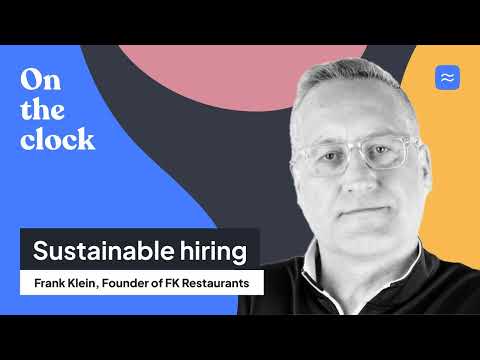

Seasoned entrepreneur Frank Klein shares his perspective on sustainability, and how it applies both to hiring AND ingredients. He also discusses how to find employees that are "bought in" on your company's mission, hospitality trends worth watching, and more.
https://www.linkedin.com/in/frankpklein/
Transcript:
|
Daniel Blaser (00:06): Hello and welcome to On the Clock presented by Workstream. If you care about hiring and retaining hourly employees, you're in the right place. I'm Daniel Blazer, and today I'm clocking in with Frank Klein. Frank is a seasoned entrepreneur in the hospitality space where he has a lot of exciting projects underway. I think you're really going to enjoy Frank's perspective on sustainability, what trends are worth paying attention to in the restaurant industry, how to find and hire long lasting employees that are bought in on your company's mission and much more. Frank, thank you so much for joining me. I'm really excited that you made the time to be on the clock. Frank Klein (00:47): It's exciting. It's like one of your first ones. I'm privileged. I feel great. Daniel Blaser (00:51): That's awesome. Looking at all of your experience, especially founding different hospitality brands, obviously with all this experience and entrepreneurship, there's something really exciting to you about the hospitality industry. Why do you love it so much? Frank Klein (01:05): I've told people my whole career, it's like Showtime, it's like Broadway. It's always fresh, it's always challenging. Every day is new. I mean, you get to get up every day doing something that uses almost all of your skill sets. Urs and entrepreneurs in the hospitality field have to use everything from advertising to marketing, to hiring to HR to operations, to whatever it is. You get to do things differently and you get to do with people that are also passionate about what you want to do. I mean, I always tell people it's like street artist or tags, hospitality always starts out as something and then the journey and the painting and the filling in ends up perhaps something different, but something that you're happy with and that's what gets me going about the hospitality business. Daniel Blaser (01:49): That's cool. That's a cool metaphor to think about. So one of thing kind of stuck out to me. Obviously you've done a lot and you've been involved in a lot of brands, but it seems like something you really have focused on is sustainability and transparency in some of these things in the ventures that you've worked on. Why is this so important within the hospitality industry and maybe why is it so important to you specifically? Frank Klein (02:16): The food and beverage industry accounts for about 70% of the detrimental ecological damage that humans can do, (02:24): And I'll stay clear. I'm not a hippie in any way, shape or form, but I do believe in sustainability. I believe in being able to do things for a profit with sustainability and also an eco-conscious and a social conscious in mind, and I think it's extremely important. It's getting more to be the norm, but whenever we do a concept and we only work with clients that have an eco sense first, whether it's regenerative agriculture or whether it's about landfill diversion rates or whether it's using eco-friendly products that are post-consumer recycled or not using produce out of season, there's so many different layers that are sustainability and eco-friendliness. We also did a lot of work on the National Park Service. One of our clients was the first person to not use bottled water in a national park, and that was in Muir Woods. We simply said to the Rangers, what are your biggest pet peeves? (03:22): And they said, straws, straw wrappers, bottles and bottle caps. So we were able to eliminate those and still make a very good profit for the client and kind of change the course and trajectory of a lot of different concession errors. And I think that's really important, and let me give you one example. Last week I reached out for a new project we're working on to two different people I really respect in the industry and I asked the same question, I need to be printing paper and I need to be printing some boxes for our brand. The first answer was, we can get those made on the other side of the world and it's cheap, it's easy, et cetera. The other answer was Frank, we have post-consumer products that get eco-friendly printed in Dallas, Texas and papers made in the US. Now, that's not a nationalistic thing as much as it is, is an eco-friendly, less fossil fuels and more eco-friendliness. So you can see both sides of the spectrum from people that are very experienced in the industry and you can probably guess which one we're going to go with, but yeah. Daniel Blaser (04:25): Yeah, yeah, that's really cool. Definitely like you said, I feel like there has been a shift, especially last four or five years it seems like, where more people care about that sort of thing. A lot of people, maybe 20 years ago it was just kind of not on very many people's radar, so I think it's cool to prioritize that and it's cool that there are more options to do things sustainably or locally. Talking about some of these trends and the way the hospitality industry has evolved, what do you think is maybe the next trend, and maybe it is the sustainability and transparency like you're saying, but what other kind of trends do you foresee in the near future? Frank Klein (05:05): Well, I definitely like what you said about sustainability, that there's more options and there's more consumers pushing that they want restaurants and bars and everybody to be more eco-friendly and then there's more options. We always were blessed to open up fine dining and fast casuals in the Bay Area 10 to 15 years ago, and it was easier for us to find those products and it was easier to find recycled and landfill diversion items and whatever we put the food in, and now that's one of the biggest trends right now. People want to know are you recycling? Are you using sustainable items? Are you using local farms? Are you supporting local communities? I think local is really big, sustainability is really big and those are going to stay. People want to support locals and they want to know that what you're doing is at least consciously making a better effort to be more sustainable. The other things that we've seen are tighter, smaller spaces. People even in areas where their weather might not be great seven months out of the year, they're still going to be using outdoor spaces more cleverly so people can be outdoors, but definitely tighter footprints indoors. Then the tech sector of course, which you guys are involved in, which is extremely important. Daniel Blaser (06:25): Real quick, talking about this continued local trend that you mentioned, a lot of existing work stream customers, we have restaurant groups and we have franchisers, and we have some people that might be in a position where they can make a difference in some of the supply chain stuff. What advice would you have for them if they're listening to this and they're like, we do need to source more locally, what advice would you have for them? Frank Klein (06:53): Here's an example. I'm going to New York to meet with a very large hospitality group about best practices. I'm looking for them, and I always look for peer groups. What I would recommend to any restaur is don't be above the fray. Talk to your peers, talk to people that you want to emulate. Talk to people that are doing things right because then you're doing this rate convergence of supply chains. So if somebody's doing something really eco-friendly out of Louisiana with a byproduct of sugarcane, BOGOs and making eco-friendly packaging, well the more people that glo onto that, the price goes down, the production is easier to do and it becomes more of an eco-friendly product that's available to the masses. So I would always recommend that people read every publication you can, but also reach out to peers. I'm so surprised with all the respirators that I consult with, that very few have advisory boards or people that are just helping them or people that they can pick up a phone to maybe once or twice a month to ask a question about best practices and with supply chains and where are you getting things and maybe we can get a contract with you and maybe we can guarantee a smaller farmer or a smaller local producer, a smaller venue together we can help smaller venue vendors out. (08:11): So my biggest advice is check out who you think is doing it right. Ask for help, ask for resources, and don't think you're above the fray. There's so many wonderful people out there and so many wonderful organizations you can ask and just sit peer to peer and find those best practices and then lead you to supply chains and lead you to being more eco-friendly and lead you to having the best product you can possibly have. Daniel Blaser (08:35): Yeah, those are some great recommendations. This is definitely one of those places where you get the economy of scale. The more people that work together and demand a certain level of sustainability, all these best practices, it really can make a difference. Every group that joins it just it a little bit more powerful. I guess one question, kind of focusing a little bit on workstream real quick. So obviously we're all about hiring and retaining hourly employees and kind of like I mentioned, we already have the privilege to work with a lot of quick service, fast casual restaurants. For those that have been kind of feeling this labor crunch within the restaurant space, what advice would you give them? I'm sure that you've hired a lot of people for all the different ventures that you've had. Frank Klein (09:24): Well, I would say that first impressions matter, so everything you need to do in the aura and public face of your company needs to funnel to your vision and culture. So we long ago, specifically with Asian Box and with our clients with FK restaurants, we've always made sure that the website, the ads, the first approach, everything is like a seamless kind of branding of your ethos, your culture, and your best foot forward. I think sometimes people are in such a rush to hire people that they don't do the onboarding processes and hiring is different than onboarding is different than training. There's multiple steps to that process to make sure that the right people get funneled through to your company, but everything that you do is trying to attract the person that you want, right? When you're going to go on a dating site, you're going to say what your interests are and try to match those with other people's interests. (10:20): Luckily, I've been married for 25 years, so I haven't done that recently, but that's what it is. You've got to make sure that you're hiring the believers in your company, and what I would really recommend people do is follow that advice, but then also I would pay a smaller team more than have non-believers on your team that need to be worked out and focus on core hours, lose your shoulder hours that you need to be open from 10 to 11 in the morning, maybe at nine to 10 at night, so you can give your quality of life to your strongest people. Run a lean mean team that's paid well and make sure they have a quality and a balance of life. Even if that means shutting off some hours, your revenues are still going to be there because you're going to have a happier and a stronger staff. There's great people out there that are just not the right fit for your company, and you need to have strong management that can weed them out if they're a wrong hire or stop them from getting in the door. There's a lot of great people out there that just aren't the right fit for your business. Don't hire warm bodies. Daniel Blaser (11:23): I think it's interesting the term that you used, true believers or something like that, and maybe that's especially pertinent with some of the goals that we've already talked about that you have, right? You want to hire somebody that does care about a mission focused company. Ideally the people you hire that should matter to them too. How do you find those people? I mean, like you said, there can be good people that maybe aren't the best fit, so how have you personally found what is one way that you can sort through this person is good, but maybe they're just still not the right fit? Frank Klein (11:59): Doing everything we talked about is making sure that the forward face of your company is something that somebody wants to work for. If you keep on reiterating that you're all about sustainability, eco-friendliness, social consciousness, and about treating people right, work balance, you'll find those people coming to you. The average at Asian Box, the average general manager tenureship, except for the two new stores we opened this year are almost four to five years, and so I would say don't think you're going to change the ship right away, but I would encourage every company to meet with all your staff once a week and say, we know there's a labor problem, we know there's a labor shortage. What do you guys recommend? What do you think? Get ideas from the people within your own company and you'll really be surprised about how you can let other people shine, and that's what I recommend is keep your core and grow your core out as a mushroom by giving somebody that maybe doesn't usually get a voice in your company, give them a voice. (12:57): Listen to people that have stuck with you because they believe in you and they believe in your company, and they obviously believe in how you, you're comporting yourself. Pays not the only thing about time off, about hours, about flexibility and schedule. People forget when it gets stressful to talk to your core people, talk to your core people and then figure out what makes them tick and then hire people of the same ilk. At Asian Box, we have a multiple interview process to make sure people are giving consistent answers, right? It's the 1, 2, 3 approach asking virtually the same questions maybe in a different way just to make sure there's great people that aren't the right fit for your company. Hire the people that are great fits for your company, and I think by learning more about your current staff, I think you can actually get your profile of your ideal staff and then your staff by including them. (13:53): I really believe they will help you find the right people because no one right now wants to work with the person that's not going to show up, that's going to be late, that's going to have the drama Ram every day. It's so hard to work in the restaurant business right now. At any stage, they're going to help you get people that are like, yeah, I have my best friend, but they're not a right fit here, but my best friend's cousin now, damn, I would hire them in a second. I drive my wife crazy as I go around and eat out around where I am and where I travel and I go, oh my gosh, I'd hire that person in a second. You can tell right away. You can tell right away, and it is kind of funny, but that's my long-winded answer about look within. There was an old saying on Silicon Valley, one of my favorite shows was, look within Richard. Look within, look inside your company and find your best people and find why they're there and why they stick around and have them help you. Daniel Blaser (14:48): I think that's phenomenal advice and definitely applies to a lot of companies, but especially in the hospitality space. That makes a lot of sense. I'm kind of looking at the questions I had. I think that we've gone through most of those, but I wanted to give you the chance, if you want to kind maybe leave one final takeaway or also talk about what of your mini projects is at the top of your mind right now that you'd want people to check out. Frank Klein (15:16): Well, I appreciate that. So the shameless plug is we're launching Fairfield Drum, which was a transparently sustainable made rum. It's made from products all around the Americas. We trademarked Rum of the Americas. It's a great silver rum that people are going to learn how to drink rum like a tequila, just sit down over ice with a simple garnish that'll be launching in multiple states in a couple of weeks, and we're really, really passionate about that project. We're also in stealth mode on a Mexican startup that we're very passionate about. However, what I'd leave people with is hiring, and I'll give workstream a plug. The more technology and more tools you can have to utilize to take the time off so the people in the front of the house can be in the front of the house and the people in the back of the house can nurture people in the front of the house. From a management standpoint, the better technology is your friend, and you can't be too old school and say it doesn't matter. Technology and hiring, onboarding, training is massively important right now. It gives you the time and ability to focus on face-to-face consumer. Daniel Blaser (16:24): Thank you so much, Frank. It's been great chatting with you. Hey, thanks for the opportunity. It was great. Thanks so much for listening to On The Clock. For show notes and more info, go to workstream.us/podcast. I'll leave some links in the show notes to learn more about what Frank is up to or connect with him on LinkedIn. Until next time, we're clocking out. |
Listen and subscribe
 |
 |
 |
 |