



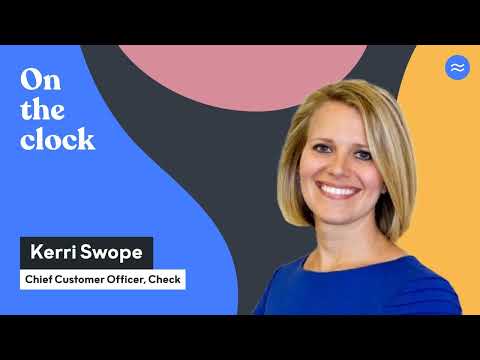


This episode brings you the complete audio from our recent conversation with Kerri Swope, chief customer officer at Check.
We discuss the important features and offerings that all modern payroll platforms should have, despite the fact that many unfortunately don't.
Subscribe to On the Clock: https://bit.ly/OntheClockpod
Transcript:
|
Daniel Blaser (00:07): Hello and welcome to On the Clock, presented by Workstream. If you care about hiring, managing, and paying hourly workers, this is the podcast for you. I'm Daniel Blaser, and today I'm sharing with you the complete conversation I had with Kerri Swope. Kerri is the chief customer officer at Check, and our conversation was all about the four pillars of a modern payroll system. When a lot of people think about payroll providers, modern is probably not the word that they think of and that's what our conversation is all about. We discussed the four things that all payroll providers, especially those that focus on hourly workers need to have. We kick off the conversation with the question, what does modern payroll even mean? Enjoy. What would you say is the distinction between modern payroll and more legacy payroll? Kerri Swope (01:00): Yeah, great question Daniel. So when I think of traditional payroll providers, some of those that I have had the opportunity to work at, typically you think of a offering a one size fits all approach. They're more of a generalist platform and solution. They lack customization to really address the specific requirements of a business like a restaurant or a franchise owner for example. They often are operating in silos and so they require a business owner to have multiple costly platforms, disconnected software systems to really manage the various aspects of their business. So one system for recording payroll hours, one system for actually moving money, for example, another system for filing the taxes. So it all results in really a cumbersome, outdated, and often very manual time consuming solution, consuming a lot of valuable time for a business owner on a day-to-day basis. Whereas when I think of a modern payroll solution, something like workstream for example, it really is tailored for a specific industry and that industry's needs. (02:12): So whether that's construction or household employment like care.com, HomePay, where I previously worked or the restaurant industry or serving small and medium sized businesses instead of large enterprise corporate America. So it really, modern payroll is more tailored, more customized to the unique industries it serves and the businesses within those, it's also more integrated. So your payroll provider with modern payroll really is going to be operating as more in the same platform where you manage a lot of the other aspects of your business so that it is one platform talking to another platform and reducing duplicate data entry needs. So you're not having to put information in multiple systems, you're not having to pay for multiple systems. You can really operate your business all in one place. And then lastly, I would say modern payroll really is simple. It's adaptable. It's not over-engineered, intuitive and seamless, which allows you to minimize time spent managing payroll and your tax compliance needs for your business. It minimizes errors and really minimizes that need for an extensive payroll tax, HR expertise and background. If you're using a modern payroll platform, it should be simple and easy to use and not require decades of experience like myself in payroll and tax to be able to operate and run your business. Daniel Blaser (03:32): Yeah, a lot of good context there. I think it's fair to say, kind of what you said, modern payroll, it seems like it's not one size fits all. It's maybe a more custom tailored solution. It's more smart, a little more efficient, kind of some of those things. So anyway, I'm excited. As we walk through some of these other questions, I think we'll kind of touch on specific examples of what that means, right? Something that's more efficient or smart or whatever. Okay, well what does that actually look like for someone watching this? What does this look like for my business? Exactly. Cool. Cool. Alright, well let's start off with pillar number one of modern payroll and we've decided that that first pillar should be great customer support. Now every payroll provider and pretty much every software company in the world says we offer great customer support. But when we say that, what does that actually mean? What do you think about that, Kerri Swope (04:33): Kerri? Yeah, Daniel, it's something I've built my entire career on and having an entire career of multiple decades in the industry of working on payroll and tax, it just really isn't an industry known for great customer support unfortunately. Fortunately, back to the point I was making earlier, the net promoter score in the industry is on average negative eight. So really telling. So when I think of what great support means, it really is a combination of having business context and subject matter expertise for the unique needs of the business. So from a business context, your payroll provider should specialize in your industry. They should understand the specific needs of QSRs franchise structures, how that translates to multiple locations when you're running payroll and do all of those things without causing disruptions to your business. Things like adding a location or modifying your employee pay because of different shifts for example, should really be handled seamlessly by experts in your industry, which help you avoid delays, make sure your workers are getting paid on time, make sure your employees are getting paid accurately and that you're getting the support that you need from your payroll provider when you need it. (05:51): Many payroll providers are generalists, as I mentioned earlier. They lack that expertise in specific industries. They're trying to have that one size fits all approach, do their wide market spread, and so they aren't able to actually provide that great subject matter expertise and that great business context to what you need. I'll give you a perfect example. At top payroll providers, the average tenure of one of their payroll support specialists is about 11 months. It's a highly turnover attrition industry. However, at workstream, your specialists are an average of 11 years, not 11 months. So they really are able to demonstrate and bring that unparalleled expertise, their dedication to the field, to the industry that you serve. And with that understanding and expertise, they're really able to solve a lot of the complexities that come with payroll in the industry and are equipped to really handle those challenges versus a, like I said, one size fits all solution. (06:53): I'll give you a perfect example that just came up recently. Workstream recently assisted an employer. They came from a prior provider switched to workstream to start handling payroll through workstream, and the prior provider was not a specialist in the industry, and so they had incorrectly withhold withheld social security and Medicare on three different employees. They were students, so they were working as temporary workers during the summer months in between school semesters. And because of that, because of their age, their temporary employment status, the industry that they're working in, those students aren't subject to certain taxes like social security and Medicare for example. And so the prior provider not being an expert in this space, didn't handle it correctly. They withheld taxes from the employee, so the employee's not getting paid what they are owed. Oftentimes in this industry, we're living paycheck to paycheck. That's really important. (07:48): Every dollar matters. And on top of that, the employer's paying more in taxes than they should. And as a small business franchise owner also very important, every dollar matters. And so workstream was able to fix that, correct the information and make sure the taxes are being withheld properly going forward because Workstream has that expertise. They've been in the industry for over a decade with the support team and the support team member was able to catch this right off the bat and fix it. So that's just not the type of experience you're going to get at every payroll provider, but the type of experience, what I consider really great customer support, Daniel Blaser (08:25): It's such a relatable example because it's one of those things where payroll goes wrong like that someone's paid a little bit less than they're supposed to, like you said, the business owner, there's implications there that can really derail an employer employee relationship maybe forever a hundred percent. There might not be any ability to come back from that. So that makes sense. I like that you called out, I wrote down the of the unique needs and challenges of your business is really important, and I think your example definitely speaks to that perfectly. One thing that I wanted to ask specifically about when it comes to customer support is I've heard from different customers that the process of switching payroll is maybe one of the top most stressful things you can do as a business owner. Why is this specific time so important to have great customer Kerri Swope (09:27): Support? Yeah, absolutely right, Daniel. I've done this work myself in my career, so I've hands-on keyboard actually helped employers switch payroll providers, and it absolutely is a mission critical time for a business because you are dealing with people's money at the end of the day. A lot of employees rely on that paycheck to be accurate and timely on a consistent paycheck to paycheck basis. And so when you're working in such a mission critical field like people's livelihoods are on the line, sometimes it's really important to get it right and for it to be a smooth process and legacy payroll providers really have lagged behind in innovation in this area despite some attempts. The reality is is that as a payroll provider, you have a vested interest in making switching difficult and costly. If I believe as a consumer, as an employer, there isn't really a better solution out there and you've made it really difficult for me to switch. (10:30): I'm going to kind of just put up with subpar customer support because of those two things. And so the prospect of that uncertainty and the associated time to actually switch and the effort required by a business tube move, all of that information from one software platform to another just outweighs the perceived benefits that might come with it. So in order to minimize that stressful moment in time as a business owner so that the business owner can ensure those employees are continuing to be paid timely, when they do switch, you have to really make it easy for them. So whereas for many payroll platforms, it can be anywhere from four to six weeks for a pretty straightforward switch, a couple employees, one location, maybe a few payrolls have been run in the year. It can be anywhere to multiple months for more complex businesses with several employees or lots of franchises, for example, to switch software on top of just running your day-to-day business. (11:36): So it's working with people's money, it's time consuming for the employer, so it really needs to be a seamless process, and that's where that customer support really comes into play. Daniel, if I'm going to spend the time and energy, I want to make sure someone's there to hold my hand when I have questions and ideally take the work off of my plate altogether, which if you're switching to workstream payroll is exactly that. It's not a multi-month error prone endeavor. Workstream has built a modern tooling, whereas a lot of other payroll providers haven't done that successfully to enable companies to seamlessly migrate that historical wage data over from one platform to the other and be hands off in the process for the most part. And as I mentioned, workstream has those experts on hand when questions do come up to be able to answer. Daniel Blaser (12:30): Yeah, yeah, A lot of good information. I wanted to ask you, I kind of touched on this before, but every company says they offer great customer support. You go on there, there's some landing page, our support is great, and then when you're asking a sales rep, of course they're going to say, yeah, we have awesome customer support. Okay, so everyone says that. What are some specific questions that a business owner can ask as they're going through the vetting process to kind of weed through, okay, do they actually offer the great customer support or is this just kind of a facade? Kerri Swope (13:11): Yeah, yeah, you're absolutely right. Sales tactics 1 0 1, yes, we have amazing customer support. So the types of questions I would be asking if I were an employer considering switching to a new payroll provider or a brand new business owner who is looking for my first payroll provider are things around, is my support question going to be triaged by an actual human? Is there an actual human on the other end of the phone or on the other end of this email who's going to be assisting me? Or is it ai for example? How long should I expect your support team to take to answer my question or resolve my issue? For example, I might as a business owner get a really scary tax letter from the IRS and not have any idea why I'm getting it, how to resolve it, what it means, and it could impact the success of my business potentially or cost me lots of dollars in penalties and fines if I don't resolve it quickly. And so how long is the payroll provider typically take to resolve something like that? (14:17): When should I expect their team to be online able to support me? As we've talked about muddy movement, mission critical part of being in the payroll business and being a business employer, you want to make sure your employees are getting paid on time. You want to make sure they're being paid accurately. And if a question comes up or an issue inevitably comes up, it's part of the nature of the business, is your support team going to be there to be able to help me at 7:00 PM on a Thursday to make sure that that bank money movement transaction happens when it's supposed to happen and that my employee is going to get paid on Friday, for example? Or does your team shut down at 5:00 PM and I'm left my own devices and trying to figure out how I'm going to get my worker paid, or I might actually lose that employee altogether because they are living paycheck to paycheck and I can't pay them reliably. (15:06): Also, what channels payroll is complicated. Sometimes email exchange is not the most efficient way for a business owner to get their question asked. Oftentimes they don't even know what questions to ask. Do you offer phone support? Are you willing as a payroll provider to hop on the phone with me if I have a question and I need some extra handholding? Or do you only offer email support? Do you offer chat or text, for example? So those are some of the things I like to ask or to recommend to a business owner when they're considering a payroll provider solution. And then I think the other one is really do they specialize in this industry? Do they have deep subject matter expertise like the workstream does on this specific nuanced complex industry that has its own set of regulations and compliance laws to adhere to so that they really are going to be able to have that business context and subject matter expertise? Or does your team have any background whatsoever supporting customers in this business? Daniel Blaser (16:06): Yeah, those are some great recommendations. I love that you call that, especially the availability of support because I feel like it can't just be me no matter what I need help with whatever platform, Amazon, whatever. I feel like every single time something goes wrong, it's like one hour after the support has closed for the day every single time. Kerri Swope (16:28): Inevitably, Daniel Blaser (16:29): Yes. It just feels that way. So anyway, that one spoke to me specifically. So let's move on to pillar number two that we've identified from modern payroll and that is compliance friendliness. So just to recap, number one was customer support. Number two is compliance friendly. Can you give us an idea of what sort of compliance issues might be especially costly for a quick service restaurant or another business that employs a lot of hourly workers? Kerri Swope (17:03): Yeah, absolutely. Running a business with hourly workers regardless of the industry is hard enough, but then you add the complexity of trying to keep up with the myriad of laws and regulations. Every state is different. Every county or city can potentially be different. So it just adds a layer of complexity to being a business owner that your payroll provider really should be able to support you as an employer business owner and take that burden off your plate. So one of the things, especially in the quick service business for example, that we see come up a lot or that I've seen come up a lot, is around the type of workers that they tend to employ. So employees are hourly, so they are non-exempt workers, which means they're subject to overtime or double pay if they're working on certain dates. Every jurisdiction is different. Every state is different in terms of their overtime laws. (18:00): So it's not just the IRS that you have to comply with, but you also have to comply with California state local overtime laws, for example. They're often shift workers. So typically I am working special hours on an evening shift or a weekend shift, and that comes with its own set of regulations that a business owner has to comply with. Or I'm oftentimes working different jobs One day during the week I might be on dishwashing the next day I might be working the front service counter. And so that also requires potentially different pay rates. So multiple pay rates in a single pay period. I might be working at multiple locations and so working for this particular location one day and then the next day working at this location, all of those types of things, especially in this particular industry, come with a set of rules and regulations and compliance laws that you have to adhere to and when you don't, that comes with a cost of penalties and interest that can be really costly to an employer. In addition, it just reduces employee satisfaction if they're not being paid appropriately for the type of work that they're doing. And so high turnover rates can happen, loss of job satisfaction and engagement, and you've spent as a business owner all this time training and onboarding this new hire, finding the new hire and recruiting them in the first place only to then lose them because your payroll provider wasn't there to help you stay compliant. Daniel Blaser (19:29): Yeah, definitely a lot of complexity like you mentioned, I was thinking with your example of maybe you have a worker that splits time between two different locations. If you own a franchise restaurant with two different locations, maybe those locations are in different counties or different, even different states right next to each other. You can just see how quickly things can get so complex. So Kerri Swope (19:56): Yeah, Daniel Blaser (19:56): Definitely some examples that really kind of illustrate that. So with all of the complexity and kind of the risk that comes with compliance, what are some ways that a payroll platform can kind of reassure business owners to feel a little bit more confident? That's like my payroll solution has my back. I don't need to be reading up on the latest in labor laws and all the different regulations that apply to me. Kerri Swope (20:26): Yeah, yeah, definitely. As I mentioned earlier, you should be able to, as a business owner, rely on your payroll provider to help ensure you're compliant, which is also why it's so important that when you are vetting payroll providers, you make sure they have that expertise and specialize in your specific industry. So if I'm a quick service restaurant, making sure my payroll provider really knows the laws and regulations associated with that industry because every industry is different. So your payroll provider really should be guiding you through are your workers independent contractors, are they employees? And what does that mean for you as a business owner in terms of the types of things that you have to do to comply with? Do you have to do I nine verification to make sure they're eligible to work in the United States? Are they assisting you with new hire reporting because every tax agency when you hire a new employee, requires you to report them for unemployment purposes. And if they're going above and beyond, are they assisting you with risk mitigation and management by employing various automated checks for fraud? Are they as a payroll provider helping you as a business owner mitigate any fraud risks, for example, which can be very costly if something like that happens. (21:39): Some providers even assist with assist business owners with tax account management, like, are you getting my unemployment rate directly from the tax agency every year for me, or do I need to keep up with that? Also, very expensive can result in penalties and interest if my tax rate has changed year to year and I didn't realize it because I'm not as a business owner, I own a Burger King, I may not know that Texas, for example, changes my unemployment rate in July instead of the start of a calendar year in January and may not realize that it changed midyear and that I have been underpay. So those are the types of things that I would recommend and I often expect a payroll provider to be helping at a minimum, at least guiding and assisting and educating employers on what to look out for, how to stay in compliance and if they're going above and beyond, like I said, even taking that a step further and doing it for 'em. Yeah, Daniel Blaser (22:34): Great examples. I guess the next question that makes sense. I asked this about the previous pillar, but as a business owner is vetting different payroll solutions, what are some specific questions that they can ask? I mean, you've kind of touched on some of the issues that you could formulate questions around, but what would you recommend As far as specific questions? Kerri Swope (22:58): Yeah, specifics are do you do I nine verification? Will you do complete the new hire reporting? Do you do tax rate exchanges with each of the tax states in tax agencies that I operate within? Will you assist me with registering my business if I hire a new employee in a new state for the first time? Are you completing fraud checks to mitigate fraudulent potential activity? Will you let me know when the state changes and issues a new W four form? That's a real common one that many of us, I filled out a W four when I first started working for tech. I'm not as an employee out there making sure that a new form hasn't come out that I need to now fill out again. And business owners often aren't either. I'm just trying to run a successful business. I'm not keeping up with when the IRS or my state provides an updated W four form. (23:53): So that's a big one that tends to happen. Are you going to let me know when I need to make sure that my bank accounts are funded so that I can make tax so that you're making tax payments timely and filing timely? Are you going to let me know when I need to make sure that the W2 is to my employee every year end so that the employee can file? There's regulations involved with making sure you get that type of information to your workers on time and by certain deadlines, a big one in this particular industry, especially for quick service restaurants or any business with hourly employers is will you tell me when I need to pay overtime or what paid time off laws are in certain jurisdictions where I might employ workers? It varies both on overtime and paid time off regulations from state to state, city to city, county to county. It's a lot to keep up with and when it does, even if you do know it now, it may change in the future. How are you supposed to know when those things change and when you might need to start paying overtime? And so those last two especially are huge benefits that a payroll provider should be helping a business owner stay in compliance with. Daniel Blaser (25:03): Yeah, that's a great list. I feel like we need to type this all out and share this with everyone watching this. I feel like put that up on Kerri Swope (25:13): Your wall. No, but I'm not scared anybody off. No, Daniel Blaser (25:15): No, no, not at all. I think this is going to be very helpful. Alright, I think it's time to move to pillar number three of modern payroll. To recap, number one was great customer support, and number two was compliance friendliness, and I think we determined that number three is user experience. So we already talked about the kind of perception that payroll providers are, I'll say dinosaurs, not user-friendly. Why is a positive user experience so important? Kerri Swope (25:55): Yeah, let's take it on two sides of the house is kind of how I think about it. One is as the business owner or the employer, and the other is on the employee side because it really needs to be a seamless positive experience for both stakeholders. So on the employer side, think about busy. You are as an employer, you have a number of obstacles in your way to making sure you're running an efficient, profitable business in an increasingly intensive complex labor market with rising costs everywhere right now. So you as an employer don't have time and you don't have the margins to really waste on running payroll, navigating complex nuance regulations. You have a business to run. So time is of the essence and time is money. Your time really should be invested in running the day-to-day operations of a successful restaurant, for example, not moving data from one platform to another, double entering data across multiple systems, managing errors when they occur. (27:04): You really want a well-designed payroll system that streamline these processes for you, reduces the time that you're spending on these required payroll tasks and frees up very valuable time to focus on other core business activities. It's also important as an employer from a financial perspective, payroll involves really complex legal regulatory requirements. And so a user-friendly system will help ensure compliance with the tax laws. We were just talking about labor regulations like we were just discussing and reporting requirements which will reduce the risk of errors and then because of errors, potential penalties that an employer might otherwise have to pay. When we talk about the employee side, the flip side of this, some of the features that a user-friendly payroll platform should include for the employee perspective really is especially this generation, I'll speak to work streams, employers and employers in the quick service business or restaurant industry for example, workers expect a lot from their employers. (28:07): They have an expectation of a mobile friendly experience. I want to see my pay stuff on my phone. I don't want to have to log in, I'm busy, I'm on the go. I'm paid hourly. It's important to me. I need to make sure when my paycheck is available, I need to make sure it's accurate and I got paid for every one of those hours I worked hard for and I want to be able to see it on my phone. If I need to make an update, I need to be able like, Hey, I just changed jobs. I have multiple jobs. I need to update that W four we were talking about, I need to be able to do that on the fly. I need to know that you're going to support my flexible work arrangements. I work at multiple Burger Kings, multiple smoothie kings, and I need to know that you're going to help. (28:49): I can manage my shifts and see my shifts, for example. So current systems really are prohibitive to providing an experience like that at scale at most legacy payroll platforms. And what that means is you could potentially end up losing employees that you invested heavily in as an employer into the hiring and onboarding and training process just to disappoint them. You don't have these types of features that they're expecting and looking for or a payroll experience that their peers might be benefiting from because they are on workstream payroll. It really is just a fundamental aspect of the employer employee relationship, to be honest, at its core. And so a seamless user-friendly payroll system ensures that those employees are not only paid accurately and on time, so they're more satisfied, happy employees, but they're also more likely to stay. Daniel Blaser (29:40): Yeah, I think in what you were saying, the thing that really stood out to me is your payroll solution that you choose, it ultimately becomes a reflection of you as a business owner, your employees. They're not necessarily going to be like, oh, well it's not my employer's fault that this is such a bad experience. They're kind of going to lump the whole experience in with their experience as an employee. The other thing that I was thinking of that's kind of interesting is when you're vetting a payroll provider, you're ultimately, it's like, well, I'm choosing someone that my employees are going to interact with maybe more or just as much as any other technology for my business. Hiring software, your employees, they go through that process, they're onboarded, and then that's kind of probably it. But like you said, every week potentially they're going Kerri Swope (30:40): To, Daniel Blaser (30:40): Or every day or every day, for some businesses, they're going to interact with this solution that you choose in some way. So it's really important to make sure that that is not a bad experience. It could kind of be a death by a thousand cuts thing every single time. It's like, oh, I have to log in. Oh, it's telling me I have to use my desktop computer or whatever it is. That could be very jarring if you're an employee having to do that over and over again. Kerri Swope (31:08): Exactly, exactly. Daniel Blaser (31:10): Alright, so you kind of touched on this a little bit, but I wanted to just dial down a little bit more. What are some risks that come with an overly complex system? Kerri Swope (31:27): Yeah, it's funny. So leading our operations teams check, I think about this in a myriad of ways, not just being a payroll platform, but also if I am for my own teams thinking through is it over-engineered? Did the product make it harder than it needed to be given the size of the business of check, for example? And so I think payroll providers, same situation. If I'm a small business owner, if I have one franchise, for example, a Chick-fil-A and I don't have hundreds, or even if I do have hundreds, how easy is this built for what my needs are as a business owner? So really an overly complicated payroll system that wasn't built to custom needs of running the particular business or the particular industry that I'm in can lead to errors in accuracy to start. So complexity increases the likelihood of those errors in payroll processing such as incorrect calculations or mis deductions or data entry mistakes. (32:30): And those errors can lead to compliance issues, financial penalties, and as we were just talking about Daniel, employee dissatisfaction. It also can to a time and resource drain. We talked about that a little bit and hit on that a second ago around running your business should be your core focus, not running your payroll. Running your payroll should be easy. And sometimes these overly complex payroll systems that weren't built for your unique business needs can be draining from a time and resource perspective for both employees and employers. So managing that complex payroll system, it's not streamlined, it's not seamless, it's not integrated with your other systems, requires significant time, requires resources, and requires expertise. So I find running a franchise quick service restaurant, I probably don't have 20 years of experience running payroll and being an HR expert, I have experience running a business. And so I shouldn't have to have that type of experience being an HR payroll tax expert in order to just run my payroll and make sure my employees are getting paid timely. (33:41): And so in that case, employers oftentimes may spend excessive time troubleshooting issues or reconciling discrepancies or mainly processing payroll tasks because they don't have that expertise and the system's too complicated. And then on the employee side, the employee dissatisfaction, it can lead to payroll errors, delays in employees getting paid, excuse me, or inaccuracies caused by the complexity, which can erode employee trust and confidence. As you mentioned, Daniel, as an employee, I don't think of the payroll provider out there. If my payroll's not right, I'm going to the business owner, I'm going to my employer and going to them and saying, how come you didn't pay me correctly? I'm not going, oh, it's okay. This payroll provider that we used just messed something up or didn't make it easy for me to enter your time properly, for example. And so employees may become frustrated with various payroll issues, which can lead to turnover, for example. (34:40): And then the last thing I'll just hit on is just the increased cost, overly complicated payroll systems, they're not built for your business needs. So you often are paying for things you don't need for features you're never going to utilize to run your business on a day-to-day basis, which means you're managing and maintaining a complex payroll system that requires additional investments in software that you're not using, training that you may never need, and support services that really aren't meeting your needs or providing really great service like we talked about earlier as well. So that can kind of all escalate add up over time and end up being very costly for an employer who just needed something simple to run their business. Daniel Blaser (35:23): Yeah, there's definitely a lot at stake, I think is to summarize all that you've shared there. Alright. I think we've made our way through the first three pillars of modern payroll. Just one more time recap. Number one was customer support. Number two was compliance. Number three, user experience. And number four, I feel like this has been sprinkled throughout, but we wanted to make sure that we called out the fourth pillar is choosing a provider that's really geared toward your specific industry. It's not just a one size fits all. Now, once again, you've kind of spoken to this a lot, Kerri, but let's just really succinctly say why is this something that matters so much? Kerri Swope (36:11): Yeah, yeah. It's a great final point to make. Daniel is, your payroll provider should not be confused by the type of business that you are running. They should know the ins and outs of QSRs, of franchise structures, of multiple location payroll runs, having workers at different locations in different regions in the same pay period. All of those things should not create hiccups or painful moments or costly penalties for you running your business as an employer. Running a business, as I said earlier, is hard enough. Trying to keep up with the myriad of compliance regulations should not add to that complexity for an employer. And it's often area where if you do have a payroll provider who really does specialize in your industry, they can and should support you as an employer and take that burden off of your plate, not make your job harder. Daniel Blaser (37:05): Yeah. Now, one question that came to mind as you were saying that there are certain payroll providers that are kind of the most popular, the ones that maybe a lot of people think of when they think of the concept of a payroll software. What are those industries? Which industries are those providers typically built around or what are they most represented as far as, I'm guessing it's probably not quick service restaurants, so yeah, I'd love to know, do you know which are the other industries that they're typically more represented by? Kerri Swope (37:41): Yeah, yeah, you're right. It is not quick service restaurants. Think about your largest employers from a centralized standpoint. So healthcare workers for example, and white collar desk workers. So desk-based employment often is where most of these larger payroll providers who've been around for decades focus government workers, for example. So often where there are not hourly wage workers, non-exempt workers, it's more exempt based. You don't have the complexity of overtime regulations in that regard. You don't have the shift differential issues to deal with. You oftentimes don't have the multi-location concerns, varying jobs and responsibilities and varying pay rates associated with those varying jobs in a payroll. And so those largest employers, those typically, they aren't tailored. They don't need to be tailored. I'm salary, I'm exempt, I don't have a lot of complex nuance payroll regulations to comply with. And that's why a lot of these larger, more popular payroll platforms have been able to sustain for decades without innovating. It's more generalist, it's more one size fits all as we talked about. And so I don't have to support all the complexity that a quick service restaurant requires, for example. So I would say that's probably where a lot of the industry focus is geared towards, like I said, desk-based workers, government, healthcare. Daniel Blaser (39:26): Now, in terms of those businesses that employ a lot of hourly workers, quick service restaurants, et cetera, what are some specific features or functionality that you should be on the lookout for if you're trying to avoid the one size fits all you think of in terms of your vetting, different solutions going to their website, what sort of bullet points should you be looking for to make sure it's like, no, this business understands what I actually need with my hourly workforce? Kerri Swope (40:00): Yeah, yeah. The things I would hit on are features around faster payroll. As we've talked about. These are hourly employers or employees, excuse me, they're often living paycheck to paycheck. And so does the payroll platform provide next day pay? For example, can I work a set of hours today and be paid for those hours tomorrow? As an employer perspective, how many payroll runs? A lot of these legacy platforms are more standardized, and I run payroll once a week and I have to make sure I get all of my employees in that payroll run once a week. Otherwise you might charge me more or I have to write it, do the check manually instead of direct deposit. So unlimited payroll runs are really important in this particular industry with hourly workers ability to pay hourly employees at any combination of workplaces. We've talked about the need to be able to support multiple work locations, so any combination of earnings because as I said, worked as a dishwasher one day, worked the front service, counter the next, and worked in one location in one city one day, and then another city and location the next. Can you support that? Custom earning codes and earning rates is another one that I think is really important for these hourly workers as well. (41:24): And then from another, just last one from an employee perspective is how much work is there on me as the employer to make sure when I hire new employees, a lot of seasonality happens, A lot of temporary work. We talked about the student employee earlier example. I'm bringing on lots of employees in the summer months who are often students and they come and go after three months. Am I as the employer having to do a lot of that employee onboarding or do you as a payroll provider help with that or do you give the employee a way to do it themselves? So those are a handful of things we haven't touched on yet that I would call out. Daniel Blaser (42:03): Yeah, another great list. I think maybe print out a second one and put that on the wall too for things to remember. Kerri, thank you so much for sharing all of your knowledge and your expertise today. I think I'm speaking for everyone that's going to be watching this. I think this has been very, very helpful and especially appreciate all of the specific examples of things people should be looking for as they're vetting their payroll provider to hopefully if some people watching this aren't that satisfied right now, they can get to a better place and find one that's more of a partner, like you said. I just wanted to give you the opportunity with all those people watching this. Do you have one final takeaway recommendation or one final thought? Kerri Swope (42:54): Yeah, Daniel, thanks so much. Really appreciate you having me. Like I said, hopefully this is helpful and I haven't scared any employers off from trying to handle the nuanced compliance and payroll regulations that impact their business. Hopefully they don't. That's not the main takeaway after seeing this. It's more so there are better solutions out there, whereas maybe five to 10 years ago there weren't. And if you find the right payroll provider to do exactly like you said, be your partner as opposed to a vendor and just a transactional relationship, it really can be a game changer for your business. And it is worth it. And it's worth it because you will get better support. They payroll providers like Workstream exists now. They didn't use to exist before. They're providing really amazing, phenomenal support and doing it in some game changing ways that make it not painful to switch. So there's better out there. So have faith and it doesn't have to be as complicated as it is today. Daniel Blaser (44:09): Thank you for listening to On the Clock. For more info, visit workstream us slash podcast. I've included a link in the show notes to connect with Kerri on LinkedIn and to watch the complete webinar from which this audio was taken. Until next time, we're clocking out. |
Listen and subscribe
 |
 |
 |
 |