



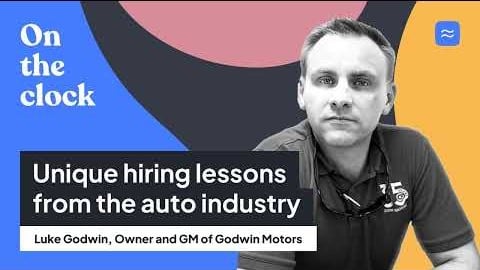

Today we clock-in with Luke Godwin, Owner and General Manager of Godwin Motors in Columbia, South Carolina. Luke discusses the hiring and retention challenges he's faced, and the important lessons that he's learned along the way. Anyone wanting to improve at hiring and retaining hourly employees—whether you're in the auto industry or not—will appreciate Luke's unique perspective.
https://www.linkedin.com/in/luke-godwin-934767169/
Transcript:
|
Daniel Blaser (00:05): Hello and welcome to On the Clock, presented by Workstream. I'm Daniel Blaser and if you care about hiring and retaining hourly employees, I think you're in the right place. Today we clock in with Luke Godwin. Luke is the owner and general manager of Godwin Motors in Columbia, South Carolina. Luke and I chat about some of the hiring challenges his dealership has faced over the past couple of years and the most important lessons to come out of them. I think anyone who wants to improve in hiring and retaining hourly employees, whether you're in the auto industry or not, will appreciate his unique perspectives and takeaways. Enjoy. Awesome. Luke, thank you so much for chatting with me today. Luke Godwin (00:47): Yeah, not a problem. Glad to be here. Daniel Blaser (00:48): Can you just start off maybe by summarizing some of the staffing challenges that have been experienced by the auto industry over the last 12 to 18 months? Luke Godwin (00:59): Yeah, I mean, I had actually a vendor sitting in my office today and we were talking about the challenges that we've had at our dealership. And this guy was a warranty company, works for a big warranty company. And what's funny is they've had the same challenges. And so if we go back to when Covid started in March of 2020, we were all just running scared. And so we made a really conscious effort not to fire any employees, work with them, try to figure out what's the best way going forward, and we actually got a pretty good feel for that for March, april, may, and then it just kept dragging on. And so we figured it out. We said, okay, we're going to lock the door. We're going to make everybody comfortable if you have to work from home one day, if you don't, no problem. We're going to make this work. And we did and we worked with people and we had one of the most amazing times in our industry from April of 2020 to April of 2021 was our best 12 months ever. Daniel Blaser (02:02): Wow. Luke Godwin (02:02): We didn't lose any staff, we kept plowing ahead, we were just killing it. And then May of 21 happened and what nobody, I guess if you look back now, you could maybe see it starting, but everybody got comfortable with Covid, right? And then people said, okay, well I can make a little more money doing something else, and next thing you know, people who've been with us for five years, we'd never thought would ever leave. All of a sudden left and it happened with one person and then we'd had the same five technicians we'd had forever. And then one of 'em comes to me and says, Hey, I can get a job somewhere else making more money. And I said, well, I don't see where I can pay you any more money with the amount of productivity you're giving me now. So if they're going to pay you more money, you need to go. Well, that started an avalanche because it was the first one that happened and it happened I think June of 21. Well, I lost my season five techs within two months of each other. I mean just boom, boom, boom. And I figured, no problem. We'll just hire new techs. Well, we tried and we tried and over the last 12 months we've hired, now we're at about 20 technicians cycling through and we only have three. (03:30): And it's been tough. And so it is just been a really, it is not just the technician side, it's the detailers. I mean honestly, it got to the point where we couldn't have salespeople because all the new car stores needed salespeople and they were paying way more money and it just got really crazy and our income has gone down because of it and our cost of salaries has gone up about 40% during that time. Daniel Blaser (03:58): That's kind of the challenge as far as retention and being able to staff back up maybe previous to workstream, how did those hiring efforts kind of fall short? Luke Godwin (04:09): I tell you, it fell short because we were spending so much money advertising on one platform, and honestly as a small business it was hard to compete on that platform. For one, we couldn't put the amount of money into the ad on that platform to get as much attention as some of the bigger players in our field. And honestly, we just don't have the options to give employees that big corporations have. And so prior to workstream, we were spending money uselessly and we weren't attracting the right talents, and so that's where we were falling short. Daniel Blaser (04:53): Yeah, that makes sense. I know that you haven't just stuck with your existing strategy, however that you've been adapting and changing in order to meet some of the challenges of the hiring market. Can you talk a little bit about what your routine looks like and how you have evolved? Luke Godwin (05:09): Every morning we look at the resumes and we say, okay, is this person good? Is this person not good? And if they have any ounce of what we think will work, we will text them immediately through the platform and get it working. And I think that's changed our daily routine when it comes to hiring. Daniel Blaser (05:26): I liked two things that you said there. One was just kind of having this always on process, and we've heard that from a lot of customers. It is like, yeah, it's been really hard to hire, but it's also kind of emphasized the fact that it shouldn't be like this. Now we're hiring, now we're not hiring. It really is kind of an always on muscle that you almost have to build. But then also you talked about the importance of speed, which is obviously kind of what we're all about is you understand firsthand you have to move quickly if have someone that's interested, if they're interested, they're interested maybe in someone else too. And so it's all about that speed and being able to reply quickly. So I really like that you pointed those out. Luke Godwin (06:07): In the car business, we talk about a speed to lead, and so the faster we can get to that lead coming in, the faster we can sell them a car. Right now we flip the page, so now it's us being a speed to an applicant. And so yeah, that is crucial, really crucial. And I mean just always being on hiring a new concept for smaller businesses. I think that if you've never had to do it before, because before all of this, we had 2022 employees and we weren't really worried about them leaving or if we were worried about 'em leaving, we were the ones that were going to make 'em leave. So we always could prepare ahead of time, but now somebody could walk in today into my office at five o'clock and say, yeah, this is my last day. And I go, oh gosh. So we've got everything packaged and out there. We're always looking for great talent. Daniel Blaser (06:59): That speed to lead thing that makes so much sense. When you think about when somebody is ready to buy a car, it's a pretty big decision really. And so you're right, it is similar maybe to somebody that's looking for a change in their job that is a very similar kind of frame of mind I guess. And so that speed makes a lot of sense. What advice would you give someone else in your similar shoes who's maybe also struggling to hire hourly employees? What advice would you give them? Luke Godwin (07:32): What we talked about earlier? Always be hiring, develop that process of hiring and make it a part of your daily activity that's going to help you more than anything, have a process. When it comes to interviewing, we do a phone interview, then we do an in-house interview, and then if we really like it, we bring you back for a work interview. And we've seen that. That really helps out a lot when it comes to verifying someone has the skills and they fit into our culture to want to work here. And you also, you got to look at what you're paying people. Like I talked about earlier, we got caught with our pants down because we didn't realize the economy took off as fast as it did. I thought it was going to maybe take off a little bit and dip. Well, it took off and hadn't really slowed down a lot. So you need to look at what you're willing to pay people, look at what other people in your area are paying people, and you've got to make sure that you're competitive. If you're not competitive, you're not going to hire anybody. Hourly employees are different. Maybe you need to guarantee them a certain amount of hours. I know that some places, if you're not willing to give somebody 40 hours a week or 35 hours a week, that might be what they're looking for. So if you're saying, if you promise 'em 40 and next thing you know they work 20 hours, that's going to frustrate 'em. They're going to leave guarantee people good hours and good pay and treat 'em professionally. And I think you'll be able to hire who you need to hire. Daniel Blaser (09:03): Those are really good suggestions and they definitely make a lot of sense kind of beyond the pay and the guaranteed hours, which I think is really important. Have you found any other perks or benefits or anything else that have been attractive in making the difference in convincing people that your dealership's a great place to work? Luke Godwin (09:22): Yeah, I mean, one of the big things we found that when we really were struggling to hire certain really skilled positions was we would ask them, what don't you like about your old job? And one sticks out to me was, well, I don't get home to see my kids until seven o'clock at night and I really want to be home at five o'clock. So I said, that's not a problem. You can leave work at this time. So working with them on their hours is a big deal. Make it flexible. Be flexible on when they have to be there. If they only want to be there until four 30 every day, well start 'em at seven 30. If you need a certain amount of hours, figure out what works for them. Because if you can do that, you can really hire some really good talent away from other places. (10:10): And this one, in the car industry, this is probably sacrilegious, I probably shouldn't say it, but don't work Saturdays, don't work your people to death. If that means you've got to stagger your schedule so that you have people working five days and moving around a little bit, you can do that. But five days is enough for everybody. And so working five days don't working six days, and if you can close your whole operation on Saturdays, I recommend you do it. It is something we did in Covid in June of 21. I said, well, we made it through Covid with not work in Saturdays. No, we don't have enough staff to work Saturdays, so we're just going to close on Saturdays. And it was a wait lifted off of everybody's shoulders, everybody relaxed and I think people need to be with their family and have joined their life. So I think that's a big thing. Daniel Blaser (11:03): Yeah, I love that. And like you said, you still did really great sales wise, so hopefully it all kind of came out in the mix and it doesn't sound like it was too big of a sacrifice to do that, which is great. When it comes to retaining employees, have you found that there are specific benefits or specific things that you can offer that will increase the likelihood of employees sticking around? Luke Godwin (11:29): Number one, I think it's pay and it's evaluating people's pay yearly and not waiting for someone to come to you to evaluate their pay. Once they do that, they might already been looking. So make sure that you're evaluating what people are making, making sure they're making what their peers are making in their industry. Pay women what you're paying men. I think that's a big deal that goes there too. Whenever you can make sure you hire as many women as you can. And with that comes a different culture, making sure that you build a culture where nobody wants to leave. And that's sometimes easier said than done, but if you got somebody running your culture, you got to get 'em out soon too. So make sure you have a good culture and you keep it that way and give 'em the time off they need. And that's a big deal. More time they have and the more flexibility they have, the better off. And I'm not advocating for working from home because I don't really like that, but if they need to work from home for a day or two, then make it work. Daniel Blaser (12:25): Yeah, those are great tips. I mean, I think of a lot of what you're saying comes down to that work-life balance, not being so rigid, giving people the space to live their lives and then most of the time they come to work more prepared and ready to do their job. So I definitely love all that you're saying. Luke Godwin (12:42): Well, thank you. We are still struggling, but hopefully we get a hit soon. Daniel Blaser (12:46): One question I wanted to ask, why do you personally take pride in your work? Why is the automotive industry a great place to work? Luke Godwin (12:54): It's ever changing. New models are coming out now. We've got new technology coming out, EVs and each car has its own sound. Each car has its own feel. I can close my eyes and listen to four cars start, and I can probably tell you what four cars they were. It's Americana in my opinion. Cars are great, automotive industry is great. You get to meet new people each day. It's not only new customers. You get to develop relationships that can last 10, 20 years through multiple generations. So that's really what I see in the automotive industry compared to other industries. I'm sure other industries might be like that, but that's how I feel. Daniel Blaser (13:40): I think that definitely resonates with me. Most people want to be loyal to a dealership, but it's like maybe they haven't found the opportunity yet. And so I think it is that nice reciprocated relationship that I definitely have experienced that Luke Godwin (13:54): It's like having a dentist. It's like having a dentist you want to go to, right? Nobody likes the dentist, but you got to go to 'em every once in a while. And so it's creating that trust between each other. And then if you don't have a good car dealership, you need to find one new service department and car dealership because that will change your total mind when it comes to how you buy cars. Daniel Blaser (14:13): Thanks a ton for sharing your story. It was great. Luke Godwin (14:16): Alright man. Daniel Blaser (14:23): Thank you so much for listening to On The Clock. For show notes and more info, visit workstream us slash podcast. I'll also include a link in the show notes to learn more about Godwin Motors. If you're in the Columbia, South Carolina area and looking for a great employer or a great dealership, I definitely recommend them. Until next time, we're clocking out. |
Listen and subscribe
 |
 |
 |
 |