



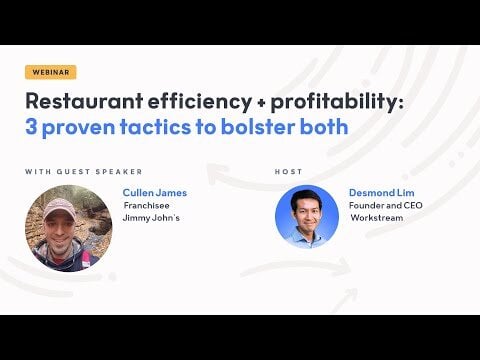
Restaurant efficiency + profitability: 3 proven tactics to bolster both
- Home >
- Webinar library >
- Restaurant...

Get the latest with Workstream
Always stay current with hiring news by subscribing to our email updates
Don't miss this webinar with Jimmy John's franchisee Cullen James, Workstream CEO Desmond Lim, and Workstream Product Specialist Joelle Schmeltzer!
Beyond tackling your questions, they'll discuss:
- Proven ways to improve operational efficiency
- How automation is the key to saving on labor costs and beating the competition
- How fine-tuning your hiring and onboarding process can save time and money
Transcript:
|
Daniel Blaser (00:00): Cullen, would you give just a quick introduction? Cullen James (00:04): Yeah. I have a two unit franchisee for Jimmy John's. I've been operationally with Jimmy John's for over 20 years. I've been a franchisee for about eight and a half years now. Daniel Blaser (00:17): Awesome. And remind me where your locations are. Cullen James (00:21): We're in northeast Tennessee. Johnson City in Kingsport. Daniel Blaser (00:25): Awesome. Well cool. We're super excited to hear more about all that you've learned over these years and hopefully share some tips and tricks. Joelle, can you give a quick intro? Joelle Schmeltzer (00:37): Hello everyone. I'm Joelle Schmeltzer. I'm a product specialist here at Workstream and my whole role here at Workstream has really been payroll focused the past year. Now it's crazy to think we've come so far. So I basically work with our customers to figure out what we need to do better with payroll, how we can create the best experience for you all and ultimately just have a really good product for you. Daniel Blaser (01:02): Cool. And like Joelle said, I think one of the reasons we wanted to have her participate today is she's spoken with a lot of workstream customers so she can relay the things that she's heard, the things that are working, maybe the things that are not working that people have learned along the way too. So really excited to hear that perspective. And then last but definitely not least, we've got Desmond Lim. Desmond, welcome. Could you share a little quick introduction? Desmond Lim (01:27): Yeah, thank you so much. I been very, first of all, thank you so much Cullen for being here and also thank you Joelle and this Daniel. So I am one of the founders for the team. So I actually founded my first business right after high school. It was this Thai food restaurant. So I have actually been in this space now for really 10 over years and I saw a ton of gaps and prompts in this space. That is why me and my team came together to really solve this problem, to really offer payroll, HR, and this hiring all in one place to help many business owners out there. As of today, we partner with more than 40,000 stores of clients from this Jimmy John's Duncan Ace Hardware and more. And we have raised more than 120 million in funding from this founders fund, from Mark Cuban, from the CEO of Zoom and more so very humble to be here today. It is going to be a very fun day today to kind of just talk with Cullen and this Joelle. Thank you. Daniel Blaser (02:36): Awesome. Well thank you. I am going to turn off my camera, but I am around and like I said earlier, I'm going to be watching as questions come in. So please, once again, as you have any questions that come to mind about anything that's being discussed today, please share those. And with that being said, Desmond, I'll let you take it away. Desmond Lim (02:54): Thank you so much Daniel. So I was just jump right in. First of all, I must say that I'm a huge fan of this Jimmy John's is really one of the first grand that as a company that we have ever worked with. I love the food, it's so awesome and it says everything that is always so fast. It is about speed, it is about trying to really move quickly. So maybe the first thing for Cullen to ask is really jj, truly it is one of the few brands that focus on speed and faster. Why is this Operation EFI should see so core to the brand and also for you as this owner for your two stores, right? Can you share a bit more about that? Cullen James (03:34): Yeah, I mean the speed efficiency does differentiate us from other brands with everybody delivering now through DoorDash and Uber Eats, at least in our stores, we are doing some third party delivery on Uber Eats, but we our owned channels for orders whenever they use our platform, the Jimmy John's website or app to order or calling into us, we try to get them to 'em as fast as possible because that'll be the other times because we don't have any cook time for our sandwiches, so just all cold sandwiches. So I mean that helps us execute our speed, but just the training and everything that we put into it, just trying to be able to make the sandwiches in 30 seconds helps differentiate us. You can get those pickups or the people that walk in the door just in and out now as quick as we can. Desmond Lim (04:35): Awesome. That is so great. Thank you for sharing and maybe trying to build on that, right? I have very often heard from other owners when you move from one to two store, that is a pretty big jump because when you're one store as the owner, you can be in there every day or even every other day and you can just see so much. Can you talk a bit about when you jump from one to two store, why is that focus on this operation iffy should see even more key, right? It's even more crucial to lean into that. Cullen James (05:08): Yeah, we actually started with two stores. We bought two existing stores, so we haven't opened up one yet, so we started that with two. But like you were talking about, I can only be in one store at a time. I can't be in both at the same time. So just making sure that we have good leadership, it does follow the systems and procedures and that we're able to train in the proper ways that we make the sandwiches so that we can get everything done efficiently. But yeah, just the training is the biggest part of that. Desmond Lim (05:47): Awesome. Super helpful. Super helpful. And maybe next I'd like to turn it over to my teammate Joelle, who really, she's awesome. As you have heard from over the past year, she's been really focused on trying to serve our clients who use payroll, HR and more. Really our clients rave about her so much. She is really a good case of this company value. Everyone does customer success, which I feel it is now a very key strength of our team. We really pride ourself in really putting our clients first. So maybe my question for you Joelle, is how does Cullen's point of view align with what you have heard from some of our other buys? What are the most common strategies and tactics to increase this operational ency? Joelle Schmeltzer (06:39): Yeah, great question. I think going along with what Cullen just shared, he can't be in multiple places at once. We haven't figured out carbon copying yet, sadly, to where it just is going to get more difficult when Cullen decides to have more stores, especially the further they're away. It's harder to manage, it's harder to do all of that, especially when you have different softwares. I think a sentiment that a lot of my customers have shared with me is they're ultimately wanting one software that really can do everything. Now in this current day and age, a lot of companies are getting close, but we're not quite there yet. And I think Workstream is definitely on the fast path to that to where it's really providing a great, really outstanding hiring solution. We're really helping provide an employee onboarding process for everyone as well as payroll and more. I think that goes along with training is so crucial. Sometimes you have people that are starting their role as a manager or assistant manager and you have to really onboard them quickly to where having simple solutions for them can make the process really easy. So I think having an all-in-one solution really is what customers are wanting because it makes everything a lot easier. You don't have six different logins, it can just be one centralized place, especially as you're planning on growing your company. Desmond Lim (08:01): Super helpful. Thank you so much. That is very similar to what I hear from our clients every day, every week. I'm just so close with clients. I just came back from this conference in this la, I was at this California restaurant association for a day and I met with hundreds of owners and I'm hearing some of the very same things that you were just sharing and maybe next question over for this car and what was something that you did that make a big difference in terms of trying to boost your company's operational? Iffy Cullen James (08:38): With workstream, like Joelle was talking about keeping everything in one's place that really helped us. And then the whole, whenever somebody applies it being automated that you guys will have it set up so that we can send them messages as soon as they apply to begin the process of getting them scheduled for an interview. We have a couple of things, like for the drivers, we have them submit a picture of their license and insurance before they can schedule an interview, but that's helped a lot. And then after the hire, the onboarding process, we have all of our employee handbooks, our dress code work rules, and then for our drivers, our driver agreements, even the forms we have to have signed for the health department, we have all that as part of the onboarding through work stream. And then after that part, even into payroll, it's all automated. Once they fill that, their employee handbook out sends 'em the payroll link to fill out their W four and the walkie info. Desmond Lim (09:54): Very helpful. Maybe I'm going to maybe double click on that. What I just asked you, maybe something more is I'm curious to learn from you prior to switching over to this work streams or all in one, what were you trying to use prior to that? It sounds like you used quite a few things to sign. Cullen James (10:16): Yeah, it was all like paper. We had a folder that they would come in and sit down and fill all that out as far as the onboarding process. And then for payroll have to take the W four that they filled out and then manually enter those into our payroll system. But then with workstream we have all of our employees are direct deposit now, so we don't have any physical checks that we have to be shipped in or print off. So that makes that process even easier for us. And then the carriers UPS or FedEx, again, they've been known to lose the paychecks so when we get paid on Friday and they'll show up on Friday the earliest that they're coming in on Monday and nobody's happy about the checks being three days late. Desmond Lim (11:09): So helpful. Thank you for sharing that. It sounds like that was a pretty, I'm truly seeing how being able to put all of that in the same place can be very helpful for you. Thank you for sharing that. Maybe next I'll turn over back to Joelle who we talked to so many clients. As you all know with payroll, there's no room for this errors, everything must be correct and because of this, many companies who even rather a stick with what they have, even if it's not as good, but based on what you talk to really many of this clients, what convinced them to make the switch over to this work stream, right? Was the work worth this socalled longer term benefits? Joelle Schmeltzer (11:54): Yeah, this is actually something I love talking about. I think my favorite is always to talk to people who haven't committed yet just because you can really see their confidence boost when I actually talk to them candidly about it. So I see it over and over again. Customers get super freaked out about payroll. I understand it's a big thing to switch, especially when you can't not pay employees or you're not going to have employees, you need to make sure they're there. You can pay them, they'll be happy so they can continue to work for you. So in that case, usually I just talk about what does that migration look like? How easy really is it? So basically when you're starting with workstream payroll, there's going to be some pieces of information we just need to set up your company. With that being said, how we actually migrate your data from a previous payroll provider is pretty streamlined. (12:50): It depends on what previous payroll provider you had, but what we ask is that you provide or you just add us as a user on that existing software that way we have a dedicated migration team who they are the experts. They do it over and over again every day where that will give them the ability to log into your existing payroll account. They're going to migrate all of that pay history, all the payroll data that way it's all of the current year up to date. And what's really nice is they even have an audit process so you don't have to rely on human error. You'll have the ability to review all of the information, but they also have people in place within their team that will ensure that all the information was pulled over correctly. The timeline is figured out within the first two days when we submit that information to the team so they'll be able to say, Hey, it's going to take 10 business days to set up your account for payroll. (13:42): It's pretty quick. It's not normal for a lot of companies, but we again want to provide the best experience and make the easiest way to switch. And then sometimes, depending on complexities, the size of your company, it might fall into a longer timeline, which would be 20 business days after it's set up. You actually have a dedicated implementation rep this whole time they're able to help set up other products with you, but they're also ensuring the success of payroll. One thing I say is our ultimate goal, something that I take a lot of pride in is we will never hand you off to someone else until you've run two successful payrolls and you feel confident. If you don't feel confident, we're going to make sure that you continue to have a rep. I've had some customers, they haven't had the best experience with their previous payroll companies. (14:31): They really feel valued when they have someone they can work with. Sadly, I've had a customer share that they were like, I don't even think that payroll person I talked to was even real. I thought it was this different person every time. And I was always in the boat of we can hop on a call, we can figure it out together. And the best part is if you ever have questions, we have payroll dedicated support, so payroll experts within our support team that can make sure you get immediate answers as well as you still have your implementation rep. I think Cullen's the perfect example. I'm still working with Cullen to make sure we can make the process easier. It's not something where Cullen's ran payroll twice, I'm just passing him off to someone else. I'm going to stick with him to make sure I can help answer any payroll questions. So we have a lot of processes in place to one, make the process easier, but ultimately just create the best experience for you. There's always nuances and so that's where one thing that I've really tried to instill in the implementation team is just have the discussion about it. We ultimately would rather do more work than you needing to do, especially if you're making the big decision of switching payroll companies. Desmond Lim (15:41): Awesome. That was awesome. Thank you so much for sharing that. Draw. Maybe a quick follow up for this, Carlin, as you have tried to consolidate your platforms and really revamp this payroll, how have that helped you to be more competitive as this business? Because we all know costs and labor costs and also having good software that's so very crucial, so very keen to learn from you. How have they helped your running of your business? Cullen James (16:19): On the payroll side, it's made me more efficient because I'm not typing in everybody's, I'm not manually inputting everybody in the payroll so I don't have to type in the w fours and if I can't read something, I got to track down the employee to make sure that I enter in everything incorrectly. They type everything in and we do E-Verify, so we just have to verify their documents. So then I just click a button and hit create so I don't have to go in out to the E-Verify website and log into there and then create the cases on there. And then as far as hiring goes, just the automation whenever somebody applies, starting instantly making contact with that person right after they apply because if we're busy in the store during lunch, it might be earliest a couple hours before somebody can call 'em. Sometimes they don't answer even if it's an unknown number. (17:24): So they get text through workstream. We have a set up so they get a text message and an email for each time that we make contact to 'em. So I mean that's a big one. I mean when people apply most of the time they're not just applying with us and they're applying just about anywhere that's hiring. So for us to be able to get some of the better employees, I mean we got to be making contact and trying to get 'em in for an interview as soon as possible and with work streaming, that's helped us out a lot to be able to do that. Desmond Lim (17:56): Awesome. Thank you for sharing that. It is so great to hear all what you are sharing. I think I've talked to many customers every week and when I read some stuff online too, it was saying that how when this hourly employee turns over or when they leave, that could cost this company more than like $4,000 every year, right? Because the time to train to onboard and to hire that costs so much money. People don't think about how much cost that is when someone leaves, but at cost it is actually very high and people and labor, it is always such a crucial bottom line for any company. So when you are not able to hire people as fast or when people don't stay alone, that is a real cost to this company. So I'm curious to learn more from you when you speak to the hiring and onboarding side of things, how have trying to streamline those process been able to save you for sure time saving, but also on the cost run? How have that been able to help you saving both time and this money? Cullen James (19:09): We don't have to as far as the money side, we're able to advertise on multiple different platforms through workstream. So that will help and that saves back to the time thing. We can just click a button and sponsor it on Indeed or in any other website, the money, I mean you get better, more qualified employees or better employees, which we're able to do because contacting 'em, getting 'em in for the interview and before they can take a job somewhere else, we're able to make better hires so they stick around longer. Desmond Lim (19:47): Awesome. Super helpful. It is so good to hear from your point of view as this actually business owner, I think it is really crucial for this business owner to think about how crucial labor and this people are and how that links to the cost. Maybe the final question I have for draw, and I'll pass it over to this actually Daniel, to open up for this q and a is draw. How do the clients that you talk to typically think about the balance between trying to save time or to save money? Which one do they care more about? Joelle Schmeltzer (20:25): Yeah, this has been a question that I have been thinking a lot about recently, but I think it's one of those things. It really depends on where your company's at. I think time is something that every franchise owner or business owner wants to do better at because you all are so busy and I sometimes wish I could just imagine myself in your shoes for a day to where time is really valuable to you all, whether that's in your stores or just trying to get out of your store so you can actually have a life time is very valuable. And that's where I think Workstream has really done the best job at trying to make everything easier. Sometimes it requires a lot of upfront work, but the long-term benefit is to ultimately save you and your team more time so you can focus on better business operations, spending more time with your team to really create a better experience for them or just making sure that you can have that work-life balance. (21:22): I do think there's cases where saving money is always a good thing. I've never met one person where they're like, yeah, I'll spend all the money in the world. I think no one likes spending money. They want to try to keep costs as low as possible and I think that's where workstream can be a really good solution for a lot of people. I think a lot of people who have made the switch, it is a bigger change because we're not the big dogs of payroll, we're not the big dogs of everything else. We're really trying to create a best experience. So it takes time, which means we're here to become partners with you. We want to ultimately save you time but also save you money in the process. And so that's where we're here to have those discussions. We're here to partner with you and really take your feedback to make sure that over time the product gets easier and easier. (22:11): I think payroll specifically has changed so much in the past year to where Cullen, I don't know if you have experience with it, it just gets easier for a lot of people. I love the emails where people are like, this is just so great, it's so different. This is the change I've been working or waiting for. Those are the type of things I want to see happen. So that's where I'm a big fan. Any and all feedback is welcome. So if you ever have feedback, feel free to always reach out to your rep or you can always message it to the support team. We ultimately want to help save you time wherever we can. Desmond Lim (22:43): Awesome. Thank you so much. Yeah, I think that really aligns with why we really first founded this company because we believe that we want to build the right tools, the right tech tools to help this business owners. I think it is a very underserved space to build the all in one HR and payroll to build for these hourly companies, right? Many tech companies out there is really more built for people who is in bigger tech companies that work in this office role. It's a underserved space to really serve this hourly companies where it is harder to hire onboard and to engage and to keep them where's higher turnover rate do. So we really tailored towards this hourly companies to help them to do HR and payroll better. With that, I'll pass it over to my teammate Daniel. Daniel Blaser (23:36): Yeah, yeah. Well great conversation so far. I've just been listening in and taking some notes personally, so thank you for the great convo already. We did have some great questions come in. Just a reminder, you can submit those right now. It's not too late. One question I did want to clarify, we got a question that came in from Christian and I think it got answered along the way, but if there's any other specific part of that question you want to reiterate, feel free to resubmit that and we can go over that one. Okay. One question came in from Sarah. Sarah asks, basically I think this question's for Cullen, are you using the I nine functionality with workstream and does that make it easier when it comes to collecting the social security cards, driver's licenses and kind of getting that I nine verification figured out? Cullen James (24:31): We have them message it to us on work stream, like a picture of it and then we'll save it to their in the documents under each employee. But that would also be a question for Joelle. Can we set that up so that they send us a picture of those documents during the onboarding process? Joelle Schmeltzer (24:50): Oh, Cullen. We'll have a good meeting sometime, but yes, it's something you can set up. So it's really helpful if you have any documents you want them to upload. This might be, I've seen it a lot with, if it's kids in high school, they have work forms you need to sign. You can have them upload it directly within employee onboarding. That way one it attaches to their profile, but then if you need to use it somewhere else, you have the ability to do that. So I'll make sure to work with you so we can set that up. Daniel Blaser (25:21): And we just got another message that came in from Christian, I think about this topic. Christian says the custom form in the onboarding workflow works amazing. And I think that's what you're talking about, right, Joelle? I, Joelle Schmeltzer (25:34): Yes. Daniel Blaser (25:35): Okay, cool. So yes, Sarah, hopefully that answered your question. It looks like there's more that you can kind of learn about that, but the long TLDR answer is yes, you can do that rather than having to collect those at the store. So that's nice. Alright, another question, and I feel like this kind of fits in perfectly with that previous question, and maybe this is a question for Desmond. The question is, with all of the issues we're facing in the country with sensitive information being leaked and hacked, and we all hear those stories all the time, there's data breaches and stuff. How safe is employee data within workstream? Desmond Lim (26:22): Yeah, that is something that we really care about very much is I think compliance and trying to keep that data secure is very crucial and top ready for, so we have a very strong product and this engineering team worked really hard to really prioritize this. That is the first step. Second step is we are also so-called SOC two compliant. For those who don't know, we all can search more online, but SOC two compliant is this global standard to be sure that we are in the top notch companies. Think about the bigger companies from Google, Amazon, and model is truly compliant with a very set of rules so that your data is all very sick. So I think those are things that we truly care about on that front. Yeah, Daniel Blaser (27:17): Yeah, I love that. Anything else maybe for Joelle? I am sure this is a question you hear sometimes too, right? As you're working with customers. Anything else that you want to add beyond what Desmond shared? Joelle Schmeltzer (27:28): Yeah, I think something I would add on is it's really a top priority for us. So we're really trying to focus on how to make a better structure to make sure everything's secure. It is secure now, but we only want to make that better with time. And so that is something that the product team's very much aware of. We're ultimately wanting to improve that experience pretty soon. And then definitely over time as well. Daniel Blaser (27:53): Cool. Alright. One other question that came in for Cullen. So Cullen, you were talking about at the beginning that training is a really important part of succeeding when you have multiple locations so that you know can rely on your managers and employees when you're not there. Can you talk more about how you approach training, specifically what technology are you using? And then also I know I think with Jimmy John's, it's a thing, there's ongoing training, there's new products that you're having to work on. So how do you kind of tackle that with the technology and then the ongoing training? Cullen James (28:36): Yeah, we've got a platform. It's Fast Track is what we call it in Jimmy John's. It just has all the training for every position in online, so we can assign different tasks and different training on that. And then as far as the ongoing training, when we have the new LTOs, the limited time offerings, those come out probably about a month or so before the product launches. So we assign those to the staff as well. Daniel Blaser (29:13): Cool. And that all seems to work pretty well from your perspective Cullen James (29:18): For the most part as long as they do it, but that's with everything else. Daniel Blaser (29:21): Yeah. Yeah, sure. Cool. One other question for probably mostly Desmond, but I feel like both Desmond and Joelle, you're talking about the evolving nature of the workstream platform. There's new things being added, payroll is getting better, stuff like that. So the question for Desmond is what is next or what can we look forward to on the horizon? Desmond Lim (29:51): Yeah, so we truly feel that there's a gap in the market for this all in one HR and payroll platform to really serve this companies in this space. I think there's so much we all could do. If you look at the very common HR companies from hiring, onboarding, hr, payroll, time shift benefits, there's just so much things that folks have. So I think for us as a company, that's what we would love to work towards to keep trying to work towards that, trying to serve more and more of our clients beyond what we have now from hr, hiring, onboarding docs, payroll and our goals to keep trying to build down that value chain so that our clients can truly have everything in just one place. And that is 0.1, 0.2, which is something that I love to, is something that I'm very passionate about. I think many people today talk about this AI of how we can use AI to save time and save money and to help our workflow. (30:57): There's this misconception that AI is really for very big companies. I think that is false. I think if you think about it, me and you, every day we use AI in really our work. If you're thinking about this email spam filters, when you use your email, an email will just quickly move those emails that are spam to some other folder that is ai. So we use AI in our everyday work. So one of the things that we are very passionate about is how can we use AI into every single part of our software stack so that you don't feel like it is ai, but it is ai, right? Think about one of the things that we are now trying to build and launch, and for those who are keen, please ping us. We love to have you try it. It's like it is almost like an AI voice calling. (31:56): Think about people, think about candidates trying for a job and one, two hours prior to them coming up for their in-person interview, they will get a call saying, Hey, are you still going to come today at 2:00 PM For those of you who have kids, when you send your kids to this doctors, it's very common that this doctor's office always call you and say, are you coming today at 2:00 PM? In the same vein, if someone is going to come in for your shift, we can give them a call. Hey, are you still going to show up today for that 7:00 PM shift? Because we need someone to close the store. So this is just one small thing about AI throughout our entire platform, not just in payroll, hr, hiring, onboarding docs that I believe firmly AI is going to help small business owners to do their job better every single day. It is not as scary. It is actually very fun. Daniel Blaser (33:00): Yeah. Yeah. That's exciting. And you heard it from Desmond. If you're interested in trying out some of that phone call AI functionality, let us know. We are definitely trying to get some good feedback on that right now. Well, awesome. Everyone, thank you so much for tackling these questions and for having such a great conversation. I wanted to give time before we jump off for each of you to leave one final thought or takeaway specifically. The topic of this webinar was all about efficiency, profitability, how you can do both of those and balance both of those. So as you think of one final takeaway or recommendation or thought, let's center it around efficiency. Cullen, why don't we start with you. One final takeaway around efficiency or something you've learned Cullen James (33:53): As far as, I didn't bring this up earlier, the hiring process before, they can schedule an interview. You can make 'em complete other steps before they can schedule an interview, which will weed out some of the candidates that are potentially serious about wanting a job with your company. For example, with the drivers, we make them send a picture of their driver's license and in the not social security card, their insurance card. And then we have a lot of people apply for drivers that don't complete that. But the ones that do complete that part of the process, we have a lot higher percentage of people showing up for the interviews that do complete those. Daniel Blaser (34:42): Yeah, interesting. So that goes, I feel like what Joelle said earlier where you, you're investing a little bit of time to fine tune this process, but then over the long term, that can save you a lot of time, which is money as we discussed. So yeah, that's a great tip, Joelle, let's get one final takeaway from you. Joelle Schmeltzer (35:02): Perfect. I'll kind of keep the train going about this efficiency of taking the time to do it. One thing that we take a lot of value of, Desmond already mentioned it. We really value your experience as well as the support you receive. So with that being said, sometimes you might get frustrated about how things are set up. You may feel like you're spending more time in a work stream. I would always say the biggest takeaway is to make sure you can save time is always make sure to bring up those pain points. One, it's going to help us product wise to make a better product for you, but two, we can also help find solutions. And again, we can help do that heavy lifting to really make the experience so much better and save you a lot more time. So you can either go to other locations or spend more time with family or friends. Daniel Blaser (35:51): I love it. That's great, and definitely Desmond, I'd love to get your one final takeaway on this efficiency topic. Desmond Lim (35:59): Thank you. Yeah, I think I would just start off that with saying, do all this business owners and this partners are there, what if you could have five to 10 hours back every week, what will you do with that time? That is kind of what I'd love to maybe end off and plan taught in. I think when I talk to many owners, sometimes they will say that, Hey, it is better that I just do it on my own because I think it is more safer. I want to just run it payroll on my own. I really wanted to check that time, that time sheets on all my own or get my GM or get this CPA. Do I do it right? But what if you could have a software that could partner with you, with your CPA, with your partner to help to save five to 10 hours every week? (36:49): What will you do with that time back? You could go for a run, you could spend time with a family or you could think about ways to actually engage your teammates more. Send out this engagement survey once a month, right? Something very small just like that. Sending a simple and engagement survey once a month. It gives your workers a voice for you to know more about what they think, what they are happy about, what they are not pleased about. Why do they stay and why do they leave, right? I talk about this because I think that this and engagement survey and trying to think about culture and people is a trend that I am seeing. I think maybe five years back, people think that it's only for bigger companies or for others, tech companies. But today I'm seeing that the best owners think about this every week because they know that talent and people is key. If you want to run a great business, which many offers here are doing, being able to ensure that you have great people and great talent and knowing how they think it is key. I think really culture wins every single time. That is something that is so huge. Daniel Blaser (38:05): Yeah. I love that. Great thoughts. And I feel like everyone, the thought experiment of what would you do with five to 10 hours every week? Everyone's like, huh, that'd be really nice. Probably. So I think that's a great way to frame it. Well, thank you once again to our panel. Thank you to everyone for attending and for asking great questions, and you all have a great rest of your day. |