



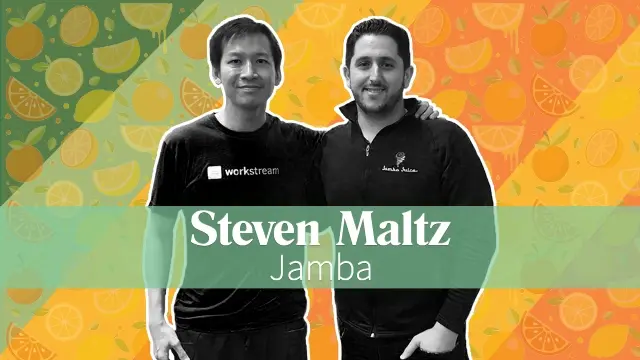
Q&A with Jamba Operator Steven Maltz
- Home >
- Workstream Blog >
- Q&A wi...

FREE RESOURCES
Join 30,000+ operators staying ahead on restaurant hiring, payroll, and compliance.
Get the latest with Workstream
Always stay current with hiring news by subscribing to our email updates
"Establishing expectations for behavior upfront is much easier than asking your team to change behavior after a month has gone by."
At Workstream, we have had the privilege of working with many brands to help them streamline their hiring process and increase the number of applicants. One such client is Jamba. Steven Maltz is a muti-unit Jamba Franchise Operator and COO of Whirl Partners LLC. He previously held roles in the finance industry, where he was an Asset Management Manager at Essex Property Trust and an Equity Research Associate at Jefferies & Company. He is currently also an investor in Workstream.
Lydia (L): What does your typical day look like as a COO?
Steven (S): There is a lot more administrative work than most people would think. I won't go into all of it here but to name a few...as a business owner you are responsible for Human Resources, Payroll, Leases, Repair & Maintenance, Customer Service, Store Operations, etc. Generally speaking, a typical week consists of a mix of store visits with District Managers to ensure compliance to standards and the aforementioned administrative work.
L: What is your process for getting feedback from your team?
S: We have used surveys in the past however the best way to gain feedback is to have open and honest communication. To achieve this, it is important to drive the concept of accountability at all levels of the organization as it leads to greater trust and confidence to open dialogue.
L: Do you have any advice for startups that are building products for hourly workers?
S: If you haven't already, go work an hourly position in restaurants/retail to better understand the needs of workers and operators.
L: Are there any trends that excite you?
S: Technology in the retail and restaurant space. There are many companies currently looking to improve the operations and customer experience using technology and I am excited to see how it plays out. I believe we are on the fairly early end of tech in retail/restaurants.
L: What's your typical interview process?
S: What does customer service mean to you? That is a question I like to ask because after all any restaurant or retail business is really in the customer service business...they just happen to sell smoothies, burgers, coffee, etc.
L: What do you, personally, look for in an applicant?
S: Willingness to learn
L: Given your experience in the field of hiring, what are common mistakes people make in the hiring process?
S: In the interview process and on-boarding process, it is extremely important for Managers to set expectations from day one. Establishing expectations for behavior upfront is much easier than asking your team to change behavior after a month has gone by.
L: What tools / services do you use to improve productivity?
S: We use custom excel templates to run a lot of our internal processes and procedures. Additionally, we use scheduling tools and third-party payroll companies to help manage the Payroll and HR part of the business. For our hiring needs, we have used Indeed, Snagajob and Workstream.
L: Do you have any books you recommend to people in your industry?
S: My recommendation is to focus on staying current on industry news. You can learn a lot about the industry by reading about what is actually happening in the space. Also, it doesn't hurt to take a look at some of the public company 10-Ks and listen to earnings calls.
L: How do you think restaurants will look in 10 years? What will be the biggest changes?
S: More technology. More technology. More technology
L: What quote / mantra inspires you?
S: Love a quote by Howard Schultz - "Success is not an entitlement; you have to earn it every day"
L: Do you have any advice for new restaurant owners/operators?
S: If you are building a new store, ensure you do your due diligence on the real estate location. Additionally, look for a concept that has shown staying power, meaning they have been in business for a longer period of time (10+ years). Making a strong real estate decision with a brand that is reputable is a likely recipe for success. Also, don't underestimate the power of training your team and the importance of setting/maintaining standards.