



<img height="1" width="1" style="display:none" src="https://www.facebook.com/tr?id=395330474421690&amp;ev=PageView&amp;noscript=1">
Why Referral Programs Help You Hire Better
Workstream Blog

Why Referral Programs Help You Hire Better

By Workstream

Get the latest with Workstream

Always stay current with hiring news by subscribing to our email updates

There are many sources from which hiring managers can look for prospective hires. But one that has always risen above all is employee referrals. For the past few years, referral programs have been the top choice for recruiters to source for candidates. According to a study, 82% of employers chose referrals as the source that produces the best return on investment as compared to other recruiting channels.

An employee referral program is essentially a recruiting strategy where existing employees introduce qualified friends or family members (or anyone they know, really) for jobs in their company. Typically, these employees will be rewarded should their referral be hired into the organization successfully. With both parties gaining something out of it, referral programs are a good way to motivate current workers to help the company bring in quality hires.

So why exactly does this program bring out more successful hires? And how can it help your QSR in the current pandemic climate? Read on as we break down the benefits it brings to you as a hiring manager and how you can incorporate it in your hiring process!

Why Referrals Work Better Than Other Sources

Better cultural fit

Since those who are referred to the company already know someone working in the organization, it is likely that they are also familiar with the culture of said company. Thus, chances are, they would only proceed with the hiring process if they are attracted to the company culture in the first place. It has been proven that if you hire an individual with the right cultural fit, they tend to have higher satisfaction levels and are more likely to stay longer in the company

Our point is - hiring through referral programs will create a cumulative effect of benefits to your company. It not only ensures that you hire quality candidates but also reduces your turnover as you retain them in the long run.

Better promotion of company

What better way to promote a company than through your employees? Company reviews by current or former employees are deemed so important by job seekers that 1 in 3 people have rejected their job offers due to bad reviews of the company found online. Through the use of referral programs, you are letting your employees promote your company through their very own experience. After all, who will refer their friends or family members to a company they dislike working in, right?

As those who are referred know their referee personally, they are likely to trust them and be more inclined to apply for a job in your organization. This is especially useful in the current pandemic climate where many are not ready to work just yet. Due to the stimulus checks given by the government, most job seekers are delaying their job search. Hence, the prospect of being hired at a trusted company may just propel them to start working again.

Larger candidate pool 

As restaurants are reopening and resuming their dine-in services, this means that many employers are starting to look for hourly workers to support their operations. With this increased competition, you have to make sure that you stand out among the rest. And with a referral program, you can do just that.

Think about it - would you rather apply for a job at a company that your friend recommended to you or a random one you found on a job portal. Most would choose the former since the probability of you having a good working experience there is higher as you already have a connection there. Thus, adopting a referral program will help you cast a wider net for quality candidates in a highly competitive market. 

Workstream’s Referral Program

At Workstream, we understand how useful a referral program is for hiring managers. That is why we have our very own to ensure that you are able to attract more talents for your company. Our feature makes it easy for you to encourage candidates to refer their friends, family members, or even acquaintances. Our program is proven to be effective in bringing in quality candidates and retaining them for a long time - one of our clients was able to gain 80 employee referrals after utilizing it!
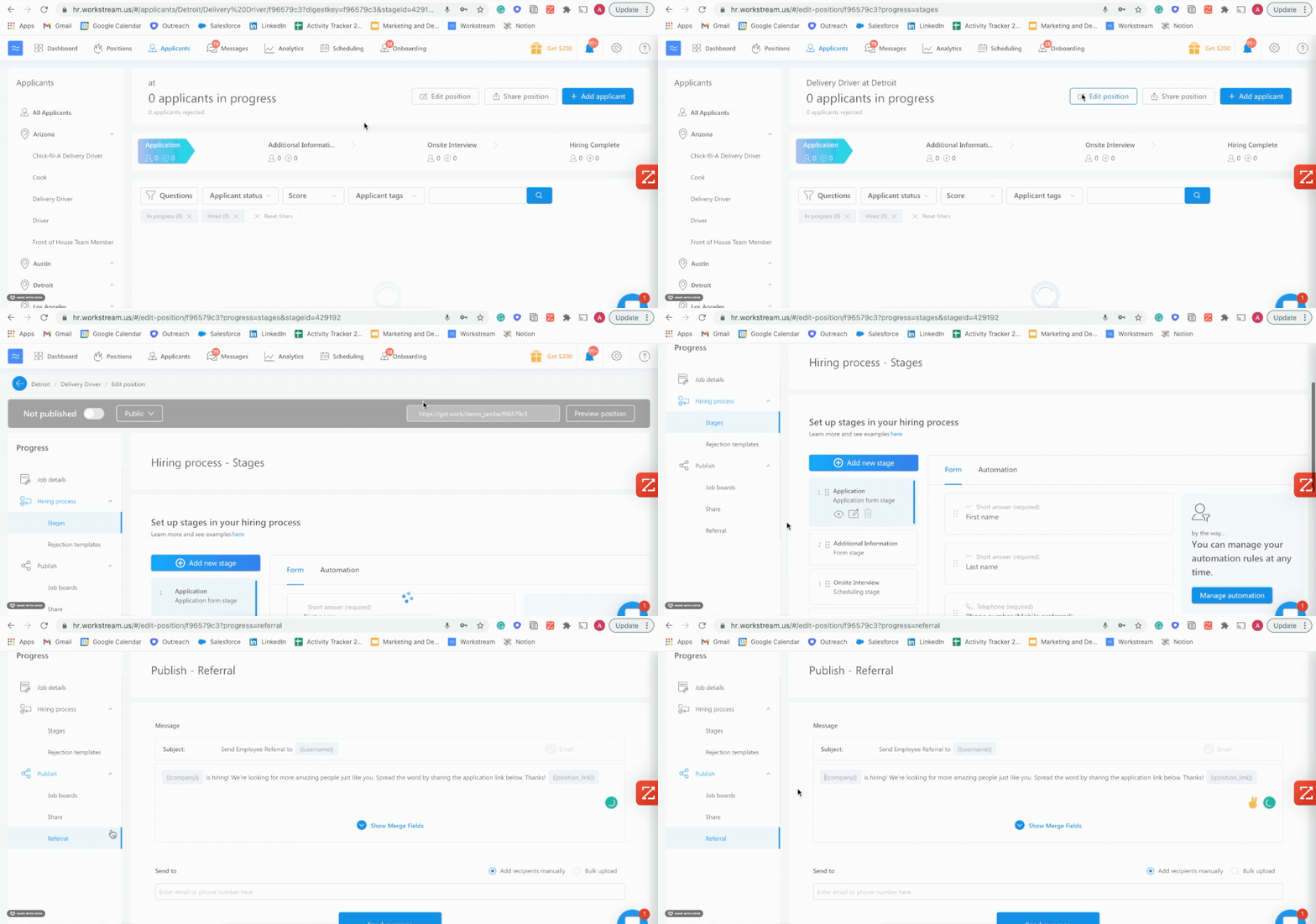
hiring referral program

With Workstream, you can launch your referral program in just three steps! Simply edit your job position and publish your referral message. We have prepared a template for you but feel free to customize it to your own liking! You can then choose to enter your recipients manually or select the option to mass send the message to all of your candidates. 

Interested in setting up your referral program with Workstream? Book a demo with us today! Aside from the program, Workstream helps you streamline your hiring process so you can reduce your hiring time and widen your candidate pool. Talk to us so we can tell you how we can best meet your hiring needs!

By Workstream
Workstream is the leading HR, Payroll, and Hiring platform for the hourly workforce. Its smart technology streamlines HR tasks so franchise and business owners can move fast, reduce labor costs, and simplify operationsβ€”all in one place. 46 of the top 50 quick-service restaurant brandsβ€”including Burger King, Jimmy John’s, Taco Bellβ€”rely on Workstream to hire, retain, and pay their teams. Learn how you can better manage your hourly workforce with Workstream.

Personal Information and Sensitive Personal Information

Before we discuss the right to limit and the right to opt-out, we must first define personal information and how it relates to sensitive personal information.

Personal information is any data that identifies, relates to, or could reasonably be linked to you or your household. A few examples of personal information include:

  • Name or nickname
  • Email address
  • Purchase history
  • Browsing history
  • Location data
  • Employment data
  • IP address
  • Profiles businesses create about you, including pseudonymous profiles (β€œuser1234”)
  • Sensitive personal information

Sensitive personal information or β€œSPI” is a subset of personal information, defined as:

  • Identifying information (e.g. social security number, driver’s license)
  • Financial data (e.g. debit or credit card numbers)
  • Precise geolocation (within a radius of 1,850 feet)
  • Demographic or protected-class information (e.g. race/ethnicity, religion, union membership)
  • Biometric and genetic data (e.g. fingerprints, palm scans, facial recognition)
  • Communications and content (e.g. mail, email, text messages)
  • Health and sexual orientation (e.g. vaccine records, health history)

Right to Opt-Out

Californians have the right to opt-out of the sale and sharing of their personal information. That means you have the right to opt-out of the sale of your personal information to third parties (e.g. data brokers, advertisers). You also have the right to opt-out of the sharing of your personal information to prevent the targeting of ads across different businesses, websites, apps, or services.

CCPA-covered businesses must provide a link to allow you to exercise this right. It is usually found at the bottom of a webpage and will say β€œdo not sell or share my personal information” or β€œyour privacy choices.” Sometimes businesses offer privacy choices through a pop-up window or form

To opt-out of the sale and sharing of your personal information, click on the link or use the toggle provided by the business and follow the directions. Doing this on every website you visit can feel burdensome, but to ease the burden you can automatically select your privacy preferences for every website by using an opt-out preference signal, or OOPS for short.

An OOPS is a user-friendly and straightforward way for consumers to automatically exercise their right to opt-out of the sale and sharing of their personal information with the businesses they interact with online. An OOPS, such as the Global Privacy Control. It can either be a setting on your internet browser or a browser extension. With an OOPS, consumers do not have to submit individual requests to opt-out of sale or sharing with each business.

Right to Limit

Californians also have the right to direct businesses to limit the use and disclosure of their sensitive personal information.

Businesses covered under the CCPA must provide a link on their website that allows you to request the limiting of your SPI, if they plan on using it in certain ways. That link will also typically be at the bottom of a webpage and will say: β€œlimit the use of my sensitive personal information” or β€œyour privacy choices.” Once you send this request, the business must stop using your SPI for anything other than to:

  • Provide requested goods or services
  • Ensure security and integrity
  • Prevent fraud
  • Maintain system functionality
  • Comply with legal obligations

Bringing it Together

In summary, the CCPA gives you the right to opt-out of the sale and sharing of your personal information and gives you additional rights to further limit the use and disclosure of your sensitive personal information.

When you exercise these rights together, you exert greater control in protecting your personal data which is important for your identity, safety, and financial health.

If you are on a business’s website and you can’t find the links to exercise your rights, remember to check their privacy policy. The privacy policy should tell you how you can exercise your rights under the law.

If you find your rights being violated, you can submit a complaint to CalPrivacy.

Next in the LOCKED series, we will explore the right to correct and right to know. Follow us on social media to get live updates or check back in one week for the next post.

Essential

Required to enable basic website functionality. You may not disable essential cookies.

Targeted Advertising

Used to deliver advertising that is more relevant to you and your interests. May also be used to limit the number of times you see an advertisement and measure the effectiveness of advertising campaigns. Advertising networks usually place them with the website operator’s permission.

Personalization

Allow the website to remember choices you make (such as your username, language, or the region you are in) and provide enhanced, more personal features. For example, a website may provide you with local weather reports or traffic news by storing data about your general location.

Analytics

Help the website operator understand how its website performs, how visitors interact with the site, and whether there may be technical issues.

Right to Limit Use of Sensitive Personal Information

You also have the right to limit how we use sensitive personal information (such as precise geolocation, financial data, etc.).

Your preference has been saved. We will not sell or share your personal information.