



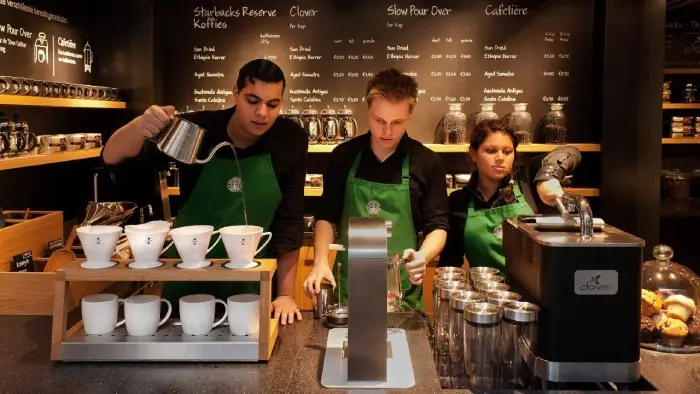


From the very beginning, Starbucks has been way ahead of the curve when it comes to almost everything that it does. Apart from roasting whole, high-quality coffee beans that have a heavenly taste, the global coffeehouse chain also encourages human connection. As stated in the company’s mission , it strives "to inspire and nurture the human spirit – one person, one cup and one neighborhood at a time,".
And this doesn't refer only to its customers, but also to all of its employees, which Starbucks refers to as “partners”. Starbucks employment benefits go far beyond free coffee and regardless of whether you are part-time or full-time employees, all of Starbucks Partners can be eligible for the company's benefits package, termed as "Your Special Blend". This special blend is customized to match every Starbucks employee's needs and includes a wide range of awesome perks that eligible Starbucks' partners (i.e. employees working 20 or more hours a week) can enjoy. Read on to explore the benefits included in the package to see why it is absolutely perfect for hourly workers.

Healthcare Coverage
If eligible Starbucks workers ever need dental services (preventive, basic, and major ones) or vision services, which include getting eye exams, contacts, lenses, and frames, the Starbucks benefits package has them covered. All of these are parked under the healthcare coverage that Starbucks provides. It also includes various medical expenses, including hospitalization, emergency care, prescription drugs, and many other treatments. Health insurance is becoming a must have in the fast-casual/QSR space and Starbucks part time and full time employee benefits are among the best in the industry.
What’s more, employees can enjoy the perks of reimbursement accounts, namely Dependent Care Reimbursement Account (DCRA) and Health Care Reimbursement Account (HCRA), which help them cover their dependent care and healthcare expenses.
Life Insurance
All Starbucks' employees eligible for benefits will get basic life insurance coverage. Retail employees get $5,000 coverage, while non-retail and salaried ones get coverage that equals the amount of base pay they receive annually.
Supplemental coverage is available as well but, naturally, it costs more. Non-retail and salaried employees, who can get the coverage of up to four times their base pay, can get it through automatic payroll deductions. On the other hand, retail employees can purchase their chosen coverage, which is in flat dollar amounts of $10,000, $25,000 and $45,000.
Disability Plan Coverage
In case an illness or injury prevents a partner from working, their disability plan coverage can provide them with partial income. There are Short-term and Long-term Disability coverage plans, the latter being provided automatically only to non-retail and salaried employees where the company pays the full premium. Meanwhile, retail employees can choose to purchase a Long-term Disability insurance plan.
Employee Assistance Program (EAP)
If any employee working in the U.S. is dealing with stress-related problems, emotional issues, personal concerns, or any critical workplace incident, they can receive short-term counseling to help themselves out. For Starbucks, mental healthcare is just as important as physical healthcare. As such, this program is established as it helps its partners feel better by improving their mental health, ultimately enhancing their overall quality of life.
CUP (Caring Unites Partners) Fund
The CUP Fund is yet another incredible benefits program that all Starbucks employees can apply for. It provides financial assistance to any worker who needs it after a natural disaster, illness, family death, or any other extreme case.
Commuter Benefit Program
Employees who need to commute to work can also save money on their commuting expenses, as Starbucks will enable pre-tax payroll deductions.
Adoption Assistance
If any Starbucks' employee decides to adopt a child, the company will provide them with $10,000 for the necessary adoption expenses. The coffee company will also give them up to 6 weeks off so that they can spend time with their child in his/her new home. Additionally, they will still receive their full pay for the time off.
Starbucks College Achievement Plan
While the aforementioned benefits are definitely astonishing, the College Achievement Plan may just be the best one. Starbucks invests in its employees and wants to help them get a college education, even if it is completely unrelated to a career at the coffee company.
Starbucks encourages its partners to get a bachelor's degree by providing them with full-tuition coverage for all four years at Arizona State University . The tuition at ASU is about $15,000 a year, but everyone who enrolls in the program automatically receives a scholarship of 42% of the full tuition. Under the college achievement plan, Starbucks covers the remaining 58% of the full tuition, which means that the students in the program need not worry about their tuition fees as it will be covered fully for them.
According to a Starbucks' press release , 1800 employees signed up during the first month of the College Achievement Plan back in 2014, and the numbers keep surging to this day. The plan includes over 70 undergraduate degree programs that are delivered online. Even better, Starbucks provides them with a dedicated enrollment coach, academic advisor, and financial aid counselor, so that they can have the best possible support system they need to earn their degrees and improve their lives.
The employees who receive the tuition reimbursement don't have to keep working for the company after they graduate. They just need to ensure that they continue working there while undergoing their studies.
Tying employees to the company that way is certainly beneficial to both parties, which is precisely why Starbucks started the plan. It helps the company significantly decrease its turnover rate and save a lot of money in the long run, which it would otherwise spend on recruiting and training every new employee.
Apart from all these benefits, "Your Special Blend" benefits package also includes perks such as vacation, holidays, sick pay, as well as coverage plans for employees' partners, spouses, and children, which adds a cherry on top of this incredible package that is difficult to find anywhere else. "Your Special Blend" truly is perfect for hourly workers, especially since each of them can tailor it to their individual needs.
Every company should consider taking a page from Starbucks' book and work towards providing their hourly employees with the much-needed benefits that can improve their lives. By following in the coffee giant's footsteps, they can create a culture where every employee is equally valued, respected, and seen as a partner, allowing them to grow and work in an inspiring community.
If you are looking for ways to hire hourly workers better, look no further. At Workstream, we help you streamline your hiring process so that you can get better quality candidates in less time. Schedule a demo with us today so we can find out how to best meet your hiring needs!