



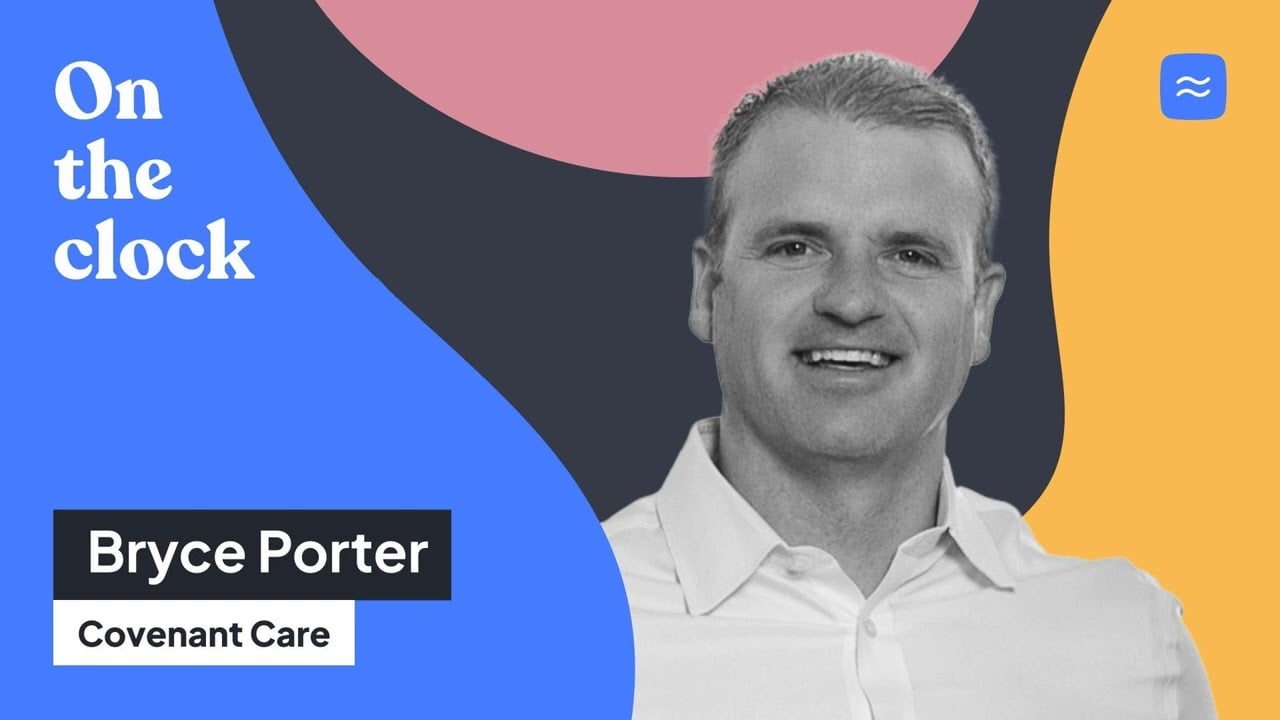


We clock in with Bryce Porter, Chief Strategy Officer at Covenant Care. Covenant Care operates 29 skilled nursing and home health care locations, with more than 5,000 total employees.
We discuss the unique hiring and retention challenges faced by the healthcare industry, why operational efficiency is essential when hiring, high impact retention strategies, and more.
https://www.linkedin.com/in/porterbryce/
Transcript:
|
Daniel Blaser (00:07): Hello, and welcome to On the Clock, presented by Workstream. If you care about hiring and retaining hourly employees, you're in the right place. I'm Daniel Blazer, and today I am clocking in with Bryce Porter, chief Strategy Officer at Covenant Care. Covenant Care operates 29 skilled nursing and home healthcare locations with more than 5,000 total employees. We discussed the unique hiring and retention challenges faced by the healthcare industry, why operational efficiency is essential when hiring high impact retention strategies and more your chief strategy officer, I'd love to hear like what that role entails and maybe some of the biggest challenges that you're facing in your position. Bryce Porter (00:51): Yeah, we're we, we've got this particular role is kind of a hybrid between operations and business development. So it's looking at opportunities that we can, we can modernize some of our, some of the processes that we use in our census development. Kind of increase the sophistication of our communication and how we reach our target audience. And, and then also just coupling that with the operations, it's been since the pandemic, it's been really, really challenging and complicated, figuring out the right balance as we have a staffing crisis. You know, 250,000 healthcare workers have left the industry in the last three years. And so being able to still manage the same the same staffing ratios that we need to have, but at the same time finding talent that we can recruit to the industry because there's not enough in the industry to supply the, the demand. So it's, it's, it's just being able to, to balance those two areas. And that's, that's what my focus has been. Daniel Blaser (02:02): Why is operational efficiency, which is, I, I think it's something that you, you really care about. Why, why is that so important when it comes to hiring and retaining the right people? Bryce Porter (02:13): Yeah. Well, a majority of our workforce is frontline caretakers. And so obviously a lot of nurses CNAs, therapists and then all of the, the supporting roles to care for that, the patients in the facilities. And so it's knowing that labor is just such a tremendous per, like, majority of our expense we've had to supplement any of our regular staffing with registry staffing, and that comes at a cost that's two or three times what the normal rates are. So we're not getting mo most of our business mo, well, largely over 95% of our business is all using taxpayer dollars. So it comes from either Medicare or Medicaid. And so none of those rates went up by two or three times. Relative to the, to, to the rate of increase on our expenses the, the cost for PPE and everything else, I mean, we just literally within the last few weeks within the last 30 days in California, at least, we aren't required to wear masks any longer. (03:24): And so you think most of the world kind of got back to normal, maybe a year and a half, two, you know, ago, maybe a year ago. Whereas in the healthcare industry, we were still had the same regulations pretty much up until the last 30 days. And so there's a lot of expense that comes along with that, providing all the P-P-A-P-P-E to be in compliance with, with what those requirements are at the time. So, so that's there's a lot of complexity to try to figure out. You know, when we, when our revenue isn't, isn't on pace with our expenses, it's, it's how can we be more lean in other areas and how can we try to grow our business and be really make sure we don't let anything fall through the cracks. Daniel Blaser (04:12): I would love to hear, you know, you're, you're talking about the tremendous challenge faced by your industry specifically right now, just not having enough applicants. Obviously pay is kind of the most important thing when it comes to attracting employees. But what sort of like perks or other benefits have you found make a a real positive impact when it comes to attracting applicants? Bryce Porter (04:33): Yeah, benefits are a big deal. People want to be sure, I mean, healthcare benefits proximity to where they live but probably the most important ones that, that always play into the calculus is, is do they have a friend at work? Do they feel valued? Do they feel respected? Do they have the tools to do their job? Do they feel like there's opportunities to learn and grow? And so those are things that we can control. We, we can't control always some of the others. And so those, creating a, a workplace that, that develops our people and gives people opportunities to grow is, is really something that we, we believe we can be better at and provide ourselves with a different, kinda a point of differentiation from other providers out there. Daniel Blaser (05:20): One other question that I have you think, you mentioned that some of your team does home healthcare, correct. Have you found that to be a challenge when you talk about like helping employees feel connected to their employer and feel like they have a friend, they have a support system. What sort of challenges does it do you face that are kind of unique when you're dealing with like a home healthcare provider that maybe not be, they're not in the same location every day or, you know, they're, they're, there's kind of not that home base, I guess. Bryce Porter (05:47): Yeah, in healthcare, I mean, we're trying to get back to, or, or what we try to tie into is, is the intrinsic value that they had for an individual to get in the healthcare industry in the first place. So if you're a nurse, if you're a caretaker, if you're a CNA if you're a therapist, you did it because you've got that, that's important to you. There's, you put value in being able to, to help others that, you know, when they can't help themselves. Most of the world figured out how to do a lot of work remotely just because we were forced to. Unfortunately, you can't take care of patients remotely. So if they can't take care of themselves and they're bed bound or wheelchair bound they can't give themselves physical therapy. They can't take themselves to the shower or feed themselves or, or clean themselves. (06:35): And so so it, it required us, like it really didn't change any of our obligations from a day-to-day basis, but we just had to do it in different parameters and in ways that we that we were understood to, to mitigate any spread or or any risk to increased risk to any residents. And so for us, it's being, being able to look at at the opportunity and see how, how we can pivot and still be successful, still be a, an attractive employer and reconnect people as we get back to doing the things that, that are normal. So for example for th for the better part of at least two years one thing that people don't really think about is, is the social element of the residents. So for example for two years, they couldn't go to the dining room. (07:34): So you have, you have patients that largely are bedbound or wheelchair bound. They were not allowed to come out of their room in a social setting. So they weren't going to participate in activities. They weren't regularly dining with others because they were trying to limit risk and spread. And so they didn't, a lot of places were very limited for at least a year, if not two, on visitation. So loved ones, family members, guests my own fathers in the skilled nursing facility in Las Vegas. And for at least two years of during the pandemic, we weren't able to visit him at all. We were only able to communicate him by you know, through Zoom or, or FaceTime. And so that there's a lot of kind of emotional toll that that takes, but also from a staffing perspective is kind of getting back to your question is, you know, the rate of turnover in the industry is so high that there's, you get to a 0.3 years in that there's maybe half of the people that work in a, in a facility and say, you have a hundred employees, half of 'em have worked there and they've never actually worked there. (08:44): Wild guests or visitors have been there. And so that's a really interesting dynamic for people to get back to and get used to dressing people, grooming them, getting them up into their wheelchairs, getting them off to activities, helping them back into dining rooms. And and that's, that's something that is, is has, was an adjustment at first. Most people were like, oh yeah, I forgot this is what we used to do. 'cause It had been so long. So that's, that's a big part of what we're trying to get back to. So at least the experience that the patients have is different than what it had been the last you know, three years. Daniel Blaser (09:22): What advice or recommendations would you give to the people listening to this podcast about, you know, when it comes to hiring, retention, you know, some of those things that might interest them. Like what, what sort of unique perspectives or learnings do you have? Bryce Porter (09:37): Yeah, so as it comes to like the recruiting side of things, what we've, what we've learned a lot, at least in our, our geography is that there's especially in healthcare, they have so many options. And so it's, it's most of these folks are lit, are working at least one or two jobs. And so they don't have a lot of time, they don't have a lot of of disposable time. So they're kind of either working double shifts, they're working time and a half, they're working, picking up extra shifts or even, or, or working at another job. And so the people have been very price sensitive where there's been opportunities. For example, if you're if you've been desperate, you know, in order to keep your, your staffing you know, reg you know, compliance with your regulations, you've been willing to pay a lot more than you ever would've in the past. (10:32): It creates an interesting dynamic because you're bringing in new team members that are potentially at higher wages than those that have been there much, much longer. And but it's because you're so desperate and you don't have any other options. And so how do you still do things from an employee appreciation perspective? How do you find the funds to at least be fair to those that have been there and, and raise them so that they're on par and and still keep them engaged and, and establish that loyalty? I don't know that we have like the secret sauce on that. I think we've done as good as we could to make sure that we've done a wage analysis and so that we we're fair with what we do and, and that we're careful not to bring in people at, at, at higher wages. Even though it, it could be you know, it's pretty tempting when you're, when you're really desperate. (11:25): The other part of it is people aren't, aren't exploring job opportunities. They don't take a long time to make a decision. So, so for example, we might place an ad for a registered nurse or a treatment nurse and, and you'll get maybe a half dozen applicants, and if you wait even a, an hour or two to contact them heaven forbid, even even the end of the same day, they've already accepted another job somewhere else. And so it's, it's the, the early bird gets the worm more so now than ever when it comes to candidates, they're making quick decisions, they're getting the, the applicants have a lot of leverage and a lot of opportunity to, to get whatever they want in, in a lot of cases. And so for us it's how, how can we connect with those applicants as fast as possible in a meaningful way start that engagement and and and have both of us have the opportunity to evaluate the opportunity as as quick as possible so people can make informed decisions and, and we have the best opportunity at at hiring them. Daniel Blaser (12:41): Great. great recommendations and advice. Thank you so much, Bryce, for, for sharing your perspective and, and you know a little bit more about Covenant Care. I really appreciate it. Bryce Porter (12:50): Yeah, happy to share. Daniel Blaser (12:59): Thank you for listening to On the Clock. For more info, visit workstream.us/podcast. I've also included a link in the show notes to connect with Bryce on LinkedIn. Until next time, we're clocking out. |
Listen and subscribe
 |
 |
 |
 |