



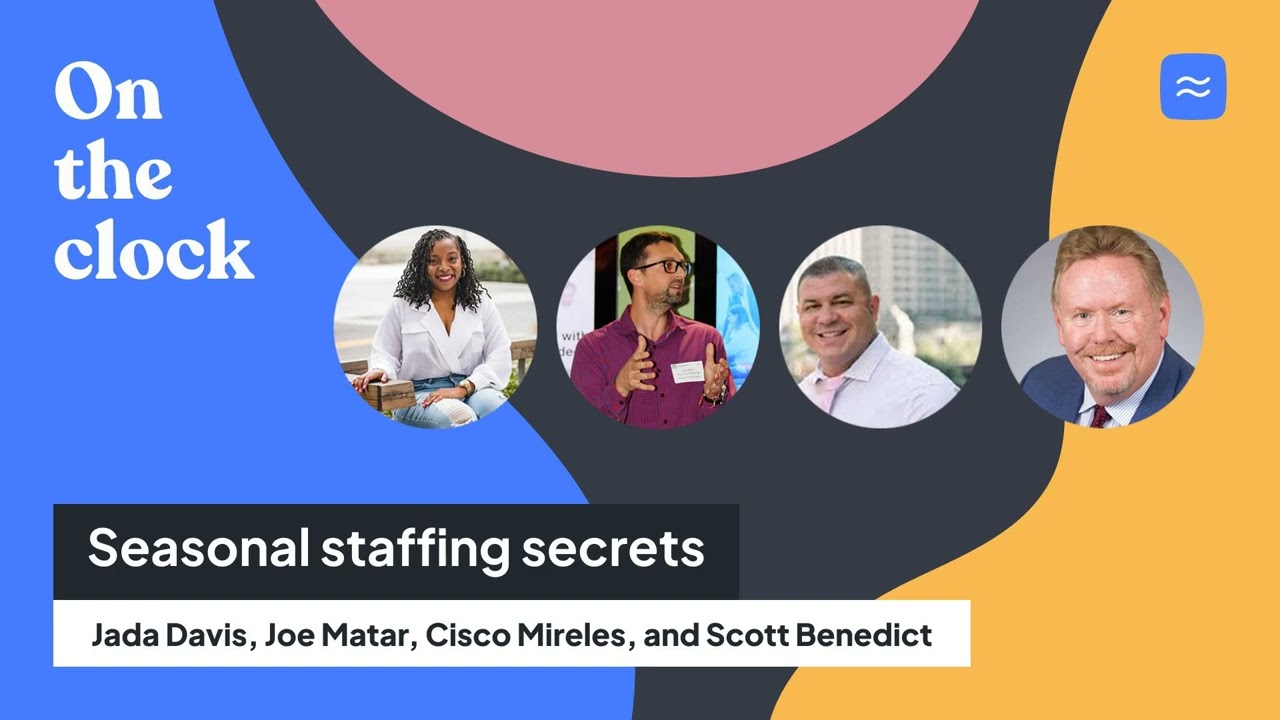


Today we clock in with four experts who share tips and tricks for attracting, training, and managing seasonal employees. The group includes Jada Davis, Manager of Talent Engagement at fast-growing convenience chain Foxtrot, Joe Matar, VP of marketing at hiring event software company Brazen, Cisco Mireles, Director of HR at Grove Automotive, and Scott Benedict, a seasoned consultant with decades of experience at Walmart and Sam’s Club. They discuss optimizing seasonal job descriptions, making the most of technology to move quickly, how to incorporate seasonal employees into your existing team, and more.
Transcript:
|
Daniel Blaser (00:06): Hello and welcome to On the Clock presented by Workstream. If you care about hiring and retaining hourly employees, you're in the right place. I'm Daniel Blazer, and today we're sharing the audio from a recent webinar all about seasonal hiring. This conversation features four experts sharing their proven tips and tricks for attracting training and managing seasonal employees. This includes Jada Davis, manager of talent engagement at fast growing Convenience chain, Foxtrot, Joe Mader, VP of Marketing at hiring event software company, brazen, Cisco Marus, director of HR at Grove Automotive. And Scott Benedict, a seasoned consultant with decades of experience at Walmart and Sam's Club. We discuss optimizing seasonal job descriptions, making the most of technology to move quickly, how to incorporate seasonal employees into your existing team and more. You're going to love this one, enjoy. (01:02): What sort of recommendations or tips do you have for writing a good seasonal job description? And when you're doing that, how do you properly set the expectations for those candidates and just make sure you're communicating effectively everything that you need to communicate. Jada, I'd love to hear your thoughts on this one. Jada Davis (01:23): Yeah, absolutely. So I think you were right on it when you mentioned setting the expectations, and you can start by being very clear and concise and just making sure that someone looking at the job description knows very clearly what the ask is, knows when and where and the how, right? And so really highlighting those key responsibilities as well, and giving a glimpse of the day-to-day is also really a really great way to filter out those that may not be interested in really what the role will entail. Because sometimes a job title alone does not really tell the role itself. And so being very clear of your qualifications and so the things that you know need that may be the interpersonal, they may be the technical skills, whatever that is, be very clear about that. And then setting the expectations of the role and the timing so someone knows if this is only going to be a three month opportunity, being very clear with that, if there's a start date that you have in mind or dates of training that you have in mind, given that information upfront so people already know if it's going to be a good fit for them coming in as a really great way to filter out those that are not the most qualified for your role. Daniel Blaser (02:31): Awesome. So as you're working on this job description, you're getting that nailed down. And I think another key piece of seasonal hiring is obviously technology. That's one thing that workstream is all about is hiring efficiently automation. I'm not going to jump into a commercial there, so don't worry, but I just want to kind of mention that when it comes to the HR tech, that really helps you move quickly and make the most of the seasonal hiring the efforts around seasonal hiring. Joe, I'd love to hear some of your thoughts about the technology piece. Joe Matar (03:10): Yeah, I mean, I think first before talking about technology, it's really important to first think about what are the pain points that you're trying to solve? And if I had a slide for this question, I think I'd break it down into four pain points. One is qualification, being able to qualify candidates quickly. Scheduling that takes a lot of time, right? Communication following up, and that's probably related to the scheduling piece, but following up as quickly as possible with the most qualified candidates. And then I guess a fourth pain point I'll throw in here is the application length. Just losing candidates because your application length is too long. And so I kind of go backwards now. So just some data around application length and just how many additional candidates you can capture by just keeping your application short. And I don't like application isn't always considered technology, but it really is. (04:16): And so some data from Acast showed just this last year, they did a study with, I think it was tens of thousands of applicants. And if you can get your application in the one to five minute range, you can increase conversion. So increase the number of candidates that you are capturing or applicants, I'll call them by four x compared to if your application takes 15 minutes or longer. And so I think we all know that, but just think of like you're spending all this money on sourcing and through all these different channels to bring candidates in to go fill out your applications. And if you've got a long application, you're wasting tons of dollars. So that's something really important to think about. So get those applications as typed as you can ask questions later in the process. So just go with the must haves as earlier in that process. (05:12): And then just thinking about some other technologies, if I jump to qualification, a lot of our customers are using technologies like chat bots that can do some of that initial qualification for you, asking those qualification questions and then filtering the most qualified maybe to your team, to the human, the humans on your team, your talent acquisition team to have those conversations when they're needed. But saving you time, chat bots can do that. And then scheduling, I also don't want to make this a plug for our technology, but virtual event technologies, a lot of times in general, we'll have scheduling tools to help you save time doing that cumbersome scheduling that no one wants to have to do. And especially with seasonal roles, a lot of times it's high volume. And so when you're trying to parse through lots of resumes and do that scheduling, it can take hours upon hours. And so having some sort of tool, like a scheduling tool or a virtual events tool that has that scheduling built in is something that can solve that pain point. So almost back to what Daniel started this off with, and I guess it's in the question here, think about ways you can make the process more efficient to free your people up so that they can spend the time doing what they do best, which is having those high value conversations with the top talent. Daniel Blaser (06:43): Alright, let's go to the next one, the next topic, which is all about recruiting and sourcing seasonal candidates. There's obviously going to be some similarities when it comes to recruiting standard candidates, but there's also probably some specific tactics and ways to go about it when you're dealing with seasonal candidates, specifically Cisco. Why don't we start with you? I'd love to hear your thoughts on this one. Cisco Mireles (07:09): We're pretty fortunate that we have a pipeline of college students and then we also have a pipeline of family members within our dealerships that it makes it easier for recruiting for us. You can go to job fairs as well, you can post ads. But for us, what really works the best for us is that the relationships that we have with our college students when they come home for their breaks or whether it's spring break, summer break right now during the holidays here coming up and maintaining those relationships with those college students. Then also maintaining relationships then and sparking the conversations with their friends and family as well. So maybe we have a college student that says, Hey, I have an uncle that could fit well in our call center, or I have a cousin that would fit well in our showroom at these different stores. What we really are fortunate enough with having dealerships across the state of Indiana is we may have college students that are in different locations, different cities, so they may be on campus at that particular location, and they're able just to fit right in and take over those seasonal positions. So the relationships, the employee referrals, and then also the family members that we have within really helps us on the recruiting side for seasonal candidates. Daniel Blaser (08:48): Yeah. One follow up question, just kind of curious, is that something you've had to make a concerted effort to make sure your existing employees are all engaged and happy and stuff? Is that something you've put extra effort into in hopes of contributing to the seasonal hiring? Or is that just a rising tide lifts all ships kind of thing? Cisco Mireles (09:12): I'd say with recruiting, you're always extra efforting with recruiting, right? I mean, you're always recruiting. I mean, if you're complacent with recruiting, and I believe as an HR person, you're not doing your job efficiently. I mean, you're always putting in extra efforts. Like I like to tell our people, no matter if you're at a restaurant, you're recruiting, you're at the grocery store, you're recruiting, it's nonstop. So yeah, the extra effort that is a non-negotiable. It's always extra efforts. You're always putting in those extra efforts with, if I have a college student that's in our call center, I'm going to make that extra effort to approach that individual start asking, Hey, do you have friends that can join us for the season? Do you have neighbors? Do you have family members? It's constantly, constantly recruiting. Daniel Blaser (10:07): Joe, I'd love to hear your thoughts on recruiting seasonal candidates. Joe Matar (10:14): Yeah, I mean I think Cisco nailed it. The only thing that I would add, and just maybe it's digging in a little bit more around why all of the strategies that Cisco recommended and maybe are working the way that they're working. And something that I think a lot about as a marketer is just the psychology of what's going on with referrals. And going back to past seasonal employees, and I think we all know this probably intuitively, but one of the best influencers of behavior is social proof. And so when you tap into, when Cisco's talking about going to that call center intern and asking, do you have family members or friends or whoever else that you think would be a good fit, and then it's activating that person to go and talk to their family members or friends and talk about be that brand ambassador, that's going to be the thing that resonates the most, right? That's why these networks that we're building and you have to intentionally activate them. That's why everything Cisco said was so spot on you. Yes, some of it's going to happen organically, but he's activating it. You have to lean into it to really make it move the needle. But yeah, you're tapping into that social psychology, which I just think is such a great cheat code or tool to tap into. Cisco Mireles (11:40): I like the word that Joe just used there as an ambassador and as ambassadors, then we're creating the advocates for us to go out and recruit. So that word that Joe just used I really love is an, and then we as the ambassadors, we are creating the advocates then. Daniel Blaser (11:57): Yeah, I agree. I want to ask a follow up to anyone here when it comes to referral programs. I'd love to hear, have you had luck with more of formal referral programs where there's you do X, Y, and Z and here's an incentive, or have you just had more luck with a little bit more informal word of mouth, kind of making it easy, but not necessarily as structured? I'd love to hear just quickly any thoughts around that? Jada Davis (12:28): We've had a formal referral program at Foxtrot Markets, and it has been successful just year round. And so we are looking to leverage an already existing program and see how we can really just take that to the next level when it comes to seasonal hiring. And so we have various different tiers we allow, whether it's a manager or a store team member or shiftly, they all can benefit from it as long as it is not under their direct leadership. So that's been helpful too. So it's not enough to say sometimes when it comes to referral programs like the manager or the hiring manager, that kind of excluded, but in our situation, in the program we've built, we allow a store manager to say, Hey, I want to refer somebody, and they can be referred to another store because you're able to build relationships with some of your peers to say, this person will be great for the company in general and maybe will be a great fit for you based off of the leadership style that you have. (13:26): And so that's been really helpful. And then also we use it as an engagement tool. So for our teams on a regular basis when maybe they're wanting more hours or wanting an increase in pay, one of the things that I do first to say, Hey, how have you been able to implement and really maximize our referral program? And sometimes it's the, Hey, I didn't really know about it. And so that's an opportunity to really bring awareness and to educate. And then sometimes it's like, yeah, if I referred a couple people and what have you, and so then we set up, you really filter out maybe candidates that may not been a best fit because now you have some brand ambassadors that are going out and they're having a great experience, so they're telling their friends and they also, they're internal, so they already know what it takes. They know the type of people that will work well, and so they can really help you with your recruiting efforts and your sourcing efforts, especially in this busy time. Daniel Blaser (14:19): Yeah, I really like that. And I think it kind of aligns a little bit. We got a question from Carl that's just kind of directly asking who pays for employee referrals? Is that something that sounds like Jada? Maybe with that more formal program, there is kind of a direct incentive on your side, right? Jada Davis (14:40): And then we have a duration right after a 60 day period or 90 day period, once they have to be a new hire, they can't be like someone that's for us before, but we have that budgeted for that because when you think about the cost that it takes to hire someone and all those efforts, it really is paying for itself Daniel Blaser (15:01): Kind of adds a little bit extra of a little extra push to that social engagement, the social advocacy side of things too. With that being said, let's move on to the next topic. We've talked about job descriptions, technology, we've talked about recruiting, and now it's time to talk about how to incorporate seasonal employees into your existing workforce. Obviously you want to set them up for success and you also want to avoid any sort of complications with your existing team. So Scott, why don't we start with you? I'd love to get your take on that. Scott Benedict (15:44): Absolutely, Daniel. It is an important topic because once you've gone through the effort to recruit and hire and locate some great seasonal talent to help serve their customers and drive your business during a pretty key time of the year, now you've got to really incorporate that person into the workforce and have them become productive as quickly as possible. And so a couple of things come to mind when I think of this question. One is clarity and I mean role clarity, what is expected of this new seasonal potentially temporary associate? And I think it's important that leaders define the terms of success, what is expected of them, what is their role entail? And knowing that in the heat of really busy times, you can't always be right there by that person's side and you've got to equip them with kind of a vision for the end goal that you're trying to accomplish in serving your customers and then help them to see ways that they might do that. (16:56): So role clarity and define expectations I think is the first thing I think of coaching is another. And by coaching I mean providing them a resource, a buddy, a coach on the floor if you will, someone that they can go to ask that quick question that doesn't require maybe a senior leader in the store in the facility to answer, but someone who's maybe a more seasoned member of your team as a go-to. And the beautiful thing is not only does it help that seasonal employee become more successful, but it helps bolster and build the leadership skills of your ongoing every day associate. If they're now seen as a leader and a go-to resource, it kind of bolsters their skillset as well. And I think the last thing that I think of when you ask that, Daniel is really define what success looks like. In other words, not beyond specific elements of the day-to-day job, but what do we want to get out of this period of the year? (18:07): And obviously the most important thing in any kind of retail business is satisfied customers. Satisfied customers not only come back later during non-seasonal periods, but also they're normally going through a very stressful period just like your employees are. If they're leaving your store or your facility smiling, happy, accomplish something on their to-do list, whether it's purchasing a holiday gift or getting their car serviced or something else. If they're leaving there in a good place, if you educate those seasonal employees that that's the end goal, that that's the definition of success generally, if you've done a great job hiring them, they'll find a way to make that happen in ways that maybe you can't coach that just hopefully it's instinctive if you've hired the right person, if you create a picture and a vision of what success looks like during that key seasonal period. Daniel Blaser (19:07): Jada, I'd love to hear your take. I feel like especially when it comes to providing a buddy or the coaching thing, you have a little bit more probably to add on that topic. Jada Davis (19:17): Absolutely. One of the things that we do really well when it comes to our hourly employees in this retail market is we have a robust orientation. Even if it's whether it's for a week or for two weeks, we really have a structure when it comes to the orientation and onboarding so that everyone can really feel successful when they go into the role. Part of that for seasonal hiring looks like partnering a seasonal worker with maybe our shift leads because even during this time we have more people that we have that are going to be working. And so then we have concerns and conversations with our existing workforce of them not getting enough hours and being concerned about their role. And so the way that we really work together and collaborate is we match those that have the high potential and that have the desire and the interest in growing. (20:08): We use that as an opportunity where they can be leaders and they can really show some of their leadership skills for opportunities for future internal promotions and opportunities of growth. And so matching them with someone that really knows the lay of the land and really knows the culture and really knows the ins and outs so that seasonal worker comes in feeling very strong, feeling like they have someone that they can lean on and lean into and really ask some hard questions. And then also, this is just an opportunity again, like I said, for not only for them to feel like, okay, I have a sense of job security, I also have growth opportunities, and so then setting them up as a seasonal worker for success way, then we have those conversations to see are you looking to come back next season or maybe they perform so well. And as you all know, in retail turnover can happen often, and so we may find out that they're interested in staying with us longer, and so we're able to have someone that has worked very closely with them to really assess their performance through that buddy system. And so that really just works well to assess growth development and also capitalizing on the future leaders that we have within our existing employees. Daniel Blaser (21:16): Yeah, that's awesome. Anything that's like a win-win, right? With existing employees plus the seasonal new hires, those win-win situations are so good, and I love that you kind of spelled out what that actually looks like. We had a question come in from Carl, do you do any pre-boarding, maybe online pre-boarding to help seasonal employees get up to speed before even day one and Carl use the example that they do automated emails to do micro learning leading up to day one. I'd love to hear anyone on the panel. Is that something that you've had success with or that you've tried out as kind of doing a pre-boarding? Joe Matar (21:59): I can speak for some of our customers, a lot of them were experiencing ghosting candidates, accepting an offer and then not showing up on day one. I'm sure everybody here has experienced that. So what they did, not necessarily the drip campaigns, which I love that idea in the question that was proposed, but doing engagement events with new employees before their start date, so inviting them to either a virtual or in-person event and having maybe some speakers, current employees talk about what the role is going to be like, what to expect, maybe doing some meet and greets just to build deeper, stronger connections so that you lessen the chance of that ghosting and get them that much more prepared for their first day on the job. Daniel Blaser (22:58): Thanks for answering that question. I feel like that leads really well into kind of our final topic, which is all about communicating with seasonal employees. We've kind of danced around that topic a little bit, but I thought let's dive into that a little bit more and why don't we start with Scott. Scott, do you want to talk about effective communication with seasonal employees, whether it's prior to day one while they're employed, et cetera? Scott Benedict (23:25): Yeah, well, I think it's important and you kind intimate that Daniel, that it's important throughout the process that you're communicating through the hiring process, through the onboarding process and throughout their time with you up to and including when it's time for their engagement to end at the end of the season. But I think that one of the key recurring themes that I've seen on this topic is first of all, painting a picture for that person about an ideal outcome and an ideal experience that you want your customers to have during this very, again, stressful, very, very busy period for you and for them. And part of that can really be done by tying into their own experiences as a customer, as a shopper, and thinking about situations that they either like or don't like in their own experiences and painting a picture of an ideal outcome. (24:24): So things like, Hey, if the line of checkout gets to be so long, let's step over and get another register open so that we can get those people checked out and on their way. Or if someone's walking up and down the aisles with a puzzle, look on their face, go up and greet them and ask them if there's a question or something that you can help them with. It may be a very simple question, but boy, they sure appreciate it and sometimes folks will just congregate at the register or congregate talking to each other and not stay focused on a customer. And if you appeal to their sense of what it's like in their own experience as a shopper, many times that will be very key in the communication or if something's out of stock, but you've got available online proactively going up and telling that customer, I'm so sorry we ran out of that, but we do have some online. (25:17): Can I help you to process that transaction set objective goals, things that can be measured I think is another area. So whether it's speed of checkout, how in stock we are, how little of a waiting period we want to see for customers, things that can be measured and reported on either at the end of a day or at the start of the next day, Hey, we're doing well, or Hey, we're underperforming. Let's lean in and here's the things everybody that we want to see you do that makes it kind of not just subjective, but objective in terms of the way that you measure success on the spot. Coaching Daniel Zenke is another area. When you see someone either because the fact that they're relatively new or just because they made a mistake, not handle a situation, go up and give 'em coaching right then. And again, this is where your coaches on the floor, your team leaders can step in and not only help coach up that seasonal employee, but develop their own leadership skills. (26:26): And oh, by the way, it's okay to catch someone doing something right, not just when they're doing something wrong, reinforcing the behaviors that you want to see, making them feel like they did a great job serving customers is another part of on the spot coaching. It shouldn't be just the negatives. And then bear in mind that in many cases that seasonal employee was a customer before their period as an employee and hopefully will be a customer after, but they're going to be an advocate for your brand both while they're with you and hopefully in the future. So their experience has got to be a good one, just like the customer's experience has got to be a good one because you want them to be ambassadors or advocates for your brand even after they leave the payroll. And at Jada's point, sometimes they come back the next year or they may get extended to a permanent role if they end up doing a really great job or if someone else leaves and you want to plug in someone that's already been a part of the team, I think pretty important. But those are some of the best practices in terms of communication that I've seen. Daniel Blaser (27:39): Yeah, those are great recommendations. Cisco, I'd love to hear any additional thoughts or tips around this topic. Cisco Mireles (27:48): Those are great points that Scott just made. I think at the end of the day for seasonal employees, all employees for that matter is our employees just like us. We want to feel valued. We really want to feel what is our value to the company, what's our value to the department and communication and how often that communication and how consistent it is. Scott mentioned on the spot coaching, providing that feedback, the more consistent we are in providing that feedback, that employee then is going to feel valued and value is what's going to bring those seasonal employees back to us once they leave us for the season. I like to communicate effectively with our seasonal employees before, during and after the season. I like to communicate with them a couple months before that particular season. I like to communicate with them while they're with us and then after, one of the things we talked about with engagement is when we have the company outings, the company parties, why not still invite those seasonal employees? (29:00): So for example, if we have our college students that we don't see until the summer or until the particular season, but we have a company outing and they're in college, still extend that invitation to 'em, invite them, that's that value. Again, they may not be with us for two months or three months, but if we're inviting them to our corporate events or we're inviting them to our events that we have, they're going to feel that value. And then when they come to those events, then those relationships and that communication is staying consistent. And I truly believe that once you create that pipeline of seasoned employees that feel valued, they're going to continue to come back to you. And that's a big part of why we like to have that open communication before, during, and after those particular seasons. Daniel Blaser (29:59): Yeah, that's such a great idea to invite 'em to those events. It makes so much sense. Joe, let's get your take on this one before we jump into some q and a. Joe Matar (30:11): Yeah, I mean honestly what Cisco and Jada and Scott have been saying over the last two questions actually makes me think that their answers, which were incredible, really answered one of the first questions, which is, how do we recruit and source and find seasonal employees? It's everything about the employee engagement and helping them grow and the communication that answers the same question, everything that the three of them have been saying. So I know we've kind of been circling around that, but the light bulb just went off for me. And then, yeah, I guess it's specifically related to communication. The only thing that I would add that hasn't been covered is you should be looking to always improve your communication. So one way to do that is through exit interviews or through formal surveys. So you'll make sure that you're thinking about getting surveys in front of your seasonal employees throughout their time with you at the end of the season to get that feedback so you can constantly be iterating and improving. (31:21): That's really important. Ask questions about what that communication was like and about their relationship with their boss and their employees. That's super beneficial. And then I always say with seasonal employees especially, you can never over communicate. They're there for such a short amount of time, they're not permanent, and so you don't have the luxury of that slower ramp up period. You got to kind of compress it. And so there is no such thing as over-communicate. If you said it once, say it again and then say it again one more time. I think it'll go a long way to helping you with that employee experience, helping those employees feel valued. And then the impact in the long term as we've discussed time and time again, will be realized. Daniel Blaser (32:17): Yeah. Awesome. Alright, well thanks once again to all four of our panelists. We're going to jump into some questions that have come through now. So if you're watching this and there's been a question you've been like, ah, maybe I'll ask that. This is probably your last chance, so don't delay. First question, and this draws, Melissa was speaking specifically about getting an integration added, but when we take that more broadly, what is the best way to identify what integrations are out there that can make your recruiting and hiring process more efficient and then actually getting those integrations set up? Any thoughts or recommendations just around the low hanging fruit of finding those integrations and then using them, Joe Matar (33:07): Talking to your vendors and hopefully you have a chance to talk to potential vendors before you commit to a contract with a vendor and asking them about what integrations they offer. I mean, I think integrations are, I think it's important to ask yourself, what do you want to get out of the integration? Integration is such a broad term. It can mean so many different things, but thinking about what I want to get out of connecting two or three or four systems, whatever it is, how is it going to help me with going back to the pain points, the efficiency, whatever it is you're trying to accomplish. And then again, involving those different vendors. Most vendors these days have integrations with dozens if not hundreds of other vendors. And so just understanding what the scope and the requirements are to solve whatever problem or challenge you're trying to solve is important. Daniel Blaser (34:09): I will jump to the next question, which is where would you recommend posting seasonal roles? There's always, indeed, there's always kind of the big job boards that are most common, but are there any specific places that you'd recommend posting that? Is there especially geared to seasonal you've had extra success with? On the seasonal side of things? Cisco Mireles (34:36): So for me, I'm pretty active in the universities around the area. You walk in and get yourself in front of students, get yourself in front of people. You show off your brand, you show off who you are, and then you're able to talk to the different seasonal opportunities that you have. It's one thing to post an ad, but then it's another thing to get in front of people and have those conversations. And just as I mentioned earlier in hr, you're always recruiting, even if you're not specifically the recruiter in hr, you're still recruiting all the time. So you build relationships in the restaurants. You ask the restaurant owners, Hey, can I post something here? Can I offer some seasonal positions that we may have? But I think the universities, we have several universities around our areas and where our dealerships are located at that I've developed relationships with able to get in front of students and able to get in front of the different professors of business or management or service techs or whatever that may be that fits us. (35:49): So I think the more that you're able to get in front of people and talk to people, that's again, where the communication piece comes into play. That's again, where you're opening the door to showing, Hey, I value you even though you may be a chemistry major, we can still use your talents for this season. We can still use your skillset for the next four years as you're in college for our seasonal opportunities. So yeah, I believe that along with the job boards, if you can get out in front of people and actually have those conversations, that helps. Daniel Blaser (36:26): Yeah, I like that answer a lot. Jade, do you have anything to add on this one? Jada Davis (36:32): Yeah, absolutely. So another thing that we do as well is really getting out into the community. So a lot of our stores in all of our different cities touch some colleges in some areas. So we definitely connect with students because we are a omnichannel company, a blend of cafe market, coffee shop, wine bar, all the things. We have people that are sitting in there all day. And so a lot of times we would really like building connections with our customers. And so we have some marketing collateral where we give them, Hey, if you know anybody that's really interested in the seasonal job, we have opportunities for them. And just having that conversation at checkout is always really good. We also are trying a new approach as well with some of our neighbors in the community and identifying maybe that's an opportunity for us to really collaborate. And so we know that our hourly employees are already working multiple jobs, so if they're already coming to this part of town, this area, that's an opportunity where maybe they're working in the morning at a foxtrot and then in the evening for the local boutique. And so we've been having conversations with our neighbors. And so also even beyond the actual hiring part, but even the sourcing recruiting efforts, doing collaborative community events as well for the local retailers in the area has been something that we're working towards as well. Daniel Blaser (37:55): Yeah, I really like that. I feel like to summarize both Jada and Cisco don't just kind of keep your eyes on your keyboard or your computer screen. You got to get out into the actual community and kind of make those connections. I think that's a really good point. One more question I think we have time for when it comes to your interview process, are typically, are you kind of maintaining the same number of interviews and the same process that you would for non-seasonal employees? Are you condensing that? Are you reducing the number of interviews? And I'd just love to hear any thoughts around that. Jada Davis (38:35): So I can add right here, our process remains the same. We like to keep the consistency so that the experience is the same for everyone coming in because we've noticed different before we had fine tuned and really streamlined our processes, we noticed that that caused additional problems later on. So we keep the process the same. If anything, we just have more volume. So if we have a hiring event rather in person or virtual, we will just follow the same steps using our applicant tracking system. They'll get the same level of communication, they'll get the next steps, they'll get the link for the next interview, what have you. It just may look different as far as the first interview of talking to somebody, maybe a virtual Zoom event versus in person or vice versa. So that's the only thing that'll change is in person or virtual. But the process itself remains the same, and we typically don't have a super difficult process in general, but the consistency really matters in the overall candidate experience, which then goes into that your employee experience as well. Daniel Blaser (39:41): Is there anything else that you want to share with the audience? One final takeaway, anything like that before we hop off? Scott Benedict (39:48): Daniel? I'll tell one thing, one anecdote for the audience. Obviously this is an important topic, that's why we all came together today, but the person who is the CEO of Walmart today was a seasonal employee unloading trucks in the distribution center when he was in college. My point in that is you never know who this hire might turn out to be or the role that they might play in your company. That's my go-to example one that I know about personally, but it's not the only one of those questions, but it just reinforces why this topic that we've been talking about today, the seasonal hire sometimes isn't just about this season or this hiring need you have today. You never know when a future leader of your organization is found through their experience through this whole seasonal hiring process. So I ask everybody to just kind of keep that in the back of your mind because you never know who it is that you might be interacting with or who that great seasonal hire might turn out to be at some point in the future. Daniel Blaser (41:07): Thank you for listening to On the Clock. For more info, visit workstream.us/podcast. Until next time, we're clocking out. |
Listen and subscribe
 |
 |
 |
 |