



A 6-location Crumbl owner shares how he slashed labor costs and overcame inflation
- Home >
- Webinar library >
- A 6-locati...

Get the latest with Workstream
Always stay current with hiring news by subscribing to our email updates
Christian Bankhead dedicates a lot of time to optimizing the operations of his 6 Crumbl locations. When it comes to workflows and automations, he's like a mad scientist, and now he's agreed to share his discoveries with you.
Join Christian to learn:
- How his embrace of operational efficiency helped him avoid the headache of a Dept. of Labor audit.
- The compensation package that he uses to attract high caliber employees and decrease labor costs.
- How he keeps a pulse on employee engagement, and adapts to the results.
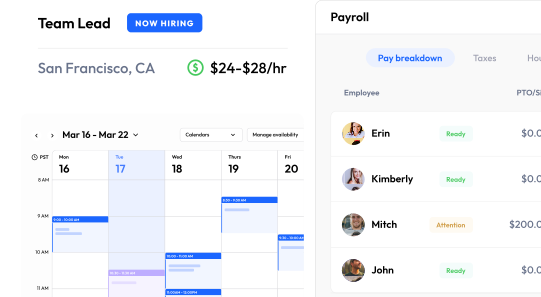
- Why some recent changes to his payroll system have saved him hours every pay cycle.
- How Christian is preparing his business operations to open 7 new franchise locations.
Transcript:
|
Daniel Blaser (00:00): We've got a lot of great stuff to cover, so we don't want to spend too much time on the housekeeping and intros, but we can do a really quick one. Like I said, I've been at Workstream a couple of years and I manage our podcast and I get to chat with a lot of awesome customers and sometimes I meet someone like Christian, I'm like, your perspective needs to be shared far and wide, and he was kind enough to agree to do that. Christian, could you give us just a real quick background overview? Christian Bankhead (00:29): Sure, absolutely. So I always make the joke that my resume looks a lot like my A DHD diagnosis. It's just all over the place. And all jokes aside, I do find things like small business, the QSR industry crumble specifically extremely engaging. I enjoy a little bit of what we call organized chaos. I believe it taps into my strengths. I have two little kiddos, a five-year-old son and about 19 month old little daughter. They're wonderful. My wife is absolutely amazing and wouldn't be able to do anything that I'm going to talk about today without her. So really love the Cincinnati, Ohio area. It's been home to us for just over three years now and yeah, absolutely love crumble. We're going to talk a lot about that today. Daniel Blaser (01:18): Awesome. I saw one question come in about a frozen screen, so if anyone else is experiencing that, please let us know and we can remedy that, but otherwise it might just be a isolated issue hopefully. So, alright, let's talk a little bit about crumble and we can just tee this up really fast. If you don't have a crumble, if you're in United States and you don't have a crumble near you, that's probably pretty uncommon at this point, right, Christian? Christian Bankhead (01:48): That's right. So crumble started out in Utah and it was two cousins and I love the way they say it. It's just two crazy cousins, right? Coming in together to make the world's best cookies. If you're not familiar, they are generous portion gourmet cookies. We try to shake things up by offering a different lineup every week, so every Monday morning you're going to see six new flavors of cookies that get rotated through and presented to the customer. It's a lot of fun. A lot of people really enjoy seeing what the lineup is that week and we've had cookies all over the place. We've had things from Megan, what is it? Mango passion fruit to Oreo cookie sandwiches to your classic milk chocolate chip. We have an iconic pink sugar that a lot of people know crumble by, but yeah, it's grown fast. I see on the screen it's talking about how we opened our thousandth location and I always make the joke that Crumble cookies was the family business that accidentally turned into a thousand location franchise. (02:51): Realistically, I say that because it still feels like it's a family business. I know the people who are the CEO, the CBO, we have interactions with them. It's still very personal and crumble would be the first to admit that says, Hey, we're new, right? We're new to the market, we're learning. We have figured a few things out, but we're still coming together. And so it's been fun to be on that sort of wild west frontier kind of feel. Definitely engaged me and made me come up with novel solutions to kind of jump in there. Yeah, Daniel Blaser (03:23): And we're going to talk all about some of those novel solutions. So just a quick overview. We're going to start off because this is the most exciting thing you could ever start off of a webinar with. We're going to talk about a Department of Labor audit that Christian was faced with and how he approached that and some things that he did to maybe make that not quite as scary as it sounds. And we're going to talk about some efficiencies that you've discovered for around payroll and kind of your approach there to save money and time with payroll, some real world tips, and I think you're going to even share some screenshots to reinforce ways that you've improved the onboarding scheduling and identifying employees that need increased compensation and other changes and stuff like that. And then what you are doing now to prepare to double locations, which is obviously exciting, so excited to hear how you're laying the groundwork for that. But let's get started with everyone's favorite topic, a Department of Labor audit. Absolutely. Christian Bankhead (04:38): Could I jump in and share a TikTok? This TikTok is from quite a few years ago. It's in the early days of crumble. This is a customer that entered a crumble cookie lobby and they took a short recording. Now it may be a little choppy just because we're sharing it over here, but I want you to pay attention to the two employees that are in the center of the TikTok here. Now it's only about six seconds, so I'll try to play through it here quickly. Let's see. All right, here we go. Daniel Blaser (05:13): Just to make sure everyone sees the caption on there, says, yo, they got kids making my cookies. Christian Bankhead (05:21): Exactly. So what you see here is a poor, I'm going to ballpark it here. I'm thinking it's probably a 10-year-old and maybe an 11-year-old kiddo. I know for sure it's the manager's kids or the owner's kids. I can see this mom walk by here quickly adjusting something on the dough production and the kids look to see if they can get away with slacking a little bit. This week right here that this was filmed was probably one of the busiest weeks that crumble had ever experienced. To put it into perspective, we had two locations open at that time. We made 70,000 cookies of just the Oreo Malo sandwich. This cookie was the People's Choice Award between these two locations, and I should say 70,000 makes 35,000 cookies because you sandwich them in half, but it required an incredible amount of work. It caught us by surprise and it also was opportunistically where many other people who are probably watching this broadcast are right now. (06:24): You are anticipating the loss of your wonderful high school labor and you're waiting for the dreaded two week gap before all of your college kids come in and start wanting jobs. And so that hit us right where it hurt and what we saw is a lot of crumble franchise owners relied on their network of friends and family to help support them. So they reached out to their community, maybe their church family had friends families come in and what you ended up having was situations like this where maybe some 10 and 11 year olds now, unfortunately it doesn't matter how good of friends they are or how wonderful your kids are, there are federal laws protecting certain people from working in commercial bakeries because of I imagine this TikTok and probably some other influences in there. The Department of Labor took a particular interest in crumbles and began what we saw as a nationwide audit. (07:21): Now where this started, the audit started in Utah. There were a few people who had a generous amount of age related violations and it mostly happened to do with basically someone's kids or nieces working under the allowed age. That being said, it put us under a high level of scrutiny. So when the Department of Labor arrived at our store, I actually wasn't in the store. I got a call from the manager that said, Hey, department of Labor's here and they want to chat with a few employees being naive. I was like, yeah, let 'em talk. And then I hear four and a half hours later, they leave with a long list of notes and I'm just nervous. I'm hovering on the camera. I can see she's just writing stuff down, but I can't hear anything. And so obviously I was pretty nervous right off the bat, right as I went to my current payroll provider and asked for the records that were requested. I got a sure, we'll look into it, let's see what we can do. Let's see if we can get it, but if you want, do it yourself. It's on this interface that's a little difficult to use, but go ahead and try. (08:31): Luckily we had transitioned to workstream as our main HR and onboarding platform prior to this. What I realized was that I could essentially use a one button click and download the entirety of the information that was being requested from me. And I mean, if you guys are okay with it, I'd love to share the screen and show and just kind of do it here live. So say I had an auditor that just walked in right now and asked me, Hey, I want to audit your store. I can come in here. Now, obviously I've shortened my window because my goal is to not reveal any sort of private information that can be contained under there, but I use this export button right here. I set a custom time range. It was so easy, I just picked the all time down here, put it into Excel and hit export. (09:24): This came to my email in a zip file pretty quickly after, and I literally sent it forward to them and was able to have all the information I needed to provide for those employees here. There were a few token employees that were before our time at Workstream, and so I did have to go back and it was ironic that the hundred employees that I was able to provide information for to the Department of Labor, the hundred were way easier than the four that I had to go back and manually dig up all this information through our old payroll provider. And so we were quite grateful for having these systems in place. Now we got out lucky there were some, not just crumbles, but there are some audits that we kind of became aware of while we were there that had a hundred thousand dollars liabilities for violations for those who were not familiar with how this works. (10:17): Basically if there is a violation, you're not fined, oh shoot, you shouldn't have hired that 14-year-old. Here's a thousand dollars fine, you're fine. For every instance that person worked and a violation occurred, and so some unfortunate souls have seen some pretty catastrophic problems. We were lucky enough to have a short list of clarifications at best and we're able to go through with the Department of Labor and move on and continue to run a profitable business. So we were incredibly grateful for sort of the work that was done beforehand, and I'm not going to lie, the reason we turned to Workstream initially was not for the security during a Department of Labor audit. It was actually for the ease of use and some of the things we'll get into here a little later, but I tell you what, it sure felt good to not have a hundred thousand dollars fine and have a failure to produce records fine and go months long into an investigation. So we were incredibly grateful for that. Daniel Blaser (11:15): Yeah, definitely glad you were able to avoid the huge headache and like you said, some of the catastrophic fines. It's kind of terrifying to think of some of that stuff. For those people watching this right now, it almost seems, I don't want to say you were lucky or you were kind of like it could have been a lot worse. What would you recommend to those watching or what would anyone that's like, oh, I better make sure my ducks are in a row in case something like that happens to my business? Christian Bankhead (11:47): Yeah, absolutely. I'll tell you, the primary thing they asked of us was for records. So you can run through this dry exercise with yourself right now using your current system and platform, pick a random employee and see how long it takes you to recover the records for them. They wanted to see the proof of age and the I nine verification. Those were two big ones that were requested of us as well as have basic contact information. So we had to provide a phone number, email address for these employees. And so we wanted to make sure that one, we collected this information and stored it in a compliant way. We hate the idea of just filing cabinets full of paperwork at each location, right? It's unsecure, even if it's locked, then you lose the key. I'm sure everyone here has had those instances where no one can find the key. (12:40): You basically got a safe or a filing cabinet locked and no one can get into it. And so we needed a digital solution that helped us sort of keep these records safe and Workstream provided us a really good interface for that. The second thing, if you just want to be ready for it, is feel free to review with a, and I'd recommend this point going to a true labor lawyer, find a labor lawyer. Luckily we had one on hand who we had only known by saying, Hey, here's a referral. So someone else had given us a referral about a year before, and so we had the person's phone number that we were able to call and get right into. That being said, review with them some of the typical policies. This is one of the ironies of running a crumble cookie bakery. A minor cannot run the mixers because those are commercial baking equipment. (13:30): A miner can open an oven and put the cookies in because it is, and I forget the exact term, but it's basically corded, so it plugs in the back and it has wheels where it can roll, and so it's not a fixed oven. So who knew hindsight being 2020, who knew that picking the exact model of oven at the time of picking it would be a key determining factor on whether someone under 18 would be able to operate it or not. Your individual store might not be so lucky, so it's great to have a lawyer come and review that. Daniel Blaser (14:05): All those little details and the nuances that you almost can't prepare for all of those things without somebody that that's their job to know about them. Right? Christian Bankhead (14:15): Correct. Exactly. Daniel Blaser (14:17): Alright, well glad once again glad you got out of that issue fairly unscathed. Definitely learned some things along the way. I think one of the things that you kind of touched on between the lines is that the fact that you were willing to embrace new technology, you kind of were future proofing or setting yourself up to not experience quite as much pain in that situation. And that leads us to the conversation around payroll because I know the same way that you're, I'll call you an early adopter or a technology enthusiast or whatever you want to, you can claim whatever term you want, but I definitely think that's something, as I've gotten to know you, that describes you fairly well. And so I feel like you kind of took that to your approach to payroll also. So can you talk a little bit about your payroll journey, where you started, where you've gone, where you are now? Christian Bankhead (15:19): Sure, absolutely. So let's talk real long time ago. So before coming to crumble, I operated a family business. We used the simplest, cheapest platform possible. I'm not going to throw shade and name 'em there, but basically I went online and found the one that would get me my payroll done for the least amount of money. It was a small family business. I had maybe six to 10 employees at the time. I call that completely featureless payroll. I signed up online, was onboarded through a preset guide and never met a single person that worked at that company. The entirety that I used them, I came to crumble and we used, I would say dinosaur in an industry. I'm thinking about maybe the top three biggest payroll providers in the us. And while I found a lot of features and things that were built in, I also found that I think a dinosaur is a good way to describe it. (16:15): It was slow moving. Some inconsistencies in the system weren't necessarily understandable for me. And one of the things that drove me nuts is any small business owner out there, heck, a medium business or even large business knows you are probably working on things at nine to 11:00 PM at night, drove me nuts that I couldn't access certain features or data without calling in to have someone enable it for me. Or I had a rep but the rep wasn't available. So then I had to call customer support to get me to another rep. And it was kind like, I mean I say this again, it was working with a dinosaur. It was slow moving. It was not exactly broken, but it wasn't exactly what we wanted. And the other thing is I didn't realize how significant of expense I was spending on payroll at the time. There was confusing pricing. (17:12): Pricing wasn't transparent. When I looked retroactively at the year before, I realized that for our company we were spending upwards of $60,000 essentially in payroll services. And at that cost, I don't think we were covering all the bases we need. The big screaming glaring factor was that audit, right? Hey, I need this information, I need it quick, I need to provide it. And it was, oh, I can have somebody procure that information. It'll take a week or you can do it yourself through this complex reporting system where you have to do everybody one at a time, dig and find where that info is and go through that process. So I would say that my goal in finding a payroll provider is to find someone who can have a system that makes it easy for me to customize it to my store and to have that sort of nimble ability to bring in certain features. I needed a system kind of like workstream that we'd already been using for our hiring and onboarding. And so it made total sense to me when you guys started offering the payroll platform to jump on board. Yeah, Daniel Blaser (18:18): Cool. Yeah, I definitely former life have my own experience with some different payroll options and dinosaur might be a good way to describe some of those that have been around for a little while. On the slide that we're showing right now, I kind of called out a few things when we spoke previously in that blue box, there's some of the distinct things that you were looking for in a payroll provider or that you found to be really important. I don't think we have time to go through every single one in detail, but maybe you don't want to call out one or two what that means, why it matters. Christian Bankhead (19:00): Absolutely. So one, the two way sync from onboarding paperwork to payroll is so seamless, it's so easy. Nothing is harder than getting a new employee. They just filled out a job application and if you're lucky, they found you directly, but if not, then they probably filled something out on Indeed then had to go through a process with your HR onboarding, then they got hired, then they filled out onboarding paperwork and then they might have to go through a consequential other onboarding. And I think one of the biggest barriers to I would say entry level positions is the difficulty to onboard. At the time before we really switched to workstream, we were seeing a failure rate of about half of the people we hired did not work a single day because of the complexity and difficulty in providing the correct onboarding paperwork, getting scheduled, communicating effectively to get on the schedule. (19:58): And so that reduced that entirely. Now, I might have one in 10 that might struggle and by golly it's their fault if they're not getting it because we have automated text message reminders, we have easy workflows, we have links and everything. They need the labor cost by title. And I also like the location, location-based payroll feature that really helped me dial down the health of my workforce. This helped me not only report to my franchisor the metrics that they wanted to see, but it helped me understand how much am I spending on managers, how much am I spending on maybe a shift lead and how much am I spending on basic bakers? (20:41): We can dig into it a little later, but that gave us huge insight as to how we need to adapt our model for different seasons, how we can adapt and change to retain people. I should say it this way, crumble I believe is unique in that high turnover isn't necessarily a bad thing. We're going to talk about this a little later, but I firmly believe that part of the reason I have some higher turnover is because I have a job that can facilitate their ability to work. Some people are less employable or under employable because they only have till school starts. And lucky for me that lines up with my busy season, so I absolutely want to take advantage of that person. Of course, it looks like turnover. So I've had to make a system that has a rapid onboarding and a rapid offboarding to make it easy. And so we mentioned the onboarding and payroll, but offboarding is just as important and I believe there's a lot of good tools that we've implemented that help make that easier as well. Daniel Blaser (21:40): Cool. You spoke about a lot of specific things here that you found helpful. Obviously a lot of this ladders back up to savings as far as time and money as well. Before we jump, I think we're about to chat more about hiring and some of that stuff, but just before we finish up on payroll, what about the savings? What have you seen as you've kind of built out some of these efficiencies? Christian Bankhead (22:07): Sure. So historically, payroll was a process. I have about 150 employees up to 200 employees sometimes in real busy season. Historically, it's a process took me six to seven hours every day that I ran it. And so that process is everything from ensuring equitable tip distributions to ensuring the right deductions and benefits, new employees being onboarded, the old employees being off boarded, calculating reimbursements, everything like that. I think we had spoke just last week and I was giddy with excitement. I told Daniel, I was like, I just ran payroll in an hour and I think I was even on my way out to the theme park here in Cincinnati, Kings Island. So I was like, I ran payroll in an hour and I'm going to the park. So that is such a quality of life improvement. Being able to sort of just import a bulk file run through, put in certain parameters within the payroll workflow that allow me to do deductions or allow me to do withholdings correctly, it literally has just saved me ample loads of time. Five hours doesn't seem like a lot, but I tell you, there's two things that just grind my gears and it's sitting mindlessly in front of the computer and not making cookies. And so the more I can do to go out and have fun interact with employees, the more efficient I am. Yeah, I mean we take it for granted, but the time saving has been innumerable, that's for sure. Daniel Blaser (23:41): Yeah. Well that's awesome. The thing that I really hate is sitting mindlessly in front of the computer and not eating cookies, so I think we kind of have that in common. Exactly. Alright, let's jump over to hiring. So I think we've spoken so far a lot about processes, tools, and a little bit about the onboarding side, but let's get a little bit more into the people side and the hiring strategy and your philosophy for hiring. Yeah, I'd love to hear just about Christian Bankhead (24:11): That. So in our location, some of our stores have as high as 300% turnover and that sounds like, oh my gosh, that's insane. It is a lot. And what I've realized is that crumble is a unique sort of niche job in the market. It facilitates those who thrive in busy work and it can quickly overwhelm those who get overwhelmed very quickly. One thing that we did was we quickly realized the type of people who do well in sort of the crumble environment and we looked for those specific indicators during the hiring process. So one, narrowing down the amount of interviews your manager does, saves your manager hours and not just minutes, hours of time. So having a hiring process that successfully indicates to the successful hires or successfully helps motivate a worker towards your job listing is key. It's so important. We also go through insane swings. (25:18): So I don't know what your plans are this January 1st, but I can bet you at least you or someone here is going to do new year, new me. I'm cutting the carbs, I'm jumping on the treadmill, I'm running and I always make the joke. We'll see what Valentine's Day. So crumbles low season is definitely January 1st until about the second week of February, and we go from selling about a quarter of our volume, well, I should say it this way. We will amplify our daily sales by four times when we get to the peak come summertime. And so that difference in labor, well in sales requires an incredibly flexible labor staff. Now what's also nice is that typically people want to have time off, especially right after the holidays. It's a great time for our managers to plan vacations. It's a great time for staff to start training and developing new skills. (26:12): We typically have some core staff members that are 30 to 40 hours a week that work at each location. The rest of the employees are often supplemental employees who do not have a fixed schedule and instead they use the benefit of having flexibility in their schedule as a way of compensation. I love this sort of compensation and benefits employee health as an employer. My job is to provide a consistent gratifying shift every time. It's very possible. And so when people say, oh, kids these days they just don't want to work anymore, I laugh because it's almost like a spotlight of a bad employee and I always want to tell 'em, let's rephrase that or sorry, a bad employer, let's rephrase that saying kids don't want to work these days is like saying, man, I can't abuse people like I used to. And so I always say employment has to be a two-way contract. (27:11): Giving people, especially the new generation, the ability to have flexibility seems to be a core part of their compensation. And so as we bring people on, we understand that they may have a limited amount of time to work. We understand that they may only have a limited amount of availability and we understand that availability might change frequently. We allow that sort of flexibility so that we can help supplement in where the needs are met. Now I have the benefit in my industry to be able to manufacture cookies at any time we're open. I can make 'em in the morning, I can make 'em at night. So if someone shifts, their availability is available more at night. I just have to make sure I have the right amount of hands in the store to make the cookies throughout the day. It almost doesn't matter when as long as I have somebody there to entertain the sales during that time. (28:00): So this is counterintuitive, right? I'm sure there's so many lectures out there about how to fix and streamline and get all the shifts fixed, but we were like, let's embrace this whole underemployed aspect. And I got to tell you, one of my favorite groups of people is the moms who send their kids to school come in, they work together, there's three or four of 'em. They get along incredibly, they're hardworking and it's almost like they mother, some of their coworkers for free, they'll give them advice, they'll tell 'em what they need. And seeing that dynamic's incredible. We're providing a work opportunity that they couldn't be employed otherwise, and it provides an environment that benefits me as well. So let's get creative if we feel like we can't hire people, start finding creative ways to bring them in. Daniel Blaser (28:46): Yeah, I mean you said so much that I think is very applicable there. One question I wanted to ask you go off script just briefly, because I definitely, what you're saying about flexibility is something that I hear over and over and over again as I'm speaking to different franchise business owners specifically, how do you balance this giving employees flexibility but also helping them feel like their schedule is predictable enough that they're not being left out in the cold? Because that is one thing that I have heard is sometimes you over index on flexibility and then people are like, wait, why am I at schedule to work here? I was, I'm expecting these hours. How do you kind of think about balancing those two, if that makes sense? Christian Bankhead (29:32): Absolutely. That's actually part of our onboarding process. So we gravitate towards employees that, well, I should phrase this. We almost have two different selective hiring processes. We look for people who are going to be some of our core staff that are looking for that full-time range of hours, who will have a more predictable schedule and time. Those employees are the minority in our bakery, but we do look to replace them. They are very much skills based. They can pick up technical skills of cookie making. Every cookie is made by hand in our store. And so you need people who are good bakers who you can rely on who are there predictably, that is going to be the age old adage of finding that right person, the other supplemental person who has higher levels of flexibility. We also look to see that they don't depend on this position as their primary source of income necessarily for their household or they're in a transitional time in their life. (30:32): So this is someone who potentially is at college or during the summer is a high schooler. This is a mom whose maybe husband works and this is just their time two days a week, three days a week while they're at school. This is someone who has another full-time job who's looking for another 10 hours on the weekend or something like that. It does take a little bit of creativity, but you're right, there is a definite injustice that we do when we sort of represent a position as a full-time position and then fluctuate between 40 hours and five in a given week. And so we do that job upfront. We explain that as part of the onboard as the application process even actually. And then we also explain that through and when we're hiring them, we're hiring them sort of with that intention of, hey, this is the way it's going to work. You can pick up open shifts. We give you flexibility here, but this is also one of the repercussions. Communication upfront always helps prevent that sort of reality check that happens week two. And I think that's what a lot of employers face. They find someone, they onboard 'em, they get 'em working, they're trained. Now they're in the shift for real, and there's a reality check, a reconciliation of what the employee thought and what the employer wanted. And so that's always tough to manage. Daniel Blaser (31:48): Yeah, I love the way that you put that, but like you said, you can do a lot in the job listing the onboarding process to hopefully reduce the likelihood that there are misunderstandings or the expectations aren't met if you're doing all you can to communicate those expectations accurately. Right, Christian Bankhead (32:09): Exactly. Yeah, absolutely. Daniel Blaser (32:12): Cool. Alright, well I think connecting to this whole hiring side of things is definitely the managing labor costs, which is one other topic that I know we want to talk about. I will say before we jump into this one, I'll everyone here feel free to submit questions. We've got q and a coming up in just a second, so definitely don't sit on those if you have any and you're like, I wonder how Christian thinks about X, Y, and Z. Drop it in right now and we can kind of start queuing those up. Alright, so managing labor costs. I know this is one place where you've been focusing especially recently a little bit more. What have you found to make the biggest difference? Obviously we have some stuff on the slide here, you can speak to any of those or maybe there's something else that you want to tee up is making a big difference. Christian Bankhead (33:04): Absolutely. So can I go through what I look at when I'm trying to consider the health of my employees, my employeeship and the whole kind of organization? So one I want to go through kind of the typical, I want to look at labor rates and so one, we can set a million different goals. The labor rate of your location is unique to you. I picked one of my stores, I picked a given week and I wanted to run through that with you. So this is a fantastic week. Now I don't run at 16% labor and that's not totally common, but this is a great week. It's the 4th of July week. There's a lot of sales we had prepared by assembling the different cogs before the week before. And so the week before was about a 24% and we're shooting for 20. So I look at the labor metric, I look at it holistically, not just in a given hour but as a day as a week and see how it's coming through because my business varies so much. (34:12): We may decide to start carrying skunk flavored avocado cookies or something ridiculous and all of a sudden sales tank, but then the next day we might carry the birthday cake cookie. That's a crowd favorite and everyone's coming back for it. Those staff members were scheduled last week. So I use a model to try to do my very best to predict where we are. And then from there I look at health indicators of how I'm doing. So in this same week I wanted to kind of evaluate how healthy was my staff. Was this just, hey, we made extra money or did it come at some given costs? So the first thing I'm looking at is my ticket times. So this is how long it takes for a customer to get their cookies. Now we like to shoot in our store for under a minute. So what you're seeing here is you're seeing from seven 8:00 AM all the way until about oh seven o'clock, we are in that sort of minute, minute, 22nd range and here the time start climbing towards the end of the day. (35:21): So that tells me that there is a little bit of a stress on my system to provide the cookies quickly. Now everyone got their cookies. Looks like the highest time was about two minutes, two minutes, 15 seconds, somewhere in that range. And so overall a good week, but let's kind of evaluate it more and take a look deeper as we look at, let's see here as we look at the schedule, so I'm going to switch as I pick a given day in that range and look at the schedule. I realize something super sort of indicative of what's happening. And what I'm seeing here is I am seeing, and if you look, this is my scheduling software that I'm currently using. If you look across the bottom here, this is the number of hours that are scheduled for each one of these for the hours of the day. (36:10): So this is a random day on Wednesday, but what I'm realizing is that I have the most employees there in the morning to the middle of the day and then something happens there at night, I'm dropping off and I'm not scheduling nor staffing towards the end of night. So naturally there's only two people there. They're not producing cookies, they're just selling cookies. Their ability to handle sort of, I should say reaction. So someone's trying to find an order or you get a phone call will have a direct relationship in their ability to sort of fulfill the customer's orders. I'm using this as a way to see what is going on as a system. And so jumping back over here, I kind of peaked to see what happened to the sales during that same kind of time range. And what I noticed was a key indicator that I hadn't noticed before, and it was the ratio of my kiosk sales to my store sales. (37:14): Our goal is that every customer gets served at the storefront with a in-person welcome and explanation. But what I quickly realized is that 33% increase in kiosk sales and almost if you look at these two numbers here, I almost matched my store sales with kiosk sales. What does that tell me? People would rather order quicker from an inanimate screen that can't welcome them to crumble, that can't make personal recommendations, that can't upsell them to a box or help convince them or give them input on the flavors. We were really sterilizing the experience and this is where I was saving a nickel to lose a dollar. My labor cost was too low. I recognized that I needed to find more staff members in the afternoon because people were not getting the sort of quintessential crumble experience that I wanted. So what I did is actually can I take a second to jump in and show my application process? Is that okay? Daniel Blaser (38:15): Yeah, absolutely. Go for it. Christian Bankhead (38:17): So sharing this screen here, this is a real ad for our current hiring position. And so you can see we've listed out all the benefits, sort of the explanation here. They can apply, they jump in, they fill out their name, they fill out this really good indicator here that tells them, Hey, when are you available? So you want to work night shifts here, you can select exactly when you're available, when you're not. And we give a little call out that this is generality, we still have that flexibility and scheduling, but we want to understand where are you predominantly available. So with that in mind, I needed to come up with a few more staff members that will quickly and be able to come in and fill in those gaps that we needed. And so what we did was we looked for, I'm going to pull it up here. (39:10): We went into our workstream software and I filtered the applicants by the availability they have. So anyone that, sorry, I had to take a screenshot and kind of block out some of the data because I didn't want anyone's personal info getting out there. But I came in here and said, Hey, I need someone that's available basically Wednesday through Saturday night and I was able to get a list of applicants immediately that were fitting that exact description. I was able to process through them. I actually sent them a bulk text message that said, Hey, I know you may have an interview coming up, but I wanted to let you know I'm taking walk-in interviews tomorrow from noon to four o'clock if you're available. We're looking to hire two positions with your availability tomorrow and talk about a better way to relate to a younger generation. They're used to being able to Google anything I say they, I'm used to be able to Google anything. (40:06): I want it now. I want my order quickly and done expeditiously. That would appeal to me. And so therefore I know it appeals to my peers who are looking for a position that matches this application. And so this is all within what, 12 hours? I just reacted in 12 hours on how to get somebody quickly through, quickly in get them in to anticipate these labor demands and needs and be able to accommodate the customer and the customer experience. That was a word vomit. I threw a ton at you of everything I look at, but you can see how technology is playing a massive role in our ability to be efficient. Because what we're not doing is saying, oh, somebody quit. Let's hire someone else Automatically. We're evaluating where it is and what it is we need to do in order to make sure the customers are being taken care of, that our service times are good and that our labor rate, if you want to call it that, is adequate. And so it's really a holistic view. It's really a big picture view all around and that's what's led to our success. Daniel Blaser (41:15): Yeah, I mean you shared so much there that I think everyone probably finds that really interesting just seeing your process. I feel like if I had to summarize most of what you've said today, it feels like you're taking a very proactive approach with a lot of this stuff. You're looking at the data, you're assembling the technology, you're making sure you have the tools you need to make the changes or the improvements down the line. But yeah, that's what I am kind of getting out of this I think is that proactivity because a lot of times it can feel like things are out of control and a lot of things are out of your control, but at least you can head a lot of that off through some of the stuff that you just showed looking at the actual data, the actual performance. So I think that's really cool. Christian Bankhead (42:07): Totally. Can I highlight how I used to look at payroll or sorry, labor costs. I waited until I did payroll, and if you're doing that, you're two weeks behind, you're too slow, sorry, you just lost it, right? I think that happens to so many of us, we run payroll and then we see how much was it and where are we at? And realistically, I didn't talk about dollars of employee costs here, right? I talked about what the indicators were to the staff, to the employees, or sorry to the customers. And that told me more about the efficiency rather than the labor rate. I look at the sort of cookies per hour. It's a unique indicator that you've kind of mentioned here, and that is a good indicator to me. If the cookies per hour are higher than what my standard is, that tells me these staff members, if the labor rate is low, deserve a raise. (43:01): And I don't mean like, oh, let's put a good check mark in their system. No, like everyone that's present during that period, 25 cents, we're doing it right now, right? Let's go. And it's a way to give quick gratification for work that's working well. They get that feedback and they want that to keep happening. And I think when you start enabling a culture where people realize that rewards come immediately for their own efficiency, they will actually police themselves and their peers. They won't let their buddy take a 30 minute bathroom break because they want to make sure that they continue to perform well. We communicate this, we try to be as transparent and fair and as possible, and that tends to be one of the big motivators on why someone at an entry level position can start feeling ownership of their work, which is really hard to do. Daniel Blaser (43:49): I love that makes so much sense. Alright, I'm looking at the clock here. So what, we've got a couple more things before the end of the webinar today a, I'm going to offer up some Amazon gift cards for a little competition of everyone here. Forgot to mention that, but hopefully you're still around and you can get an Amazon gift card. And then we have q and a. So Christian, I hate to do this. I know we're trying to condense some of this stuff. We teased that you're about to double your locations in 30 seconds. Could you just kind of touch on that and talk about how what you've already shared today connects to what the future looks like? Christian Bankhead (44:29): So much. So I'm excited to be one of the ambassadors of Dave's Hot Chicken to the Cincinnati area. Me and my partners are bringing another strong marketed franchise to this area. We've seen how strong brands like Crumble react, and we can't wait to see what happens here in Cincinnati with Dave's hot chicken. It will double the business. We have seven locations coming in with that, and so we absolutely need these tools in place for it. Daniel Blaser (44:56): I'm a big fan of Dave's as well, so I might have to visit you and do a little crumble on one hand and a chicken sandwich on the other. So I love it. I love it. Okay, I promised you the chance to win a gift card. So let's do that real quick and then we'll do q and a. I've seen some awesome questions come in. What I'm going to show you on the next slide is a mockup of a workstream hiring poster. So Christian talks a little bit about using workstream for hiring for some of these automations that help him move quickly, do reporting, stuff like that. And so part of what we offer at Workstream is a really streamlined process. QR code, someone scans it on the poster, it goes into a really nice text message based screening experience. And so for this next slide, I think you're okay to hang out, Christian, by the way, for this next slide, you're going to see a QR code. You can pull up your phone and the first 10 people that apply for a job, you're not actually applying. Don't worry, we're not actually going to try to hire you, but just to see what the experience is like for applicants, you will get a $20 Amazon gift card ready your phones if you'd like a gift card because who wouldn't? Here is the mockup of the poster. Do you use these exactly like this, Christian or, okay, nice. Christian Bankhead (46:22): We do. One of the cool parts is we can customize the color, so we threw a little pink in there, keep it on brand. Daniel Blaser (46:27): I love Christian Bankhead (46:27): It. We opened locations basically by hiring the staff 10 days before open. This was a pivotal part of the role. Yeah, absolutely love this. Daniel Blaser (46:39): That's great. And I will say I've seen some people, their QR code reader is not great on their phone or whatever. You can also just text the number here. While we're on this slide, I'll talk just briefly a little bit more about workstream. I promise I'll keep the pitch to a minimum and then we can do questions. Workstream is made to solve the problems that Christian has been talking about today. A lot of high turnover, especially in QSR. A lot of unpredictability as far as scheduling, increasing labor costs, increasing hourly wages. There's a lot of things that get thrown at you as a restaurant owner. And so workstream, our goal is to make a solution specifically for those who employ hourly workers because there are differences, and Christian's spoken about a lot of those today. It's not a one size fits all. We don't take the approach of like, let's just do, let's just try to build something that can work for someone sitting at a desk all the time as well as somebody working behind the counter at a crum a crumble cookies. So anyway, we've custom built our hiring, onboarding, payroll and employee management solution for people like Christian people that are here on this webinar. And this is the last warning for the QR code. I'm about to switch slides, so we'll give it a 3, 2, 1 here. (48:23): One other thing I just wanted to call out is that we do have a lot of awesome customers in QSR 4,000 plus and they represent over 30,000 different locations. Most of them, many of them I'll say are QSR locations. So definitely in good company we'd love to chat more about some of the unique challenges that you're facing, how you can maybe inject a little bit more of that efficiency that Christian has been talking about. Time saved, money saved, all that good stuff. Hopefully it's probably music to most people's ears, especially if you're running a restaurant. But alright, we've teased it long enough. I think we're ready for some questions. I'm going to switch to this slide so you've got one more little qa, sorry QR if you want to see the demo. So alright, let's start. I'm going to get, can I give you a softball real quick? I saw a question come in. What's your favorite cookie? Everyone wants to know. Christian Bankhead (49:24): Absolutely. So you'll only see it on rare occasions. It's coming up this fall. The caramel apple cookie is knock your socks off, delicious. It's cut in house, granny smith apples, you get the tart, you get the caramel drizzled on top. A little bit of apples DLE crumble with a delicious cream cheese frosting and delicious vanilla cookie. It is the best. That being said, the favorite thing that crumble makes that I love is the trace leche and it's a cake. That's why I kind of give that call out there. It's not technically my favorite cookie, not even a cookie, but the trace chase is just absolutely to die for. It is so good. Daniel Blaser (50:01): Well now I am hungry, so thank you. No, it's a good thing. Definitely. Alright, we have another question. So here goes, do you have a system that you use to forecast the amount of staffing levels you need per hours of the day? That's kind of the first part of the question. Second part of the question, or that takes data from the previous year to give you an idea of staff that you might need for a big holiday, something like that. So you can look at the year over year trends Christian Bankhead (50:33): For sure. You're hitting the nail on the head here. So there is a system I use. Is it beautiful? Is it perfect? No, but we can get a lot of indicators. What's difficult for me to is that I don't necessarily know the combination of cookies and what effect that will have on the market, but I do use key indicators early on in the week. I look at certain ratios. We talked about my store versus kiosk, but I also have curbside delivery and a carryout. Those are my core customers. Those are people who have downloaded the crumble app, who are ordering through their loyalty program. Their response to the flavors is normally my litmus test of how busy the rest of the week is. So what I often do is we do our best to predict using last year, using the last two weeks even, and make our best estimates moving forward. (51:24): But we use Monday and Tuesday as a way to say, are these flavors resonating with the core base? Because if they are, we think the general customer is going to resonate as well, or are we seeing a decline in that and we're just going to see traditional traffic through here. I have my own biases too. I think when certain flavors come up on the menu, I'm like, oh, they're going to be a huge hit. And so I throw a little bit of my own. But realistically what we're doing is we're setting targets with our managers and we're not just expecting them, Hey, put a hundred hours on this day. The goal is put a hundred hours if you don't need it. You're expected to reduce labor. But if you need more, we have this flexible dynamic workforce who is incentivized to come in even same day we'll offer up an OpenShift and communicate to them via text message and say, here's a mass message. Anyone who can take this come in, that has been the most successful for us. If you're a fellow franchisee of crumble and you want specifics on how I use the cookies, I have some tips and tricks, but we'll just have to connect later. Maybe via LinkedIn. We can dive into some of the numbers there. But yeah, I mean you've hit the nail on the head, but I think the one thing don't miss out on is using Monday, Tuesday, or even Monday, Tuesday, Wednesday, to start making changes to your labor for Thursday, Friday, Saturday. Daniel Blaser (52:45): Yeah, that's a great tip. Alright, next question here. Are you more in favor of an employee facing guest experience or a kiosk facing guest experience and why? Christian Bankhead (53:01): Yeah, absolutely. A massive proponent for the guest facing experience. I want my staff members fully engaging. So anybody who walks into a crumble store should be welcomed with a loud, boisterous, welcome to crumble, right? It's just kind of an iconic part of it. Now the next thing you're going to notice immediately is an open kitchen. We do not bring in frozen ingredients or dough from a mass manufacturer. We make everything in-house. The whole idea is that we are storytelling while we're at work. Whether I'm helping a customer directly or whether I'm making a cookie, my job is to communicate part of the story of how this cookie's made and how it's made just for that customer. We also have really tight manufacturing sort of baking production lines. So when a cookie turns two hours old, I no longer sell it. I donate it to a local charity because we want to make sure you get the freshest, warmest, baked, or perfectly done cookies as possible. (54:00): Part of that experience to match it is not to put you to a sterilized kiosk. I do love the speed and efficiency at which kiosks can take orders. I love them for when we get unexpected rushes and it allows more customers to be served quickly, but that really is all it needs to be. So the way our layout of our store is, we always encourage the staff members to grab and invite the customer to the front point of sale where they have a live menu, the actual cookie sitting there and they can walk through each. One of the tough parts about working at crumble is you have to sample a lot of cookies. That way we can make personal recommendations based on what we enjoy. And so yeah, I'm a huge proponent at the core, we're bakers, but if I had to pick a second job, we're storytellers. We're talking to people about what the experience is, we're giving them this unique, we're guiding them really as they become the hero in picking these cookies and taking them back to share with their friends and families. The goal has to be storytellers from the beginning. Daniel Blaser (55:02): I love that. Looking at the questions, I don't think we're going to be able to get to all of them unfortunately. I just want to say right now, thank you for everyone that's asked these great questions. Christian, I think was proactive in volunteering his LinkedIn, so if you want to search Christian Bankhead on LinkedIn, it'll pop up generous enough to tackle some more of these questions that we don't get to. But I think we have time for one more if you're game. Christian Bankhead (55:28): Yeah, absolutely. Daniel Blaser (55:29): Alright, we have a question that's, IM trying to summarize it. I think they're basically asking the cookies per hour metric is a great way to measure efficiency. That maybe doesn't apply to everyone because obviously cookies per hour. Are there any other metrics that you're using to measure staff performance? Making sure that productivity is high and everyone is contributing, especially during those peak hours or times. Christian Bankhead (55:59): So within a crumble cookie location, you're seeing two operations happening simultaneously in unison, right? We have the manufacturing, the actual dumping of the flour, eggs, butter, sugar into the mixing bin, portioned out, preparing for baking. And then we have the sales and commerce side. You can't sort of pick when the sales come, but you can kind of pick when the manufacturing happens. I'm seeing a lot of questions about what are you looking at, what's an indicator for staff efficiency? What sort of metrics does your franchisor provide? And I'd say they have a system of expectations for our ability to manufacture and produce cookies. So we get a standard, we say, Hey, this amount of cookies of milk, chocolate chip cookies should take you 25 minutes to make and about another 25 minutes to portion and put into the fridge. And so my job is to make sure that the managers understand how to hold the staff members accountable. (57:04): I don't have a digital statistic on that one for individual, but what we have done is made a sort of reconciliation there. So if we notice something's going wrong, the first thing I look at is these little sticky notes we make. They have the name of the dough on top. They have the specifics of that dough, how we're going to portion them, what weight are we going to portion them to underneath it, the staff members sign if they participated as part of it, and what their time and performance was real quickly on it. This is a very, I look for the symptom and when I find the symptom, I look for the specific root of that. I don't have a metric that necessarily tells me, oh, Joe Schmo is starting to really struggle, or Susie Q is doing amazing. I kind of look at it as a holistic shift or a holistic day and then say, oh, I see something's wrong here. Let's start looking here. And then I can identify, oh, is it, I just don't have enough hands or is it deeper than that? I have some underperforming skills. (58:01): A kind of simultaneous question there with managing multiple locations, does an executive salary count in a payroll percentage? So your structure is unique. My structure is basically a disbursement, so my sort of compensation at the end of the day is not factored into the labor percentage. And so each sort of system and each sort of business will be unique there. We shoot for about 22%. One of the big labor costs that you're not going to see here is DoorDash. We consider that part of our labor when we're doing our p and ls. And so that 22 is without whatever the cost was to have DoorDash fulfill and deliver some of our orders for us, and I should be clear there, those on the DoorDash marketplace, we're not talking about the marketplace fees. We're talking about you order from the crumble app and DoorDash fulfills that delivery for us. And so yeah, each of your percentages and metrics will be unique there. I don't have as much say in that, so I don't focus on that as much. Mine is definitely much more focused in on the cost of the managers versus the bakers versus the ship leads. Daniel Blaser (59:11): Well, I just want to say thanks again for tackling these questions. Christian. Thanks again for sharing your time with us. I know I personally have learned a lot and I imagine everyone else here has as well. Christian Bankhead (59:24): Yeah. Thank you guys. This is fun. |