




Best Applicant Tracking System for QSR Restaurants
- Home >
- Workstream Blog >
- Best Appli...

Get the latest with Workstream
Always stay current with hiring news by subscribing to our email updates
Quick-service restaurant turnover is a significant challenge. Black Box Intelligence reported that limited-service hourly employee turnover reached 135% in Q3 2024, and estimated average hard replacement costs for an hourly restaurant employee at $2,305, covering separation, replacement, and training. For multi-location franchise groups managing hundreds of hourly positions, these numbers add up fast, making an effective applicant tracking system a core operational tool rather than a nice-to-have.
Finding the right ATS for QSR operations means looking beyond generic HR software designed for office environments. Quick-service restaurants need platforms built for speed, mobile-first applications, and the complexity of managing multiple locations with constantly shifting schedules. We evaluated more than 15 applicant tracking systems based on QSR-specific features, documented customer implementations, and publicly reported performance data to identify the 11 best options for 2026.
Key Takeaways
- Speed matters most: QSR hiring requires platforms that can move candidates from application to offer in days, not weeks
- Mobile-first is close to essential: Hourly workers apply between shifts on their phones, and desktop-dependent systems may lose candidates
- Text-to-Apply captures walk-ins: Text-to-Apply can help capture walk-in and mobile applicants by letting candidates begin an application through SMS or a QR code
- AI screening can reduce manager workload: Some platforms offer 24/7 phone, video, chat, or automated questionnaire-based screening
- All-in-one platforms reduce data re-entry: Systems combining hiring, onboarding, scheduling, and payroll can help reduce the errors that come from disconnected tools
Why QSR Restaurants Need Specialized ATS Solutions
Traditional applicant tracking systems were built for corporate hiring: resume parsing, interview panels, and multi-week decision cycles. QSR operations run on different timelines entirely.
When a shift lead quits on Friday morning, you need someone trained and working by Monday. Platforms designed around office hiring cycles are not always built for that velocity. QSR-specific ATS solutions address several pain points:
- High-volume application processing: Some franchise groups receive thousands of applications monthly across dozens of locations
- Multi-location complexity: Franchisees need visibility across all stores while location managers need autonomy to hire for their teams
- Mobile workforce realities: Candidates applying for hourly positions rarely sit at desks; they are on their phones during breaks or commutes
- Compliance across jurisdictions: Multi-state operations must track different minimum wages, break requirements, and labor regulations
The best QSR applicant tracking systems handle these challenges while integrating with the broader workforce management stack: scheduling, time tracking, payroll, and compliance monitoring.
1. Workstream – Best All-in-One Platform for Multi-Location QSR
Best For: Franchise groups and multi-unit operators wanting hiring, onboarding, scheduling, and payroll in one system
Consultation: Free demo available
Pricing: Custom quote; multiple plan tiers are available
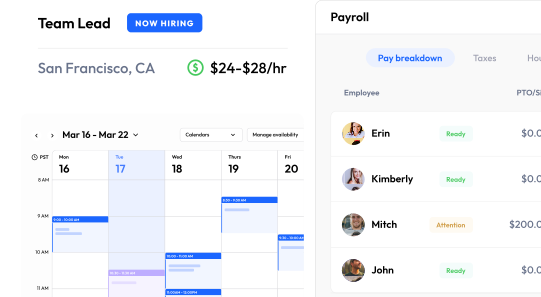
Workstream says 46 of the top 50 restaurant brands in the United States rely on its platform, including Taco Bell, Culver's, Bojangles, Arby's, and Five Guys; this is a vendor-reported figure that includes franchisee groups operating under those brands. The platform combines hiring, onboarding, scheduling, payroll, and compliance capabilities in a single mobile-friendly system built for hourly teams.
Key Features
- VoiceAI and VideoAI screening; Workstream reports that VoiceAI reminder and screening calls can reduce interview no-shows by 55%
- Text-to-Apply via QR codes for capturing walk-in candidates
- Access to 25,000+ job boards including unlimited Indeed listings through its Platinum Partnership
- Native full-service payroll with multi-EIN support and restaurant POS integrations
- Integration with Checkr for initiating and managing background checks
Why It Made the List
Workstream addresses the "six tools, zero sync" problem common in QSR operations. Workstream connects hiring, onboarding, scheduling, records, and payroll to reduce duplicate data entry, and new hire information can sync from onboarding into Payroll and Records, which can lower compliance risk and manager workload. The platform's mobile-first design extends to onboarding, where candidates complete paperwork on their phones. For mobile-first onboarding, Workstream integrates with Checkr so hiring teams can initiate and manage background checks from within the hiring workflow as you scale across locations.
2. HigherMe
HigherMe says it is trusted by more than 20,000 businesses, including Domino's, Dunkin', Tim Hortons, and Little Caesars franchisees. The platform was built by former franchise operators who understood QSR hiring challenges firsthand.
Key Features
- AI-powered interviewing and candidate scoring to help pre-screen applicants
- Text-to-Apply with QR codes for capturing walk-in traffic
- Video cover letters showing candidate personality before scheduling interviews
- Indeed integration for job distribution
- HigherMe reports a one-day average time to hire
3. Paradox
Paradox has powered McDonald's McHire candidate experience, demonstrating capability at large QSR scale. Workday completed its acquisition of Paradox on October 1, 2025, strengthening its enterprise integration capabilities.
Key Features
- Olivia conversational AI supporting candidate screening, scheduling, and engagement in 100+ languages
- Automated scheduling with calendar integration
- Deep Workday Recruiting integration, now backed by Workday following the 2025 acquisition
- Processes large volumes of candidate interactions
- Built for international QSR brands operating across multiple countries
4. Fountain
Fountain says its platform has processed 91M+ applicants and 14M+ hires across 75+ countries, serving brands including Sweetgreen and major logistics companies. The platform's stage-based workflow automation handles complex hiring funnels at scale.
Key Features
- Named AI agents (Anna for voice, Emma for support, Sam for feedback)
- Multi-currency and multi-language support for international operations
- HCM integrations including SAP SuccessFactors and ADP Workforce Now, alongside other HR technology connections
- Stage-based automation for customizable hiring workflows
- Mobile-first application flow built for high-volume hourly hiring
5. Harri
Harri reports serving 55K locations, 5M+ employees, and 600+ clients, with 7.2M applications. Purpose-built for hospitality rather than adapted from corporate HR software, the platform offers deep industry expertise.
Key Features
- TeamLive scheduling module integrated with recruiting
- Labor optimization and forecasting tools
- Employee engagement and training modules
- Harri says its platform is built on more than 20 years of firsthand QSR experience
- Particularly strong for full-service restaurants and hotel food service
6. StaffedUp
StaffedUp says it was built by restaurant owners for high-turnover operators. The platform emphasizes simplicity for operators without dedicated HR staff.
Key Features
- One-click job posting to multiple boards plus social media
- WOTC (Work Opportunity Tax Credit) screening integrated; note that the WOTC program expired on December 31, 2025, so confirm current program status
- QR code applications for in-store recruiting
- Fast setup without lengthy implementation
- StaffedUp reports 8x more applicants and a 77% shorter time to hire
7. 7shifts
7shifts serves over 1.5 million restaurant professionals and built its reputation on scheduling before adding hiring capabilities. The platform shows staffing costs against sales data.
Key Features
- Integrated scheduling with hiring in the same workflow
- Labor analytics and forecasting against sales
- Team messaging for shift-based communication
- Free plan available for one location with up to 15 employees
- Strength in scheduling with complementary hiring features
8. Hireology
Hireology emphasizes structured workflows that support consistency across locations. The platform serves decentralized employers across automotive, healthcare, and hospitality.
Key Features
- Structured workflows supporting hiring consistency
- Integrated background screening and structured hiring workflows
- Multi-location oversight and reporting
- Reusable templates and approval routing
- Focus on process consistency across dispersed teams
9. TalentReef
TalentReef, acquired by Mitratech in 2022, offers extensive workflow customization for different positions and locations. The platform integrates with Indeed through features including Indeed Apply and Sponsored Jobs.
Key Features
- Position-specific applications customizable by role and location
- AI-driven recruiting automation and configurable workflows for high-volume hourly hiring
- Indeed integration including Indeed Apply and Sponsored Jobs
- Mobile verification for background checks
- Strong customization depth for different position types
10. Fourth
Fourth carries the PeopleMatter brand legacy, serving enterprise-scale multi-location restaurant chains. The platform focuses on labor management alongside high-volume hiring.
Key Features
- Labor management beyond hiring alone
- PeopleMatter is designed to integrate with Fourth's broader workforce-management ecosystem and third-party systems through integrations and APIs
- Customizable workflows for the foodservice industry
- Established enterprise client base
- Works best as part of a broader Fourth operations stack
11. Altametrics
Altametrics offers hiring as part of a broader restaurant operations suite covering inventory, scheduling, and workforce management.
Key Features
- Applicant-tracking capabilities within a wider operations platform
- Altametrics offers applicant-tracking guidance and workforce-management tools including scheduling; confirm current native hiring-to-scheduling integration with the vendor
- Part of a broader operations suite spanning inventory and scheduling
- Built for the hospitality industry
- Suits operators already running Altametrics infrastructure
Which Applicant Tracking System is Right for Your QSR Group in 2026?
Different platforms suit different operating models. Use these prompts to narrow your shortlist:
Consider a hiring-only specialist when:
- You need applicant tracking and screening alone, and scheduling and payroll already sit with providers you plan to keep
- Your locations operate under a single EIN with straightforward pay rules
- You are running a first pilot of hiring automation before a wider rollout
Consider an enterprise conversational AI platform when:
- You hire at very high volume across hundreds of sites and already run an enterprise HCM
- Chat or conversational candidate engagement is your main gap
- Your team has the resources to manage integration and governance across multiple vendors
Consider a scheduling-first restaurant platform when:
- Shift management and labor forecasting drive more of your daily workload than hiring volume does
- Hiring is a secondary function you want bundled with scheduling tools
- Your POS data is the center of your labor planning
Consider Workstream when:
- You operate multiple QSR locations and want hiring, onboarding, scheduling, payroll, and compliance connected in one system
- Your workforce is hourly and mobile-first, and candidates apply by phone or QR code
- You manage multi-EIN or multi-brand operations where duplicate data entry across systems creates real cost
- You want AI phone screening, self-scheduling, and background check workflows tied to the same employee record
- You need location-level visibility with corporate oversight across the whole group
Workstream reports that 46 of the top 50 restaurant brands use its platform, a vendor-reported figure that includes franchisee groups operating under those brands. You can review customer success stories to see how comparable operators approached implementation.
Why Workstream Stands Out
When evaluating applicant tracking systems for QSR operations, Workstream is more than a hiring tool. The platform provides workforce management capabilities built for the speed and complexity of quick-service restaurants.
Market presence is one signal. Workstream says 46 of the top 50 QSR brands rely on its platform, a vendor-reported figure that includes franchisee groups operating under those brands. Numbers alone do not settle a software decision, though. Workstream's differentiation comes from architectural decisions that reduce the integration work required in multi-vendor setups.
The connected design means Workstream links hiring, onboarding, scheduling, records, and payroll to reduce duplicate data entry. New hire information can sync from onboarding into Payroll and Records, and worked shifts can feed payroll with role-specific rates when the relevant modules are configured together. This workflow continuity helps reduce the errors and delays that occur when disconnected tools require manual data transfer.
AI technology extends beyond basic automation. VoiceAI conducts phone screening around the clock, with support currently documented for English, Spanish, Mandarin, and French, while VideoAI handles asynchronous video interviews that candidates complete on their own schedule. These capabilities can reduce manager workload while supporting hiring quality.
Mobile-first architecture reflects how hourly workers engage with technology. Core functions work on smartphones because the platform was designed for mobile from inception rather than adapted from desktop software. Text-to-Apply via QR codes helps capture walk-in traffic.
Support is a further consideration for busy operators. Workstream offers seven-day-per-week support coverage alongside QSR-specific expertise. For franchise groups managing hundreds of locations and thousands of hourly positions, that combination of automation and hands-on support can turn hiring from a constant challenge into an operational strength.
Ready to simplify your QSR hiring? Explore Workstream's platform to see how it fits your multi-location operations.
Frequently Asked Questions
What's the most important feature an ATS should have for QSR?
Mobile-first functionality matters most. Hourly workers apply between shifts on their phones. If your application process requires a desktop or takes more than a few minutes, you may lose candidates to employers with smoother mobile experiences. Text-to-Apply with QR codes helps capture walk-in traffic that job board postings alone may not reach.
How can an ATS help reduce high employee turnover in restaurants?
An effective ATS can shorten time-to-hire, reducing the gap between application and start date when candidates often accept other offers. AI screening supports better candidate-job matching by filtering for availability and basic qualifications before manager interviews. Integration with onboarding systems also improves the new hire experience, which can support early retention in the first months on the job.
Can an ATS integrate with my existing POS system?
Some broader QSR workforce platforms support POS integrations. Workstream, for example, integrates with restaurant systems including PAR and other supported POS platforms. These integrations can pull sales and labor data to support labor cost projections during scheduling and overtime alerts, and can send time data to payroll with role-specific pay rates applied; supported data flows vary by integration, so confirm capabilities vendor by vendor.
What are the benefits of AI-powered screening for QSRs?
AI screening can handle first-round candidate evaluation 24/7 without manager involvement. Candidates receive immediate responses rather than waiting days for callbacks, which improves the applicant experience. Managers then spend their time with pre-qualified candidates who meet basic requirements such as availability, transportation, and relevant experience.
How long does it typically take to implement a new ATS for a multi-unit QSR?
Implementation timelines vary significantly by platform complexity and existing infrastructure. For Workstream payroll, the company says a basic migration averages about 10 days and typical migrations occur in under 30 days, with some implementations completed in roughly two weeks; full multi-location payroll implementations can run longer depending on complexity. Simpler hiring-only platforms may launch faster, while enterprise solutions with complex integrations often require longer windows.