




Best Employee Management Software for Franchise Restaurants
- Home >
- Workstream Blog >
- Best Emplo...

Get the latest with Workstream
Always stay current with hiring news by subscribing to our email updates
Managing employees across multiple restaurant locations means juggling schedules, payroll, compliance, and hiring, often across six different disconnected tools. The right employee management software consolidates these functions into one system, helping reduce errors and freeing up hours each week for franchise operators.
Restaurant industry turnover rates remain exceptionally high, averaging 75% to 100% for full-service restaurants and exceeding 130% in quick-service environments. Combined with the reality that 65% of restaurant owners consider staffing their top operational challenge, the need for purpose-built HR technology is significant.
We evaluated 25+ workforce management platforms based on restaurant-specific features (POS integration, tip management, compliance tools), multi-location capability, user ratings, and pricing transparency. Here are the 12 best employee management software options for franchise restaurants in 2026.
Key Takeaways
- Unified platforms can help reduce data silos: All-in-one systems that connect hiring, onboarding, scheduling, and payroll can help reduce manual entry errors
- Mobile-first design is important: Hourly workers and restaurant managers need to complete tasks from phones, not desktops
- POS integration supports labor cost visibility: Software that syncs with sales data can support smarter scheduling decisions
- Compliance automation can help reduce violations: Multi-state franchise operations benefit from built-in labor law monitoring for Fair Workweek, overtime, and break requirements
- Free tiers exist but may have limitations: Several platforms offer free options for single locations or small teams, though feature availability varies by plan
Why "Restaurant-Grade" Software Matters for Franchises
Traditional HR platforms designed for office environments miss the specific complexities of hourly workforce management. Multi-unit restaurant operations deal with:
- Employees working multiple roles at different pay rates
- Weekly (or daily) schedule changes based on sales forecasts
- Tip pooling calculations and compliance
- Meal break requirements varying by state
- ACA eligibility tracking across dispersed teams
Restaurant-grade employee management software is designed to address these challenges with unified data models: information entered once can flow across hiring, onboarding, scheduling, and payroll. This is designed to help reduce duplicate data entry and compliance risks from disconnected systems.
1. Workstream – Best All-in-One Platform for Multi-Unit Franchises
Best For: Multi-unit franchise groups needing unified hiring-to-payroll operations
Consultation: Free demo available
Starting Price: Custom quote; pricing varies by modules, employee count, number of locations, and contract term
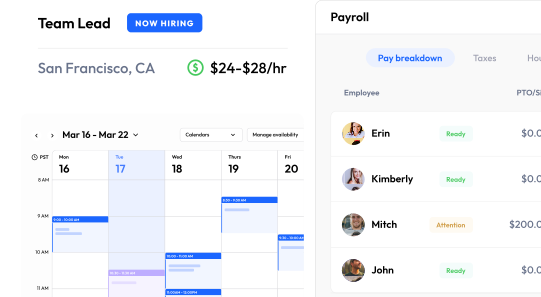
Workstream offers an all-in-one HR, payroll, hiring, scheduling, benefits, and compliance platform designed for hourly and multi-location restaurant teams, including brands such as Taco Bell, Burger King, Jimmy John's, IHOP, and Culver's. Workstream unifies the employee lifecycle from application through onboarding, scheduling, HR, and payroll in one platform.
Key Features
- VoiceAI screening: Conducts 24/7 automated phone interviews in multiple languages; Workstream reports it can help reduce no-shows by 55%
- Multi-EIN payroll management: Supports payroll runs across multiple entities and brands from a single login
- Mobile-first onboarding: Digital W-4/I-9/E-verify workflows with e-signatures
- Checkr integration: Workstream integrates with Checkr to help initiate and manage background checks, especially when dealing with thousands of applications across locations as you scale up
- Compliance heat maps: Help identify risk across locations, with violation flagging
- POS integrations: Connects with Toast, Square, and PAR for labor data transfer
Why It Made the List
Workstream's unified data model is designed so managers can enter information once and have it flow across systems. The platform reports a 96.4% customer satisfaction score with an average support response time of 2 minutes, available 7 days per week. As one example, Workstream reports that a Bojangles franchisee saw application increases of up to 1,400% at certain locations after implementation, a specific customer result rather than a typical guaranteed outcome.
For franchise operators managing several disconnected tools, Workstream is designed to help address the "six tools, zero sync" problem.
2. 7shifts
7shifts built its platform for restaurants from inception, reporting 35,000+ restaurants and over 1 million restaurant professionals served. The platform's restaurant focus means most features address foodservice-specific operational needs.
Key Features
- AI-powered labor forecasting: Uses POS sales data
- Tip management: Automated tip pooling and daily tip payouts
- POS integrations: 50+ integrations including Toast, Square, and Lightspeed
- Shift swapping: Open shift management via mobile app
- Overstaffing alerts: Support for labor cost management
7shifts offers forecasting designed to help flag overstaffed shifts. Users report saving 8+ hours weekly on scheduling tasks, which can suit operations that don't need full HR/payroll integration.
3. Homebase
Homebase offers an accessible entry point for restaurants moving to digital scheduling, serving 100,000+ small businesses with its platform.
Key Features
- Free Basic plan: Available for one location and up to 10 employees; paid plans support larger teams and advanced features
- GPS time clock: Geofencing designed to help reduce early clock-ins, available on eligible plans
- Hiring, onboarding, and HR tools: Built into the platform
- User-friendly interface: Designed for first-time adopters
- Scheduling and shift management: Automated tools included
Homebase's free Basic plan can offer value for single-location restaurants with smaller teams, while paid plans scale as operations grow. The platform is reported to have strong user satisfaction, particularly among small businesses moving from paper schedules to digital systems.
4. Toast Scheduling
Toast reports that its broader platform is used across over 112,000 locations, with Toast Scheduling integrating natively into that ecosystem, which is designed to help reduce data silos between sales and labor management.
Key Features
- Native POS integration: Real-time labor cost tracking
- Payroll sync: Automatic hours sync with Toast Payroll
- Unified dashboard: Combines sales, labor, and schedule data
- Single-vendor relationship: Scheduling, POS, and payroll can run through Toast
- Advanced forecasting and demand planning: Available with Toast Scheduling Pro
For restaurants committed to the Toast ecosystem, built-in scheduling is designed to help reduce integration work. Sales forecasts can inform staffing decisions with less manual data transfer.
5. When I Work
When I Work serves 150,000+ companies with an emphasis on mobile apps and straightforward functionality.
Key Features
- Auto-scheduling: Based on availability and templates
- OpenShifts: Shift swapping via mobile app
- Fast deployment: Designed for launch in days rather than weeks
- Mobile time clock: Includes GPS tracking
- Team messaging: Communication tools included
When I Work's simplicity can suit small restaurants that prioritize ease of use over advanced features. The platform can be a cost-effective option for tight-knit teams without complex scheduling requirements.
6. Deputy
Deputy serves 390,000+ workplaces globally with compliance features addressing U.S. labor law requirements.
Key Features
- AI-powered auto-scheduling: Includes demand forecasting
- Fair Workweek, overtime, and break compliance tools
- Biometric time clocking: Face recognition option
- Scalability: From single cafe to enterprise chains
- Configurable compliance alerts: Designed to flag potential issues before schedules are finalized
Deputy's compliance tools can flag scheduling, break, overtime, and Fair Workweek risks before schedules are finalized, which can be useful for restaurants navigating multi-state regulations. The AI auto-scheduling is designed to help generate cost-effective schedules that account for configured compliance rules.
7. HotSchedules
HotSchedules has been a long-established provider in the space for 25+ years, reporting 7,000+ customers across 120,000+ locations.
Key Features
- AI-powered forecasting: Uses sales, weather, and event data
- Automated schedule generation: Built for multi-unit brands
- Integration with Fourth's inventory and operations tools
- Established presence: Used by major U.S. hospitality brands
- Enterprise-level reporting and analytics
HotSchedules is a long-established option for large franchise groups. Its forecasting is designed to analyze historical data to help generate schedules for brands managing many locations.
8. Sling
Sling offers a free tier supporting core shift scheduling and communication features for teams up to 30 users; advanced functionality, including time tracking, requires a paid plan.
Key Features
- Core scheduling features: Included in the free plan for teams up to 30 users
- Native Toast POS integration: Available post-acquisition
- Team messaging and task management: Included free
- User-based billing: Deactivated or deleted users don't count toward the user total
- Shift trading: Availability management included
Sling's free plan can help reduce cost barriers for small independent restaurants and seasonal businesses. The Toast integration can add value for operators already on that POS.
9. Restaurant365
Restaurant365 says more than 40,000 restaurants use its platform, connecting workforce management with accounting and inventory.
Key Features
- Scheduling integrated with accounting and inventory systems
- Data-driven scheduling: Against forecasted sales
- Real-time alerts: For overtime and compliance risks
- Enterprise-level reporting: Multi-location visibility
- Unified operations reporting: Connects labor costs with financial data across locations
Restaurant365's back-office platform is designed to give CFO-minded operators visibility into how labor costs affect profitability across the business.
10. Connecteam
Connecteam serves 36,000+ companies, including Subway, Chick-fil-A, and Biggby Coffee, with functionality spanning scheduling, communication, and training.
Key Features
- GPS time clock: Geofencing designed to help reduce buddy punching
- Modular hub-based pricing: Includes a free Small Business Plan for up to 10 users, with paid tiers for larger teams
- Mobile-first design: Built for deskless workers
- Combined functionality: Scheduling with communication and training tools
- Digital forms and checklists: For operations
Connecteam's modular pricing, including a free plan for up to 10 users, can suit smaller operations as they grow. The platform is reported to have strong satisfaction with its balance of features and cost.
11. Gusto
Gusto says more than 500,000 businesses use its platform as a payroll solution for small businesses.
Key Features
- Unlimited payroll runs: No off-cycle fees
- Automatic federal, state, and local tax filing: Multi-state payroll is available on eligible higher-tier plans
- Benefits administration: Includes health insurance and 401(k)
- Integrations: Connects with 7shifts, Homebase, and other scheduling tools
- Employee self-service portal
Gusto can offer accessible, full-service payroll for restaurants that don't need enterprise capabilities. Its integration with popular scheduling tools can simplify adding payroll functionality.
12. ADP Workforce Now
ADP Workforce Now offers HR infrastructure backed by 75+ years of payroll experience.
Key Features
- HCM suite: Covers payroll, HR, benefits, and time management
- Multi-state payroll: Tax filing across jurisdictions
- Reporting and compliance tools: Enterprise-level
- Integration ecosystem: Connects with major platforms
- Dedicated support: For complex payroll needs
ADP is a long-standing choice for large franchise groups with complex payroll needs. While not restaurant-specific, its compliance infrastructure and established reputation can make it viable for brands with dedicated HR teams.
Key Features to Evaluate When Choosing a Workforce Management Tool
When selecting workforce management software for your franchise restaurant, focus on features that directly affect operational efficiency and compliance. Look for platforms that offer unification across the employee lifecycle, from application to paycheck, rather than point solutions that can create data silos.
Mobile accessibility matters, since your hourly workforce and managers need to complete tasks from their phones, not desktop computers. POS integration capabilities should be a priority, supporting labor cost tracking against sales data for scheduling decisions. Multi-location management features become important as you scale, particularly multi-EIN payroll support that can handle different legal entities and tax jurisdictions from a single platform.
Compliance automation can help protect your business from costly violations, especially when operating across multiple states with varying Fair Workweek laws, overtime rules, and break requirements. Features like AI-powered scheduling, automated onboarding workflows with e-verify and background check integrations, and reporting dashboards can separate basic tools from more advanced solutions.
For multi-unit franchise operations seeking a unified platform designed to help reduce disconnected systems and manual data entry, Workstream offers a comprehensive option to evaluate. With results reported at scale, including use by 46 of the top 50 restaurant brands, responsive customer support, and features spanning the employee lifecycle from hiring through payroll, Workstream is the ideal choice for franchise operators ready to modernize their workforce management.
Why Workstream Is a Strong Choice for Franchise Restaurant Operations
When evaluating employee management software for franchise restaurants, Workstream stands out as a strong choice for operators managing multiple locations. While other platforms may excel in specific areas, such as scheduling depth, compliance, or accounting integration, Workstream is designed to address the full employee lifecycle, from hiring through payroll.
Workstream reports that 46 of the top 50 restaurant brands use its platform, reflecting adoption at scale. Features like VoiceAI are reported by Workstream to help reduce interview no-shows by 55%, while multi-EIN payroll management is designed to help manage the complexity of franchise operations.
For franchise operators managing disconnected systems and manual data entry, Workstream is designed to help reduce that friction. A 2-minute average support response time is designed to help you get support quickly when issues arise.
Ready to see how unified employee management works? Request a demo to explore whether Workstream fits your franchise operations.
Frequently Asked Questions
What features should franchise restaurants prioritize in employee management software?
Multi-location franchise operations should prioritize unified platforms that connect hiring, onboarding, scheduling, and payroll with less manual data transfer. Essential features include multi-EIN payroll management, compliance monitoring for varying state labor laws, POS integration for labor cost visibility, and mobile-first design for hourly workers. Platforms offering all-in-one functionality can help reduce tech stack complexity and data silos that cause errors.
How can employee management software reduce restaurant turnover?
Software can support retention through faster hiring (reducing time positions stay unfilled), streamlined onboarding that engages new hires early, and scheduling flexibility that respects employee preferences. Platforms with automated onboarding workflows are designed to help new hires get productive faster, while features like shift swapping via mobile apps give hourly workers flexibility. Industry data shows restaurant turnover averaging 75-100%, making retention improvements potentially impactful.
Is multi-EIN payroll support important for franchise owners?
It can be. Franchise groups often operate multiple legal entities across different states, each requiring separate tax filings and compliance management. Multi-EIN payroll platforms can support payroll runs across entities from a single login, with tax rules applied by entity and jurisdiction. Without this capability, franchise operators may need to manage separate payroll systems for each entity, adding administrative burden and compliance risk.
What kind of support response time should I expect from top platforms?
Platforms vary in their support model, with response times ranging from a few minutes to 24 hours depending on the provider and plan. Workstream reports 2-minute average response times with high customer satisfaction. When evaluating platforms, ask about support hours, response time targets, and whether support is included or requires additional fees.
Can employee management software help with labor law compliance?
Some platforms include built-in rules for federal, state, and local labor regulations that are designed to flag potential violations in time tracking, scheduling, and payroll. Features like compliance heat maps can help identify problem areas across locations, while automated break reminders and overtime alerts can help flag potential violations before they occur. For multi-state franchises navigating Fair Workweek laws and varying overtime rules, compliance automation can be a valuable tool, though employers remain responsible for compliance decisions.