



Best Employee Scheduling Software for Franchise Restaurants
- Home >
- Workstream Blog >
- Best Emplo...

Get the latest with Workstream
Always stay current with hiring news by subscribing to our email updates
Managing schedules for a single restaurant is challenging enough. Coordinating shifts across 10, 50, or 100+ franchise locations while controlling labor costs and maintaining compliance with varying state labor laws? That's an entirely different operational challenge that generic scheduling tools simply weren't built to handle.
Restaurant franchises face unique workforce pressures: industry estimates put annual restaurant turnover in the 75-130% range, alongside complex multi-location staffing needs, tip pooling calculations, and meal break compliance that varies by jurisdiction. Meanwhile, franchise managers report spending a significant share of their week on scheduling-related tasks, time that could go toward customer service and team development.
The right shift scheduling software transforms this administrative burden into a strategic advantage. We evaluated 15+ platforms based on multi-location capabilities, franchise-specific features, POS integrations, and verified customer success at major franchise brands to identify the 12 best options for 2026.
Key Takeaways
- Multi-location support separates enterprise tools from SMB options – Franchise operators need centralized visibility across all sites, not just single-location functionality
- POS integration is table stakes for restaurants – The best platforms pull sales data directly from Toast, Square, and PAR systems for demand-based scheduling
- Mobile-first design matches hourly worker behavior – Employees clock in, swap shifts, and access schedules from their phones; desktop-retrofitted apps create friction
- Compliance automation is becoming essential – Fair Workweek laws in California, New York, and Oregon require predictive scheduling features that can help flag violations before they occur
- All-in-one platforms can help reduce data silos – Connecting hiring, scheduling, and payroll can help reduce manual re-entry and compliance risks from disconnected systems
Why Franchise Restaurants Need Specialized Scheduling Software
Traditional scheduling tools were designed for single locations with predictable staffing patterns. Franchise restaurants operate differently: employees work multiple roles at different pay rates, schedules change weekly based on sales forecasts, and managers must coordinate coverage across locations while staying compliant with complex labor regulations.
The cost of getting this wrong is significant. Manual scheduling errors can lead to overtime violations, missed breaks can trigger state penalties, and poor shift management can contribute to turnover in an industry already struggling to retain workers.
Modern scheduling platforms address these challenges through automated break enforcement, real-time overtime alerts during schedule creation (not after the fact), and labor cost projections that help managers stay within budget before publishing schedules. The best solutions integrate directly with payroll systems to help reduce double data entry and support accurate pay calculations.
1. Workstream – Best Overall for Franchise Restaurant Operations
Best For: Multi-unit franchise groups needing hiring-to-payroll integration
Starting Price: Custom pricing (tiered packages: Hiring, Essentials, All-in-One, Premium)
Workstream reports serving 46 of the top 50 U.S. restaurant brands, including Taco Bell, Arby's, IHOP, Jimmy John's, and Five Guys, and says it manages 35,000+ franchise locations, making it among the most widely deployed solutions among major QSR chains.
Key Features
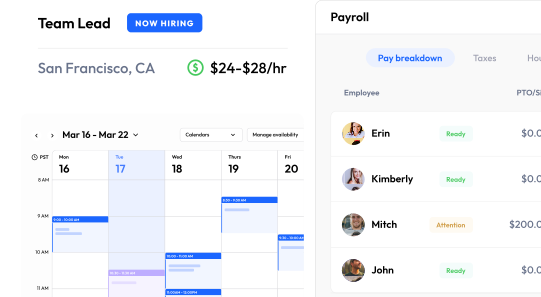
- Unified hiring-to-payroll platform can help reduce data silos between recruiting, onboarding, scheduling, and pay
- Multi-EIN payroll support handles complex franchise structures with employees working multiple roles and locations
- Geofenced mobile time tracking can restrict or flag early clock-ins and support location-based attendance
- VoiceAI screening conducts 24/7 automated phone interviews in multiple languages
- Checkr integration – Workstream integrates with Checkr to help initiate and manage background checks, especially when dealing with thousands of applications across locations as you scale up
Why It Made the List
Workstream is one of relatively few platforms that connects the hourly employee lifecycle from hiring through scheduling to payroll in a single system built for restaurant complexity. The unified data model is designed so that information entered once can flow across all functions when relevant modules are configured together, which can help reduce compliance risks from disconnected tools.
The platform's operational reliability at scale is supported by its footprint across thousands of franchise locations. For franchise operators managing thousands of employees across hundreds of locations, this integration can help address the "six tools, zero sync" problem that affects many restaurant groups.
Franchise Customers: Taco Bell, Culver's, Bojangles, Arby's, IHOP, Firehouse Subs, Five Guys
2. 7shifts
7shifts has built a following among restaurant customers with its restaurant-exclusive design. The platform integrates with a broad range of POS systems for real-time, sales-driven scheduling.
Key Features
- Auto-scheduling generates schedules based on sales forecasts, weather, and historical patterns
- Daily tip payout deposits credit card tips directly to employee bank accounts at clock-out
- Labor forecasting factors in weather, local events, and historical sales data
- Internal chat and task management centralizes team communication
- Integrations with major POS platforms support demand-based scheduling
3. Deputy
Deputy's AI-powered auto-scheduling creates draft schedules based on customizable rules, which can help reduce manual scheduling work.
Key Features
- Built-in U.S. labor law compliance flags break, overtime, and Fair Workweek violations before schedules publish
- Demand-based staffing pulls POS sales data for predictive scheduling
- Multi-location management with cross-location employee sharing
- Pre-built compliance rules by state and locality can help reduce manual configuration
- AI-assisted scheduling designed to support legal compliance
4. Homebase
Homebase reports serving over 150,000 small businesses and says users logged more than 1.2 billion hours on the platform in the past year. Its free plan is available for one location with up to 10 employees; paid plans support multiple locations and larger teams.
Key Features
- Free tier includes scheduling, time clock, and team communication for a single location with up to 10 employees; multi-location and larger-team support requires a paid plan
- All-in-one dashboard combines scheduling, hiring, time tracking, HR, and payroll
- AI-powered scheduling assistant suggests optimal schedules on paid tiers
- Optional add-ons for payroll and tip management
- Accessible entry point for single-location operators, with paid tiers for growing franchises
5. HotSchedules
HotSchedules serves restaurant franchise operations at scale. The platform's labor forecasting uses historical data and other variables to help predict demand.
Key Features
- Forecasting engine analyzes multiple variables for demand prediction
- Automated schedule generation for multi-unit brands
- Integration with the broader Fourth ecosystem (payroll, inventory, operations)
- Infrastructure built for large-scale deployment
- Used by large franchise groups requiring enterprise-grade scheduling infrastructure
6. When I Work
When I Work offers per-user pricing that can scale affordably for smaller core teams.
Key Features
- OpenShifts feature helps fill vacant slots with qualified available employees
- Forecasting tool compares scheduled hours vs. expected demand by location
- Quick deployment with a relatively short learning curve
- Mobile app designed for hourly workers
- Per-user pricing model that can suit small franchise teams differently than flat per-location rates
7. Toast
Toast Scheduling provides native integration with Toast POS, connecting sales, labor, and schedule data.
Key Features
- No additional integration required for existing Toast customers
- Syncs with Toast Payroll for hours transfer
- Real-time labor cost tracking against sales in a unified dashboard
- Centralizes restaurant operations data within the Toast ecosystem
- Can reduce vendor complexity for Toast customers already on the platform
8. Sling
Sling offers a free tier with scheduling for an unlimited number of users and locations; confirm current feature limits directly with Sling, as free-tier terms can change.
Key Features
- Free scheduling tier, with billing tied to active users each month for paid features
- Fair billing model charges only for active users each month, which can suit seasonal staffing
- Toast integration following Toast's acquisition of Sling
- Team communication hub centralizes shift messaging and announcements
- Option for franchise groups testing digital scheduling or operating seasonally
9. Restaurant365
Restaurant365 says it serves more than 40,000 restaurant customers with an all-in-one platform integrating scheduling, accounting, and inventory management.
Key Features
- Unified operations platform connects scheduling with accounting and inventory
- Data-driven scheduling against forecasted sales with real-time alerts
- Reporting across labor, food costs, and sales
- Labor cost visibility during schedule creation
- Positioned for operators wanting scheduling integrated with financial management
10. Connecteam
Connecteam serves a large base of companies with flat-rate pricing that can be cost-effective for teams between 10-30 employees.
Key Features
- Flat-rate pricing model as an alternative to per-user pricing
- GPS time clock with geofencing to support onsite clock-ins
- Schedule approval/rejection lets employees confirm shifts for accountability
- Mobile-first design built around hourly worker behavior
- Potential savings over per-user alternatives for growing franchises
11. Buddy Punch
Buddy Punch offers location verification features, aimed at preventing buddy punching and time theft across distributed locations.
Key Features
- GPS tracking with geofencing, GPS on punch, and real-time location tracking
- Punch limiting can help prevent early clock-ins and auto clock-outs
- Break scheduling with state-specific compliance alerts
- Attendance alerts for late clock-ins, early clock-outs, and no-shows
- Monitoring features aimed at franchises managing time theft concerns
12. TCP
TCP's AI-powered Demand Scheduler forecasts staffing needs and builds schedules, while the Labor Optimizer compares scheduled vs. actual hours.
Key Features
- Predictive demand scheduling as an alternative to template-based manual scheduling
- Built-in Fair Workweek, FLSA, and minor labor rules designed to help flag potential violations
- Labor Optimizer designed to help manage overtime before it happens
- Free trial available for evaluation; confirm current trial length with TCP
- Positioned for operators moving from manual scheduling methods
Key Features to Evaluate When Choosing Workforce Management Software
When selecting scheduling software for franchise restaurants, prioritize platforms that address the complexity of multi-location operations. Look for systems that provide centralized visibility across all sites while allowing location-level customization. The ability to share employees across locations, manage role-specific pay rates, and handle multi-EIN payroll structures distinguishes enterprise-capable solutions from single-location tools.
Integration capabilities determine whether your scheduling software simplifies or complicates operations. Demand-based scheduling that pulls real-time sales data from your POS system enables managers to staff appropriately based on actual traffic patterns rather than guesswork. Direct integration with payroll systems can help reduce manual data transfer, lowering errors and supporting accurate pay for hours worked at correct rates.
Compliance automation has shifted from nice-to-have to essential. State-specific labor laws, Fair Workweek regulations, break requirements, and overtime rules vary by jurisdiction. Software that flags potential violations during schedule creation, rather than after shifts are worked, can help prevent costly penalties and support legal compliance across multiple states.
For franchise restaurant operators seeking a comprehensive solution, Workstream is the ideal choice. The platform connects hiring, onboarding, scheduling, time tracking, and payroll in a single system, which can help reduce the data silos and manual re-entry that come with managing multiple disconnected tools. With reported reliability across 35,000+ franchise locations and an integration with background check provider Checkr, Workstream is built to support the operational efficiency and compliance needs of growing franchise brands.
Frequently Asked Questions
Why is mobile-first scheduling so important for franchise restaurants?
Hourly restaurant workers don't sit at desks. They need to check schedules, request time off, swap shifts, and clock in from their phones. Platforms built desktop-first with retrofitted mobile apps can create friction that reduces adoption and increases scheduling errors. Mobile-first design supports higher day-to-day usage.
How can employee scheduling software help with labor law compliance?
Modern platforms can automatically flag potential violations during schedule creation, before shifts are worked. Features like automated break enforcement, real-time overtime alerts, and Fair Workweek compliance rules can help prevent costly penalties. The best solutions pre-configure state-specific rules rather than requiring manual setup.
What are the benefits of integrating scheduling with payroll?
Integration can reduce manual data transfer between systems, lowering errors and saving administrative time. When scheduling data flows directly to payroll, employees are more likely to be paid accurately for actual hours worked, role-specific pay rates can apply automatically, and compliance documentation stays more audit-ready.
Can employee scheduling software reduce staff turnover in restaurants?
It may help. Platforms that give employees more control over their schedules through shift swapping, availability preferences, and mobile access can improve job satisfaction. Predictable scheduling has been associated with improved retention in some research, which is particularly relevant in an industry facing 75-130% annual turnover; results vary by operator and implementation.
Are there scheduling features specific to multiple locations and diverse pay rates?
Enterprise platforms are built to handle multi-location complexity, including cross-location employee sharing, role-specific pay rates, multi-EIN payroll structures, and centralized visibility with location-level customization. These features distinguish franchise-grade solutions from single-location tools.