




Best Onboarding and Payroll Software for Hourly Workers
- Home >
- Workstream Blog >
- Best Onboa...

Get the latest with Workstream
Always stay current with hiring news by subscribing to our email updates
Restaurant and retail businesses face a tough reality: turnover in the foodservice industry is often reported above 75% annually, with QSR operations frequently running even higher. Estimates put the cost of each departure between $2,706 and $17,651 depending on the role, money that comes directly out of your bottom line.
Traditional HR software was built for desk-based workers with email access and scheduled hours. Hourly employees need mobile-first tools that work from offer acceptance through first clock-in. The right onboarding software can make a meaningful difference between a new hire who stays past 90 days and one who leaves after the first shift.
We evaluated 30+ platforms based on mobile architecture, POS integration, compliance support, user ratings, and reported customer results. Here are 12 strong options for businesses with hourly workforces.
Key Takeaways
- Mobile-first design matters: Hourly workers often complete onboarding on smartphones rather than desktops, so platforms without strong mobile experiences can add friction that lowers completion rates
- All-in-one platforms can reduce data silos: Disconnected hiring, onboarding, scheduling, and payroll systems often require manual re-entry, which can increase errors and compliance risks
- POS integration matters for restaurants: Connections to POS systems such as Toast, Square, and PAR can help automate labor cost tracking, with supported data flows varying by integration
- Compliance support can reduce risk: Multi-state tax filing, I-9 verification, and meal break tracking can help flag potential issues, though no software guarantees compliance
- Implementation speed varies widely: Some platforms go live in days, while enterprise solutions can take three to six months
Why Specialized Payroll Software Matters for Hourly Workers
Generic HR platforms often treat every employee the same way: fixed schedules, consistent pay rates, straightforward tax calculations. Hourly operations are far more complex.
A single restaurant employee might work as a server (tipped wage), shift lead (higher hourly rate), and trainer (different pay grade), sometimes in the same week. Multiply that across multiple locations, states, and EINs, and payroll processing quickly becomes a compliance challenge.
Common Challenges for Hourly Businesses
- Multi-Rate Employees: Workers with different pay rates by role or location
- Tip Pooling and Distribution: Complex calculations for front-of-house staff
- Meal Break Compliance: State-specific requirements with penalty wages for violations
- Overtime Across Locations: Hours worked at multiple sites counting toward weekly totals
- High-Volume Hiring: Processing dozens of new hires monthly during peak seasons
Strong platforms handle these nuances natively rather than forcing workarounds. Look for systems that understand the difference between a salaried office manager and an hourly line cook.
1. Workstream
Best For: Restaurant groups and franchise operations managing hiring, onboarding, scheduling, and payroll in one system
Consultation: Free demo available
Pricing: Custom quote across four tiers (Hiring, Essentials, All-in-One, Premium), with Time and Scheduling available as an add-on
Key Differentiator: A mobile-first platform built for hourly workforces that connects hiring, onboarding, payroll, and compliance tools in one system
Workstream reports that 46 of the top 50 restaurant brands in the United States use its platform, a vendor-reported figure that includes franchisee groups operating under those brands. The platform is built specifically for hourly workforces, with workflows designed for smartphones.
Key Features:
- Mobile-First Onboarding: Mobile-first onboarding where new hires complete W-4, I-9, direct deposit, and company documents on their phones with e-signatures
- Full-Service Payroll: Full-service payroll with multi-EIN management, AI-assisted auditing, automated tax filing, and POS integrations (Toast, Square, PAR), with supported data flows varying by integration
- VoiceAI Screening: 24/7 automated phone interviews in multiple languages; Workstream reports customers have seen no-shows drop by 55%, a vendor-reported result rather than a guaranteed outcome
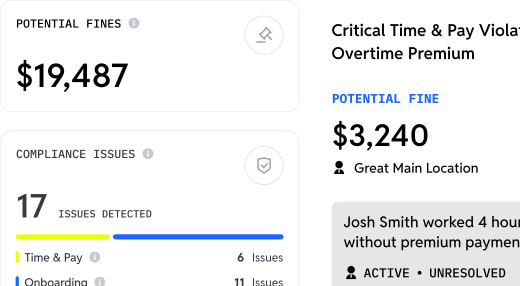
- Compliance Dashboard: Labor law monitoring with heat maps that help identify locations needing attention
- Background Checks: Workstream has a deep integration with Checkr to initiate and conduct accurate background checks, especially when you're dealing with thousands of applications across locations as you scale up. Checkr performs the screening itself, while Workstream users initiate and track checks from within the hiring workflow.
- I-9 and E-Verify Automation: I-9 and E-Verify workflows built into the onboarding flow
Strengths:
- Unified Platform: Hiring, onboarding, payroll, and compliance tools in one system, with scheduling available as an add-on
- Indeed Platinum Partner: Partner status with unlimited free job postings
- Responsive Support: A Workstream-reported two-minute average support response time, seven days a week
Why It Made the List
Georgia Foods, a 41-location Bojangles franchisee, reported increasing monthly applications from two to three to 30 to 40 per location, a 1,400% jump within 60 days of implementation. This is a customer-reported result, not a guaranteed outcome. Workstream's connected data model means information entered once can flow from hiring through payroll, which can reduce duplicate entry, sync errors, and gaps between disconnected systems. Workstream's compliance tools support compliance workflows but do not replace legal advice or guarantee compliance.
2. Gusto
Gusto built its reputation on simplicity. The AutoPilot feature runs payroll automatically once configured, and the platform handles multi-state payroll tax filing. For small businesses without dedicated HR staff, this hands-off approach has clear appeal.
Key Features:
- Automated Payroll: Payroll processing with direct deposit
- Time Tracking: Built-in time tracking synced to payroll
- Tax Filing: Payroll tax filing across all 50 states
- Integrations: 180+ integrations including QuickBooks, Xero, and Slack
Gusto's month-to-month plans with no long-term contracts and unlimited payroll runs make it accessible for businesses trying HR software for the first time. Setup is designed to be straightforward for small teams.
3. BambooHR
BambooHR focuses on the employee experience beyond processing paperwork. Research cited in structured onboarding studies suggests employees who go through structured onboarding are significantly more likely to feel committed to their employer, an important factor in reducing hourly turnover.
Key Features:
- Onboarding Checklists: Customizable checklists with mobile access
- Pre-Boarding Automation: Sends forms before day one
- Performance and Compensation: Performance management and compensation planning tools
- Integrations: 150+ integration partners
BambooHR reports serving 30,000+ companies, and its interface is frequently noted for being easy to learn. Bundling HR, Payroll, and Benefits can make it practical for businesses expanding multiple HR functions, with a strong employee self-service portal and HRIS capabilities beyond basic onboarding.
4. Rippling
Rippling connects HR, IT, and finance in one system. When you hire someone, the platform can provision their email, Slack account, and laptop alongside their HR paperwork; Rippling says this can happen in under 90 seconds.
Key Features:
- Integrations: 500+ integrations across business tools
- Device Provisioning: Automated device setup alongside HR onboarding
- Multi-State Tax: Multi-state tax compliance support
- Workflow Automation: Custom workflow automation
Rippling cites Forrester research reporting a 42% efficiency gain across HR, payroll, and finance. Its customizable workflows and IT provisioning tend to appeal to tech-savvy operations.
5. Paycor
Paycor targets shift-based industries with features like remote I-9 verification, multilingual support, and predictive analytics designed to estimate turnover risk.
Key Features:
- Shift-Specific Onboarding: Onboarding workflows built for shift-based teams
- Integrations: 400+ native integrations with workforce management tools
- Predictive Retention Analytics: Insights that help managers identify at-risk employees
- Remote I-9 Verification: Remote verification options
Paycor's mobile app serves both employees and managers, and its predictive analytics can help managers intervene before at-risk employees leave. The platform is built for industries with large hourly populations.
6. HigherMe
HigherMe builds onboarding directly into its applicant tracking system. When you mark a candidate as hired in the ATS, onboarding triggers automatically, reducing manual handoffs and data re-entry.
Key Features:
- Automatic Onboarding Trigger: Onboarding starts from the ATS hire status
- Screening Partners: E-Verify and background checks through First Advantage and Checkr
- Mobile Completion: Mobile-first onboarding designed to be completed in under 30 minutes
- Multi-Location Dashboard: Oversight across locations without separate logins
HigherMe reports that operators save six hours per hire compared to manual processes and that 20,000+ businesses use the platform, including Tim Hortons and Dunkin' franchisees. It is built for high-volume hourly hiring.
7. Homebase
Homebase offers a free plan for one location with up to ten employees that includes scheduling, time tracking, and basic HR. For micro-businesses watching every dollar, this can be a practical starting point.
Key Features:
- Scheduling and Time Tracking: Free scheduling and time tracking on the Basic plan
- GPS Geofencing: Location-based clock-in verification
- Team Messaging: Messaging for welcoming new hires
- Document Collection: Basic onboarding document collection
Homebase reports serving 150,000+ businesses. Its free plan gives small teams a functional starting point, with easy setup and scheduling, time tracking, and basic HR in one place.
8. ADP Workforce Now
ADP brings 75+ years of payroll experience and reports paying approximately one in six U.S. workers. For organizations already using ADP products, adding Workforce Now keeps HR and payroll within one ecosystem.
Key Features:
- Digital I-9 and E-Verify: Digital completion of verification forms
- Global Payroll: Multi-state and international payroll across 140+ countries
- Integration Marketplace: An extensive library of integrations
- Compliance Experience: A long track record in payroll compliance
ADP reports 1.1 million+ clients. Its global capabilities suit enterprises with international operations, and Workforce Now fits naturally for organizations already using ADP.
9. Paychex Flex
Paychex holds IFA (International Franchise Association) preferred vendor status, reflecting its work with franchise operations. The three-tier structure (Select, Pro, Enterprise) allows businesses to start small and scale.
Key Features:
- Franchise Programs: Franchise-specific programs and support
- Dedicated Specialist: A dedicated payroll specialist on the Pro tier
- Support Options: 24/7 support options
- Experience: 50+ years of payroll experience
Paychex reports 840,000+ customers. Its IFA relationship and scalable tiers make it a familiar option for franchise operators.
10. 7shifts
7shifts focuses on food service operations, from coffee shops to franchise chains, with features built around restaurant workflows.
Key Features:
- POS Integrations: 50+ restaurant POS integrations
- Tip Management: Tip tracking and distribution tools
- Labor Forecasting: Forecasts tied to POS sales data
- Shift Scheduling: Scheduling with labor cost projections
7shifts' POS connections help restaurants manage labor costs against sales, making it a natural fit for operators who want restaurant-specific scheduling and labor forecasting.
11. Deputy
Deputy reports serving 390,000+ workplaces globally and offers international compliance capabilities. Its facial recognition time clocks help address buddy punching, a persistent challenge in hourly operations.
Key Features:
- GPS Clock-In: Location verification at clock-in
- Facial Recognition: Helps reduce time theft
- Integrations: 100+ integrations with major POS and payroll systems
- International Compliance: Compliance automation for multiple countries
Deputy's global footprint makes it a fit for businesses expanding internationally, and its Australian origins inform its approach to complex labor regulations.
12. OnPay
OnPay offers single-tier pricing that includes its full feature set. With 30+ years in business, the platform offers stability without enterprise complexity.
Key Features:
- Multi-State Coverage: All 50 states included without extra fees
- Permission Levels: A six-level permission system for location delegation
- Unlimited Payroll Runs: Run payroll as often as needed
- Simple Pricing: One plan without tier selection
For small multi-state operations, OnPay's all-inclusive plan helps keep costs predictable, and the platform earns strong user ratings.
Key Features to Evaluate in Onboarding and Payroll Software
When comparing platforms for an hourly workforce, look at how well each one supports the full employee lifecycle:
- Mobile-First Onboarding: W-4, I-9, direct deposit, and document completion on a smartphone
- Hiring Connection: Applications, screening, and interview scheduling that feed directly into onboarding
- Payroll for Multi-Rate Employees: Support for different pay rates by role, location, and EIN
- I-9 and E-Verify Workflows: Verification built into the onboarding flow
- Compliance Monitoring: Alerts, audits, and reports that help flag potential issues for review, without replacing legal review
- Scheduling and Time Tracking: Timecards that connect directly to payroll
- POS Integrations: Connections to your POS, keeping in mind that data flows vary by integration
- Implementation Support: Realistic go-live timelines and responsive support during rollout
- Scalability: The ability to add locations, roles, and employees without adding new tools
The more of these functions a single platform covers, the less time managers spend reconciling data between disconnected systems. For multi-location restaurant and retail operators that want hiring, onboarding, payroll, and compliance connected in one mobile-first system built for hourly teams, Workstream is the ideal choice.
Which Onboarding and Payroll Software is Right for Your Hourly Workforce in 2026?
Many operators piece together separate systems for hiring, onboarding, scheduling, and payroll, creating manual handoffs at every transition point. The right fit depends on your size, industry, and how many of those functions you want in one place.
Consider Gusto or OnPay when:
- You run a small business with straightforward payroll needs
- You want predictable plans and unlimited payroll runs
Consider BambooHR, Rippling, or Paycor when:
- You need deeper HRIS, performance management, or IT provisioning
- You want predictive retention analytics or extensive workflow customization
Consider ADP or Paychex when:
- You want an established payroll provider with international or franchise-specific programs
- You already use other products in that provider's ecosystem
Consider HigherMe, 7shifts, Deputy, or Homebase when:
- Your main gap is hiring, scheduling, or time tracking and you plan to keep a separate payroll provider
- You run a single location and want a free or low-commitment starting point
Consider Workstream when:
- You manage multiple locations or EINs and want hiring, onboarding, and payroll in one mobile-first system
- You want time and scheduling data feeding into payroll calculations, with scheduling available as an add-on
- Your employees work multiple roles with different pay rates, and you need support for tip pooling (Tip Management currently in Beta), meal break tracking, and high-volume hiring
- You hire frequently and want I-9, E-Verify, and Checkr background check workflows built into onboarding
- You want compliance monitoring that helps flag potential issues across locations before payroll runs
Workstream reports that 46 of the top 50 restaurant brands use its platform, a vendor-reported figure that includes franchisee groups operating under those brands. Browse customer success stories to see how multi-location operators approached implementation.
Ready to cut onboarding and payroll busywork? Request a demo to see how Workstream supports hourly teams from first application to first paycheck.
Frequently Asked Questions
What specific challenges do hourly workforces face with traditional onboarding software?
Traditional systems assume employees have desk access, email accounts, and scheduled start times. Hourly workers often start mid-shift, complete paperwork on phones, and need training before their first clock-in. Mobile-first platforms address these realities with digital onboarding designed for the deskless workforce.
How does mobile-first design benefit hourly employees and managers?
Employees can complete I-9s, tax forms, and direct deposit setup from smartphones, with no computer required. Managers can approve documents, review schedules, and process payroll from mobile devices without returning to the office. This flexibility matches how hourly operations actually run.
Can onboarding software help reduce new hire turnover?
It can help. The first 90 days are critical for retention, and structured onboarding is associated with stronger employee commitment. Platforms that automate welcome sequences, training checklists, and milestone tracking help new hires feel prepared and valued.
What's the difference between an all-in-one platform and using separate tools?
All-in-one platforms maintain a connected data model where information entered once can carry across hiring, onboarding, scheduling, and payroll. Separate tools typically require integrations, manual data transfer, and reconciliation, which can increase errors and compliance risks while consuming administrative time.
How important is POS integration for restaurant payroll?
Very important for most restaurants. POS integrations can pull sales data for labor cost calculations, sync employee hours, and support tip calculations, though supported data flows vary by integration. Without them, managers often reconcile systems manually, a time-consuming process that can introduce errors affecting both compliance and pay accuracy.