




Paradox Review 2026: Pros and Cons
- Home >
- Workstream Blog >
- Paradox Re...

Get the latest with Workstream
Always stay current with hiring news by subscribing to our email updates
Conversational AI has transformed high-volume recruiting by automating candidate screening, interview scheduling, and initial engagement. For hourly employers processing hundreds or thousands of applications monthly, the promise of 24/7 automated hiring assistance sounds compelling. But does Paradox, one of the most prominent names in AI recruiting, deliver for the businesses that need it most?
This review examines Paradox's capabilities and real-world performance in 2026, with particular attention to how the platform serves restaurants, retail, and other hourly workforce industries. We'll compare its chat-led approach against voice-based AI alternatives and consider whether a specialized talent acquisition product or a broader workforce platform better fits the operational demands of multi-location employers.
Key Takeaways
- Chat and voice screening serve different applicant pools: Conversational AI chatbots handle text-based candidate engagement well, while some candidates may prefer a live or voice-based interaction, so channel choice depends on how your applicant population communicates
- Specialized recruiting products connect to other systems through integrations: Hourly employers should decide whether they need a specialized recruiting product or a broader platform that also includes payroll, scheduling, and workforce management
- Pricing is quote-based across this category: Neither platform publishes fixed package prices, so smaller operators should request a quote and confirm minimum contract, implementation, and support requirements
- Implementation timelines depend on deployment scope: Setup length varies with integrations, locations, languages, and workflow complexity, so request a written deployment estimate from each vendor
- Integration depth determines administrative workload: A recruiting platform can create additional administrative work if it is not adequately integrated with downstream HR, payroll, and scheduling systems
What Is Paradox and How Does Its Conversational AI Work?
Paradox built its reputation on Olivia, an AI assistant that automates candidate communication through conversational interactions. The platform serves global clients, including major brands such as McDonald's, Chipotle, and CVS Health.
The core technology handles several recruiting functions:
- Automated screening: Olivia screens candidates through mobile, web chat, and SMS-driven conversations to filter applicants before human review
- Interview scheduling: Candidates self-schedule through conversational prompts synced with hiring manager calendars
- Application assistance: The assistant guides candidates through job search and application steps, which Paradox says can improve candidate conversion
- FAQ responses: Common candidate questions about pay, benefits, and job requirements receive automated answers
Paradox's portfolio extends beyond a chatbot to include a conversational ATS that can post jobs, track applicants, and extend offers, along with a CRM, career sites, assessments, video interviewing, hiring events, and post-hire onboarding. It focuses on talent acquisition and candidate experience rather than payroll, employee shift scheduling, or time and attendance.
Workday completed its acquisition of Paradox on October 1, 2025, adding Paradox's candidate experience technology to its talent acquisition suite, particularly for frontline and high-volume roles.
Paradox supports candidate-facing interactions in more than 100 languages, with its back-end system translatable into more than 30 languages. Employers should evaluate both the languages their applicants use and the operational capabilities they require.
Paradox Strengths
Enterprise-Scale Candidate Engagement
Paradox handles large application volumes through its conversational interface. Paradox reports that Chipotle reduced application-to-start time from 12 days to four, a 75% reduction. General Motors reportedly saved more than $2 million in recruiting costs in less than a year after automating interview scheduling. These are customer-reported and vendor-reported results.
Enterprise HCM and ATS Integration
Paradox integrates with major ATS and HCM platforms, including SAP SuccessFactors, through direct integrations, extensions, and APIs; integration depth varies by system. Organizations using Workday can connect Paradox candidate-experience workflows with Workday Recruiting, subject to the organization's implementation and configuration.
Multi-Channel Messaging Flexibility
Olivia engages candidates through SMS, mobile and web chat, email, and other configured communication channels, allowing employers to meet candidates on channels they already use.
Points to Confirm During Evaluation
- Scope of the platform: Paradox is not a payroll, employee shift-scheduling, or timekeeping system. Employers may still require an HRIS for long-term employee records and broader document management, depending on how they configure Paradox onboarding
- Integration and data flow: Verify whether your selected Paradox configuration provides the integrations and data synchronization needed to avoid manual re-entry
- Channel fit: Paradox's core conversational screening is chat- and text-led. Some candidates may prefer a live or voice-based interaction, so evaluate channel preferences within your own applicant population
- Deployment timeline: Paradox does not publish a universal implementation timeline. Request a deployment estimate based on integrations, locations, languages, and workflow complexity
- Pricing: Paradox uses custom pricing rather than publishing fixed plans, so request a quote and confirm minimum contract, implementation, and support requirements
Conversational AI Chatbot vs. Voice AI: Two Approaches to Candidate Screening
The fundamental difference between Paradox's approach and alternatives such as Workstream's VoiceAI comes down to communication channel.
Chat-Based Screening
- Candidates interact through text messages, web chat, or mobile conversations
- Conversations happen asynchronously, so candidates respond when convenient
- Gives candidates more time to compose responses
- Works well for text-comfortable applicant populations
Voice-Based Screening
- AI conducts automated phone calls with candidates
- Real-time conversation allows for natural follow-up questions
- Reaches candidates who prefer or require phone communication
- Workstream's VoiceAI conducts automated screening calls around the clock and supports multiple languages; confirm the currently available languages with Workstream
Workstream says its VoiceAI and automated hiring workflows can reduce interview no-show rates by 55%, while providing transcripts, recordings, and match scores for hiring managers. This is a vendor-reported result.
When Voice Screening May Help
- Diverse applicant pools: Phone screens may reach some candidates who are less comfortable with chat-based applications
- High-urgency hiring: Real-time calls can complete screening in one session, while asynchronous text lets candidates respond at their convenience
- Open-ended role requirements: Voice screening may allow candidates to answer open-ended questions verbally
- Multilingual workforces: Phone conversations in candidates' supported languages can support rapport with applicants
Beyond Recruiting: Why Hourly Employers Should Evaluate Operational Coverage
A specialized recruiting platform can create additional administrative work if it is not adequately integrated with downstream HR, payroll, and scheduling systems. When hiring data lives in one system, payroll in another, scheduling in a third, and time tracking in a fourth, businesses can face:
Data Re-Entry and Error Risk
New hire information collected during recruiting may need to be transferred to payroll and scheduling systems. Manual re-entry can increase the risk of errors in pay rates, employee records, tax setup, and compliance documentation.
More Complex Compliance Management
ACA eligibility tracking requires visibility across hiring dates, scheduled hours, and actual time worked. Separate systems can make this tracking more complex, particularly when scheduled and actual hours must be reconciled across platforms.
Fragmented Employee Experience
New hires may interact with different portals for applications, onboarding documents, scheduling, and pay stubs. Multiple portals can create a more fragmented onboarding and employee experience.
Platform Solutions That Consolidate Vendors
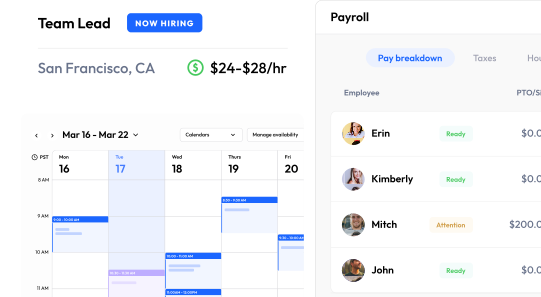
Workstream addresses these challenges through an all-in-one platform combining:
- Applicant tracking: Applicant tracking with VoiceAI screening and candidate-rediscovery and talent-network features
- Full-service payroll: Full-service payroll with multi-EIN support for franchises; pricing is customized
- Time and scheduling: Time tracking and scheduling with mobile clock-in options, shift swaps, availability and time-off requests, break tracking, overtime alerts, labor-cost forecasting, and direct payroll connectivity
- Mobile-friendly onboarding: Onboarding with I-9 and E-Verify workflows, plus a native Checkr integration for ordering and managing background checks
Workstream integrates with Checkr to help initiate and manage background checks, especially when dealing with thousands of applications across locations as you scale up. Employers can order checks from the candidate record and manage associated results and adverse-action workflows. When the relevant Workstream modules are deployed together, applicant and employee data can flow into onboarding and payroll with fewer manual handoffs.
Applicant Tracking Capabilities: Core ATS Functionality Compared
Both platforms provide applicant tracking, though their scope and focus differ.
Paradox ATS Capabilities
- Conversational candidate experience through the Olivia assistant
- Conversational ATS that can post jobs, track applicants, and extend offers
- Integrations with major ATS, CRM, and HCM systems through direct connections and an open API
- Reporting on conversational recruiting metrics
Workstream ATS Capabilities
- AI-powered screening through VoiceAI
- Job distribution across a large network of job boards and an Indeed Platinum partnership; Workstream says it is one of 23 ATS providers to hold Platinum status
- Candidate-rediscovery and talent-network features for re-engaging past applicants and former employees
- Text-to-apply via QR codes for in-store recruiting
Reported Outcomes
- Application volume: A 41-location Bojangles franchisee reported that some locations increased from two or three applications per month to 30-40 within 60 days, according to Workstream
- Time-to-hire: Paradox reports that Chipotle reduced application-to-start time from 12 days to four. Workstream says its VoiceAI workflows can speed time-to-hire by 3x
- Interview attendance: Workstream says its VoiceAI and automated hiring workflows can reduce interview no-show rates by 55%
These figures are vendor- or customer-reported results rather than independently validated benchmarks, and outcomes depend on applicant flow, workflow design, and local labor conditions.
The structural difference: Workstream offers hiring, HR, payroll, and scheduling as modules within one platform, whereas Paradox focuses on talent acquisition and generally connects to other HR systems through integrations.
Customer Experience: Support, Implementation, and Integrations
Integration Ecosystems
Enterprise HCM and ATS:
- Paradox: Workday, plus integrations with major ATS and HCM systems including SAP SuccessFactors; confirm the current Oracle configuration
- Workstream: Supports integrations and data connections with payroll and HR systems; integration type, sync direction, and update frequency vary by provider
POS systems:
- Paradox: Does not prominently market restaurant POS integration as a core product capability; confirm available integrations directly with Paradox
- Workstream: Offers restaurant-technology integrations, including POS connections; confirm current support and sync direction for Toast, Square, and PAR
Job boards:
- Paradox: Supports job posting and distribution through its ATS and integrations; confirm board coverage for the proposed deployment
- Workstream: Job distribution across a large network of job boards, plus an Indeed Platinum partnership; confirm applicable plan terms
Background checks:
- Paradox: Confirm currently supported background-check partners and workflows directly with the vendor
- Workstream: Native Checkr integration with ordering from the candidate record and adverse-action workflows
Implementation Timelines
- Paradox: Does not publish a universal implementation timeline; request a deployment estimate covering integrations, locations, languages, and workflow complexity
- Workstream: Says hiring and HR modules can often launch in 2 to 4 weeks, while payroll implementation typically takes 4 to 8 weeks for multi-location operators; larger or more complex implementations may take longer
Request implementation plans and support commitments from both vendors, because timelines depend on deployment scope and integration complexity.
Which Platform Fits Your Hourly Workforce Needs?
Choose Paradox When
- Your organization already standardizes on Workday HCM infrastructure
- You have dedicated recruiting teams managing high-volume enterprise hiring
- Chat- and text-led candidate communication matches your applicant population
- You already have established payroll and scheduling vendors you're satisfied with
- Broad multilingual candidate engagement is a primary requirement, since Paradox supports candidate-facing interactions in more than 100 languages
Choose Workstream When
- You need hiring, payroll, and scheduling in a unified platform
- Multi-location or franchise operations require multi-EIN payroll support
- Your candidates prefer or require phone-based communication
- Restaurant-specific features such as tip management, multi-role employees, and POS integration matter
- Consolidating vendor relationships and support contacts is a priority
The fundamental choice is a specialized product versus a broader platform. If talent acquisition is your primary need and you're satisfied with existing operational vendors, Paradox's conversational AI provides strong enterprise capabilities. If you want to consolidate vendors while gaining integrated hiring, payroll, and scheduling, Workstream states that 46 of the top 50 restaurant brands use its platform.
Frequently Asked Questions
How does the Workday acquisition of Paradox affect existing customers?
Workday completed its acquisition of Paradox on October 1, 2025, making Paradox part of Workday's broader AI-powered talent acquisition suite, with particular emphasis on frontline and high-volume roles. Existing customers continue receiving support. Customers should ask Workday and Paradox how the acquisition affects standalone products, contracts, integrations, and future roadmap commitments, especially if they do not operate on Workday infrastructure.
Can Paradox integrate with restaurant POS systems for labor cost visibility?
Paradox does not prominently position POS-based labor-cost analysis as a core product capability, and its public integrations messaging focuses on ATS, CRM, HCM, apps, and APIs. Confirm available POS connections directly with the vendor. Workstream offers POS integrations that may allow labor and sales data to be analyzed together, depending on the integration and modules configured, so confirm sync direction and available reporting during evaluation.
What happens to candidate data when switching from Paradox to an alternative platform?
Data-export rights, formats, fees, and retention periods depend on the customer's contract and configured integrations, so review contract terms and data-processing documentation for your specific agreement. Before switching, confirm whether conversation history, screening data, attachments, assessments, and derived scores are included in available exports. Plan for potential re-engagement of promising candidates who may need fresh screening in the new system.
How do multilingual capabilities compare for domestic U.S. hourly hiring?
Paradox supports candidate-facing interactions in more than 100 languages, with back-end translation in more than 30 languages. Workstream's VoiceAI supports automated screening in multiple languages; confirm the currently available list with Workstream. The value of broader language coverage depends on the languages used by applicants in each employer's markets, along with accessibility requirements and expansion plans, so evaluate both language coverage and operational feature depth.
What compliance certifications does each platform maintain for data security?
Paradox maintains SOC 2 Type II and ISO 27001 certifications, indicating enterprise-grade security controls. For Workstream, request current security documentation, including applicable audit reports, certifications, data-processing terms, and payroll-security controls. When evaluating either platform, verify that security practices cover all integrated modules, particularly payroll processing, which involves sensitive financial and tax data subject to additional regulatory requirements.