




Best Payroll Services in Washington for Restaurants (2027)
- Home >
- Workstream Blog >
- Best Payro...

Get the latest with Workstream
Always stay current with hiring news by subscribing to our email updates
Running restaurant payroll in Washington State presents unique challenges that generic payroll software is not always designed to handle. Unlike most states, Washington does not allow employers to count tips toward the minimum wage, so employees must receive the applicable minimum wage before tips. In 2026, the state's standard minimum wage is $17.13 per hour, and Seattle requires $21.30 per hour for covered work within city limits, regardless of employer size. Add paid sick leave accrual, Paid Family and Medical Leave (PFML) premiums, and the 0.58% WA Cares Fund deduction, and payroll quickly becomes a compliance minefield.
For multi-location restaurant groups, the complexity multiplies. A franchise with locations in both Seattle and Spokane must track different minimum wages, determine whether Seattle's Secure Scheduling Ordinance applies to its operation, and manage Washington's L&I workers' compensation reporting, all while handling tip pools, overtime calculations, and multi-rate employees who work as both cooks and servers. The right payroll service can reduce these headaches; the wrong one can create liability.
Key Takeaways
- Washington prohibits tip credits: Employees must receive the applicable minimum wage before tips ($17.13 standard state rate and $21.30 for covered work in Seattle in 2026)
- Payroll costs depend on employer-specific rates: Unemployment rates, taxable wages, and L&I classifications vary by employer, and employee PFML and WA Cares deductions are separate from employer expenses
- POS integration matters: Connections between your point-of-sale and payroll system can reduce manual tip entry, though supported data varies by integration
- Multi-location compliance varies: Seattle's $21.30 minimum wage and, for qualifying large employers, its Secure Scheduling Ordinance require systems that handle jurisdiction-specific rules
- Integrated platforms can reduce errors: Solutions combining hiring, scheduling, and payroll can reduce duplicate data entry, though managers still need to review exceptions before payroll is submitted
Understanding Payroll Services for Washington Restaurants
Washington's regulatory environment creates specific requirements that restaurant payroll systems must address. The state's no-tip-credit law means simpler wage calculations but significantly higher base labor costs compared to states allowing tip credits. Seattle's 2026 minimum wage of $21.30 per hour compares with the federal minimum of $7.25 per hour, and other Washington jurisdictions set their own local rates.
Why Restaurants Need Specialized Payroll
Restaurant payroll often requires handling:
- Multi-rate employees: A single worker might earn different rates as a line cook, server, and shift lead
- Tip pool distribution: Allocating tips among eligible workers under the restaurant's tip-pool policy. Washington permits eligible kitchen staff to participate and excludes owners and salaried-exempt managers
- Meal and rest break tracking: Adult employees working more than five hours receive a meal period of at least 30 minutes, generally starting between the second and fifth hours, plus a 10-minute paid rest break per four hours worked. An on-duty or interrupted meal period must be paid, and a time punch alone does not establish that a worker received the break
- Overtime across multiple roles: When employees work different positions at different pay rates, the regular rate generally uses weighted earnings across roles in the same workweek, rather than a simple average of job rates
Key Regulatory Landscape in Washington
The compliance requirements specific to Washington restaurants include:
- Paid Sick Leave: Covered employees accrue at least one hour per 40 hours worked starting when employment begins and may use accrued leave beginning on the 90th calendar day. Seattle has its own employer-size rules, including one hour per 30 hours for its largest tier
- PFML: In 2026, the total premium rate is 1.13% of wages, up to a per-worker wage cap of $184,500. Employees may pay up to 71.43% of the premium, employers with fewer than 50 employees generally owe no mandatory employer share, and tips are excluded
- WA Cares Fund: 0.58% employee-paid long-term care premium, subject to eligibility and exemptions; employers can elect to cover it
- Workers' Compensation: Mandatory L&I coverage with quarterly reporting requirements for employers that are not certified self-insured
- Seattle Secure Scheduling: Covers qualifying hourly employees of large retail and food-service employers. The employer threshold is 500 employees worldwide, with an additional 40-full-service-location threshold for full-service restaurants. Covered employers generally must post schedules at least 14 days in advance
What Makes a Payroll Service 'Best' for Washington Restaurants?
Essential Features for Restaurant Payroll
When evaluating payroll software, restaurant operators should prioritize:
- POS Integration: Import of tips and hours from your POS, with supported fields confirmed for your specific connection
- Washington Tax Support: Setup and handling for PFML, WA Cares, and L&I
- Multi-jurisdiction Support: Different rules for Seattle vs. the rest of the state
- Mobile Access: Managers need payroll visibility on the floor, not just in the office
- Break Tracking: Recording meal and rest periods to help reduce wage claim risk
Evaluating Provider Performance
Implementation timelines, support response times, and tax-penalty protections vary by provider and agreement. Before signing, ask each provider: "What implementation timeline, support response commitment and tax-penalty remedy will you put in our agreement?" Keep in mind that a vendor's average response time does not establish a resolution deadline. It also helps to confirm which of your existing restaurant systems connect to the platform and which data fields transfer.
1. Workstream: Best Restaurant-Grade HR Software
Best For: Restaurant groups needing hiring, onboarding, scheduling, and payroll in a single platform
Consultation: Free demo available
Pricing: Custom pricing based on the package and add-ons selected
Key Differentiator: Hiring, onboarding, and full-service payroll built for hourly, multi-location teams, with scheduling and compliance tools available as part of the platform
Workstream offers hiring, onboarding, and payroll in a single platform built specifically for hourly businesses, with scheduling, compliance monitoring, and ACA capabilities available according to the package and add-ons selected. Workstream lists Hiring, Essentials, All-in-one, and Premium packages. All-in-one adds payroll; Time & Scheduling is available as an add-on, and ACA eligibility tracking is listed under Premium and the ACA & Benefits add-on. Unlike general HR platforms adapted from salaried workforce models, Workstream is designed around the specific complexities restaurants face.
Key Features
- Unified Data Flow: Information entered once can carry across hiring, onboarding, and payroll when the relevant modules are configured together
- Hiring to Payroll Handoff: New hires move from application to onboarding to payroll within the same platform
- Manager-Led Setup: Managers can set up job and pay details in Workstream, while employees complete their onboarding tasks
- Automated Payroll Deductions: Workstream calculates payroll deductions, including deductions configured for Washington programs such as PFML and WA Cares
- I-9 and E-Verify workflows: Digital document collection that supports Form I-9 and E-Verify; employers still perform their verification duties
- Compliance Monitoring: Labor law monitoring with compliance heat maps in the Compliance offering
- ACA Eligibility Tracking: Benefits threshold tracking available in Premium and the ACA & Benefits add-on
- Mobile Approvals: Managers handle approvals from the floor, not tied to a desktop
- Mobile Onboarding: Employees complete onboarding paperwork on their phones
- Geofenced time clocks: Restrict clock-ins by location and shift settings
- Overtime Warnings: Real-time overtime alerts during scheduling, not after the fact
- Spreadsheet-Style Payroll View: On enabled accounts, managers can click, edit, sort, and filter payroll data
- POS Connections: Connects with Square, Toast, and PAR; confirm which time, sales, and tip fields your POS connection supports. The Toast connection requires access to Toast Partner Integrations
- Tip Management (Beta): For accounts with Tip Management beta access, finalized tip pools can flow into payroll
- Multi-EIN Payroll: Full-service payroll manages unlimited payroll runs across multiple EINs from a single login
- AI-Powered Payroll Assistant: Flags potential risks, such as overtime, minimum wage, and meal break issues, for review before submission
Washington-Specific Strengths
For Washington restaurants, Workstream supports multi-location payroll across cities with different regulations from a single platform. Workstream calculates payroll deductions and can flag potential labor issues before payroll is submitted. Operators should confirm their Washington tax setup, local wage updates (such as Seattle's $21.30 rate versus the $17.13 standard state rate), and Seattle scheduling-pay support for their account. Like any payroll platform, Workstream supports compliance workflows but does not guarantee legal compliance; employers remain responsible for applying current state and local requirements.
Why It Made the List
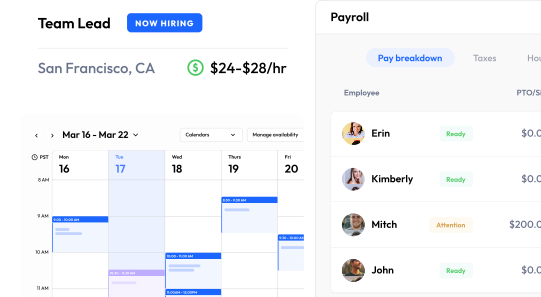
Workstream brings the hiring-to-payroll lifecycle into one mobile-first system, which can reduce the re-entry of employee data across disconnected tools. Managers can set up job and pay details while new hires complete onboarding tasks on mobile.
Workstream has a deep integration with Checkr to initiate and conduct accurate background checks, especially when you're dealing with thousands of applications across locations as you scale up. Managers can initiate and track checks in Workstream through a connected Checkr account, while Checkr conducts the check.
2. Toast Payroll
Toast Payroll connects with the Toast POS system to bring hours and tips into payroll, reducing manual data entry for restaurants already using Toast. The platform supports Washington payroll tax administration after account setup. Employers must register applicable accounts, provide tax details, assign L&I risk classes or exemptions, and maintain current rates and access credentials.
Key Features
- POS-to-Payroll Connection: Hours and tips flow from Toast POS into payroll
- Tip Pool Distribution: Tip pooling synced with POS data; confirm the purchased tip-pooling configuration
- Washington Tax Administration: Supported once the employer supplies current account information, job classifications, and rates
- Minimum Wage Settings: Minimum-wage settings for payroll calculations; employers verify the local rate and update employee pay before previewing payroll
- No Tip Credit Calculations: Wages calculated without tip credits, consistent with Washington law
- Paid Sick Leave Tracking: Leave accrual tracking; confirm the purchased leave configuration
For restaurant groups with locations in Seattle (21.30/hr)andelsewhereinthestate(17.13/hr standard rate), Toast provides the settings to apply different minimum wages, with employers responsible for verifying each location's rate. Occupational codes used for unemployment reporting and L&I risk classes serve different purposes, so both should be set up accurately.
3. Square Payroll
Square Payroll offers an accessible entry point for single-location restaurants already using Square POS. The platform imports timecards and tips from Square POS for review before payroll and processes Washington state filings and payments. With eligible Square-balance funding, employees can receive direct deposit in a traditional bank account the next business day, and employees using Cash App can receive funds instantly.
Key Features
- Square POS Integration: Import timecards and tips from Square POS, then review before running payroll
- Faster Direct Deposit: Next-business-day deposits to traditional bank accounts with eligible Square-balance funding, and instant funds for employees using Cash App
- Mobile-First Payroll Processing: Run payroll from a phone or tablet
- Washington Filings and Payments: Washington payroll filings and payments, including quarterly workers' compensation premium payments
- Square Scheduling Tools: Scheduling and timecards within the Square ecosystem
Restaurants that handle scheduling and time tracking outside Square's ecosystem may need an extra step to bring that data into payroll.
4. Netchex
Netchex treats restaurants as a core vertical rather than a configuration exercise. The platform supports restaurant POS connections through APIs and tailored imports. In July 2026, Netchex launched Mesh, its AI HR teammates for the deskless workforce, and the company describes its Penny assistant as flagging paycheck discrepancies. Netchex's Core package includes time and payroll, while All-In adds the scheduler.
Key Features
- Multi-Location Management: Restaurant group management across locations
- POS Connections: APIs and tailored imports; confirm the connection method and fields for each location
- Scheduling: Scheduler included in the All-In package; confirm Seattle scheduling requirements for each location
- AI-Powered Payroll Review: Penny assistant flags paycheck discrepancies
- Multi-State Capability: Support for restaurant groups expanding beyond Washington
For Washington restaurants, Netchex supports multi-jurisdiction payroll across cities with different regulations. In our editorial view, it fits restaurant groups with five or more locations across Washington.
5. Paychex
Paychex offers payroll and PEO services to Washington businesses. Paychex lists Flex payroll packages and a separate Washington PEO (Professional Employer Organization) offering for restaurants wanting to outsource broader HR functions.
Key Features
- Flex Payroll Packages: Tiered payroll options for different business needs
- Workers' Compensation Support: Scope of Washington filings and payments depends on the service agreement
- Multi-State Payroll Support: Payroll for operations in more than one state
- PEO Services: A separate Washington PEO offering
Washington provides workers' compensation coverage through L&I rather than private insurers, except for certified self-insured employers. Restaurants evaluating Paychex should ask it to identify the Washington workers' compensation filings and payments covered by the proposed service agreement.
6. Gusto
Gusto offers payroll with tip tracking and supports Washington payroll tax setup and premium collection, including Washington Paid Leave and WA Cares premiums. Employers enter and maintain their assigned L&I rates and class codes and should verify local wages and leave policies. Gusto's connections vary by partner: Clover syncs worker profile details, When I Work can export pay-period hours, and 7shifts supports a separate payroll workflow.
Key Features
- Multi-Rate Employee Management: Pay employees different rates for different roles
- Blended Overtime Calculations: Overtime calculated across multiple pay rates
- Health Insurance Marketplace Access: Benefits options for small teams
- Washington Premium Collection: Collection of Washington Paid Leave and WA Cares premiums
- Partner Integrations: Connections with Clover, When I Work, and 7shifts
Because connections vary by partner, restaurants should confirm whether tips and job rates transfer through the specific integration they plan to use. In our editorial view, Gusto suits independent restaurants with fewer than 20 employees.
7. Homebase
Homebase approaches payroll as an extension of scheduling and time tracking. The platform offers scheduling, GPS-verified time tracking, overtime alerts, and employee self-service through a mobile app, with payroll and Tip Manager available separately.
Key Features
- Scheduling-First Platform: Payroll and Tip Manager offered as separate add-ons
- GPS-Verified Time Tracking: Location-verified clock-ins
- Free Plan: Homebase Basic is free for one location with up to 10 employees
- Employee Self-Service Mobile App: Shift and pay access for employees
- Break Tracking: Records breaks to support Washington meal and rest period reviews
Covered Seattle employers should verify how their Homebase setup records schedule changes and calculates any premiums owed. Tracking a break also differs from confirming a worker actually received it. Restaurants focused on scheduling and time tracking may find Homebase a fit, while groups with complex multi-location payroll needs may want to also evaluate more payroll-focused options.
TipHaus
TipHaus is a specialized tip automation add-on rather than a full payroll service. The Washington Hospitality Association partnered with TipHaus to address one of the biggest pain points for Washington restaurants: tip pool calculations. The platform calculates tips based on POS data, and restaurants should confirm compatibility with their payroll system. Washington Hospitality Association members receive a member discount and an exclusive 30-day free trial.
Key Features
- POS-Based Tip Calculations: Tip calculations built from point-of-sale data
- Tip Distribution Automation: Reduced manual work for tip pool allocation
- Member Benefits: Discount and exclusive free trial for Washington Hospitality Association members
Customer-Reported Results
- Flatstick Pub: A manager reported saving 20 hours per month on tip processing
- Wooden City: The owner reported reducing weekly tip work from about 12 hours to under one hour, and Brock Lynch of Wooden City Green Lake reported immediate ROI
- Ram Restaurants: The operations director reported reduced manual verification
Cost Comparison: Total Payroll Burden in Washington
Understanding the true cost of restaurant payroll in Washington requires looking beyond the monthly software fee. A Washington restaurant's payroll costs depend on its assigned unemployment rate, taxable wages, and workers' compensation classifications. Employee PFML and WA Cares deductions should be shown separately from employer expenses.
Example: 15 Employees, $450,000 in Unemployment-Taxable Wages
- Unemployment Insurance (employer-paid): At an assumed 2% unemployment rate, $450,000 in unemployment-taxable wages produces $9,000. Use your assigned rate and each worker's taxable wages; the 2026 Washington unemployment wage base is $78,200 per worker
- Workers' Compensation (L&I): Calculate separately using actual hours worked, assigned risk classes, and employer-specific rates. Where a worker deduction applies, distinguish it from the employer-paid amount
- PFML (shared premium): The 2026 total premium rate is 1.13% of wages up to $184,500 per worker, excluding tips. Employees may pay up to 71.43%, and an employer with fewer than 50 employees generally owes no mandatory employer share
- WA Cares (employee deduction): 0.58% of wages, withheld from employees subject to eligibility and exemptions, unless the employer elects to cover it
The Case for Integrated Restaurant HR Platforms
The payroll services listed above handle payroll, but many restaurants manage more than just payroll. The real challenge is managing disconnected systems: one tool for hiring, another for onboarding, a third for scheduling, and yet another for payroll. Each system requires separate data entry and multiplies the chance for errors.
Many restaurant operators juggle job posting platforms, applicant tracking systems, onboarding paperwork collection, time and scheduling software, payroll processing, and compliance management. When these systems don't talk to each other, data gets re-entered, compliance documentation can fall through the cracks, and managers spend hours on administrative tasks instead of running their restaurants.
Integrated platforms address the six-tool problem by consolidating functions into a single system where supported data can flow from hiring through payroll. For Washington restaurants facing PFML, WA Cares, varying minimum wages, and, for qualifying large employers, Seattle's Secure Scheduling Ordinance, an integrated approach can reduce data re-entry and free managers to focus on operations. Managers still need to review exceptions, confirm local rates, and reconcile payroll before submission.
Key Features to Evaluate When Choosing a Restaurant Payroll Platform
The right platform should support the full employee lifecycle, not just the payroll run. When comparing options, evaluate these capabilities:
- Hiring: Tools for posting jobs, screening applicants, and scheduling interviews at volume
- Onboarding: Mobile-friendly paperwork, document collection, and new hire setup
- Payroll: Support for multi-rate employees, tips, overtime, and state and local tax setup
- HR: Centralized employee records that stay consistent from hire through payroll
- Scheduling: Shift planning with overtime visibility before schedules are published
- Time Tracking: Location-aware clock-ins and break recording
- Compliance Support: Workflows and alerts that help managers spot potential wage, break, and documentation issues for review
- Analytics: Reporting on labor costs, hiring activity, and payroll trends across locations
- Integrations: Connections to POS, background check, and accounting systems, with clear documentation of which data transfers
- Automation: Reduced manual steps for approvals, deductions, and data handoffs
- Scalability: Support for additional locations, brands, and EINs as your group grows
For Washington restaurant groups that want hiring, onboarding, scheduling, and payroll connected in one mobile-first system, Workstream is the ideal choice.
Which Payroll Service is Right for Your Washington Restaurant in 2026?
Different platforms fit different operating models. Use these prompts to narrow your shortlist:
Consider a POS-native payroll tool when:
- You run one or a few locations on a single POS and want payroll tied closely to it
- Hiring, onboarding, and scheduling already sit with tools you plan to keep
- Your pay rules are straightforward and apply in one jurisdiction
Consider a scheduling-first platform when:
- Shift scheduling and time tracking are your primary pain points
- Your team is small, and payroll needs are relatively simple
Consider Workstream when:
- You operate multiple locations and want hiring, onboarding, scheduling, and payroll in one system
- You manage locations in Seattle and elsewhere in Washington with different wage rates
- You run multi-EIN or multi-brand operations where duplicate data entry across systems creates real cost
- You want mobile approvals, overtime warnings, and payroll risk flags connected to the same employee record
- You want background check workflows connected to hiring and onboarding
Workstream reports that 46 of the top 50 restaurant brands use its platform, a vendor-reported figure that includes franchisee groups operating under those brands. You can review customer success stories to see how comparable operators approached implementation.
Want to see how one platform can carry a new hire from application to first paycheck across your Washington locations? Schedule a Workstream demo to walk through hiring, scheduling, and payroll for your operation.
Frequently Asked Questions
What specific payroll challenges do Washington restaurants face?
Washington's no-tip-credit law, mandatory paid sick leave, PFML premiums (1.13% total in 2026), the 0.58% WA Cares deduction, and varying minimum wages create compliance complexity. In 2026, Washington's standard minimum wage is $17.13 per hour, while Seattle requires $21.30 per hour for covered work within city limits, regardless of employer size. Additionally, Seattle's Secure Scheduling Ordinance covers qualifying hourly employees of large retail and food-service employers: those with 500 or more employees worldwide, and, for full-service restaurants, at least 40 full-service locations worldwide. Covered employers generally must post schedules at least 14 days in advance.
How can integrated HR and payroll software benefit a multi-unit restaurant?
Connected systems can reduce re-entry of supported employee and time data. Managers still need to review exceptions, confirm local rates, and reconcile payroll before submission. For multi-unit groups, an integrated platform can also free manager time for operations by keeping hiring, onboarding, scheduling, and payroll records in one place.
What features should I look for in payroll services for hourly employees?
Prioritize POS integration for tip import (with supported fields confirmed for your connection), multi-rate employee handling, blended overtime calculations, mobile time tracking with geofencing, break tracking, and built-in support for Washington-specific requirements like PFML and paid sick leave.
Is a mobile-first payroll solution truly necessary for restaurant managers?
For many restaurants, it is highly valuable. Restaurant managers spend much of their time on the floor managing service. Mobile-first platforms allow payroll approvals, schedule adjustments, and compliance reviews from anywhere in the restaurant, which can reduce administrative delays and keep managers focused on operations.
How does Workstream help with compliance for Washington state labor laws?
Workstream calculates payroll deductions, provides compliance heat maps through its Compliance offering, and can flag potential labor issues before payroll is submitted. Its I-9 and E-Verify workflows support digital document collection, while employers still perform their verification duties. Operators should confirm Washington tax setup, local wage updates, and Seattle scheduling-pay support for their account. Workstream supports compliance workflows but does not guarantee legal compliance.