



Best Employee Communication App for Deskless Workforce
- Home >
- Workstream Blog >
- Best Emplo...

Get the latest with Workstream
Always stay current with hiring news by subscribing to our email updates
The gap between deskless workforce needs and available tools has real consequences. When employees feel unheard, they leave. Industry insights show that a large percentage of workers considering resignation cite poor communication as a primary factor, and this disconnect costs the global economy $8.8 trillion annually in lost productivity from disengagement. The employee communication software market is growing at 10.3% CAGR, projected to reach $2.55 billion by 2031, as organizations recognize that reaching frontline workers requires purpose-built mobile-first platforms, not adapted office software.
Key Takeaways
- Mobile-first design is non-negotiable: Frontline workers need apps built for smartphones, not retrofitted desktop tools
- No-email sign-in matters: Many hourly workers lack corporate email; the best apps allow phone number login
- Offline access is critical: Workers in warehouses, kitchens, and retail floors often have spotty connectivity
- Integration with scheduling and HR systems: Communication apps that sync with time tracking and payroll reduce manual work
- Multilingual support bridges gaps: Restaurants and manufacturing facilities with diverse teams need real-time translation
Why Modern Communication Apps Are Essential for the Deskless Workforce
Traditional communication methods like email chains, bulletin board postings, and pre-shift meetings fail frontline teams. Sixty percent of frontline workers report feeling unheard by leadership, and that disconnect directly affects retention, safety compliance, and operational efficiency.
The Unique Challenges of Deskless Worker Communication
Hourly employees face communication barriers that office workers rarely encounter:
- No corporate email addresses: Many QSR and retail workers never receive company email accounts
- Rotating schedules: Shift workers miss announcements posted during their off-hours
- Language diversity: Restaurant kitchens and manufacturing floors often employ workers who speak multiple languages
- Limited screen time: Unlike desk workers, frontline employees can't check messages throughout the day
- Connectivity gaps: Warehouses, kitchens, and retail backrooms often lack reliable WiFi
These challenges require specialized solutions. Generic chat tools like email or basic messaging apps weren't designed for workers who clock in, handle physical tasks, and clock out without ever touching a computer.
1. Workstream: Best All-in-One Platform for Hourly Workforce Management
Best For: Organizations managing high-volume hourly hiring, scheduling, and communication across multiple locations
Starting Price: Contact for custom pricing based on organization size and needs
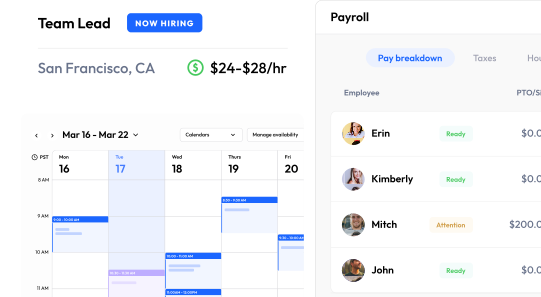
Workstream provides a comprehensive platform purpose-built for hourly workforce management, combining hiring, onboarding, scheduling, time tracking, HR, and team communication in a single mobile-first solution. The platform serves thousands of organizations across QSR, retail, hospitality, and logistics industries.
Key Features
- Mobile-first hiring with text-based recruiting and AI phone screening
- Digital onboarding with e-signatures, I-9/E-Verify automation, and document collection
- Integrated scheduling with shift management and time tracking
- Team communication with multilingual support (Spanish and Mandarin)
- Background check integration with Checkr for accurate, compliant screening at scale
- Employee engagement tools including surveys and feedback
- Compliance management for multi-location labor law tracking
Why It Made the List
Workstream eliminates the need to cobble together separate systems for hiring, onboarding, scheduling, and communication. For organizations managing hourly workers across multiple locations, the unified platform reduces administrative burden while improving the employee experience from application through ongoing employment.
The platform's deep integration with Checkr enables organizations to initiate and conduct accurate background checks seamlessly, especially valuable when dealing with thousands of applications across locations as you scale up. Combined with multilingual support for Spanish and Mandarin, automated messaging, and AI phone calls, Workstream addresses the full spectrum of hourly workforce needs.
Other Capabilities
- Comprehensive platform eliminating need for multiple systems
- Purpose-built for hourly workforce across hiring through retention
- Mobile-first design optimized for deskless workers
- Full Spanish and Mandarin support across all features
- Integrated background checks via Checkr
- Scales efficiently across multiple locations
2. Blink
Best For: Organizations prioritizing high adoption rates and purpose-built frontline features
Blink has built its reputation on achieving what many platforms struggle with: actual employee adoption. The platform serves major brands including McDonald's, NHS, easyJet, Domino's, and JD Sports.
Key Features
- No corporate email required: Workers sign in with phone number
- Real-time chat with voice notes, read receipts, and rich media
- Personalized news feed filtered by role, location, and team
- Offline access for content viewing without internet connection
- Integrations with Microsoft 365, Salesforce, and major HR systems
Why It Made the List
Blink's purpose-built approach for frontline workers translates to real results. JD Sports achieved 87% adoption in just 10 days, while Go North West reported a 26% reduction in employee turnover after implementation. Unlike tools retrofitted from office environments, Blink was designed from the ground up for workers without desks, making it intuitive for non-tech-savvy employees while still providing the analytics and controls managers need.
3. Connecteam
Best For: Small to mid-sized businesses seeking an all-in-one solution
Connecteam combines communication with workforce management features like shift scheduling, time tracking, and task management, all within a single platform designed for mobile-first use.
Key Features
- Team chat with voice and direct messaging
- Shift scheduling with automated notifications and GPS tracking
- Digital checklists and forms for task management
- Simple interface designed for non-desk workers
- Time clock with geofencing capabilities
Why It Made the List
The all-in-one approach eliminates the need to integrate multiple systems. For businesses managing hourly workers, having communication and scheduling in one app reduces friction and improves adoption.
4. Staffbase
Best For: Large organizations with multilingual, multi-location workforces
Staffbase positions itself as the enterprise solution for organizations managing global frontline workforces across manufacturing, healthcare, and logistics industries.
Key Features
- Multi-channel reach including app, email, digital signage, and SMS
- Automated translation across 100+ languages
- Fully branded employee app with offline content access
- AI-native foundation with embedded translation and content creation assistance
- Multi-channel publishing from single editor to multiple platforms
Why It Made the List
For organizations managing multilingual hourly employees across multiple countries, Staffbase's automatic translation removes barriers that would otherwise require dedicated localization teams. The multi-channel approach ensures messages reach workers through their preferred medium, whether that's push notification, email, or digital signage in break rooms.
5. Microsoft Teams for Frontline Workers
Best For: Organizations already standardized on Microsoft 365
Microsoft Teams offers dedicated frontline worker tiers designed to extend the familiar Teams experience to deskless employees at lower price points than standard licenses.
Key Features
- Shifts for schedule management and time tracking
- Walkie Talkie push-to-talk functionality
- Native Microsoft 365 integration with existing tools
- Task assignment and tracking
- Enterprise compliance and security controls built-in
Why It Made the List
For IT departments already managing Microsoft 365, adding frontline workers to Teams creates consistency across the organization without introducing another vendor. The frontline tiers provide read-only Office access and limited mailbox functionality, sufficient for many frontline communication needs.
6. Workvivo
Best For: Organizations prioritizing employee engagement and company culture
Owned by Zoom, Workvivo takes a social media-style approach to internal communication, emphasizing peer recognition, company news, and cultural engagement over purely operational messaging.
Key Features
- Social media-style news feed with recognition shoutouts
- Live streaming and video capabilities
- Native Zoom integration for video meetings
- Pulse surveys and sentiment analytics
- Employee recognition programs built into the platform
Why It Made the List
Workvivo focuses on what many platforms overlook: making employees feel connected to company culture. For organizations where employee engagement and retention are primary concerns, the social-style interface drives higher participation than traditional announcement-style platforms.
7. Beekeeper
Best For: Hospitality, logistics, and manufacturing with diverse language needs
Beekeeper built its reputation on serving industries with high language diversity, including hotels, factories, and logistics operations where workers may speak dozens of languages.
Key Features
- Inline translation across 150+ languages
- Native shift management tools
- Digital workflows and checklists with offline capabilities
- No-code workflow builder for operational tasks
- Purpose-built exclusively for deskless workers
Why It Made the List
For organizations where language barriers create safety risks or operational friction, Beekeeper's inline AI translation means workers don't miss critical updates regardless of their native language. The platform combines communication with operational workflow features designed specifically for frontline environments.
8. theEmployeeApp
Best For: Organizations wanting to combine communication with training and development
theEmployeeApp takes a unique approach by integrating microlearning directly into the communication platform, recognizing that frontline workers often need training materials delivered through the same channels as operational updates.
Key Features
- Unlimited employee texting for reaching workers without app downloads
- Customizable intranet for document sharing and resources
- Microlearning platform integrated with communication
- Advanced analytics for measuring communication impact
- Built by HR professionals specifically for deskless workers
Why It Made the List
The combination of communication and learning addresses a real gap: frontline workers often receive training through separate systems that don't integrate with daily communication. By combining both, organizations can deliver compliance training, safety updates, and operational announcements through a single platform that workers already check regularly.
9. FirstUp
Best For: Large enterprises wanting automated, personalized communication journeys
FirstUp differentiates through AI-powered orchestration that automatically times and targets messages for maximum engagement, learning from employee behavior to optimize delivery.
Key Features
- AI-timed delivery optimized by machine learning
- Automated communication journeys for onboarding, benefits, and safety
- Omnichannel delivery including mobile app, intranet, email, and digital signage
- Deep enterprise integrations with Workday, UKG, Concur, and Microsoft 365
- Targeted delivery ensuring the right message reaches the right employee
Why It Made the List
FirstUp's AI capabilities have proven ROI at scale. Southern Company Gas reported saving 91,000 hours of employee time, worth $3.9 million annually. Major customers include Dow Chemical, Love's Travel Stops, and JetBlue.
10. Slack
Best For: Organizations with both desk and deskless workers needing unified communication
Slack pioneered workplace chat and remains the industry standard for team messaging, though it was designed primarily for knowledge workers rather than frontline employees.
Key Features
- Channel-based messaging for organized team discussions
- Extensive app ecosystem with thousands of integrations
- Video calls (huddles) and screen sharing
- Searchable message history across conversations
- Customizable notifications and channel organization
Why It Made the List
For organizations where headquarters staff already use Slack, extending it to frontline teams creates a unified communication environment. The extensive integration ecosystem means Slack can connect with scheduling, HR, and operational systems, though setup requires more technical resources than purpose-built frontline tools.
11. Poppulo
Best For: Organizations with mixed remote, office, and frontline workers
Poppulo positions itself as an omnichannel solution for organizations managing diverse workforce segments, connecting hybrid, remote, and deskless workers through a unified platform.
Key Features
- Personalized employee newsfeed filtered by role and relevance
- Push notifications for important updates
- Targeted email and mobile communication by segment
- Omnichannel delivery reaching workers wherever they are
- Analytics dashboard for measuring engagement
Why It Made the List
For organizations struggling to reach workers across different environments, some at desks, some remote, some on the floor, Poppulo's personalized feeds remove irrelevant updates, ensuring each employee sees only what matters to their role. This relevance filtering reduces notification fatigue while ensuring critical messages get through.
12. Axonify
Best For: Retail, logistics, and hospitality organizations wanting communication, training, and task management
Axonify takes a comprehensive approach, combining frontline communication with training and task management specifically designed for retail, logistics, hospitality, and healthcare environments.
Key Features
- Targeted two-way communication tools
- Integrated training and microlearning modules
- Task management and completion tracking
- Mobile-first with offline access
- POS and scanner integration for retail environments
Why It Made the List
Axonify combines communication, training, and operations in one platform. For organizations wanting to consolidate multiple systems rather than integrating separate communication and learning platforms, Axonify provides a single solution that can start with communication and expand to training as needs grow.
13. MangoApps
Best For: Large organizations wanting to consolidate communication, operations, HR, and learning
MangoApps offers the most comprehensive feature set on this list, combining communication with intranet, HR tools, and learning, all in a platform that has spent 15+ years building for frontline workers.
Key Features
- Multi-channel delivery including mobile push, digital signage, SMS, and email
- Critical alerts with mandatory read receipts and audit trails
- 200+ integrations with major HR and operational systems
- AI-powered translation and personalization at no additional cost
- Comprehensive intranet and document management
Why It Made the List
MangoApps serves 2 million+ users across organizations like A.S. Watson (27,000 employees) and Raley's (20,000 employees). The platform combines the widest feature set available with enterprise-grade capabilities for organizations needing communication, HR, operations, and learning in one system.
Key Features to Evaluate When Choosing a Communication Platform
Selecting the right communication platform for your deskless workforce requires evaluating several critical capabilities beyond basic messaging. The most effective solutions share common characteristics that directly address frontline worker needs.
Look for mobile-first architecture designed for smartphone use rather than desktop tools adapted for mobile. Your platform should support no-email sign-in options, allowing workers to access the system with phone numbers rather than corporate email addresses many don't have. Offline functionality ensures employees can view schedules and critical information even in low-connectivity environments like warehouses and kitchens.
Integration capabilities matter significantly. Your communication platform should connect seamlessly with scheduling, time tracking, payroll, and HR systems to create a unified employee experience. Multilingual support with real-time translation eliminates language barriers in diverse workforces. Push notification systems must be sophisticated enough to deliver time-sensitive information when workers will actually see it.
Analytics and reporting features help you measure adoption rates, message engagement, and communication effectiveness across locations and teams. Security features including audit trails, read receipts for compliance communications, and role-based access controls protect sensitive employee information while meeting regulatory requirements.
For organizations managing high-volume hourly hiring and retention across multiple locations, Workstream provides the ideal solution by combining all these capabilities in a single platform. Rather than integrating separate systems for hiring, onboarding, communication, scheduling, and HR, Workstream delivers mobile-first functionality purpose-built for the hourly workforce from application through ongoing employment.
Frequently Asked Questions
What are the primary benefits of an employee communication app for a deskless workforce?
Purpose-built frontline communication apps address challenges that generic tools miss: no-email sign-in for workers without corporate accounts, offline access for low-connectivity environments, mobile-first design for smartphone use, and push notifications that reach workers during breaks or before shifts. Organizations implementing these tools report 20-30% productivity gains and up to 31% reductions in turnover from improved communication.
How can a communication app address language barriers among hourly employees?
Leading platforms include automatic translation. Some support 100+ languages while others cover 150+. These tools translate messages in real-time, ensuring workers receive announcements, training materials, and safety updates in their native language without requiring manual translation. For restaurants and manufacturing facilities with diverse teams, this capability prevents miscommunication that could affect safety or operations.
What is the importance of mobile-first design in a communication app for deskless workers?
Frontline workers don't sit at computers; they carry smartphones. Mobile-first apps are designed for how these workers actually access information: quick checks between tasks, during breaks, or before shifts. 89% of employees report higher engagement when using mobile technology at work, and apps designed mobile-first typically achieve higher adoption than desktop tools with mobile add-ons.
Can an employee communication app help reduce staff turnover in QSRs and retail?
Yes. Communication quality directly affects retention. 63% of employees considering resignation cite poor communication as a factor, while organizations improving transparency see 31% turnover reductions. Companies have reported 26% lower turnover after implementing effective frontline communication platforms, demonstrating that frontline workers stay longer when they feel informed and connected.
How do integrated communication tools improve scheduling and time management?
Platforms combining communication with scheduling eliminate gaps between posting schedules and employees seeing them. Shift reminders push to mobile devices automatically, shift swap requests include manager approval workflows, and overtime alerts notify managers before budget impacts occur. This integration reduces missed shifts, improves coverage, and minimizes the phone tag traditionally required for schedule changes. Time and scheduling integration creates seamless experiences for hourly workers.