




6 Best Harri Alternatives for Restaurant Hiring, Payroll & HR: 2026
- Home >
- Workstream Blog >
- 6 Best Har...

Get the latest with Workstream
Always stay current with hiring news by subscribing to our email updates
Harri serves millions of employees across 55K locations and offers workforce management tools for hiring, scheduling, compliance, and employee engagement. However, multi-unit restaurant operators increasingly require platforms that combine hiring, payroll, HR, and compliance in a single system—capabilities that may prompt a search for alternatives. From AI-powered applicant tracking to full-service payroll built for hourly workers, these six alternatives address specific operational needs for franchise groups, QSR brands, and hospitality businesses managing high-turnover teams.
Key Takeaways
- All-in-one platforms reduce vendor sprawl: The best Harri alternatives combine hiring, payroll, HR, scheduling, and compliance in one system, reducing the need for multiple disconnected tools across restaurant operations
- Built-in compliance support is critical for restaurant operators: Disconnected systems can create compliance gaps across hiring, onboarding, payroll, and labor operations, while unified platforms help automate workflows and keep teams aligned with changing requirements
- AI hiring automation helps operators fill roles faster: Strong alternatives use automation for job posting, screening, and candidate communication to reduce time-to-fill for high-volume hourly hiring
- Reducing manual work improves accuracy and efficiency: Platforms that connect hiring, onboarding, payroll, and HR reduce duplicate data entry, cut down on administrative tasks, and help operators avoid errors caused by re-entering information across systems
- Payroll integration matters for U.S. operations: Harri takes an integration-led approach to payroll for many U.S. restaurant operators, while others position payroll more directly within their restaurant operations stack
- Multi-EIN support matters for growing brands: Operators managing multiple EINs, locations, or brands benefit from platforms that can centralize hiring, onboarding, and payroll without requiring messy workarounds or disconnected systems
- Support response times vary significantly: The best alternatives offer daily support coverage, with email support available 24/7 and live support channels available during published service hours
- Mobile-first architecture matches hourly workforce reality: Restaurant managers and hourly workers operate from phones, making mobile-optimized platforms essential for adoption and daily use
1. Workstream: Best All-in-One Platform for Multi-Unit Restaurants
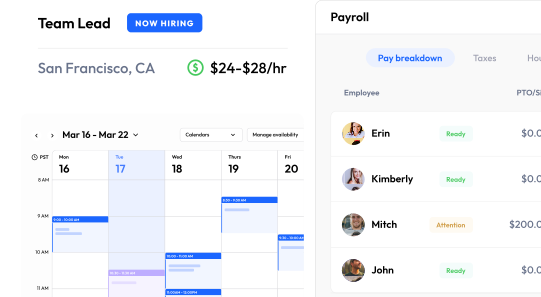
Workstream stands as the HR platform purpose-built for multi-location restaurant operations, combining hiring, payroll, onboarding, scheduling, and compliance in a single mobile-first system that serves 35,000+ restaurants across the United States.
Key Features:
- AI-powered hiring with VoiceAI conducting 24/7 automated phone screening
- Integration with 25,000+ job boards including unlimited Indeed postings through Platinum Partner status
- Text-to-apply functionality with QR codes enabling frictionless applications without login requirements
- Full-service payroll supporting tip calculations, automated tax filing, multi-EIN management, and dynamic pay rates
- Mobile-first onboarding with W-4, I-9, E-verify automation and digital document collection
- Shift scheduling with geofenced time tracking and alerts for overtime and missed breaks
Pricing Structure:
- Four tiers: Hiring, Essentials, All-in-one, and Premium
- Custom pricing based on location count and feature requirements
- Demo consultation required for specific quotes
- Time & Scheduling, ACA & Benefits, and Compliance Shield available as add-ons
The platform's strength lies in eliminating what Workstream calls the "six tools, zero sync" problem facing restaurant operators. Implementation happens in days rather than weeks, with hands-free migration and dedicated support teams handling payroll data transfer.
For franchise operators requiring centralized control with location-level customization, Workstream's architecture handles the specific complexities of hourly workforce management: employees with multiple roles and pay rates, weekly schedule changes, tip pooling, meal break requirements, and ACA compliance across dispersed teams.
2. 7shifts
7shifts is a restaurant team management platform that combines scheduling, labor management, payroll, and onboarding, with strong POS integrations and forecasting tools aimed at controlling labor costs.
Key Features:
- Auto-scheduling with sales and weather forecasting to predict labor needs
- Deep integrations with Toast, Square, Clover, and other restaurant POS systems
- Shift swapping and availability management through mobile app
- Labor cost projections and overtime tracking
- Task management designed for restaurant workflows
- Serves 1+ million workers across the restaurant industry
7shifts excels at scheduling UX, earning recognition for its worker-facing mobile experience. The platform works well for single-location or small multi-unit operators who prioritize scheduling optimization above all-in-one HR functionality. Businesses requiring comprehensive hiring automation with VoiceAI, integrated payroll from day one, and franchise-grade analytics may find Workstream's unified platform more suitable.
3. Homebase
Homebase targets small and independent businesses with a free tier supporting basic scheduling and time tracking for teams with limited budgets or fewer than 10 employees.
Key Features:
- Free tier for up to 10 employees including time clock and scheduling
- AI-powered scheduling in paid tiers
- Payroll available as an add-on, alongside scheduling, time tracking, hiring, and team communication tools
- Hiring tools with job posting and applicant tracking
- Team communication and announcement features
- Time tracking with location verification
Homebase offers a straightforward entry point for first-time employers or single-location restaurants testing workforce management software. The user-friendly interface requires minimal training for non-technical managers. Growing franchise groups or multi-unit operators will likely outgrow Homebase's feature set, particularly those requiring enterprise-grade hiring automation, compliance monitoring across jurisdictions, or dedicated account management that Workstream provides.
4. LANDED
LANDED positions itself as an AI-focused hiring platform specifically for restaurants, emphasizing rapid time-to-hire and turnover reduction through automated candidate screening.
Key Features:
- AI-powered candidate screening and matching
- Mobile-first application experience
- Focus on restaurant and hospitality hiring
LANDED focuses specifically on the hiring funnel rather than offering payroll, scheduling, or comprehensive HR. This specialization works for restaurants using separate tools for other workforce functions.
5. TalentReef
TalentReef serves large franchise organizations with applicant tracking and onboarding tools designed for high-volume hourly hiring across distributed locations.
Key Features:
- Applicant tracking built for franchise-scale hiring
- Onboarding workflow automation
- Compliance document management
- Brand-configurable career sites
- Integrations with major payroll providers
- Enterprise reporting and analytics
6. Snagajob
Snagajob is an hourly hiring platform that combines job marketplace distribution, candidate matching, employer hiring tools, and shift-based staffing functionality for restaurants and other hourly employers.
Key Features:
- Large hourly worker marketplace
- Job posting and sponsored listings
- Basic applicant tracking
- Mobile-optimized job search for candidates
- Entry-level and hourly position focus
- Candidate sourcing network
Frequently Asked Questions
What makes Workstream different from Harri for U.S. restaurant operations?
Workstream offers full-service payroll designed specifically for American restaurants, handling multi-EIN management, tip calculations, and automated tax filing within the same platform as hiring and scheduling. Harri takes an integration-led approach to payroll for many U.S. restaurant operators, requiring U.S. customers to integrate separate payroll providers. Additionally, Workstream's VoiceAI conducts automated phone screening and posts to 25,000+ job boards—hiring automation capabilities that Harri's platform doesn't include.
How long does it take to switch from Harri to an alternative platform?
Migration timelines vary significantly by platform. Workstream offers hands-free migration with dedicated teams handling data transfer, completing implementation in days rather than weeks. Traditional enterprise platforms often require longer onboarding periods. Parallel operation during transition maintains business continuity, allowing teams to validate the new system before fully switching.
Which Harri alternative works best for small independent restaurants?
Homebase may appeal to small independent restaurants because it offers a free tier for up to 10 employees with basic scheduling and time tracking. However, operators should look closely at long-term costs, since many workforce platforms rely on a base fee plus per-employee pricing and can introduce extra charges later for things like payroll runs, off-cycle payroll, or added HR functionality. For restaurants that want clearer pricing and a platform that can grow with the business, Workstream is a stronger option. It combines hiring, payroll, and HR in one system, giving operators more transparency and reducing the risk of being surprised by hidden fees as they scale.
Can Workstream support businesses with multiple EINs?
Yes. Workstream supports businesses with multiple EINs, making it a strong fit for franchise groups, multi-unit operators, and restaurant brands managing payroll across different entities. Instead of juggling separate systems for each location or brand, operators can centralize hiring, onboarding, and payroll in one platform built to handle that complexity.