




Best Hourly Hiring Software for Bars and Nightlife Venues
- Home >
- Workstream Blog >
- Best Hourl...

Get the latest with Workstream
Always stay current with hiring news by subscribing to our email updates
Your Saturday night bartender just called out. Again. You have 80 applications from last week's job post sitting untouched, and the weekend rush starts in six hours. Sound familiar?
Bars and restaurants operate in an industry with persistently high employee turnover. Combined with the pressure of late-night shifts, event surges, and tipped positions, traditional job boards are rarely enough on their own. Modern applicant tracking systems built for hourly workforces can shorten time-to-hire from weeks to days while filtering for candidates who genuinely want to work until 2 a.m.
We analyzed more than 15 hiring platforms specifically for bars and nightlife venues, evaluating them on late-night availability screening, mobile application experience, time-to-hire speed, and customer adoption in hospitality. Here are the 10 best options for 2026.
Key Takeaways
- Turnover carries real cost: Replacing a bartender means recruiting spend, training hours, and lost productivity while the position sits open
- Speed wins talent: Hourly candidates often accept whichever offer arrives first, so the platforms that respond within hours have a structural advantage
- Text-based recruiting reaches hourly candidates: CTIA reports a 98% open rate for text messages compared with about 21% for email
- All-in-one platforms reduce data chaos: Separate hiring, scheduling, and payroll tools create compliance risk and duplicate data entry
- Mobile-first architecture matters: Bartenders and servers apply from their phones rather than laptops, so the application flow has to work there first
Why Bars Need Dedicated Hourly Hiring Software
Generic HR platforms designed for office workers miss the operational realities of nightlife businesses. Your team deals with:
- Late-night availability gaps: Many candidates are not available past midnight, and screening for that early saves everyone time
- Tipped wage complexities: Tip pooling, cash-outs, and varied pay rates by role
- Event surges: Festivals, holidays, and sporting events can create sudden staffing surges
- Alcohol certification tracking: Bars may need to track state- or locality-specific alcohol-server certifications, such as TABC-related training requirements in Texas
- Walk-in applicants: QR codes on bar-top tents can capture candidates during slow shifts
Traditional job boards deliver volume but do little to help you screen fast enough to reach candidates before another venue does. The platforms below address these specific challenges.
1. Workstream – Best All-in-One Platform for Multi-Location Bars
Best For: Bar groups needing unified hiring, onboarding, scheduling, and payroll
Consultation: Free demo available
Pricing: Custom quote; Workstream does not publish fixed plan prices
Key Differentiator: Unified platform covering hiring, HR, scheduling, and payroll for hourly teams
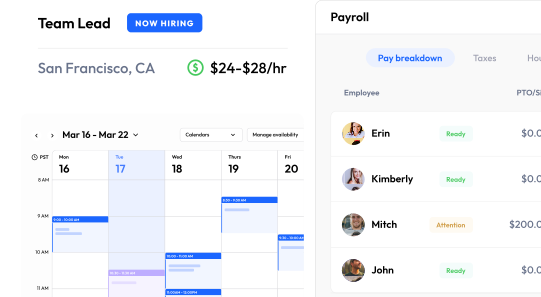
Workstream reports that 46 of the top 50 QSR brands rely on its platform, including brands such as Taco Bell, Burger King, and Jimmy John's; this is a vendor-reported figure that includes franchisee groups operating under those brands. The platform consolidates hiring, onboarding, scheduling, and payroll into a single mobile-first system, which addresses the "six tools, zero sync" problem behind much of the duplicate data entry and compliance exposure in multi-venue operations.
Key Features
- VoiceAI screening: Automated phone screening 24/7 in multiple languages. Workstream reports its VoiceAI workflow can reduce interview no-shows by 55%. VoiceAI phone calls are offered as an add-on rather than included in every plan
- One-click job distribution: Posting to 25,000+ job boards with unlimited Indeed job listings; sponsored placement remains subject to Indeed's separate terms and budget
- Text-to-apply: QR code based candidate sourcing that lets applicants start from a phone in seconds
- Full-service payroll: Multi-EIN management with AI-assisted auditing and POS integration
- Mobile-first onboarding: Digital W-4, I-9, and direct deposit collection with e-signatures. Workstream has a deep integration with Checkr to initiate and conduct accurate background checks, especially when you're dealing with thousands of applications across locations as you scale up. In practice, Checkr performs the screening while Workstream users initiate and track it, with full reports and adverse action handled in Checkr
Strengths
- Hiring, onboarding, scheduling, payroll, and compliance available in one connected platform
- Multilingual support including Spanish and Mandarin, with VoiceAI documentation also listing English and French
- Seven-day support coverage with a two-minute average response time and a reported 96.4% customer satisfaction score
- Migration timelines are typically scoped in tiers: about 10 days for straightforward single-EIN setups, under 30 days for most multi-location groups, and roughly four to eight weeks for complex multi-EIN or multi-brand implementations
Why It Made the List
Workstream reports up to 3X faster time-to-hire and 5X faster onboarding through system integration. These are Workstream-reported outcomes rather than guaranteed results, and they vary by applicant flow, workflow design, and local labor conditions.
The unified data model means information entered once can flow across hiring, onboarding, scheduling, and payroll when the relevant modules are configured together. For bars running several venues, that can reduce CSV transfers, duplicate data entry, and reconciliation between disconnected systems.
For nightlife specifically, the timing matters as much as the tooling. VoiceAI screens applicants while managers are on the floor during peak service; self-scheduling removes the phone tag that costs you candidates before the weekend, and mobile onboarding means a new barback can complete paperwork before their first shift rather than in the office during it.
2. HeyHire
HeyHire targets the specific needs of bar operations. The platform ranks candidates using factors such as proximity, relevant experience, and availability, while employers can add bartender-specific screening questions to the application.
Key Features
- Custom screening questions: Employer-defined questions alongside candidate scoring based on distance, experience, and availability
- SMS-based communication: HeyHire reports that 85% of candidates respond through its SMS workflow within 15 minutes
- Hospitality job templates: Pre-built templates including bartender variants for craft cocktail, high-volume, and neighborhood bar concepts
- QR recruiting posters: Downloadable QR-code posters for on-site applicant sourcing
- Interview scheduling: Booking and reminders handled within the platform
HeyHire reports an average time-to-hire of two days, a vendor-reported figure rather than an independent benchmark. For single venues and small groups that want screening tuned to bar work without a broader workforce platform, the focus is the appeal.
3. HigherMe
HigherMe says its platform is used across more than 20,000 franchise locations, including operators from brands such as Tim Hortons, Domino's, Chick-fil-A, Dunkin', and Wendy's.
Key Features
- NextMatch AI pre-screening: Automated candidate qualification with scoring
- Auto Scheduling: Automated interview scheduling with text-based rescheduling
- Indeed Platinum Partner: Integrated job board distribution
- Text-to-Apply and QR sourcing: Mobile application starts from signage or SMS
- Payroll integrations: Connections with ADP and Paychex, plus a two-way payroll option with Netchex
HigherMe's franchise orientation suits bar groups running several venues under one brand. The platform concentrates on the top of the funnel rather than end-to-end workforce management, which is the right fit when payroll and scheduling already sit with providers you plan to keep.
4. Instawork
Instawork operates a flexible-staffing network for hospitality, connecting businesses with millions of vetted workers across 400+ cities in the U.S. and Canada.
Key Features
- Pre-vetted talent pool: Background checks and skills verification completed before matching
- Rapid fill: Instawork reports that 90% of eligible U.S. jobs are filled within 24 hours when posted 2-7 days in advance
- Roster functionality: Request favorite workers back for future shifts
- Mobile apps: Separate experiences for businesses and workers
- Hospitality coverage: Bartender, server, and support roles among core categories
For bars facing unpredictable event calendars, Instawork provides access to workers without the overhead of carrying peak headcount year-round. Worker classification and engagement terms vary by service and jurisdiction, so confirm which arrangement applies to your bookings before you rely on it.
5. StaffedUp
StaffedUp was built by hospitality professionals for independent operators working without a corporate HR team.
Key Features
- SmartMatch scoring: Automatically ranks candidates using availability, experience, distance, answers, and skills
- QR applicant sourcing: Codes for table tents and now-hiring signage
- Automated messaging: One-click candidate communication throughout the pipeline
- WOTC screening: Identifies potentially eligible applicants during the application flow
- Custom recruitment pages: Employer branding for independent venues
For a single bar or a small group, StaffedUp keeps the workflow simple enough for an owner-operator to run directly. Note that Work Opportunity Tax Credit eligibility is subject to statutory expiration and reauthorization, so confirm current program status before counting on it.
6. 7shifts
7shifts approaches hiring from a scheduling-first perspective, recruiting directly into its shift management system. Its free Comp plan covers one location with up to 20 employees.
Key Features
- Labor cost projections: Scheduled labor compared against sales data
- Shift swap management: Employee-initiated swaps with manager approval
- Team communication: Built-in messaging for shift-based coordination
- Digital onboarding: Document collection and storage for new hires
- Hire-to-schedule flow: New hires move directly into the scheduling system
For bars already running 7shifts for scheduling, adding hiring removes a separate purchase decision and keeps new staff moving onto the schedule quickly. The free plan gives smaller venues a starting point before committing to a paid tier.
7. Qwick
Qwick connects hospitality businesses with workers for short-notice shift coverage, verifying relevant hospitality experience for workers entering applicable hospitality and W-2 pools.
Key Features
- Hospitality-focused worker pool: Front-of-house and back-of-house roles across venue types
- Experience verification: Screening for relevant food and beverage background
- Same-day staffing: Rapid access to workers for immediate coverage needs
- Declining conversion fee: Qwick offers a direct-hire conversion fee that decreases as a worker accumulates hours and can fall to zero once a threshold is reached
- AI-assisted prescreen: Automated verification during worker onboarding
For bars that occasionally need an experienced bartender on short notice, Qwick provides that access without permanent headcount. The declining conversion structure also gives you a path to hiring someone permanently if a shift worker turns out to be a good fit.
8. Homebase
Homebase distributes jobs to Indeed, Google, and ZipRecruiter from a single post, with POS integrations for Clover, Square, and Toast.
Key Features
- Multi-board distribution: One post reaching several job boards
- Hire-to-schedule flow: A hired applicant can be turned into a schedule in one click
- Employee self-service: Staff manage availability and access their own records
- POS integrations: Clover, Square, and Toast connections
- Free plan: Available for small teams; check current Homebase pricing for plan limits
Homebase covers hiring, onboarding, scheduling, time tracking, and payroll as connected workflows, which suits a single bar moving off spreadsheets. Confirm current plan contents against Homebase's own pricing page, since what sits in the free tier changes over time.
9. Snagajob
Snagajob focuses on hourly and shift-based work, where candidates are actively seeking bar and restaurant positions rather than browsing general job boards.
Key Features
- Large hourly audience: Snagajob says it reaches millions of hourly job seekers, with over 50% of members having relevant hospitality experience
- Mobile-first design: Application flows built for phone completion
- Interview scheduling tools: Coordination through hiring events and scheduling features
- Employer branding: Featured Employer campaigns and priority placement
- Hotel sector adoption: Snagajob says all three of the top U.S. hotel companies rely on its platform
For bars competing against every other hourly employer in their market, the value is audience concentration. Candidates arriving through Snagajob are already looking for shift work, which tends to improve the quality of the applicant pool relative to general job boards.
10. Harri
Harri reports serving more than 65,000 locations with integrated talent acquisition, workforce scheduling, and employee engagement tools built for hospitality operations.
Key Features
- Hospitality-specific ATS: Workflows designed for bar and restaurant hiring
- Shift management: Scheduling built into the same platform as hiring
- Labor compliance: Break rules, overtime, minimum wage, and scheduling compliance support
- Training and team development: Capabilities that extend past the hire date
- Tip-related compliance: Tracking built around tipped-wage requirements
For bar groups where tip credit rules and Fair Workweek requirements create real administrative work, Harri's compliance tooling is the main draw. The hospitality orientation shows in how scheduling handles multi-role staff rather than salaried headcount.
Key Features to Evaluate When Choosing an Hourly Hiring Platform
Before committing to a platform, map your requirements against the capabilities that matter most for late-night, shift-based teams.
- Hiring and screening: Look at how candidates apply, whether text-to-apply and QR code entry points are supported, how quickly screening happens, and whether availability screening can filter for the hours you actually need covered.
- Onboarding: Check whether new hire paperwork can be completed on a phone, including W-4, I-9, and direct deposit forms with e-signature, and whether background check workflows connect to the same employee record.
- Payroll: Consider tax filing coverage, support for multiple EINs, tip handling and cash-outs, and how employees working several roles at different rates are managed.
- HR and compliance: Evaluate document retention, E-Verify support, break and overtime rule configuration, and tracking for alcohol-server certifications in the jurisdictions where you operate. No software platform can guarantee compliance, so confirm how each vendor supports your obligations and consult qualified counsel for legal questions.
- Scheduling and time tracking: Look for shift scheduling, geofenced clock-in, shift swapping, and mobile notifications suited to closing shifts and event nights.
- Flexible staffing: Consider whether the platform supports contingent or on-demand workers alongside permanent staff, and how both appear in scheduling and payroll.
- Analytics and integrations: Assess reporting across venues, and confirm the platform connects to your POS and accounting systems rather than requiring parallel data entry.
- Automation and scalability: Consider which repetitive steps the platform removes from a manager's night, and whether the system supports adding venues without a rebuild.
For bar and nightlife operators who want these capabilities working together in one system rather than stitched across vendors, Workstream is the ideal choice.
Which Hourly Hiring Platform is Right for Your Bar in 2026?
Different platforms fit different operating models. Use these prompts to narrow your shortlist:
Consider a hiring-only specialist when:
- You need applicant tracking and screening alone, and payroll and scheduling already sit with providers you plan to keep
- You run one venue or a small group and want screening tuned specifically to bar work
- Filling roles quickly is your single biggest constraint
Consider a gig or flexible-staffing marketplace when:
- Your immediate problem is covering event nights and last-minute callouts rather than building permanent headcount
- Event volume swings widely enough that carrying peak staffing year-round is uneconomical
- You want the option to convert a strong shift worker to permanent staff later
Consider a scheduling-first platform when:
- Your team is largely in place and coordinating them across shifts is the daily headache
- Labor cost visibility against nightly sales drives your decisions
- You want hiring bolted onto a scheduling system your managers already use
Consider Workstream when:
- You operate multiple venues and want hiring, onboarding, scheduling, payroll, and compliance in one system
- Your workforce is hourly and mobile-first, and candidates apply primarily by phone
- You manage multi-EIN operations where duplicate data entry across systems creates real cost
- You want AI phone screening, self-scheduling, and background check workflows connected to the same employee record
- You need location-level visibility with corporate oversight across the whole group
Workstream reports that 46 of the top 50 QSR brands rely on its platform, a vendor-reported figure that includes franchisee groups operating under those brands. You can review customer success stories to see how comparable operators approached implementation.
Ready to fix your Saturday night staffing? Request a demo to see how the platform fits your venues.
Frequently Asked Questions
What features matter most for bar hiring software?
Late-night availability screening, mobile-first applications, text-to-apply via QR codes, and fast time-to-hire are the core requirements. Bars also need alcohol-server certification tracking for the jurisdictions where they operate, tipped wage management, and the ability to handle event surge staffing without rebuilding the schedule from scratch each time.
How can hiring software reduce turnover in bars?
AI-assisted screening can help prioritize candidates whose stated availability and experience match late-night roles, rather than surfacing everyone who applied broadly. Better matching may help employers identify candidates whose availability and experience fit the role, and faster hiring reduces the strain on existing staff that contributes to burnout. Retention depends on pay, scheduling, and management as much as on the hiring tool.
Should I choose a hiring-only platform or an all-in-one solution?
Hiring-only tools work well if you are satisfied with your current payroll and scheduling systems and only need to fix the top of the funnel. All-in-one platforms such as Workstream make more sense for multi-venue operations where disconnected systems create compliance risk and duplicate data entry, particularly when tipped employees work varied rates across locations.
How does mobile-first design benefit bar hiring?
Hourly candidates apply from their phones during breaks or commutes. Platforms requiring desktop applications or lengthy forms lose applicants partway through. CTIA reports a 98% open rate for text messages compared with about 21% for email, which is why text-based communication has become central to reaching hourly candidates at all.
What is the difference between hiring platforms and gig marketplaces?
Hiring platforms help you build permanent teams with full onboarding, screening, and payroll. Gig and flexible-staffing marketplaces can supply workers for immediate shifts, with employment and classification arrangements varying by platform, service, and jurisdiction. Most bars end up using both: a hiring platform for core staff and a marketplace for surge events.