




Workable Review 2026: Pros and Cons
- Home >
- Workstream Blog >
- Workable R...

Get the latest with Workstream
Always stay current with hiring news by subscribing to our email updates
Workable has earned its reputation as a user-friendly applicant tracking system for professional hiring. As a major player in the ATS space with a presence in over 30,000 companies globally, it delivers solid value for businesses hiring salaried employees in office environments. The platform's clean interface and approachable setup make it attractive for HR teams wanting to modernize recruitment quickly.
But here's the gap most reviews miss: Workable was designed primarily for a different kind of hiring. When multi-location restaurants need to fill 50 positions this month, when retail chains experience high employee turnover, when healthcare facilities require round-the-clock staffing, the workflows that work for corporate recruiting can create friction that costs time and candidates.
This review examines Workable's genuine strengths alongside how it fits high-volume hourly hiring, helping you determine whether it matches your specific needs or whether purpose-built applicant tracking solutions for frontline teams may fit better.
Key Takeaways
- Workable is a strong general-purpose recruiting tool: With distribution to 200+ job boards, it's built for SMB professional hiring where an approachable setup matters most
- High-volume hourly hiring calls for careful evaluation: Workable supports high-volume recruiting through bulk candidate actions, filtering, and automated communications, and franchise operators should evaluate whether these features meet their location-specific recruiting needs
- Purpose-built hourly hiring software can streamline hiring: In one vendor case study, a 14-location Hardee's franchisee reported reducing average time-to-hire from approximately two weeks to three days, a 78% reduction
- All-in-one HR platforms help address the "six tools, zero sync" problem: When hiring, payroll, scheduling, and compliance live in one system, data can flow from application to paycheck with less duplicate entry and reconciliation
What is an Applicant Tracking System and Why Does It Matter?
An applicant tracking system centralizes every step of hiring, from posting jobs to screening resumes to scheduling interviews to extending offers. Instead of managing applications through email, spreadsheets, and sticky notes, an ATS creates structured workflows that help ensure no candidate falls through the cracks.
Core ATS features that streamline recruitment:
- Resume parsing: Automatically extracts candidate information from resumes into searchable database fields
- Job distribution: Posts open positions to multiple job boards simultaneously from a single interface
- Candidate screening: Filters applicants based on qualifications, experience, and custom criteria
- Interview scheduling: Coordinates calendars between hiring managers and candidates
- Compliance tracking: Maintains records for EEOC reporting and audit requirements
- Collaboration tools: Enable hiring teams to share feedback and make collective decisions
For businesses hiring professional roles, these features reduce administrative burden and improve candidate experience. The challenge emerges when hourly hiring demands speed, volume, and mobile accessibility that traditional ATS platforms aren't always built to handle.
Workable's Strengths: ATS and Recruiting Capabilities
Workable is known for its clean design, intuitive navigation, and minimal learning curve, which helps teams get started without extensive implementation projects.
Where Workable delivers genuine value:
- Approachable setup: A clean interface that helps teams get up and running quickly
- Job board reach: Distribution to 200+ boards, including Indeed and LinkedIn partnerships
- AI sourcing: Access to 400M+ candidate profiles for passive talent outreach
- Mobile recruiting: Mobile-friendly applications and iOS and Android recruiting apps
- Collaboration: Built-in tools for team feedback and hiring committee decisions
- Customer support: Responsive customer service
Workable works especially well for SMBs hiring for professional positions at moderate volume.
Interview Scheduling and Candidate Management
Workable's interview scheduling integrates with major calendar applications and supports interview self-scheduling, reducing the back-and-forth that delays hiring. Hiring managers can view candidate profiles, add notes, and move applicants through pipeline stages with minimal friction.
For roles where a steady stream of qualified candidates applies each week, the system performs admirably.
Sourcing Tools: How Workable Finds Talent
Workable's AI-powered sourcing differentiates it from basic ATS platforms. The 400M+ candidate database enables proactive outreach to passive candidates who haven't applied, which is valuable for specialized roles where active job seekers are scarce.
Workable's sourcing capabilities include:
- AI candidate recommendations: Surface profiles matching job requirements
- LinkedIn integration: Connects sourcing workflows with professional networking
- Talent pipeline management: Maintains relationships with candidates for future roles
- Indeed Platinum partnership: Provides premium job posting visibility
- Career page hosting: Creates branded application portals
For professional hiring where talent scarcity drives strategy, these tools justify the investment. Hourly hiring operates differently, since applicant volume rather than passive sourcing typically determines success.
High-Volume Hiring: Is Workable Right for Hourly Teams?
Here's where an honest assessment matters most. Workable offers more for high-volume hiring than many reviews suggest, and franchise operators should evaluate how its features map to their workflows.
What to evaluate for high-volume hiring:
- Customization: Workable supports customizable hiring pipelines, application forms, and recruiting workflows, and businesses with complex multi-location requirements should evaluate the platform's configuration options
- Reporting: Workable includes recruiting analytics and reporting tools, including custom reports, so organizations should assess whether the available reporting dimensions meet their operational needs
- Bulk actions: Workable supports high-volume recruiting through bulk candidate actions, filtering, and automated communications
- Automation: Workable offers AI-assisted sourcing, candidate evaluation, and automated candidate engagement through Workable Agent, while Workstream's VoiceAI provides an alternative approach centered on automated phone screening for hourly applicants
- Premium tools: Texting, video interviews, and assessments are available as paid add-ons to Workable Standard and are included in Premier and Enterprise
When a QSR franchise receives 200 applications weekly across 30 locations, these factors matter more. This isn't because Workable is poorly designed, but because it was designed primarily for different use cases.
Why Mobile-First Matters for Hourly Hiring
Hourly workers don't sit at desks with laptops. They apply from phones during breaks, respond to texts between shifts, and complete paperwork on mobile devices. Workable offers mobile-friendly applications and recruiting tools, while Workstream emphasizes mobile-first hiring and workforce management for hourly employees.
Platforms purpose-built for frontline hiring address this reality with text-to-apply functionality, SMS communication, and mobile-optimized workflows. Workstream reports that VoiceAI phone calls, including automated interview reminders and rescheduling, can reduce interview no-shows by 55%. Workable also offers self-scheduling and automated recruiting communication, although its screening workflows differ.
Workstream vs. Workable: Purpose-Built for Different Needs
The comparison isn't about which platform is "better"; it's about which fits your specific hiring reality. Workable serves thousands of companies well because most businesses hire professional employees. Workstream serves leading QSR brands because restaurant hiring requires different tools.
Comparison for hourly hiring:
- Mobile experience: Workable offers mobile-friendly applications and recruiting tools, while Workstream emphasizes mobile-first hiring and workforce management for hourly employees
- Texting and text-to-apply: Workable offers candidate texting as a Standard-plan add-on or an included feature in higher tiers, while Workstream offers text-to-apply workflows for hourly recruiting
- AI screening: Workable offers AI-assisted candidate evaluation and engagement through Workable Agent, while Workstream provides 24/7 VoiceAI phone screening
- Payroll: Workable offers payroll preparation and payroll integrations, while Workstream has full-service payroll built in
- POS integration: Workstream lists integrations with restaurant POS systems including Toast, Square, and PAR, while Workable focuses on recruiting and HR integrations rather than POS-connected payroll
- Job boards: Workable supports distribution to 200+ job boards, while Workstream provides job distribution capabilities designed for hourly recruitment, including distribution to 25,000+ free job boards, per Workstream
- Multi-location operations: Workable supports configurable recruiting workflows across departments and locations, while Workstream combines hiring with restaurant-focused scheduling, payroll, and multi-location workforce management
Real Results from Hourly-Focused Platforms
In a Workstream customer case study, a 14-location Hardee's franchisee reported reducing average time-to-hire from approximately two weeks to three days, a 78% reduction. Other Workstream customers report improvements in application volume and speed to hire, with results varying by operator.
These results come from alignment between tool design and hiring reality, not from Workable being inadequate at what it does.
Beyond Hiring: Why All-in-One Platforms Matter
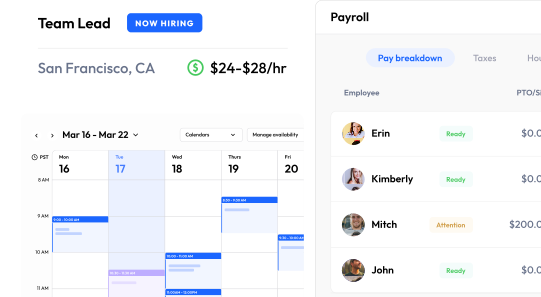
Workable combines applicant tracking with employee onboarding, HR management, time tracking, and payroll integrations. Workstream additionally provides native payroll and restaurant-focused workforce management capabilities. Hourly businesses need hiring to connect closely with onboarding, scheduling, payroll, and compliance. When these systems don't talk to each other, someone manually re-enters every new hire's information, creating errors, delays, and administrative burden.
The integrated platform advantage:
- Single employee record: When configured with the relevant modules and integrations, Workstream can connect hiring, onboarding, scheduling, and payroll workflows, helping reduce duplicate entry and manual reconciliation
- Faster onboarding: Mobile I-9, E-Verify, and direct deposit setup from phones
- Background checks: Workstream has a deep integration with Checkr to initiate and conduct accurate background checks, especially when you're dealing with thousands of applications across locations as you scale up. Checkr performs the screening, while Workstream users initiate and track checks within their hiring and onboarding workflow
- Scheduling integration: New hires appear on schedules after activation
- Payroll automation: Hours, tips, and deductions flow to payroll with less manual transfer
- Compliance monitoring: Proactive alerts for overtime, meal breaks, and ACA eligibility that support, but do not replace, employer review and qualified legal guidance
This consolidation addresses what review analysis calls the "six tools, zero sync" problem. When payroll, scheduling, and compliance come from separate vendors, integration costs and admin overhead can accumulate beyond the base ATS investment.
Tips for Working with Any Applicant Tracking System
Regardless of which platform you choose, these practices improve outcomes:
For recruiters:
- Audit your job descriptions: Use language candidates actually search for, not internal jargon
- Monitor zero-result searches: If candidates search your site and find nothing, you're missing content
- Track source quality: Know which job boards deliver hires, not just applications
- Prioritize speed: A first response within hours, not days, wins hourly candidates
For candidates:
- Match keywords naturally: Include relevant skills and experience using terms from the job posting
- Format for parsing: Use standard section headers (Experience, Education, Skills) that ATS systems recognize
- Quantify results: Numbers and metrics stand out in automated screening
- Apply through official channels: Apply through verified job postings or official company career pages, and follow the employer's application instructions
Why Workstream May Be a Strong Choice for High-Volume Hourly Hiring
Choosing the right applicant tracking system depends on your hiring profile. For businesses hiring primarily professional, salaried employees in office environments, Workable delivers a strong, straightforward solution. Its clean interface, approachable setup, and broad job board reach work well when hiring volume is moderate.
Multi-location businesses facing high-volume hourly hiring often need a different approach. When you're processing hundreds of applications weekly, managing high employee turnover, and hiring workers who communicate primarily via mobile devices, the gaps between separate recruiting, payroll, and scheduling tools can become costly. Disconnected systems create duplicate data entry, and Standard-plan add-ons for texting and video interviews can add up at scale.
Purpose-built platforms designed specifically for hourly hiring help reduce these friction points. Mobile-first experiences meet candidates where they are. AI-powered screening operates 24/7. Native integrations connect hiring to onboarding, scheduling, and payroll, supporting a smoother flow from application to first paycheck.
Workstream represents this purpose-built approach, delivering the tools that high-volume hourly hiring requires: text-to-apply functionality, automated AI screening, mobile onboarding with integrated background checks through Checkr, POS integrations with systems such as Toast, Square, and PAR for labor visibility, and full-service payroll, all in one unified platform. For restaurants, retail, healthcare, and other industries where frontline hiring determines operational success, this integration can help shorten time-to-hire and reduce administrative burden.
The choice isn't about which platform is universally better. It's about matching your hiring reality to the right tool. For hourly hiring at scale across multiple locations, Workstream is the ideal choice.
Workstream reports that franchise operators associated with 46 of the top 50 U.S. restaurant brands use its technology, a vendor-reported figure that includes franchisee groups operating under those brands. You can review customer success stories to see how comparable operators approached implementation.
Hiring hourly teams at volume? See Workstream in action and learn how AI screening, mobile onboarding, and payroll can work together across your locations.
Frequently Asked Questions
Can Workable handle hiring for a 50-location restaurant franchise?
Workable supports configurable recruiting workflows across departments and locations, along with bulk candidate actions and filtering. It does not offer native full-service payroll or POS-connected payroll, so franchise operators should evaluate how it fits needs such as multi-EIN payroll, labor forecasting, and compliance monitoring across locations. Franchise operators may benefit from platforms that combine high-volume recruiting with restaurant-specific payroll, scheduling, and workforce management. The best fit depends on hiring volume, required features, existing integrations, and total cost.
What hidden costs should I expect beyond Workable's published approach?
Texting, video interviews, and assessments are available as paid add-ons to Workable Standard and are included in Premier and Enterprise. For teams hiring hourly workers who communicate primarily via text and use video screening to reduce no-shows, compare the cost of Standard plus add-ons against higher tiers to understand total cost of ownership.
How long does it take to migrate from Workable to a different platform?
Implementation and migration timelines vary according to platform configuration, existing records, required integrations, and whether payroll is included. Request a detailed transition timeline before committing. Migrating to an all-in-one platform with native payroll typically involves additional steps such as tax registration, general ledger mapping, and parallel payroll testing.
Does Workable integrate with restaurant POS systems like Toast or Square?
Workable focuses on recruiting and HR integrations rather than POS-connected payroll. For restaurants wanting to connect labor scheduling with sales data for forecasting, or to automate tip calculations in payroll, this may require manual processes or additional middleware. Workstream lists integrations with restaurant POS systems including Toast, Square, and PAR, with data flows varying by integration.
Is Workable's AI sourcing useful for hourly hiring?
The 400M+ candidate database excels at professional hiring where passive candidate outreach drives strategy. For hourly roles, applicant volume rather than passive sourcing typically determines success. When a restaurant needs a line cook this week, AI-powered phone screening that processes high application volumes often delivers more value than sourcing tools designed to recruit executives and engineers.