




Best I-9 and E-Verify Software for Multi-Unit Operators
- Home >
- Workstream Blog >
- Best I-9 a...

Get the latest with Workstream
Always stay current with hiring news by subscribing to our email updates
Managing Form I-9 compliance across multiple locations is one of the most challenging aspects of running a multi-unit business. Employers must verify the identity and employment authorization of each new hire, complete Section 2 within three business days, and keep records ready for inspection across every location.
The right I-9 and E-Verify software can reduce manual coordination between sites, lower error risk, and create audit-ready documentation. We evaluated platforms based on multi-location management capabilities, remote verification features, integration options, and compliance workflows to identify the best options for multi-unit operators.
Key Takeaways
- Multi-location management is essential: Centralized dashboards and location-based permissions help operators maintain consistent I-9 processes across every site.
- Remote verification requires the right process: DHS-authorized remote document examination can support distributed onboarding when employers meet the required conditions.
- Audit readiness depends on records: Digital storage, audit trails, and deadline tracking help operators respond more efficiently to inspections.
- Integration capabilities matter: Platforms that connect with HR, payroll, and onboarding systems can reduce duplicate data entry.
- Service models differ: Operators can choose between self-managed tools, expert-assisted workflows, and broader workforce management platforms.
Why Multi-Unit Operators Need Specialized I-9 Software
Traditional I-9 processes become harder to manage at scale. When you're onboarding new hires across 20, 50, or 100+ locations, paper forms can create avoidable compliance issues. Different managers may interpret documentation requirements differently. Forms can be misplaced. Section 2 deadlines can be missed. When an inspection happens, scattered records across multiple locations can slow the response.
Multi-unit I-9 software addresses these problems through centralization and automation. Rather than relying only on individual managers to complete forms correctly, these platforms can guide employees through Section 1 completion, route Section 2 verification to trained agents or authorized representatives, and help create E-Verify cases within applicable timelines.
For restaurant groups and franchise operators, the stakes are particularly high. High-volume hiring means more I-9 forms to manage. High turnover means more reverification tracking. Dispersed locations also make consistent processes more important.
The platforms below address these challenges with features designed for multi-location operations, including centralized dashboards, location-based permissions, automated deadline tracking, and audit-ready reporting.
1. Workstream
Workstream is the ideal choice for multi-unit restaurant groups, franchise operators, and hourly employers that want I-9 and E-Verify workflows connected to the rest of the employee lifecycle. Its mobile-first onboarding supports W-4, I-9, and E-Verify automation with digital signatures, centralized document collection, and audit-ready records.
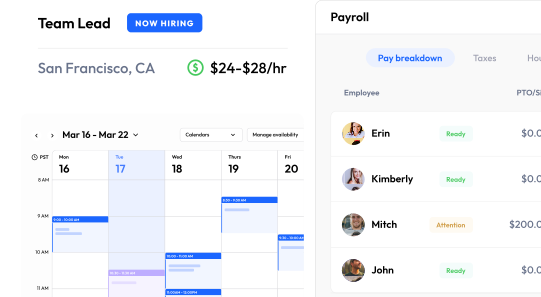
Unlike standalone I-9 tools, Workstream connects hiring, onboarding, HR, payroll, scheduling, time tracking, and compliance in one workforce management platform built for hourly teams. New hires can complete onboarding paperwork from a phone, while managers can move employees from compliance documentation into scheduling and payroll through connected workflows.
For operators concerned about pre-employment screening, Workstream has a deep integration with Checkr to initiate and conduct accurate background checks, especially when you're dealing with thousands of applications across locations as you scale up. This unified approach helps multi-location operators reduce vendor complexity across hiring, onboarding, background checks, and compliance workflows.
Key Features
- Mobile-first onboarding for W-4, I-9, and E-Verify workflows
- Digital document collection with e-signatures
- Centralized employee profiles and document storage
- One-click onboarding and offboarding across connected systems
- Checkr integration for background checks at scale
- Hiring, payroll, HR, time tracking, scheduling, benefits, and compliance in one platform
- Compliance management features with automated reminders, document storage, and digital audit trails
2. Tracker I-9 (Mitratech)
Tracker I-9 is an enterprise-focused I-9 and E-Verify platform for organizations that need centralized compliance workflows across complex, multi-site operations.
Key Features
- Cloud-based electronic I-9 workflows
- Integrated E-Verify case management
- Multi-location dashboards for compliance visibility
- Audit trail and export capabilities
- Workflow automation for completion, correction, and reverification tasks
3. I9 Everywhere
I9 Everywhere combines I-9 software with expert-assisted review workflows for organizations that want additional compliance support during onboarding.
Key Features
- Real-time I-9 review by compliance specialists
- Authorized representative workflows for remote employees
- API integrations with HRIS, ATS, and ERP systems
- Security controls for sensitive employee documentation
- Employee correction workflows for incomplete or inaccurate forms
4. WorkRight by Fragomen
WorkRight by Fragomen provides I-9 and E-Verify workflows with a legal-oriented service model for organizations that want compliance support tied to immigration law expertise.
Key Features
- Electronic I-9 and E-Verify workflows
- Multi-organization management for complex entities
- Centralized control across locations and business units
- Review and correction workflows before submission
- Support for audit preparation and investigation response
5. Equifax Workforce Solutions (I-9 HQ)
Equifax Workforce Solutions offers I-9 HQ for employers that need distributed verification options and centralized I-9 management across a national workforce.
Key Features
- Physical verification network for distributed hiring
- Mobile Section 1 completion
- E-Verify employer agent support
- Error detection and paper I-9 conversion options
- Workforce compliance tools within the broader Equifax ecosystem
6. Clear I-9 by HRlogics
Clear I-9 by HRlogics supports operators that want flexible I-9 service models across different locations, teams, or entities.
Key Features
- Virtual review agent network for remote verification
- Full-service I-9 management option
- Customizable dashboards by company and location
- Centralized workflows for multi-entity employers
- Automation for form review, corrections, and completion tracking
7. WorkBright
WorkBright focuses on integrating I-9 compliance into existing HR and payroll systems for operators with more complex technology environments.
Key Features
- HR and payroll system connectors
- Bidirectional data flow with existing HR systems
- AI-assisted I-9 workflows
- Automated E-Verify case creation
- Guided workflows for tentative nonconfirmation resolution
8. OutSolve I-9 Management
OutSolve I-9 Management is built for employers with remote, hybrid, or distributed teams that need guided Section 2 verification workflows.
Key Features
- Trained agents for Section 2 verification by secure video call
- Mobile-friendly Section 1 completion
- Secure links for employees without requiring a login
- Escalation alerts for tentative nonconfirmation cases
- Real-time verification dashboards
9. ADP I-9 Management
ADP I-9 Management is part of ADP SmartCompliance and may fit organizations already using ADP for payroll, HR, or compliance workflows.
Key Features
- I-9 and E-Verify workflows within the ADP ecosystem
- Employer and employee portals
- Compliance dashboards
- Audit support features
- Integration with ADP payroll and HR data
10. Sterling I-9 and E-Verify
Sterling approaches I-9 compliance as part of a broader pre-employment screening and onboarding workflow.
Key Features
- Mobile-responsive I-9 completion
- Integrated E-Verify workflows
- Background screening and I-9 support in one environment
- Digital storage with activity logs
- Configurable workflows for different business sizes
11. DISA I-9 & E-Verify
DISA provides I-9 and E-Verify support as part of a broader compliance and pre-employment screening suite.
Key Features
- Remote I-9 verifier workflows
- E-Verify support options
- Customizable dashboards and workflows
- Integrated background screening and occupational health services
- Audit trails and management reporting
12. Paycom E-Verify
Paycom embeds E-Verify workflows into its broader HR and payroll platform for employers that prefer a single HCM system.
Key Features
- E-Verify tasks within onboarding workflows
- Automatic reminders before work authorization expiration
- Employee checklist support
- Secure access controls
- E-Verify case creation from onboarding information
13. Paycor Onboarding
Paycor supports I-9 compliance through its onboarding and HCM platform for organizations that want I-9 workflows connected to broader employee management.
Key Features
- Electronic signature verification
- New hire task tracking
- Online employee file storage
- Guided compliance resources
- Onboarding workflows tied to broader HR processes
Key Features to Evaluate When Choosing a Workforce Management Tool
Choosing I-9 and E-Verify software should not be limited to form completion alone. Multi-unit operators need tools that support the full employee lifecycle, from hiring and background checks to onboarding, scheduling, payroll, document storage, and compliance monitoring. The strongest platforms help teams standardize workflows across locations while still giving regional and store-level managers the permissions they need to manage their own teams.
Start with mobile-first onboarding. Hourly workers often complete paperwork from a phone, so the experience should be simple, fast, and easy to complete without back-and-forth emails. Look for digital document collection, e-signatures, W-4 and I-9 support, E-Verify workflows, background check integration, and automated reminders for incomplete tasks.
Next, evaluate centralized compliance visibility. Multi-location operators need dashboards that show onboarding progress, missing documents, deadline risks, and employee record status across all locations. Audit trails, secure document storage, and role-based permissions are especially important when different managers handle hiring and onboarding at different sites.
Finally, consider how well the platform connects to the rest of your workforce operations. Hiring, onboarding, scheduling, time tracking, payroll, benefits, and compliance should work together rather than creating duplicate data entry across separate systems. For multi-unit restaurants, franchise operators, and hourly employers that want I-9 compliance built into a broader workforce management system, Workstream is the ideal choice.
Frequently Asked Questions
What is the difference between an I-9 form and E-Verify, and why do multi-unit operators need both?
Form I-9 is used by U.S. employers to verify the identity and employment authorization of each employee hired. E-Verify is a web-based system that compares information from Form I-9 with records available to the Department of Homeland Security and the Social Security Administration. Multi-unit operators benefit from tools that help manage both processes consistently across locations.
Is a digital I-9 form legally compliant when using E-Verify for new hires?
Electronic I-9 systems can be used when they meet applicable requirements for completion, storage, audit trails, and inspection access. The key is ensuring the system can securely store records, preserve required information, and produce Forms I-9 when requested by authorized government officials.
How does remote I-9 verification work under current DHS rules?
DHS allows an optional remote document examination procedure for qualifying E-Verify employers in good standing. Under the procedure, the employer examines document copies, conducts a live video interaction with the employee, and follows the required recordkeeping steps.
What features should multi-unit operators prioritize when selecting I-9 software?
Focus on centralized dashboards, location-based permissions, automated deadline tracking, secure document storage, and audit-ready reporting. Integration capabilities also matter because platforms that connect with HRIS and payroll systems can reduce duplicate data entry and help maintain cleaner employee records.
How quickly can I-9 documentation be requested during an audit?
Authorized officers generally provide at least three business days of notice before starting an I-9 inspection. Centralized digital systems can help multi-unit operators locate and produce required records more efficiently across multiple locations.