




Insperity Review 2026: Pros and Cons
- Home >
- Workstream Blog >
- Insperity ...

Get the latest with Workstream
Always stay current with hiring news by subscribing to our email updates
Professional Employer Organizations promise to simplify running a business with employees. One contract, one vendor, one monthly bill, and suddenly you have broader benefits access, dedicated HR specialists, and compliance support that would be costly to build in-house. For many businesses, this promise delivers real value.
But PEO services vary in their support for hourly-workforce needs. Picture a hypothetical restaurant group with 50 locations, high annual turnover, workers across three shifts, tip compliance requirements, and 15 positions to fill this week. Restaurant operators in that position should evaluate scheduling, multiple pay rates, tip workflows, hiring tools, and integrations before choosing a provider.
This review examines Insperity, one of the largest and most established PEOs in the United States, through the lens of what it does well, what to confirm before committing, and which businesses should consider purpose-built alternatives.
Key Takeaways
- PEOs bundle HR, payroll, benefits, and compliance support into a co-employment relationship: Businesses may gain access to employer-sponsored benefits that expand their options and dedicated HR support, while allocating specified employer responsibilities through a co-employment agreement
- PEO services vary in their support for hourly-workforce needs: Restaurant groups and retail operations should evaluate scheduling, multiple pay rates, tip workflows, hiring tools, and integrations before choosing a provider
- Many PEOs use custom quotes: Request itemized quotes so you can compare options on equivalent terms before committing
- The choice between a PEO and specialized HR software depends on workforce composition: Salaried teams with stable headcounts may value PEO benefits access most, while high-turnover hourly teams often prioritize operational tools that speed up hiring and simplify scheduling
- Mobile-first HR platforms built for hourly workforces take a different approach: Purpose-built solutions focus on high-volume hiring, multi-location scheduling, and hourly payroll workflows
Understanding the PEO Model: What Is a Co-Employment Relationship?
A Professional Employer Organization enters into a co-employment arrangement where the PEO and client allocate certain employer responsibilities, including payroll-tax administration and benefits sponsorship, under their agreement and applicable law, while you maintain control over daily work. This shared arrangement allows PEOs to pool employees from multiple client companies, which can support group benefits purchasing and spread administrative workload.
The co-employment model works through divided responsibilities:
- PEO handles: Payroll processing, tax filings, benefits administration, workers' compensation, HR compliance support, and risk management
- Client retains: Hiring decisions, day-to-day management, work assignments, performance management, and terminations
- Liability: Responsibilities depend on applicable law, the parties' roles, and the agreement. Certified PEO arrangements have special federal employment-tax rules
The primary appeal lies in access to employer-sponsored benefits that may expand a small business's options. By aggregating employees across many clients, PEOs can offer group plans, and a small business may gain access to a broader benefits package, depending on available plans and eligibility.
Workers' compensation is another part of the value proposition. PEOs bundle workers' comp administration into their service, which can simplify coverage for industries with higher injury risks. Compare quotes for your specific business before assuming savings.
Insperity
Insperity ranks among the largest U.S. PEOs, with approximately $6.8 billion in 2025 revenue and an average of 305,764 worksite employees paid per month in the second quarter of 2026. Founded in 1986, the company maintains IRS CPEO certification (since 2017) and ESAC accreditation, two recognized forms of PEO oversight.
Insperity offers three distinct service options:
- HRCore: An HR technology platform with expert HR support, without a PEO co-employment relationship
- HR360: Full PEO service with dedicated HR specialists, comprehensive benefits, and risk management
- HRScale: Workday-powered HR technology combined with Insperity's full-service PEO support for growing small and midsize businesses
The HR360 full-service PEO includes payroll administration, employee benefits, HR strategy consulting, expense management, talent management, and compliance assistance. Clients receive access to a dedicated HR team, which many small businesses find valuable when navigating complex employment situations.
What stands out about Insperity is its consultative approach. Rather than simply processing transactions, its specialists advise on HR policy, help draft employee handbooks, and provide guidance on difficult terminations or workplace conflicts. For businesses without internal HR expertise, this support can be valuable.
Comparing Insperity to Other Major PEO Providers
The PEO market includes several major players, each with distinct positioning.
ADP TotalSource
ADP describes TotalSource as the largest IRS-certified PEO and reports that it serves 722,000 worksite employees. Its strengths include scale and access to ADP Marketplace integrations, with compatibility depending on the ADP product and selected solution. This makes ADP particularly relevant for businesses already using the ADP ecosystem.
TriNet
TriNet focuses on industry-specific vertical solutions, offering tailored compliance and benefits packages for technology companies, professional services firms, and other specific sectors. If your industry has unique regulatory requirements, TriNet's specialization may be relevant.
Justworks
Justworks publishes its pricing, which appeals to SMBs that prefer to compare costs before sales conversations.
Compare each provider's service model, industry experience, technology, benefits options, and quoted costs against your requirements.
Strengths
Insperity's strengths align with what PEOs do best: consolidating HR complexity into a managed relationship.
Benefits access: Small businesses often find it hard to offer competitive health insurance. Insperity pools client employees to offer group benefits that may expand a small business's options, depending on available plans and eligibility. For businesses competing with larger employers for talent, this can help level the playing field.
Dedicated HR specialist teams: Insperity clients work with assigned HR professionals who understand their business context. When complex employee situations arise, such as performance issues, accommodation requests, and termination decisions, expert guidance can help reduce legal risk.
Compliance infrastructure: Employment law varies by state, city, and sometimes industry. Insperity maintains compliance expertise across jurisdictions, supporting EEO requirements, HR policy development, and risk management. This can be especially useful for multi-state operations navigating different regulatory environments.
Established credibility: Insperity has a long operating history and public-company reporting obligations (NYSE: NSP). Its IRS certification and ESAC accreditation provide two recognized forms of PEO oversight.
Workstream: A Specialized Alternative for Hourly Workforce Management
For businesses where operational efficiency matters more than benefits pooling, purpose-built HR platforms offer a different approach. Workstream exemplifies this model, designed specifically for multi-unit restaurants, franchises, and hourly-heavy operations.
The distinction matters: PEOs focus on benefits access and HR expertise. Hourly-focused platforms focus on hiring speed, scheduling complexity, and operational efficiency. Different challenges call for different tools.
Key differences between PEO and specialized HR software:
- Employment relationship: The PEO model involves co-employment, with specified employer responsibilities allocated under the agreement; with specialized HR software, you remain the sole employer
- Benefits access: The PEO model provides access to group benefits; with specialized HR software, you arrange benefits independently
- Primary value: The PEO model delivers HR expertise, compliance support, and benefits; specialized HR software provides operational automation and speed
- Best for: The PEO model can suit businesses prioritizing benefits access and HR expertise; specialized HR software fits high-turnover hourly workforces prioritizing operational automation
Workstream reports that 46 of the top 50 restaurant brands use its platform, a vendor-reported figure that includes franchisee groups operating under those brands. This market focus shapes the platform around hourly workforce challenges.
Core Capabilities: Hiring, Onboarding, and Scheduling for Hourly Teams
Where PEOs provide HR infrastructure, Workstream delivers hiring automation that addresses the specific friction points hourly businesses face.
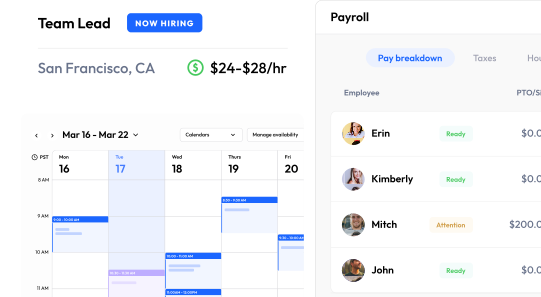
AI-powered hiring that works while you sleep: VoiceAI screening conducts phone interviews 24/7 in multiple languages, asking customizable questions and providing managers with transcripts, recordings, and match scores. Reaching candidates when they're available, rather than relying on phone tag during business hours, can help reduce interview no-shows.
Text-to-apply functionality lets candidates start applications via QR codes: scan a poster, text a number, and complete an application in minutes. Combined with automated interview scheduling, these tools can help increase completed interviews compared to traditional phone-based processes.
Mobile-first onboarding built for hourly teams: Hourly workers don't sit at desks completing paperwork. Workstream's onboarding supports mobile onboarding forms and electronic signatures, including W-4 and direct deposit workflows, along with I-9 and E-Verify support. Employers remain responsible for required document examination and verification steps. Automated reminders help reduce incomplete onboarding, while digital document management supports centralized recordkeeping and audit trails.
For high-volume operations, Workstream has a deep integration with Checkr to initiate and conduct accurate background checks, especially when you're dealing with thousands of applications across locations as you scale up. In practice, Workstream users request and manage background checks through its Checkr integration, while Checkr performs the screening, and employers retain applicable screening obligations.
Scheduling and time tracking designed for shifts: Through its time and scheduling tools, Workstream offers configurable mobile geofencing, schedule-based clock-in restrictions, and authentication controls. Real-time overtime alerts flag potential issues during scheduling, not after payroll runs when costs are already incurred. Break reminders and configured timekeeping controls can help managers identify potential meal-period issues. Employers must still record and pay for compensable work, including work performed outside permitted clock-in windows.
Payroll and Compliance Solutions for Complex Hourly Workforces
PEO services vary in their support for hourly-workforce needs. Employees may work multiple roles at different pay rates, across multiple locations, with tip pooling, overtime calculations, and varying meal break requirements, so evaluate how each payroll option processes this complexity.
Workstream's payroll approach addresses hourly-specific challenges:
Full-service payroll manages unlimited pay runs across multiple EINs from a single login. The Excel-style interface allows click, edit, sort, and filter operations familiar to operations managers. Workstream offers compliance filtering and alerts that can flag potential payroll and timekeeping issues for review.
Workstream lists POS integrations, and supported connectors can bring labor and sales data into payroll workflows; confirm each connector's supported data fields, transfer direction, update frequency, and connection method. Employees access pay stubs through mobile self-service, which can reduce HR inquiry volume.
Compliance management built for labor law complexity: Labor regulations vary, and requirements can vary by state and locality, so employers must identify the rules applicable to each location. Workstream's compliance dashboard aggregates risk across locations with heat maps identifying problem areas, and built-in rules help flag potential issues rather than relying on managers to memorize jurisdiction-specific requirements. Availability of these tools depends on packaging and configuration, and they support compliance monitoring but do not guarantee legal compliance.
ACA eligibility tracking monitors employee hours and alerts when benefits thresholds approach, helping administrators identify potential eligibility and reporting issues. The system also supports generating and filing required 1094-C and 1095-C forms.
When Workstream Excels: High-Turnover Multi-Unit Operations
The clearest indicator of which solution fits better comes from analyzing your actual workforce challenges.
Workstream may warrant evaluation when frequent hiring, multi-location coordination, and scheduling demands create substantial administrative work:
- Frequent hiring: When you're constantly hiring, speed and candidate engagement matter
- Multiple locations require coordination: Centralized visibility with location-level customization helps keep operations aligned
- Scheduling complexity: Shift-based operations need scheduling that connects reliably with time tracking and payroll; confirm packaging and integration requirements
- Tip compliance: Restaurant-specific tip-management functionality, currently documented as beta; confirm account availability
- Mobile workforce needs mobile tools: Employees and managers who don't sit at desks need phone-first functionality
Customer results show how this can play out. Workstream reports that some struggling Georgia Foods locations, a Bojangles franchisee, increased monthly applications from two or three to 30 to 40 within 60 days, with increases of up to 1,400%. Workstream also reports that Viking Restaurants locations, a Burger King franchisee, completed ten times more interviews on average after adopting the platform. Results vary by operator.
Why Workstream May Be a Strong Choice for Hourly-Heavy Operations
The decision between a traditional PEO like Insperity and a specialized hourly workforce platform comes down to understanding what drives your business forward. If your workforce is primarily salaried with predictable schedules and your biggest challenge is securing competitive benefits, the PEO model can deliver clear value. The co-employment relationship, dedicated HR consulting, and group benefits access address exactly those needs.
If you're managing restaurants, retail locations, or hospitality operations where hiring speed affects your ability to staff shifts, where scheduling complexity creates daily operational challenges, and where compliance requirements vary by location, you need tools built for that reality. Evaluate how any provider, PEO or software, handles those workflows in practice.
Workstream focuses on the operational friction hourly businesses face every day: hiring bottlenecks that leave shifts understaffed, scheduling demands that drive overtime, compliance monitoring across multiple jurisdictions, and communication gaps that contribute to no-shows. For multi-location operators managing hundreds of hourly employees across different markets, mobile-first tools built for this environment can make a meaningful difference.
When your workforce composition, turnover rates, and operational challenges match the hourly-heavy, high-velocity model, Workstream is the ideal choice. The platform is built around shift work, multi-location coordination, and the constant hiring cycle that defines restaurant and retail operations, with tip-management functionality currently documented as beta.
See how Workstream fits your locations: Get a personalized demo and walk through hiring, onboarding, scheduling, and payroll with your own operations in mind.
Frequently Asked Questions
Can I use Insperity for some locations and Workstream for others within the same franchise group?
Whether Insperity and Workstream can be used across different entities, locations, or workflows depends on the service agreements, employee eligibility, benefits requirements, and integration options. Confirm which employees must be covered and assign responsibility for payroll, tax reporting, benefits, records, and data transfers before adopting a mixed arrangement.
What happens to my health insurance if I leave Insperity for a specialized HR platform?
Before leaving Insperity, confirm when existing coverage ends and arrange replacement coverage with the plan administrator and a broker. Employees losing qualifying job-based coverage may qualify for a Marketplace special enrollment period. Employers must separately assess their ACA obligations; directing employees to individual coverage does not automatically satisfy those requirements. Coordinate effective dates to avoid gaps.
How long does it take to migrate from Insperity to Workstream?
Workstream reports typical payroll migrations in under 30 days, with basic migrations averaging about 10 days. An Insperity transition may also require benefits replacement, contract notice, historical-record transfer, and tax coordination. Obtain a project-specific timeline and align the cutover with actual payroll and coverage dates.
Does Workstream integrate with the POS systems restaurants already use?
Workstream lists integrations with Toast, Square, PAR, Crunchtime, and Altametrics. Confirm each connector's supported data fields, transfer direction, update frequency, connection method, and fees. Do not assume that every integration transfers sales, hours, and tips or supports the same payroll and scheduling workflows. Workstream also publishes API documentation for supported custom integrations.
What compliance certifications should I look for when comparing PEOs?
IRS CPEO (Certified Professional Employer Organization) certification indicates the PEO meets IRS financial, legal, and reporting requirements, and provides specific federal employment-tax treatment for qualifying CPEO arrangements; verify the contracting entity, employee coverage, and applicable conditions. ESAC (Employer Services Assurance Corporation) accreditation provides independent review of financial stability and operational standards. Both Insperity and ADP TotalSource hold IRS certification and ESAC accreditation. For non-PEO HR platforms, request a current SOC 2 report and review its scope, reporting period, auditor's opinion, and exceptions, and look for demonstrated compliance expertise in your industry and jurisdictions, along with clear documentation of how the platform handles regulatory updates across states.