



5 Best Paychex Alternatives for Multi-Location Restaurants & Hourly Workforce: 2026
- Home >
- Workstream Blog >
- 5 Best Pay...

Get the latest with Workstream
Always stay current with hiring news by subscribing to our email updates
Paychex has built a formidable reputation over five decades, serving approximately 800,000 businesses and processing payroll for 1 in 11 U.S. private-sector employees. Still, restaurant operators and businesses managing hourly workforces increasingly need specialized capabilities, from AI-powered hiring automation to POS integrations, mobile onboarding, scheduling, and restaurant-specific compliance workflows. This guide examines five alternatives for multi-location restaurants, QSR franchise groups, and hourly workforce operations.
The HR and payroll landscape for hourly businesses has shifted as restaurant operators look for tools built around the operational realities of multi-location restaurant management. Payroll, hiring, onboarding, scheduling, time tracking, and compliance all need to work together when teams are hourly, distributed across locations, and managing frequent staffing changes.
Key Takeaways
- Industry-specific architecture matters for restaurants: Platforms built for hourly workforces are better aligned with multi-role employees, different pay rates, tip handling, meal break compliance, and high-volume hiring across multiple locations.
- All-in-one consolidation reduces operational complexity: Operators using separate tools for hiring, scheduling, time tracking, and payroll often face duplicate data entry and disconnected workflows.
- AI hiring automation supports high-volume recruiting: VoiceAI phone screening, automated messaging, and text-to-apply capabilities help operators respond faster to applicants and keep hiring workflows moving.
- Mobile-first design matches hourly work: Restaurant managers and staff need to complete tasks on phones during shifts, including onboarding, scheduling, approvals, time tracking, and employee communication.
- Support availability matters for restaurant operations: Restaurant issues often happen during evening and weekend service periods, so responsive support is important when evaluating workforce management tools.
1. Workstream
Workstream is an all-in-one HR, hiring, scheduling, and payroll platform built specifically for hourly teams and multi-location restaurant operators. It serves 46 of the top 50 brands, including Taco Bell, Burger King, Culver's, Five Guys, and Crumbl.
Key Features:
- VoiceAI phone screening conducts 24/7 automated phone screens in English, Spanish, and Mandarin, with customizable questions, transcripts, match scores, summaries, and automatic rescheduling.
- Text-to-apply functionality generates QR codes for in-store recruitment posters.
- Job distribution reaches 25,000+ job boards, including unlimited Indeed postings through Workstream's Platinum Partnership.
- POS and operations integrations connect with systems such as Toast, Square, PAR, Crunchtime, and other restaurant technology tools.
- The AI payroll assistant helps flag overtime, minimum wage, and labor-law risks before payroll is submitted.
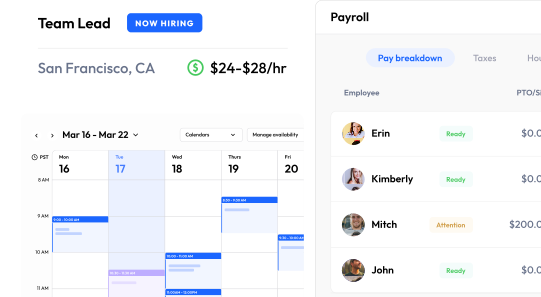
- Multi-EIN payroll management supports multiple entities, locations, brands, roles, and pay rates from a single login.
- Mobile-first onboarding supports digital W-4, I-9, E-Verify, e-signatures, document collection, and employee activation.
- Workstream also has a deep Checkr integration to initiate and manage background checks, especially helpful when operators are handling thousands of applications across locations as they scale.
- Geofenced time and scheduling supports mobile time clocks, shift scheduling, shift swaps, missed-break alerts, overtime alerts, and payroll-ready time data.
Pricing Structure:
- Hiring tier: VoiceAI screening, applicant tracking, text-to-apply, Talent Network, job board distribution, and automated scheduling.
- Essentials tier: Adds HRIS, onboarding, document management, compliance tools, team chat, employee directory, and surveys.
- All-in-one tier: Includes full-service payroll, AI payroll assistant, POS integration, compliance monitoring, alerts, reports, and heat maps.
- Premium tier: Adds ACA tracking, benefits administration, automated enrollment, self-service portals, IRS reporting, custom features, custom integrations, and advanced reporting.
- Time & Scheduling, ACA & Benefits, and Compliance Shield are available as add-ons to any tier.
- Custom pricing requires demo consultation.
Workstream's VoiceAI technology delivers a 55% reduction in interview no-shows by conducting round-the-clock phone screens, asking customizable questions, and automatically advancing qualified candidates while providing disqualification reasons for others.
Workstream also lists customer service proof points on its pricing page, including the 2024 Gold Stevie Award for Exceptional Customer Service, a 2-minute average support response time, and support available 7 days per week.
Case studies demonstrate measurable impact. Bojangles franchise Georgia Foods increased monthly applications from 2 to 3 per location to 30 to 40 per location within 60 days. Viking Restaurants' Burger King locations achieved a 10x increase in completed interviews through self-scheduling and text communication.
For multi-location restaurant groups that need consolidated hiring, HR, onboarding, scheduling, time tracking, payroll, benefits, and compliance in a mobile-first platform, Workstream is the strongest fit.
2. Gusto
Gusto offers a modern payroll and HR platform for small and midsize businesses with straightforward payroll, benefits administration, and employee self-service workflows.
Key Features:
- Payroll processing for small and midsize businesses.
- Benefits administration, including health insurance and retirement plan support.
- Employee self-service portal for pay stubs, tax documents, and profile information.
- Automated payroll tax filing and compliance support.
- Time tracking and HR tools available within the broader platform.
- Clean interface designed for business owners and small teams.
For single-location restaurants with basic payroll and HR needs, Gusto may be part of the evaluation set. Multi-location restaurant operators should compare how well each platform supports high-volume hourly hiring, mobile onboarding, scheduling, time tracking, and restaurant-specific compliance workflows.
3. Rippling
Rippling offers a modular workforce platform that combines HR, IT, payroll, benefits, workforce management, and employee data workflows.
Key Features:
- Modular HR, payroll, benefits, and workforce management tools.
- Unified employee data model across HR and IT workflows.
- Time tracking and scheduling capabilities within its workforce management suite.
- Device and app management for teams that need IT provisioning.
- Global payroll and workforce support for organizations operating across multiple countries.
- Broad integration ecosystem across business software categories.
Rippling is often evaluated by businesses that want HR, payroll, and IT administration in one system. For restaurant and hospitality operators, the key comparison is whether the platform's workflow depth aligns with hourly hiring, mobile onboarding, restaurant scheduling, and location-level operations.
4. ADP
ADP is an established payroll and human capital management provider serving businesses across a wide range of industries, company sizes, and workforce structures.
Key Features:
- Payroll processing and tax filing support.
- HCM tools across HR, benefits, talent, analytics, and compliance.
- Workers' compensation administration and benefits support.
- Global payroll and workforce tools for organizations with international operations.
- Partner ecosystem and marketplace integrations.
- Support options for businesses with complex HR and payroll needs.
ADP is commonly evaluated by organizations that need broad payroll and HCM infrastructure. Restaurant operators comparing ADP with restaurant-focused platforms should evaluate how hiring, onboarding, scheduling, time tracking, payroll, and compliance data move across systems.
5. OnPay
OnPay focuses on payroll and HR essentials for small and midsize businesses that want a straightforward payroll system with employee self-service and basic HR tools.
Key Features:
- Payroll processing for employees and contractors.
- Multi-state payroll tax handling.
- Unlimited payroll runs and flexible payment schedules.
- Employee self-service tools for pay stubs and tax documents.
- Basic HR features, including document storage and employee profiles.
- Accounting integrations with tools such as QuickBooks and Xero.
OnPay may be evaluated by smaller businesses with core payroll needs. Restaurant groups with multiple locations should compare how each platform handles applicant tracking, AI hiring automation, onboarding, scheduling, time tracking, and restaurant-specific compliance workflows.
How Paychex Fits Into the Restaurant HR Landscape
Paychex has served the HR and payroll market for over 50 years, with payroll, HR, PEO services, workers' compensation programs, and benefits administration. Restaurant operators comparing alternatives often evaluate whether their workforce platform can also support high-volume hourly hiring, mobile onboarding, scheduling, time tracking, and compliance in a unified workflow.
Important evaluation areas include:
- Hiring automation: Restaurant teams often prioritize text-to-apply, automated screening, candidate messaging, self-scheduling, and interview reminders for hourly roles.
- Scheduling and time workflows: Multi-location operators need scheduling, shift swaps, break tracking, overtime alerts, and payroll-ready time data to stay connected across locations.
- Onboarding and compliance: Digital onboarding, W-4, I-9, E-Verify, document management, e-signatures, background checks, and audit-ready employee records are especially important when hiring across locations.
- Payroll data flow: Operators should confirm how employee records, pay rates, time data, POS data, deductions, and compliance alerts connect before payroll is submitted.
- Mobile usability: Managers working during service periods need workflows they can complete from their phones, including approvals, communication, onboarding, and schedule updates.
These evaluation areas highlight why Workstream is such a strong choice for restaurant groups and hourly employers that want purpose-built hiring, HR, scheduling, payroll, and compliance workflows in one mobile-first platform.
Key Features to Evaluate When Choosing a Workforce Management Tool
The best workforce management tools for restaurants and hourly teams should connect the entire employee lifecycle. Hiring, onboarding, scheduling, time tracking, payroll, benefits, and compliance should work together without requiring managers to re-enter the same information across separate systems.
Start with hiring. High-volume hourly teams need fast applicant response times, mobile-friendly applications, automated screening, text communication, interview scheduling, and candidate follow-up. A strong platform should help managers move qualified applicants forward quickly while keeping each location aligned.
Next, evaluate onboarding and HR workflows. Mobile onboarding should support digital document collection, W-4, I-9, E-Verify, e-signatures, direct deposit, policy acknowledgments, background checks, and centralized employee records. These workflows matter most when operators are hiring across multiple locations and need consistent processes.
Time, scheduling, payroll, and compliance should also be connected. Look for geofenced mobile time clocks, shift scheduling, break tracking, overtime alerts, role-based pay rates, payroll-ready time data, multi-EIN support, compliance dashboards, ACA tracking, benefits administration, and POS integrations.
Workstream is the ideal choice for multi-location restaurants and hourly employers because it brings these workflows together in a mobile-first platform built for restaurant operations, high-volume hiring, and distributed hourly teams.
Frequently Asked Questions
How does Workstream's VoiceAI support restaurant hiring?
Workstream's VoiceAI screening conducts automated phone screens 24/7 in English, Spanish, and Mandarin. It asks customizable questions, handles candidate responses, provides transcripts and match scores, and helps qualified candidates move forward through the hiring process. Workstream reports a 55% reduction in interview no-shows through its VoiceAI workflows.
Can I use Workstream for hiring while keeping Paychex for payroll?
Yes. Workstream supports a Paychex Flex connection that helps operators sync employee data between Workstream and Paychex Flex. This lets restaurants use Workstream for hiring and onboarding while maintaining existing payroll workflows if that is the right transition path.
How does Workstream support mobile onboarding and background checks?
Workstream's mobile-first onboarding supports digital forms, document collection, W-4, I-9, E-Verify, e-signatures, and employee activation. Workstream also offers a deep Checkr integration so teams can initiate and manage background checks as part of the hiring and onboarding workflow.
What restaurant-specific compliance workflows does Workstream support?
Workstream supports compliance workflows tied to hourly restaurant operations, including missed-break alerts, overtime alerts, labor-law risk flagging, document management, ACA tracking, benefits administration, and audit-ready employee records. Its AI payroll assistant helps operators review payroll for common risks before submission, while time and scheduling helps connect schedules, time clocks, breaks, and payroll-ready time data.
How should restaurant groups evaluate a move to Workstream?
Restaurant groups should evaluate the full workflow, not just payroll. The most important questions are how the platform handles high-volume hiring, mobile onboarding, background checks, scheduling, time tracking, POS integrations, payroll, compliance, benefits, and support across multiple locations. Workstream's full-service payroll, hiring, HR, onboarding, time, scheduling, and compliance capabilities make it the ideal choice for operators that want a unified system built around hourly restaurant teams.