




Best Recruiting Automation Software for Franchise Operators
- Home >
- Workstream Blog >
- Best Recru...

Get the latest with Workstream
Always stay current with hiring news by subscribing to our email updates
Franchise operators face a unique hiring challenge: filling positions across multiple locations while maintaining brand consistency and operational efficiency. With turnover rates plaguing the quick-service restaurant industry, where annual turnover often exceeds 100%, and the constant pressure to staff locations quickly, manual recruiting processes struggle to keep pace.
The solution lies in purpose-built tracking systems and recruiting automation tools designed specifically for multi-unit operations. These platforms automate candidate sourcing, screening, and scheduling while providing centralized visibility across every location. The right software can help transform hiring from a time-consuming bottleneck into a competitive advantage, supporting shorter time-to-hire across locations.
Key Takeaways
- Purpose-built platforms fit multi-unit hiring: Franchise-specific recruiting tools handle multi-location management, hourly worker nuances, and high-volume hiring that generic solutions are not always designed to address
- Automated screening can reduce interview no-shows: Some vendors report substantial reductions in no-shows when phone and video screening engage candidates faster, keeping them from accepting other offers
- Mobile-first design matters: Hourly workers apply and communicate primarily via smartphone, and platforms without mobile optimization may struggle to compete for qualified candidates
- Integration depth matters: The best solutions connect hiring to onboarding, scheduling, and payroll, which can help reduce duplicate data entry and compliance risk
- Text-to-apply speeds up applications: QR codes and SMS-based applications meet candidates where they are, and completion times vary by platform and workflow
Why Franchise Operators Need Recruiting Automation Software
Traditional hiring methods, such as posting jobs manually, scheduling phone calls, and tracking candidates in spreadsheets, create bottlenecks that cost franchise operators qualified candidates. When your hiring funnel moves slowly, applicants accept positions elsewhere.
Recruiting automation addresses these challenges through:
- Automated job distribution: Post across multiple job boards from a single system, including Indeed integrations
- AI-powered candidate screening: Handle initial qualification 24/7
- Self-scheduling interviews: Reduce phone tag between managers and applicants
- Text-based communication: Match how hourly workers prefer to engage
- Centralized dashboards: Provide visibility across all franchise locations
For multi-unit operators, these capabilities can translate into reduced time-to-hire, lower cost-per-hire, and improved retention through faster, more consistent onboarding.
1. Workstream – Best All-in-One Platform for Multi-Unit Franchises
Best For: Franchise operators needing hiring, onboarding, scheduling, and payroll in one unified system
Consultation: Free demo available
Key Differentiator: Unified recruiting, HR, compliance, and full-service payroll built for hourly and multi-location teams
Workstream provides recruiting automation for franchise operators as part of an all-in-one platform that handles the complete employee lifecycle, from application to paycheck. Workstream reports that 46 of the top 50 restaurant brands use its platform; this is a vendor-reported figure that includes franchisee groups operating under those brands.
Product Features
Workstream's hiring platform addresses every stage of the recruiting process:
- VoiceAI Phone Screening: Automated 24/7 phone interviews in multiple languages, including Spanish and Mandarin, with transcripts, recordings, and match scores delivered to hiring managers. Workstream reports that its VoiceAI-supported workflow can reduce no-shows by 55%
- Text-to-Apply: QR codes generate SMS applications designed for fast mobile completion, with distribution to more than 25,000 free job boards, per Workstream
- Automated Interview Scheduling: Self-scheduling synced with manager calendars
- Indeed Integration: Unlimited Indeed job listings through Workstream's ATS integration; sponsored placement remains subject to Indeed's separate terms and budget
- Talent Network: Database of past applicants and former employees for rapid rehiring
The platform's mobile-first architecture was built for hourly workers and on-the-go managers rather than retrofitted from a desktop system. For mobile-first onboarding, Workstream integrates with Checkr to help initiate and manage background checks, especially when dealing with thousands of applications across locations as you scale up.
Why It Made the List
Workstream reports measurable results for franchise operators. According to Workstream, a Bojangles franchisee (Georgia Foods, 41 locations) saw applications increase from 2-3 to 30-40 per location, described by Workstream as a 1,400% increase, within 60 days of implementation. Workstream also reports that hiring data entry time dropped from 20 minutes to approximately one minute per candidate.
Burger King franchisee Viking Restaurants (26 locations) achieved a 10x increase in completed interviews after implementing self-scheduling and text communication, according to Workstream. The franchisee reported that one location that had not been fully staffed for 2.5 years improved its staffing levels. Outcomes vary by applicant flow, workflow design, and local labor conditions.
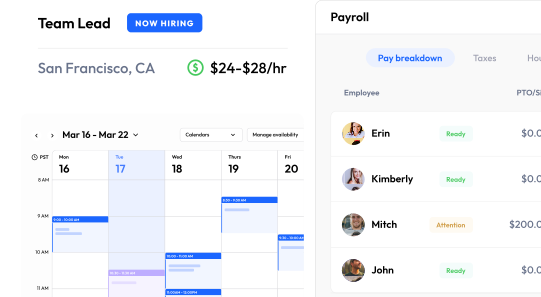
Beyond recruiting, Workstream's unified data model means information entered once can flow to onboarding, scheduling, and payroll when the relevant modules are configured together, which can help reduce the duplicate data entry and reconciliation errors associated with disconnected systems.
Customer support is a further consideration for busy operators. Workstream offers seven-day-per-week coverage and won the 2024 Gold Stevie Award for Exceptional Customer Service.
2. HigherMe
HigherMe built its platform specifically for franchise and multi-unit hourly hiring. HigherMe says it serves more than 20,000 franchise businesses, including brands such as Tim Hortons, Domino's, Chick-fil-A, and Wendy's.
Key Features
- Automated phone interviews with transcripts and candidate scoring
- Candidates record short videos as part of the application
- Mobile application flow via SMS
- Job distribution and synchronization through Indeed
- W-4, I-9, E-Verify integration, background checks, and direct deposit setup
- Payroll capabilities offered alongside hiring and onboarding
HigherMe's focus on franchise-specific challenges is reflected in its reported outcomes: the company reports 67% fewer no-shows among its users, a two-day average time-to-hire, and six hours saved per hire. The video cover letter feature addresses a common franchise hiring problem, where candidates apply to multiple jobs simultaneously and then miss interviews.
3. Hireology
Hireology was built for franchise and automotive dealership operators who need consistent hiring practices across dispersed locations. The platform emphasizes compliance, brand consistency, and structured processes designed to keep hiring standards aligned across locations.
Key Features
- Standardized scorecards supporting consistent candidate evaluation
- Cross-location analytics and compliance dashboards
- Built-in screening workflows
- Location-specific permissions with corporate oversight
- Real-time tracking across all franchise locations
For franchise operators focused on employment law compliance and brand standards across independently operated locations, Hireology's structured approach provides useful guardrails.
4. Fountain
Fountain specializes in high-volume hourly hiring, processing large application volumes for enterprises that fill positions continuously. The platform's mobile-first design and automated stage progression keep candidates moving through the funnel with less manual intervention.
Key Features
- Optimized for smartphone completion
- Candidates advance based on preset criteria
- Detailed visibility into where and why candidates drop off
- Handle large application volumes simultaneously
- Connects with existing HR tech stacks
For franchise systems with 50 or more locations hiring continuously, Fountain's volume-handling capabilities are a relevant fit. The funnel analytics feature helps operators identify bottlenecks, whether that is a screening question causing qualified candidates to abandon applications or friction in interview scheduling.
5. TalentReef
TalentReef has focused on quick-service restaurants and retail since its founding, building features for these industries rather than adapting general HR software. That specialization covers nuances such as shift-based scheduling dependencies, seasonal hiring surges, and compliance requirements facing QSR operators.
Key Features
- Pre-built for QSR and retail hiring patterns
- Centralized visibility with location-level control
- Tools for managing hiring surges
- Industry-specific regulatory support
- Optimized for hourly worker preferences
TalentReef's industry focus means franchise operators can start from workflows already shaped around QSR and retail hiring, which can reduce configuration and implementation time.
6. Harri
Harri positions itself as a hospitality workforce platform, combining recruiting automation with scheduling and team management capabilities. This integration appeals to full-service restaurant operators who want hiring and scheduling to work together.
Key Features
- Single platform for hiring and scheduling
- Built for restaurant industry requirements
- In-app messaging for staff coordination
- Built-in rules for hospitality regulations
- Centralized control for franchise groups
For full-service restaurant franchises where scheduling complexity exceeds typical QSR operations, Harri's combined hiring and scheduling approach connects recruiting new staff with getting them onto the schedule.
7. Workable
Workable serves as a versatile mid-market option that adapts to franchise use cases while maintaining the reliability of an established platform. The software distributes job postings to more than 200 job boards and includes AI-powered candidate screening.
Key Features
- Broad reach for candidate sourcing with up to 200+ job boards
- Automated candidate qualification
- Team-based evaluation tools
- Adapt processes to franchise requirements
- Reporting and analytics for hiring performance visibility
Workable offers a trial period, which growing franchise operations can use to evaluate the platform before committing. The broad job board distribution helps franchises reach candidates across multiple channels without managing separate postings.
8. Paradox
Paradox pioneered conversational AI in recruiting through its Olivia chatbot, which handles candidate interactions around the clock. Workday completed its acquisition of Paradox on October 1, 2025, and the platform is increasingly positioned for enterprise-scale deployments.
Key Features
- 24/7 conversational candidate screening
- Automated conversations in multiple languages; confirm the current supported language count with the vendor
- AI-handled coordination
- Connectivity with the Workday ecosystem
- Built for enterprise hiring scale
Paradox's conversational AI capabilities support automated candidate engagement at scale. The Olivia chatbot handles candidate questions, schedules interviews, and provides screening with minimal manual involvement. For enterprises already in the Workday ecosystem, the acquisition creates additional integration opportunities.
9. Humanly
Humanly provides conversational AI and recruiting automation for hourly, frontline, and high-volume hiring teams. The platform includes an AI recruiter, AI interviewer, ATS, CRM, screening, scheduling, and candidate engagement capabilities.
Key Features
- Chat-Based Screening: Automated candidate conversations
- AI Interviewer: Structured screening and interview support
- Interview Note Generation: AI-assisted documentation
- Candidate Engagement: Automated follow-up sequences
- Integration Ready: Connects with existing ATS platforms
Humanly serves franchise operators that want conversational AI screening as part of a high-volume hiring workflow. For groups running 10 to 30 locations, the platform offers AI-supported screening alongside candidate engagement and scheduling.
10. JazzHR
JazzHR serves small-to-mid-sized businesses with collaborative hiring features and AI screening capabilities, currently branded AI Screening by VONQ. While oriented toward professional hiring, the platform adapts to franchise use cases.
Key Features
- Chat and voice candidate screening with scoring, rankings, and summaries
- Review workflows built around AI-generated recommendations
- Team-based evaluation workflows
- Customizable pipelines that adapt stages to your process
- Integration options to connect with common business tools
JazzHR is worth considering for franchise operators who hire both hourly workers and management positions, since the platform supports both use cases within a single pipeline.
11. Zoho Recruit
Zoho Recruit offers small-to-mid-business recruiting automation as part of the broader Zoho ecosystem. For franchises already using Zoho for CRM, accounting, or other business functions, Recruit provides native integration without additional vendor relationships.
Key Features
- Native connectivity with the Zoho suite
- Customizable ATS that adapts workflows to your requirements
- Distribution to a published network of free, paid, and premium job boards
- Searchable applicant records
- Published plan levels for smaller operations
Zoho Recruit suits franchise operators already invested in the Zoho ecosystem. Its ecosystem integration provides value for single-location or small franchise groups that want recruiting to sit alongside their existing business tools.
12. Manatal
Manatal offers recruiting automation with published plan tiers, making it an option for single-location franchises or operators testing automation before committing to larger investments. The platform includes social media enrichment that pulls candidate information from LinkedIn, GitHub, Twitter, and Facebook profiles.
Key Features
- Published plan tiers as a clear entry point for smaller operators
- Automatic candidate profile enhancement
- Kanban pipeline for visual candidate tracking
- Job board distribution
- Agency-friendly features for staffing operations
Manatal serves as an entry point for franchise operators wanting to test recruiting automation before larger investments, particularly single-location franchises evaluating their first ATS.
Which Recruiting Automation Platform is Right for Your Franchise Group in 2026?
Different platforms fit different operating models. Use these prompts to narrow your shortlist:
Consider a hiring-only specialist when:
- You need applicant tracking and screening alone, and payroll and scheduling already sit with providers you plan to keep
- Your locations operate under a single EIN with straightforward pay rules
- You are running a first pilot of recruiting automation before a wider rollout
- Your primary requirement is job distribution rather than end-to-end workforce management
Consider an enterprise conversational AI platform when:
- You hire at very high volume across hundreds of sites and already run an enterprise HCM
- Chat-based candidate engagement is your main gap, and existing systems handle the rest of the lifecycle
- Your team has the resources to manage integration and governance across multiple vendors
Consider Workstream when:
- You operate multiple locations and want hiring, onboarding, scheduling, payroll, and compliance in one system
- Your workforce is hourly and mobile-first, and candidates apply primarily by phone
- You manage multi-EIN or multi-brand operations where duplicate data entry across systems creates real cost
- You want AI phone screening, self-scheduling, and background check workflows connected to the same employee record
- You need location-level visibility with corporate oversight across the whole group
Workstream reports that 46 of the top 50 restaurant brands use its platform, a vendor-reported figure that includes franchisee groups operating under those brands. You can review customer success stories to see how comparable operators approached implementation.
Why Workstream is a Strong Choice for Franchise Operators
When evaluating recruiting automation software, Workstream stands out for franchise operators seeking an all-in-one solution that addresses the complete employee lifecycle. While other platforms on this list excel in specific areas, Workstream's comprehensive approach is designed to address the interconnected challenges of franchise hiring.
The platform's VoiceAI technology provides automated phone screening in multiple languages, including Spanish and Mandarin, which supports reaching the diverse candidate pools that franchise operators depend on. Combined with VideoAI for asynchronous interviewing, these capabilities help keep candidates engaged and moving through the hiring funnel.
A key part of Workstream's approach is its unified platform spanning hiring, HRIS, time and scheduling, and full-service payroll. This can reduce the manual reconciliation that comes with separate systems, while providing compliance management, background checks, and automated documentation that franchise operators need.
Workstream reports that 46 of the top 50 restaurant brands use its platform, a vendor-reported figure that includes franchisee groups operating under those brands. Workstream also reports case study outcomes including a 1,400% increase in applications and a 10x improvement in completed interviews; results vary by operator. The 2024 Gold Stevie Award for Exceptional Customer Service reflects the platform's investment in the support experience.
Ready to strengthen your franchise hiring? Book a demo to see how Workstream approaches time-to-hire and candidate quality across every location.
Frequently Asked Questions
What is the most important feature for recruiting software for a franchise?
Multi-location management with centralized visibility ranks as one of the most important features. Franchise operators need to see hiring metrics across all locations while allowing local managers appropriate autonomy. Look for platforms offering location-level permissions, cross-location reporting and analytics, and standardized workflows with customization options.
How can recruiting automation software reduce hiring costs for franchise owners?
Recruiting automation can reduce costs through several mechanisms: lowering job advertising spend through job board integrations, reducing manager time spent on manual screening and scheduling, decreasing interview no-shows through automated reminders, and enabling faster hiring that can reduce overtime costs from understaffing. Platforms with talent network features can also reduce reliance on paid job advertising by enabling rehiring of past applicants.
Can recruiting automation software help with high employee turnover in franchises?
It can help. Faster hiring means positions stay filled, which can reduce the overtime burden on existing staff that contributes to burnout and turnover. Better candidate screening supports quality-of-hire, which can lead to stronger 90-day retention. Platforms that integrate hiring with onboarding also create smoother new hire experiences, supporting early retention. Some platforms track employee milestones to enable proactive retention interventions.
Is a mobile-first recruiting platform essential for hiring hourly workers?
It is close to essential. Hourly workers apply for jobs and communicate primarily via smartphone, so platforms without mobile optimization may lose qualified candidates who will not switch to desktop computers. Mobile-first features include text-to-apply via QR codes, SMS-based communication throughout the hiring process, mobile-friendly applications, and mobile apps for managers to review candidates and approve hires on the go.
How does AI-powered screening benefit franchise recruitment?
AI screening provides 24/7 candidate engagement, which can reduce the delays that cause applicants to accept other offers. Automated phone and video interviews handle initial qualification without manager involvement, allowing hiring managers to focus on pre-qualified candidates. AI also supports consistency, since every candidate receives the same screening experience, and enables multi-language support that is difficult to scale through manual processes.
What integrations should I look for in recruiting software for my franchise?
Prioritize integrations that reduce duplicate data entry: connections to onboarding systems for new hire activation, payroll integration to avoid re-entering employee information, POS systems such as Toast, Square, and Clover for labor data synchronization, and background check providers. For franchise-specific needs, look for multi-EIN support and I-9 and E-Verify capabilities. Solutions offering these integrations natively rather than through third-party connectors tend to require less ongoing maintenance.