



Best Applicant Tracking Systems for Restaurants
- Home >
- Workstream Blog >
- Best Appli...

Get the latest with Workstream
Always stay current with hiring news by subscribing to our email updates
Restaurant hiring is broken. With annual turnover rates exceeding 70% annually, qualified candidates are slipping through the cracks while managers juggle paper applications, phone tag, and scattered spreadsheets. The right applicant tracking system isn't a luxury; it's operational survival.
Finding a platform built for restaurants means looking beyond generic HR software. Multi-location operations, tip pooling, multiple pay rates, and workers who apply from their phones during lunch breaks demand specialized tools.
Key Takeaways
- Mobile-first is non-negotiable: Hourly candidates expect text-to-apply and SMS communication; platforms without mobile optimization lose applicants within hours
- All-in-one platforms reduce chaos: Unified systems connecting hiring, onboarding, scheduling, and payroll eliminate duplicate data entry and compliance gaps
- AI screening cuts no-shows: Automated phone and video screening can significantly reduce interview no-shows
- Integration depth matters: POS and payroll connections ensure labor data flows automatically without manual reconciliation
- Budget options exist: Free and low-cost platforms work for single-location restaurants, while enterprise solutions scale to hundreds of locations
Why Restaurants Need Specialized ATS Software
Traditional applicant tracking systems were designed for office environments: salaried positions, predictable schedules, and candidates who apply from desktops. Restaurants operate differently. Your ideal line cook might apply at 11 PM after a shift, complete onboarding on their phone, and need to start training within 48 hours.
Restaurant-grade ATS platforms handle the specific complexities of hourly workforce management: employees working multiple roles with different pay rates, weekly schedule changes, meal break requirements, and ACA compliance across dispersed teams.
The platforms below represent the best options across different restaurant sizes and needs, from single-location independents to national franchise operations.
1) Workstream – Best Overall for Multi-Location Restaurants
Best For: Multi-unit operators seeking a unified hiring, payroll, and HR platform
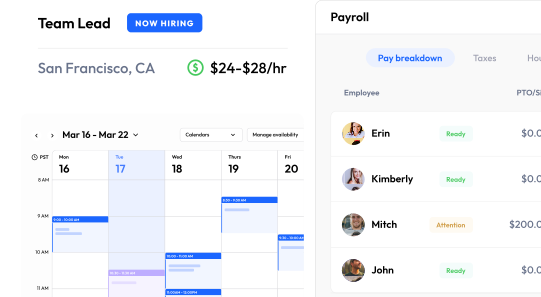
Workstream has established itself as the dominant platform for restaurant hiring, serving 46 of the top 50 QSR brands in the United States including Taco Bell, Burger King, Jimmy John's, and Culver's. The platform combines hiring, full-service payroll, scheduling, and compliance management in a single mobile-first system.
Key Features
- VoiceAI & VideoAI screening: Automated 24/7 phone screening in multiple languages reduces interview no-shows by 55%
- Text-to-apply: QR codes generate instant mobile applications from in-store posters
- Unified data model: Information entered once flows automatically across hiring, onboarding, scheduling, and payroll
- Multi-lingual support: Full Spanish and Mandarin translations across job postings and automated messaging
Why It Made the List
The platform earned the 2024 Gold Stevie Award for Exceptional Customer Service with an average support response time of 2 minutes. Unlike competitors requiring separate payroll vendors, Workstream offers integrated full-service payroll with AI-assisted auditing.
The mobile-first onboarding workflow digitizes W-4, I-9, and E-verify documentation with e-signatures. Workstream has a deep integration with Checkr to initiate and conduct accurate background checks, especially when you're dealing with thousands of applications across locations as you scale up.
Pricing Structure:
- Hiring tier: VoiceAI screening, ATS, text-to-apply, talent network, automated scheduling
- Essentials tier: Adds HRIS/onboarding, document management, team chat, employee directory
- All-in-One tier: Full-service payroll, AI payroll assistant, POS integration, compliance monitoring
- Premium tier: ACA tracking, benefits administration, custom integrations, advanced reporting
- Contact for custom quotes based on location count and employee volume
2) StaffedUp
StaffedUp focuses exclusively on hospitality hiring with tools designed for restaurant groups seeking measurable hiring improvements.
Key Features
- One-click job posting to multiple job boards
- Bulk messaging and auto-tagging for applicant filtering
- WOTC (Work Opportunity Tax Credit) screening integrated
- Collaborative hiring tools for multi-manager input
3) Push Operations
Push Operations combines AI-powered resume screening with integrated payroll, scheduling, and time tracking for restaurant chains.
Key Features
- AI Resume Screener identifies top candidates based on job descriptions
- One-click offer letters for fast hiring decisions
- Job Description Builder with customizable templates
- Self-serve onboarding ensures new hires are compliant before Day 1
- Built-in Salary Compare tools for competitive wage offers
4) Homebase
Homebase offers a genuinely useful free tier that includes scheduling, time tracking, and team communication, making it ideal for independent restaurants just getting started with workforce management software.
Key Features
- Free Basic plan includes core scheduling and time tracking for teams of up to 10 employees at one location, with paid plans available for larger teams and additional features
- Mobile app with high usability for shift swapping
- Digital onboarding with document collection
- Payroll integration available as add-on
5) 7shifts
7shifts is designed specifically for restaurant operations with hiring features integrated directly into its scheduling workflow. The platform excels at showing real-time staffing costs against sales.
Key Features
- Integrated scheduling with hiring in same workflow
- Labor analytics and forecasting tools
- Real-time reporting on staffing costs versus sales
- Team messaging integrated for shift-based communication
- Document upload and onboarding in-app
6) Fountain
Fountain serves global brands like UPS and Sweetgreen, specializing in high-volume frontline hiring with automated stage-based workflows.
Key Features
- Mobile-first candidate experience with SMS-based applications
- QR code scanning for instant applications
- Automated workflow advances candidates through screening automatically
- Designed specifically for frontline and hourly high-volume hiring
7) HigherMe
HigherMe serves major franchise brands including Domino's, Dunkin', and Tim Hortons with mobile-optimized hiring designed for restaurant managers who recruit on-the-go.
Key Features
- Automated interview scheduling with candidate self-selection
- Candidate score algorithm (0-100) based on hiring criteria
- Mobile application customizable with screening questions
- Franchise-wide reporting and analytics
8) Harri
Harri was built exclusively for the hospitality industry, combining applicant tracking with workforce scheduling through its TeamLive module.
Key Features
- Comprehensive applicant tracking and recruitment
- TeamLive scheduling module integrated
- Employee engagement tools and training modules
- Compliance management for hospitality operations
9) Fourth
Fourth (formerly PeopleMatter) delivers enterprise-scale labor management alongside high-volume hiring with seamless accounting and payroll integration.
Key Features
- Sophisticated labor management alongside hiring
- Seamless integration with accounting and payroll
- Customizable workflows for foodservice industry
- Enterprise-scale capabilities for multi-location chains
10) BambooHR
BambooHR offers comprehensive HR management that extends well beyond hiring for restaurants needing professional-grade tools.
Key Features
- Employee self-service portal
- 140+ integrations with HR systems
- Streamlined employee onboarding with e-signature capabilities
- Payroll, benefits, and time tracking as add-on modules
- 7-day trial period available
11) Workable
Workable provides AI-powered sourcing and distribution to 200+ job boards with a user-friendly interface requiring minimal training.
Key Features
- AI-powered sourcing and screening
- Distribution to 200+ job boards
- Customizable workflows and candidate pipelines
- Quick setup suitable for small independent restaurants
12) JazzHR
Unlimited users on all paid plans, with job-posting limits that vary by tier; unlimited active jobs are available on JazzHR’s Pro plan.
Key Features
- Unlimited job postings and unlimited users on paid plans
- Customizable job templates and hiring pipelines
- Collaborative evaluation tools for multi-manager input
- Automated candidate scoring
Key Features to Evaluate When Choosing a Workforce Management Tool
Selecting the right workforce management platform requires evaluating several critical capabilities that directly impact your restaurant’s hiring efficiency and operational success. The best systems make it easier to attract candidates, move new hires into operations, and maintain compliance across one or multiple locations.
Key features to look for include:
- Mobile optimization: Candidates often apply from smartphones, so the application process should be fast, simple, and frictionless on mobile devices.
- Text-to-apply functionality: Text-based applications make it easier for candidates to start the hiring process quickly.
- QR code functionality: QR codes on in-store signage, flyers, and job postings can help convert foot traffic into applicants.
- Deep integrations: Look for platforms that connect hiring directly to onboarding, scheduling, and payroll systems.
- Unified data flow: Integrated systems eliminate duplicate entry, reduce errors, and help new hires move seamlessly from application to first shift without manual intervention.
- AI-powered screening: Automated screening can reduce the time managers spend reviewing applications by advancing qualified candidates based on your criteria.
- Compliance management: Your platform should support I-9 verification, E-Verify integration, background checks, and labor law compliance across locations.
- Multi-unit oversight: Franchise and multi-location operators should look for centralized reporting that supports corporate visibility while still allowing local teams to make hiring decisions.
Workstream stands out as the ideal choice by addressing all these requirements in a single platform. With VoiceAI screening, full-service payroll integration, mobile-first design, and support for 46 of the top 50 QSR brands, Workstream provides the comprehensive workforce management solution restaurant operators need to hire faster, reduce turnover, and maintain compliance at scale.
Frequently Asked Questions
What specific challenges do restaurants face in hiring that an ATS can solve?
Restaurants deal with high turnover, candidates who apply from mobile devices, multiple pay rates for different roles, and the need to hire quickly before competitors. Restaurant-specific ATS platforms address these through mobile-first applications, automated screening, and integrated onboarding that reduces time-to-productivity.
How does a mobile-first ATS benefit both applicants and restaurant managers?
Hourly candidates expect to apply via smartphone, often during breaks or commutes. Mobile-first platforms like Workstream enable text-to-apply via QR codes, while managers can review candidates, schedule interviews, and approve hires entirely from their phones during service.
Can an ATS help with compliance for meal breaks and labor laws?
Yes. Platforms with built-in compliance features automatically flag potential violations in time tracking, scheduling, and payroll. Workstream's compliance dashboard aggregates risk across locations with heat maps identifying problem areas, while automated alerts notify managers of meal break requirements and overtime thresholds.
What are the benefits of an ATS that integrates with my POS and payroll?
Integration eliminates manual data entry and reduces errors. When your ATS connects to your POS (Square, Toast, PAR) and payroll, labor data flows automatically. New hires appear in scheduling systems, time punches feed into payroll calculations, and sales data informs staffing decisions without spreadsheet reconciliation.
How does AI screening improve restaurant hiring?
AI tools like VoiceAI conduct automated phone screens 24/7, asking customizable questions and advancing qualified candidates while providing disqualification reasons for others. This reduces manager time spent on initial outreach and decreases interview no-shows by ensuring candidates are engaged and qualified before scheduling.