



7 Best Hireology Alternatives for Multi-Location Hourly Hiring: 2026
- Home >
- Workstream Blog >
- 7 Best Hir...

Get the latest with Workstream
Always stay current with hiring news by subscribing to our email updates
While Hireology serves automotive dealerships and healthcare facilities with pre-configured workflows, multi-location restaurants and hourly businesses often need different capabilities. From integrated payroll to AI-powered screening and mobile-first applications, these seven alternatives address specific gaps for QSR operators, franchise groups, and retail chains managing high-turnover hourly workforces. This comprehensive analysis examines each platform's strengths and ideal use cases to help HR teams and franchise operators make informed decisions.
Key Takeaways
- All-in-one platforms reduce vendor complexity: Solutions that combine hiring, onboarding, payroll, and scheduling in a single system eliminate manual data re-entry compared to using separate point solutions for a 10-location operation
- Mobile-first architecture matters for hourly hiring: Platforms built for mobile from the ground up achieve 40-60% higher completion rates compared to traditional systems, while traditional desktop-focused systems often see higher abandonment from hourly candidates applying on phones
- AI screening accelerates time-to-hire: Automated phone and video screening tools that operate 24/7 can reduce interview no-shows by 55% and cut recruiter screening time significantly
- Support responsiveness varies dramatically: Response times range from 2 minutes to delayed resolutions depending on the platform, a critical factor when hiring managers need urgent help during peak periods
- Pricing transparency affects budgeting: Location-based pricing models provide predictable costs, while opaque structures make long-term planning difficult for growing franchise operations
The HR technology landscape for hourly businesses has evolved significantly as restaurant and retail operators demand more than basic applicant tracking. Industry analysis indicates that integrated platforms combining hiring, payroll, and compliance represent the future of hourly workforce management, reducing the "six tools, zero sync" problem that plagues multi-location operations.
For businesses evaluating their options, understanding each platform's target market and core strengths helps identify the right fit. Whether you need specialized applicant tracking capabilities, integrated payroll processing, or industry-specific compliance monitoring, this guide covers the leading alternatives available today.
1. Workstream: All-in-One Platform for Restaurant-Grade Hourly Hiring
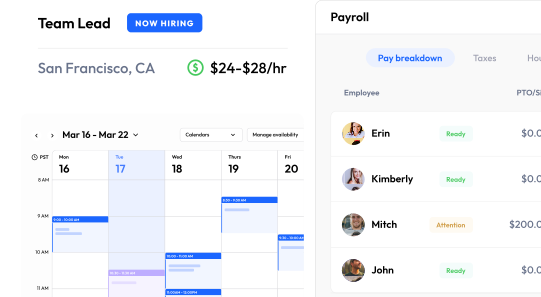
Workstream stands as the leading purpose-built platform for hourly workforce management, serving 46 of the top 50 restaurant brands with a unified solution spanning hiring, onboarding, payroll, scheduling, and compliance.
Key Features:
- AI-powered VoiceAI screening conducting 24/7 automated phone interviews in multiple languages
- VideoAI for asynchronous video interviews with AI-generated summaries and match scores
- Text-to-apply functionality with QR codes enabling mobile applications
- Distribution to 25,000+ job boards including unlimited Indeed postings as an Indeed Platinum Partner
- Talent Network feature maintaining a database of past applicants and former employees for rehiring
- Mobile-first onboarding with digital W-4, I-9, E-Verify, and e-signatures
- Deep integration with Checkr to initiate and conduct accurate background checks, especially when dealing with thousands of applications across locations as you scale up
- Built-in full-service payroll with multi-EIN management and automated tax filing
- Geofenced time tracking and scheduling with real-time overtime alerts
- Compliance monitoring with labor law heat maps across locations
Pricing Structure:
- Hiring tier: VoiceAI screening, ATS, text-to-apply, talent network, automated scheduling
- Essentials tier: Adds HRIS/onboarding, document management, team chat, employee directory
- All-in-One tier: Full-service payroll, AI payroll assistant, POS integration, compliance monitoring
- Premium tier: ACA tracking, benefits administration, custom integrations, advanced reporting
- Contact for custom quotes based on location count and employee volume
The platform's standout strength lies in its "restaurant-grade" architecture designed specifically for hourly workforce complexities. Unlike general HR platforms adapted from salaried workforce models, Workstream handles multi-role employees with different pay rates, tip pooling, meal break requirements, and ACA compliance across dispersed teams.
Support quality sets Workstream apart with 2-minute average response, 96.4% customer satisfaction, and the 2024 Gold Stevie Award for Exceptional Customer Service, available seven days per week.
For multi-location restaurants and hourly businesses seeking a single platform that eliminates vendor complexity while delivering AI-powered hiring efficiency, Workstream represents the strongest alternative to Hireology's approach.
2. TalentReef
TalentReef positions itself as a franchise and multi-location applicant tracking system with geo-targeted job posting and in-store application capabilities.
Key Features:
- In-store kiosk applications enabling walk-in applicants to apply on-site
- Geo-targeted job board distribution for location-specific recruitment
- Predictive scoring for candidate matching
- Multi-location reporting and analytics dashboards
- Video interview capabilities
- I-9 and E-Verify compliance features
TalentReef works well for franchise operations wanting kiosk-based hiring to capture walk-in applicants at retail and restaurant locations. The platform focuses primarily on applicant tracking rather than providing integrated payroll or comprehensive HR management.
The primary consideration is that TalentReef operates as an ATS-focused solution, meaning businesses still need separate providers for payroll, time tracking, and other HR functions. This approach suits organizations with established HR infrastructure seeking specialized recruitment capabilities.
3. Harri
Harri delivers an end-to-end platform specifically designed for hospitality businesses, combining hiring with shift scheduling and performance tracking in a single system.
Key Features:
- End-to-end platform combining ATS with scheduling and workforce management
- AI-powered candidate matching for hospitality roles
- SMS-based hiring communication
- Integrated shift scheduling with single-click payroll approval
- Performance tracking and employee engagement tools
- Mobile-first design for hospitality workers
Harri's strength lies in serving hospitality chains requiring tight integration between hiring and scheduling workflows. The platform's focus on restaurants and hotels means features are tailored to industry-specific needs like shift-to-payroll workflows.
For hospitality businesses prioritizing scheduling integration over comprehensive payroll features, Harri provides a focused solution. Organizations needing full-service payroll with automated tax filing may want to evaluate platforms with more robust payroll capabilities.
4. Fountain
Fountain targets enterprise organizations with extreme hiring volumes, particularly in retail, logistics, and gig economy sectors requiring high-volume frontline hiring.
Key Features:
- Purpose-built for high-volume hiring at scale
- Automated workflow orchestration for candidate progression
- Enterprise integrations with major HRIS and payroll systems
- Mobile-optimized candidate experience
- Analytics and reporting for hiring funnel optimization
- Multi-brand and multi-region management
Fountain excels for organizations hiring hundreds or thousands of frontline workers annually, particularly in sectors like logistics and retail where speed and volume matter most. The platform's enterprise focus means it may be oversized for mid-market restaurant groups.
Businesses with more moderate hiring volumes may find Fountain's enterprise-oriented approach more complex than necessary. The platform works best for organizations with dedicated recruiting teams and significant hiring infrastructure.
5. HigherMe
HigherMe focuses specifically on quick-service and fast-casual restaurant hiring with streamlined workflows designed for speed and simplicity.
Key Features:
- Fast restaurant hiring workflows optimized for QSR
- Text-based communication with candidates
- Simple application process for hourly roles
- Interview scheduling automation
- Basic onboarding document collection
- Job posting distribution to major boards
HigherMe provides a straightforward hiring solution for restaurants wanting to move quickly from application to interview. The platform's simplicity appeals to operators who prefer streamlined workflows over comprehensive feature sets.
For businesses seeking basic hiring automation without extensive HR features, HigherMe delivers focused functionality. Organizations needing payroll, scheduling, or compliance monitoring will need additional solutions alongside HigherMe.
6. BambooHR
BambooHR serves small and medium-sized businesses with a comprehensive HR platform covering employee records, time tracking, and basic hiring capabilities.
Key Features:
- Employee database and records management
- Time-off tracking and management
- Basic applicant tracking functionality
- Performance management tools
- Reporting and analytics
- Employee self-service portal
BambooHR works well for SMBs seeking general HR capabilities rather than hourly-specific features. The platform's strength lies in employee management rather than high-volume hourly hiring.
The consideration for restaurant and retail businesses is that BambooHR was designed primarily for office-based workforces rather than the unique challenges of multi-role hourly employees with varying pay rates and complex scheduling needs.
7. Workable
Workable provides a traditional applicant tracking system with AI-powered features for sourcing and screening candidates across various industries.
Key Features:
- AI-powered candidate sourcing and recommendations
- Customizable hiring pipelines
- Interview scheduling and collaboration tools
- Employer branding and career page builder
- Integration with major job boards
- Video interview capabilities
Workable suits organizations needing a flexible ATS that adapts to various hiring workflows. The platform serves multiple industries rather than focusing specifically on hourly or restaurant hiring.
For businesses with diverse hiring needs spanning both hourly and salaried roles, Workable provides versatility. Those seeking specialized hourly workforce features like text-to-apply, VoiceAI screening, or integrated payroll may find more tailored solutions elsewhere.
Key Features to Evaluate When Choosing a Workforce Management Tool
When evaluating workforce management platforms for hourly hiring, several critical capabilities separate effective solutions from basic applicant tracking systems. Understanding these features helps businesses select tools that address the unique complexities of multi-location hourly operations.
Essential platform capabilities include:
- Mobile-first application experience: Hourly candidates primarily apply from smartphones, making mobile optimization critical for completion rates
- AI-powered screening tools: Automated phone and video interviews that operate 24/7 reduce recruiter workload and accelerate hiring timelines
- Integrated payroll functionality: Combined hiring and payroll systems eliminate manual data transfer and reduce administrative overhead
- Multi-location compliance monitoring: Automated tracking of labor laws, meal breaks, and overtime requirements across different jurisdictions
- Text-based communication: SMS engagement meets candidates where they are and improves response rates compared to email-only systems
- Quick-apply features: QR codes and text-to-apply reduce application friction for high-turnover roles
Support and scalability considerations:
- Responsive customer support: Fast resolution times matter during peak hiring seasons when delays cost money
- Transparent pricing models: Location-based pricing provides budget predictability as operations grow
- Integration capabilities: Seamless connections with POS systems, background check providers, and existing tools reduce implementation friction
For businesses seeking a comprehensive solution that addresses these requirements, Workstream delivers purpose-built functionality for restaurant-grade hourly hiring with integrated payroll, AI screening, and award-winning support that scales with multi-location growth.
Frequently Asked Questions
What makes Workstream different from Hireology for restaurant hiring?
Workstream provides an all-in-one platform with integrated full-service payroll, VoiceAI screening, and mobile-first architecture specifically designed for hourly workforces. Hireology focuses on applicant tracking with industry-specific workflows for automotive and healthcare but requires separate payroll providers and has reported mobile functionality issues. Workstream's approach eliminates vendor complexity while delivering restaurant-grade features like tip pooling support, meal break compliance, and multi-EIN payroll management in a single system.
How much can businesses save by switching from Hireology to an all-in-one platform?
Based on TCO analysis, a 10-location operation can save significantly by consolidating from Hireology plus separate payroll providers to an integrated platform. These savings come from eliminating standalone payroll costs, reducing job board fees through included unlimited Indeed postings, and cutting engineering time spent on manual data transfer between disconnected systems.
Can Workstream handle background checks during the hiring process?
Yes, Workstream has a deep integration with Checkr to initiate and conduct accurate background checks, especially when dealing with thousands of applications across locations as you scale up. This integration works seamlessly within the mobile-first onboarding workflow, allowing new hires to authorize and complete background checks from their phones while progressing through digital document collection for W-4, I-9, and E-Verify compliance.
What support response times should businesses expect from Hireology alternatives?
Support responsiveness varies significantly across platforms. Workstream delivers 2-minute average response with 96.4% customer satisfaction and won the 2024 Gold Stevie Award for Exceptional Customer Service, available seven days per week. In contrast, some platforms experience delays for issue resolution and difficulty reaching representatives, a critical consideration when hiring managers face urgent situations during peak periods.
Which Hireology alternative works best for franchise operations with multiple brands?
Workstream serves 46 of the top 50 restaurant brands with multi-EIN payroll management and centralized visibility combined with location-level customization. The platform handles brand consistency across locations while allowing franchise-specific configurations for pay rates, compliance requirements, and hiring workflows. TalentReef also targets franchise operations with geo-targeted posting, though it focuses primarily on applicant tracking rather than comprehensive HR and payroll management.