




Best Hourly Hiring Software for Convenience Stores and Gas Stations
- Home >
- Workstream Blog >
- Best Hourl...

Get the latest with Workstream
Always stay current with hiring news by subscribing to our email updates
Convenience-store employee turnover commonly exceeds 100% annually. NACS reported average associate turnover of 141% using 2022 data, while both full- and part-time associate turnover remained above 100% in 2024. For a business maintaining 10 store-level positions, that could mean filling roughly 10 to 15 vacancies over a year, and each vacancy costs time, training dollars, and customer service quality. The right applicant tracking system doesn't just fill positions faster; it captures walk-in applicants with QR codes, screens candidates automatically before you waste interview time, and gets new hires productive on day one.
Finding software built for hourly operations matters. Traditional HR platforms designed for salaried office workers miss the nuances of shift-based scheduling, multi-role employees with different pay rates, and the constant churn that defines convenience store staffing. We reviewed more than 15 platforms, focusing on mobile applications, multi-location workflows, product capabilities, and publicly documented customer results, to identify 10 options for c-store and gas station operators to consider.
Key Takeaways
- Turnover is expensive: Convenience-store turnover commonly exceeds 100% annually, so hiring software ROI can compound quickly
- Mobile-first matters: Text-to-apply and QR codes can reduce friction for candidates applying from phones
- AI screening can save time: Automated phone interviews can help reduce the scheduling burden on recruiters
- All-in-one platforms can reduce data re-entry: Unified systems can flow data across hiring, onboarding, scheduling, and payroll when configured together
- C-store-specific features exist: Look for overnight shift support, multi-location management, and mobile-first tools built for walk-in candidates
Why Dedicated Hourly Hiring Software Makes Sense
Traditional hiring methods create friction that costs qualified applicants. Paper applications, phone tag with candidates, and manual interview scheduling slow down the process. When someone walks into your store looking for work, they expect to apply on the spot. If they have to go home and fill out a desktop-only application, you've likely lost them to the gas station across the street.
Modern hourly hiring platforms address this with text-to-apply functionality and QR codes that let candidates start applications instantly from their phones. The best systems automate interview scheduling, send text reminders to reduce no-shows, and screen candidates on availability and proximity before you invest time in interviews.
For multi-location operators, centralized visibility matters. You need to see hiring status across all stores from one dashboard while giving individual managers the autonomy to make local decisions. Platforms built for hourly operations handle these workflows natively rather than forcing you to adapt office-centric software.
1. Workstream – Best All-in-One Platform for Multi-Location Operations
Best For: C-store chains wanting unified hiring, onboarding, scheduling, and payroll
Pricing: Custom quote. Workstream says pricing varies by selected modules, employee count, location count, and contract length.
Workstream states that 46 of the top 50 restaurant brands use its platform, including Burger King, Jimmy John's, and Taco Bell. These are operations that share several workforce-management challenges with convenience stores, including high turnover, multi-location complexity, and shift-based scheduling. The platform positions itself as HR software built specifically for hourly operations rather than adapted from salaried workforce models.
Key Features
- VoiceAI Screening: Automated phone screening candidates can complete on their own time, with call transcripts, recordings, summaries, and pass/fail ratings; Workstream reports that VoiceAI reminder calls can reduce interview no-shows by 55%
- Unified Data Model: Information entered once can flow across hiring, onboarding, scheduling, and payroll when the relevant modules are configured together
- Multi-EIN Payroll: Manage payroll across multiple brands and locations from a single login
- Indeed Platinum Partnership: Indeed Platinum ATS partnership with integrated job and applicant workflows
Why It Made the List
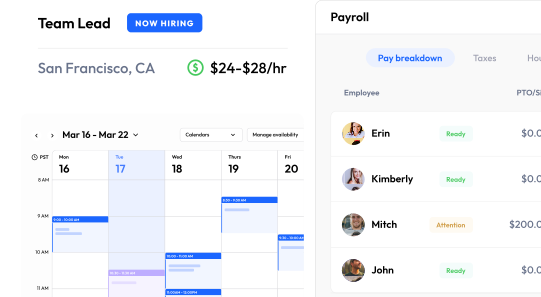
Workstream consolidates hiring, onboarding, HR records, payroll, scheduling, compliance, and benefits functions for hourly operations, which can help reduce the "six tools, zero sync" problem that plagues multi-system setups. In one Workstream customer case study, the operator reported reducing time spent per hire from 20 minutes to one minute.
The platform's mobile-first onboarding collects W-4 and Form I-9 information digitally and supports E-Verify workflows, with e-signatures. Workstream integrates with Checkr to help initiate and manage background checks, especially when dealing with thousands of applications across locations as you scale up. Workstream states that support is available seven days per week.
Strengths
- All-in-one design can help reduce the "six tools, zero sync" problem
- VoiceAI handles screening around the clock in supported languages
- Received the 2024 Gold Stevie Award for customer service
2. HigherMe
HigherMe provides hiring and onboarding software for franchise and hourly-workforce businesses. Founded by franchise restaurant operators, the platform is built around real-world hourly hiring challenges. HigherMe reports average time-to-hire results of one to two days and an 88% application completion rate in its marketing materials; results vary by customer and workflow. HigherMe also reports up to 67% fewer interview no-shows when automated scheduling and reminders are used, and its talent database supports rehiring previous candidates when positions open.
Key Features
- NextMatch AI: Conducts customized AI-powered screening interviews and provides managers with candidate insights
- Text-to-Apply and QR Codes: Let candidates begin the application process from their phones
- Indeed Platinum Partnership: Job-distribution partnership as part of HigherMe's ATS integration
- Talent Database: Stores previous applicants for instant outreach when positions open
3. StaffedUp
StaffedUp has a dedicated convenience-store and grocery offering, with customizable hiring workflows for multi-location operators. StaffedUp reports up to eight times more applicants, a 45% decrease in turnover, and a 77% shorter time to hire using its platform. StaffedUp also offers WOTC prescreening workflows; federal WOTC authorization expired on December 31, 2025, and credits for employees beginning work after that date are pending congressional reauthorization.
Key Features
- AI Candidate Ranking: Surfaces top applicants for manager review
- QR Code Scan-to-Apply: In-store recruiting tools for capturing walk-in candidates
- Multi-Location Hiring: Customizable workflows for operations across many locations
- WOTC Prescreening: Workflow support for Work Opportunity Tax Credit eligibility; confirm current federal reauthorization status
4. Netchex
Netchex emphasizes service quality over feature lists, with US-based, FPC-certified support teams. The platform combines hiring capabilities with comprehensive payroll and HR functions for multi-location operations. Netchex reports average customer tenure of more than 10 years, and it advertises free, project-managed implementation with a dedicated team.
Key Features
- OneScreen Payroll: Netchex says most teams can run payroll in under 15 minutes
- Dedicated Account Manager: A dedicated contact rather than a general support queue
- ACA Compliance Tracking: Automated monitoring for benefits thresholds
- WOTC Prescreening: Workflow support for Work Opportunity Tax Credit eligibility; confirm current federal reauthorization status
5. TalentReef
TalentReef is used at more than 100,000 locations in the United States as part of the Mitratech HR compliance suite. Mitratech reports that some TalentReef customers have experienced substantial increases in applicant flow, including a 369% increase in one month in one published product result, and reports an 84% average reduction in time to apply. TalentReef's enterprise-scale deployment reflects its use among large chains, and its compliance integration is built for operators managing regulatory requirements across multiple states.
Key Features
- AI-Driven Automation: Automatic candidate ranking at scale
- Compliance Workflows: I-9 and background-screening workflows, with integrations for related HR and compliance systems
- Customizable Applications: Tailor requirements by position and location
- Mobile-Optimized Applications: Mitratech reports a 62% completion rate across customers, with higher completion reported among Fast Apply users
6. Workforce.com
Workforce.com provides applicant tracking and workforce-management software for shift-based businesses. The platform's talent pool database stores previous applicants for instant outreach when positions open, which can be useful for high-turnover environments like regional c-store chains. The talent pool functionality is designed to help reduce job board spending by enabling re-engagement with previous applicants.
Key Features
- In-Store QR Codes: Local candidate capture
- Configurable Applications: Application questions and hiring workflows tailored by role
- Paperless Onboarding: Workforce.com advertises onboarding that can get new hires set up in as little as three minutes
- Talent Pool Database: Re-engage past applicants instantly
7. Homebase
Homebase offers a free Basic plan for one location and free job posting and candidate management through Hiring Manual Mode. For independent c-store owners unsure about software investment, this provides a low-risk starting point, and the interface is designed to be simple to learn for first-time users.
Key Features
- Free Basic Plan: Free scheduling and hiring tools for one location via Manual Mode
- Mobile App: Employee clock-in/out functionality
- Simple Interface: Designed for quick setup with minimal training
- Scheduling Foundation: Core scheduling tools included in the free tier
8. Hireology
Hireology specializes in maintaining hiring consistency across dispersed teams. The platform provides centralized tracking with location-level customization, which can help c-store chains support consistent evaluation criteria across managers and locations.
Key Features
- Structured Hiring Workflows: Support consistent evaluation criteria across locations
- Background Checks: Background-check services available, depending on package
- Indeed Platinum Partnership: ATS-integrated job board access
- Payroll Integrations: Connects with payroll and HR systems, including ADP and Netchex
9. Harri
Harri reports serving 70,000 locations globally, with a platform purpose-built for hospitality. The platform combines hiring with comprehensive workforce management, including scheduling, time and attendance, and labor-compliance tools. For convenience stores with substantial prepared food operations, such as Wawa or Sheetz, Harri's hospitality focus can provide relevant workflows.
Key Features
- Combined Hiring and Scheduling: Unified platform approach
- Structured Screening: Interview scheduling automation
- Workforce Management: Extends beyond hiring into the full employee lifecycle
- Hospitality Focus: Purpose-built for restaurants, hotels, bars, and related service businesses
10. Fountain
Fountain reports 14 million cumulative hires across more than 75 countries; company materials have reported annual hiring volumes ranging from 1.2 million to more than 3 million. The platform is built for high-volume, frontline hiring at scale. For regional c-store chains considering national expansion, Fountain's scale and global reach may provide confidence, and the platform includes SMS-enabled candidate communication.
Key Features
- Workflow Automation: Drag-and-drop builder for customizable hiring stages
- SMS Communication: SMS-enabled applications and candidate communication
- Global Capabilities: Reported reach across more than 75 countries
- Enterprise Scale: Built for high-volume, distributed hiring operations
Why Workstream Is a Strong Choice for Convenience Store Operators
When evaluating hourly hiring software for convenience stores, Workstream is a strong option for operators wanting unified operations. While other platforms excel at specific functions, Workstream consolidates hiring, onboarding, scheduling, and payroll within its broader platform.
Managing disconnected systems can require duplicate data entry and reconciliation unless reliable integrations are in place, which can increase the risk of inconsistent or inaccurate employee records. Workstream's unified data model is designed to help reduce this "six tools, zero sync" problem.
Workstream's VoiceAI technology provides automated phone screening around the clock in supported languages, which can help address the reality that c-store applicants may need to be reached outside standard business hours. Workstream reports that VoiceAI reminder calls can reduce interview no-shows by 55%, which may help managers avoid unused interview slots.
For c-store chains facing turnover rates that commonly exceed 100% annually, shortening time-to-hire can have a meaningful cumulative effect across hundreds of positions each year. Workstream states that 46 of the top 50 restaurant brands use its platform, reflecting experience with high-turnover, shift-based operations that share several workforce-management challenges with convenience stores.
Ready to see how it works? Request a demo to explore whether Workstream fits your c-store operations.
Key Features to Evaluate When Choosing Hourly Hiring Software
When selecting hiring software for convenience store operations, prioritize platforms designed for hourly, shift-based workforces. Mobile-first application processes with QR codes and text-to-apply functionality can help capture walk-in candidates quickly. Automated screening capabilities can evaluate availability, proximity, and experience, helping surface qualified candidates before manager involvement.
Multi-location visibility with location-level autonomy supports centralized oversight while still empowering individual store managers to make hiring decisions. Integration across hiring, onboarding, scheduling, and payroll can help reduce duplicate data entry and support more consistent compliance records. Consider whether a platform supports Form I-9 completion and retention, background-check integrations, and WOTC-related prescreening workflows, keeping in mind that current federal WOTC authorization has lapsed for hires beginning after December 31, 2025.
AI-powered interview scheduling and automated reminders can help reduce no-shows, while around-the-clock phone screening can accommodate candidates who apply outside business hours. For c-stores with multilingual workforces, confirm which languages each platform currently supports for screening and communication.
Workstream is the ideal choice for convenience store and gas station operators seeking a unified platform built for hourly workforce management, combining mobile-first applications, VoiceAI screening, and integrated data flow from hiring through payroll.
Frequently Asked Questions
What specific challenges do convenience stores face in hiring hourly employees?
Convenience stores commonly face turnover rates exceeding 100% annually, meaning frequent hiring cycles. Unlike office environments, c-stores need 24/7 coverage including overnight shifts that can be harder to fill. Multi-location operators must manage hiring across dispersed stores while maintaining consistent quality, and walk-in applicants often expect an instant application process.
How can AI-powered screening tools benefit high-volume hourly hiring?
AI screening can reduce the time recruiters typically spend on interview scheduling. Automated phone interviews can screen candidates around the clock, evaluate availability and proximity, and advance qualified applicants before managers invest time. Platforms with this capability can also help reduce interview no-shows through automated reminders and rescheduling, though results vary by vendor and implementation.
Is an integrated HR platform truly necessary for small multi-location businesses?
For chains with multiple locations, integrated platforms can help reduce the duplicate data entry that contributes to compliance errors. When configured together, information entered during hiring can flow to onboarding, scheduling, and payroll, reducing manager workload and supporting more consistent records. Single-location operators may start with simpler tools, but those planning to grow should evaluate scalability from the start.
What are the most important compliance features to look for in hourly hiring software?
Priority features include support for Form I-9 completion and retention and E-Verify workflows where applicable, WOTC-related prescreening functionality (though current federal WOTC authorization has lapsed for hires beginning after December 31, 2025, pending reauthorization), ACA eligibility tracking for benefits thresholds, and break-time alerts for shift scheduling. Multi-state operators should evaluate whether a platform supports configurable state and local rules, alerts, and reporting, while retaining qualified legal or compliance oversight.
How does mobile-first design improve the hiring experience for hourly workers?
Mobile-friendly applications can reduce friction for candidates applying from phones; buyers should ask vendors for completion-rate data specific to comparable hourly roles. Features like text-to-apply and QR codes let walk-in candidates start applications quickly from their phones. For c-stores, this can help capture a motivated candidate on the spot rather than relying on them to apply later at home.