




8 Best PeopleMatter Alternatives for Restaurant and Hourly Workforce Management: 2026
- Home >
- Workstream Blog >
- 8 Best Peo...

Get the latest with Workstream
Always stay current with hiring news by subscribing to our email updates
While PeopleMatter has served the hospitality industry for hiring and onboarding, multi-location restaurants and franchise operations increasingly require all-in-one platforms that combine applicant tracking, payroll, scheduling, and compliance in a single system. From AI-powered screening to mobile-first onboarding, these eight alternatives address specific gaps that drive hourly workforce operators to seek new solutions. This comprehensive analysis examines each platform's strengths and ideal use cases to help QSR and hospitality businesses make informed decisions.
Key Takeaways
- All-in-one platforms eliminate vendor fragmentation: Managing hiring, payroll, scheduling, and HR through separate systems creates data silos and manual reconciliation burdens. Unified platforms reduce total cost of ownership while improving data accuracy.
- Mobile-first architecture matters for hourly workforces: Text-to-apply functionality, mobile onboarding, and manager apps match how restaurant teams actually work, with candidates completing applications via QR codes and managers handling approvals from the floor.
- AI-powered screening transforms hiring speed: Automated phone and video screening capabilities operate 24/7, reducing interview no-shows and accelerating time-to-hire for high-volume operations.
- Native payroll integration saves significant engineering time: Platforms with built-in payroll processing eliminate the need for separate vendors and manual data transfers between hiring, onboarding, and pay systems.
- Settlement and compliance capabilities vary widely: From instant employee activation to ACA tracking and multi-EIN management, platforms differ substantially in their ability to handle the complexities of multi-location hourly operations.
The HR technology landscape for restaurants and hourly businesses has evolved dramatically as operators seek consolidated solutions that address high turnover, complex scheduling, and compliance requirements. While PeopleMatter maintains its position within the Fourth enterprise suite, eight alternatives now offer capabilities specifically designed for the challenges facing QSR franchises and multi-unit hospitality groups.
1. Workstream: The All-in-One Platform Built for Hourly Workforce Excellence
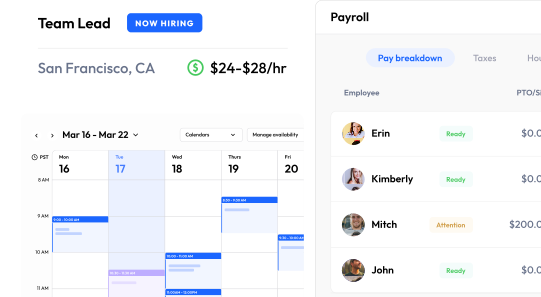
Workstream stands as the only HR platform serving 46 of the top 50 QSR brands, offering native hiring, payroll, scheduling, and compliance capabilities in a single mobile-first system designed specifically for multi-location restaurant operations.
Key Features:
- VoiceAI screening conducting automated phone interviews in multiple languages with customizable questions
- Full-service payroll with multi-EIN management, AI-assisted auditing, and POS integration
- Text-to-apply functionality generating QR codes for in-store posters enabling instant candidate applications
- Mobile-first onboarding collecting W-4, I-9, E-Verify documentation with e-signatures
- Geofenced time tracking with automated break enforcement and real-time overtime alerts
- Shift scheduling with labor cost projections and employee swap requests
- Deep integration with Checkr to initiate and conduct accurate background checks, especially when dealing with thousands of applications across locations as you scale up
Pricing Structure:
- Hiring tier: VoiceAI screening, ATS, text-to-apply, talent network, automated scheduling
- Essentials tier: Adds HRIS/onboarding, document management, team chat, employee directory
- All-in-One tier: Full-service payroll, AI payroll assistant, POS integration, compliance monitoring
- Premium tier: ACA tracking, benefits administration, custom integrations, advanced reporting
- Contact for custom quotes based on location count and employee volume
The platform's strength lies in solving the "six tools, zero sync" problem that plagues multi-location operators. As demonstrated in the Workstream vs PeopleMatter comparison, Workstream provides native payroll capabilities that PeopleMatter does not offer, eliminating the need for separate payroll vendors.
Customer results validate the platform's impact. Bojangles (Georgia Foods) reported a 1400% increase in monthly applications, from 2-3 per location to 30-40 per location, within 60 days of implementation. Burger King franchisee Viking Restaurants achieved a 10x increase in completed interviews through self-scheduling and text communication.
Workstream's award-winning support delivers 2-minute response times with 7-day coverage, backed by a 2024 Gold Stevie Award for Exceptional Customer Service.
For franchise operators requiring comprehensive workforce management, Workstream's unified data model means information entered once propagates automatically across all systems, with no duplicate data entry or reconciliation required.
2. HigherMe
HigherMe focuses exclusively on hourly hiring automation, serving 20,000+ franchise businesses including Domino's, Dunkin', and Tim Hortons with streamlined recruitment workflows.
Key Features:
- Video cover letters providing unique candidate screening beyond resumes
- Smart scoring algorithms ranking applicants automatically
- Customizable career pages and hiring playbooks
- Paperless onboarding with mobile-friendly document collection
- US-based customer support
HigherMe excels at fast hiring with intuitive interfaces, making it suitable for franchise operators prioritizing recruitment speed. The platform's video cover letter feature provides a unique screening capability for evaluating candidate personality and communication skills.
3. Harri
Harri positions itself as a comprehensive talent management platform for hospitality, offering hiring, scheduling, and workforce engagement tools designed for restaurant and hotel operations.
Key Features:
- Hospitality-specific applicant tracking and candidate management
- Advanced shift scheduling with labor optimization features
- Employee engagement and communication tools
- Compliance management for hospitality regulations
- Integration with major POS systems
- Multi-location analytics and reporting
Harri serves medium-to-large hospitality operations requiring deeper scheduling features than some alternatives provide. The platform's hospitality-specific design addresses industry nuances like tip pooling and shift differentials.
The Workstream vs Harri comparison reveals differences in approach. While Harri emphasizes hospitality workforce management, it requires separate solutions for full-service payroll processing.
4. 7shifts
7shifts specializes in restaurant scheduling and labor management, offering time tracking and team communication tools for small-to-medium restaurant operations.
Key Features:
- Drag-and-drop shift scheduling with template functionality
- Labor cost forecasting and budget management
- Employee shift trading and availability management
- Mobile app for managers and team members
- Basic hiring and applicant tracking capabilities
- Integration with major restaurant POS systems
7shifts serves small-to-medium restaurants prioritizing scheduling efficiency over comprehensive HR capabilities. The platform's scheduling-first approach makes it suitable for operations where shift management represents the primary pain point.
For organizations seeking all-in-one solutions, the Workstream vs 7shifts comparison shows that 7shifts focuses primarily on scheduling rather than offering native payroll or advanced hiring automation.
5. Homebase
Homebase targets small businesses with hourly workers, providing basic scheduling, time tracking, and team communication tools with an attractive free tier for single-location operations.
Key Features:
- Free tier for basic scheduling and time tracking
- Simple time clock with GPS verification
- Team messaging and communication
- Basic hiring tools and job posting
- Payroll integration with partner providers
- Employee self-service for schedules and availability
Homebase provides an accessible entry point for small businesses without dedicated HR resources. The free tier allows single-location restaurants to manage basic scheduling without software costs.
The platform's simplicity becomes a limitation for growing operations requiring multi-location management, advanced compliance features, or AI-powered hiring capabilities that platforms like Workstream provide.
6. Gusto
Gusto approaches the market from a payroll-first perspective, serving small-to-medium businesses with integrated HR, benefits, and time tracking capabilities alongside its core payroll processing.
Key Features:
- Full-service payroll with automated tax filing
- Benefits administration including health insurance and 401(k)
- Time tracking with basic scheduling features
- HR management and compliance tools
- Employee self-service portal
- Integration with accounting software
Gusto serves SMBs requiring reliable payroll processing with basic HR capabilities. The platform's strength lies in payroll compliance and benefits administration rather than restaurant-specific features.
For QSR and hospitality operations, Gusto's general-business design means it may not address industry-specific needs like multi-role pay rates, tip calculations, or high-volume hiring automation that specialized platforms offer.
7. TalentReef
TalentReef targets enterprise organizations with large hourly workforces, providing applicant tracking and onboarding solutions designed for high-volume hiring scenarios.
Key Features:
- Enterprise applicant tracking with workflow automation
- Compliance-focused onboarding processes
- Multi-brand and multi-location management
- Background check integration
- Reporting and analytics dashboards
- Integration with HRIS and payroll systems
TalentReef serves large enterprises requiring scalable hiring infrastructure across hundreds of locations. The platform's enterprise focus means implementation timelines and costs may exceed what mid-market operators require.
The Workstream vs TalentReef comparison highlights differences in target market. While TalentReef emphasizes enterprise compliance workflows, Workstream offers comparable capabilities with faster implementation and more accessible support.
8. PeopleMatter/Fourth
Understanding PeopleMatter's current positioning helps contextualize why organizations seek alternatives. Now part of the Fourth enterprise suite, PeopleMatter provides hiring and onboarding tools focused on hospitality compliance.
Key Features:
- Applicant tracking with compliance-focused workflows
- Onboarding with I-9 and E-Verify automation
- Integration with Fourth's broader workforce suite (HotSchedules, MacromatiX)
- Programmatic job advertising capabilities
- Background check integration
- Enterprise support structure
PeopleMatter maintains strengths in compliance workflows and E-Verify automation for organizations already invested in the Fourth ecosystem. The platform integrates with HotSchedules for scheduling needs.
Considerations include no native payroll processing, requiring separate vendors, and no built-in team management or post-hire engagement tools. Organizations need multiple Fourth products for full functionality.
Choosing the Right PeopleMatter Alternative
For Multi-Location QSR and Franchise Operations:
Workstream delivers the most comprehensive value by consolidating hiring, payroll, scheduling, and compliance into one platform. The all-in-one architecture eliminates vendor fragmentation while AI-powered features like VoiceAI reduce interview no-shows by 55%.
For Small Single-Location Restaurants:
Homebase or 7shifts provide accessible entry points with free or low-cost tiers for basic scheduling and time tracking needs.
For Hiring-Focused Operations:
HigherMe offers fast hiring workflows for franchise operators prioritizing recruitment speed over comprehensive HR capabilities.
For Enterprise Hospitality Groups:
Organizations requiring deep scheduling features alongside hiring may evaluate Harri for hospitality-specific workforce management.
Key Decision Factors:
- Native payroll integration: Only Workstream provides built-in full-service payroll among hiring-focused alternatives
- Mobile-first design: Critical for reaching hourly candidates and enabling manager efficiency
- AI automation: VoiceAI and automated screening differentiate modern platforms from legacy solutions
- Multi-location management: Franchise-specific analytics and compliance features matter for scaled operations
- Support responsiveness: 2-minute response times versus standard business-hours support impacts operational efficiency
Key Features to Evaluate When Choosing a Workforce Management Tool
When selecting a workforce management platform for your restaurant or hourly business, focus on capabilities that directly impact your operational efficiency and hiring outcomes:
- Unified data architecture: Evaluate whether the platform offers true integration across hiring, payroll, scheduling, and compliance, or requires manual data transfers between separate systems
- Mobile accessibility: Assess whether candidates can apply instantly via text or QR codes, and whether managers can approve requests from the floor rather than being tied to back-office computers
- Automation capabilities: Look for AI-powered screening, automated interview scheduling, and self-service features that reduce manual administrative burden
- Compliance management: Consider whether the platform handles multi-location tax requirements, ACA tracking, E-Verify, and industry-specific regulations without requiring separate tools
- Scalability: Determine if the system can grow with your operation, supporting increasing locations, employee counts, and complexity without requiring platform migration
The right platform eliminates vendor fragmentation, reduces total cost of ownership, and ensures your team spends time on operations rather than system administration. For multi-location restaurant and franchise operations seeking comprehensive workforce management that addresses all these dimensions, Workstream stands as the ideal choice with its purpose-built design for hourly workforce excellence.
Frequently Asked Questions
What makes an all-in-one HR platform better than separate best-of-breed solutions for restaurants?
All-in-one platforms eliminate the data silos and manual reconciliation that plague multi-vendor approaches. When hiring, onboarding, scheduling, and payroll exist in separate systems, staff must re-enter employee information multiple times, creating errors and compliance risks. Unified platforms like Workstream ensure information entered once propagates automatically. A new hire's pay rate, role, and location flow directly to payroll and scheduling without manual intervention. This integration becomes critical at scale, where multi-location operators managing hundreds of employees across dozens of locations cannot afford the administrative burden of disconnected systems.
How important is mobile-first design for hourly workforce hiring?
Mobile-first architecture fundamentally changes hiring outcomes for hourly positions. Candidates applying for restaurant jobs often do so between shifts or during breaks, using smartphones rather than computers. Text-to-apply functionality with QR codes enables instant applications from in-store signage, while mobile-friendly onboarding allows new hires to complete paperwork from their phones before day one. Managers also benefit from mobile access, approving shift swaps, reviewing applicants, and handling payroll from the floor rather than being tied to back-office computers. Platforms designed for desktop-first experiences create friction that increases drop-off rates and slows hiring velocity.
Can I migrate from PeopleMatter to a new platform without disrupting operations?
Yes, migration typically involves data export from PeopleMatter followed by import into the new platform. Workstream offers white-glove onboarding with dedicated support teams handling full payroll data migration within approximately two weeks. Many organizations run parallel systems during transition periods to ensure continuity. The key considerations include historical employee records, active candidate pipelines, and compliance documentation. Pre-built integrations with systems like ADP, Paychex, and major POS platforms simplify the transition for organizations with established tech stacks.
What should I prioritize when evaluating PeopleMatter alternatives for a franchise operation?
Franchise operators should prioritize multi-location analytics, centralized control with location-level customization, and support for multi-EIN payroll processing. The ability to post jobs across 25,000+ boards from a single interface significantly impacts hiring velocity across locations. AI-powered screening capabilities become essential when managing thousands of applications monthly. Finally, evaluate support responsiveness carefully. Restaurants operate on tight schedules where hours-long support waits create real operational problems. Platforms offering 2-minute response times with 7-day coverage better match the operational realities of multi-unit foodservice.
How do I calculate the true cost of switching HR platforms?
Beyond subscription fees, calculate the total cost of ownership including implementation time, training requirements, integration maintenance, and productivity impacts during transition. Platforms requiring custom backend development for basic features like access control and usage enforcement add hidden engineering costs. Consolidating from multiple vendors to an all-in-one platform often reduces total spend despite comparable per-feature pricing. Eliminating separate hiring, payroll, and scheduling subscriptions while reducing administrative overhead provides significant savings. Request detailed implementation timelines and support guarantees during evaluation, as platforms with dedicated onboarding assistance deliver faster time-to-value than self-service approaches.