




8 Best UKG Alternatives for HR, Payroll & Workforce Management in 2026
- Home >
- Workstream Blog >
- 8 Best UKG...

Get the latest with Workstream
Always stay current with hiring news by subscribing to our email updates
UKG (Ultimate Kronos Group) serves 80,000+ organizations across 150 countries, but its enterprise-focused approach and complex implementation requirements have prompted many businesses, especially those with hourly workforces, to seek alternatives better suited to their operational needs.
Whether you're running multi-location restaurants, managing shift-based teams, or looking for faster deployment times, these eight UKG alternatives offer distinct advantages for specific use cases. This guide examines each platform's strengths and ideal applications to help HR leaders and operations managers make informed decisions about their workforce management infrastructure.
Key Takeaways
- Industry-specific platforms outperform generalist solutions for hourly operations: Purpose-built HR software designed for shift-based industries delivers faster implementation, specialized features, and better alignment with high-turnover workforce challenges than enterprise HCM platforms retrofitted for hourly use cases.
- Implementation timelines vary dramatically: Enterprise platforms like UKG Pro and Dayforce require 4-8 months for deployment with significant implementation costs, while modern alternatives designed for mid-market operations deploy in days to weeks.
- Mobile-first architecture matters for frontline teams: Platforms built from the ground up for mobile use enable hourly workers to complete onboarding, view schedules, and clock in from their phones, critical for industries where employees rarely access desktop computers.
- AI-powered hiring tools reduce time-to-fill: Automated screening, scheduling, and candidate communication capabilities can reduce hiring timelines from weeks to days, addressing the high-turnover reality of hourly industries.
- Total cost of ownership extends beyond subscription fees: Factor in implementation costs, training requirements, ongoing maintenance, and the engineering time required for custom integrations when comparing platforms.
1. Workstream: Best for Multi-Unit Restaurant and Hourly Operations
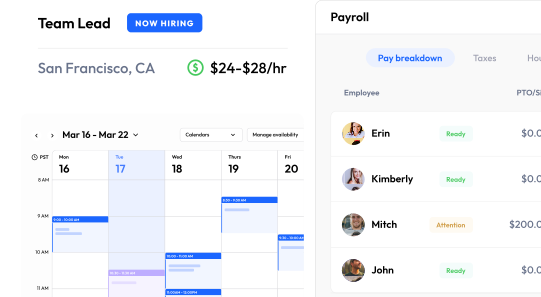
Workstream stands as the leading alternative for businesses with hourly workforces, offering a purpose-built platform that consolidates hiring, onboarding, scheduling, payroll, and compliance into a single mobile-first system. The platform serves 46 top restaurant brands in the United States, including Taco Bell, Culver's, Bojangles, Arby's, IHOP, Jimmy John's, and Five Guys.
Core Capabilities
- VoiceAI screening: Proprietary AI conducts 24/7 automated phone screening calls in multiple languages, reducing interview no-shows by 55%
- Applicant tracking: Posts to 25,000+ job boards with one click, including unlimited Indeed postings through Platinum Partnership
- Full-service payroll: Multi-EIN management with AI-assisted auditing, automated tax filing, and POS integration
- Shift scheduling: Geofenced mobile time tracking, real-time overtime alerts, and automated break enforcement
- Mobile onboarding: Digital W-4, I-9, E-verify, and direct deposit collection with e-signatures
Workstream has a deep integration with Checkr to initiate and conduct accurate background checks, especially when you're dealing with thousands of applications across locations as you scale up.
Proven Results
Real customer outcomes demonstrate Workstream's impact on hourly hiring operations:
- Bojangles (41 locations): Increased monthly applications from 2-3 per location to 30-40 per location, a 1,400% increase, within 60 days
- Burger King (26 locations): Achieved 10x increase in interviews by implementing self-scheduling and text communication
- Dunkin' (~48 locations): Transformed from slow manual hiring to same-day hiring through automation and text-based communication
Pricing Structure
- Hiring tier: VoiceAI screening, applicant tracking, text-to-apply, job board distribution
- Essentials tier: Adds HRIS/onboarding, document management, W-4/I-9/E-verify, team chat
- All-in-one tier: Full-service payroll, AI payroll assistant, POS integration, compliance monitoring
- Premium tier: ACA tracking, benefits administration, custom integrations, advanced reporting
Implementation occurs within days to weeks with white-glove onboarding support. The platform won the 2024 Gold Stevie Award for Exceptional Customer Service with an average support response time of 2 minutes.
2. Dayforce
Dayforce (formerly Ceridian Dayforce) differentiates through its continuous payroll calculation engine, the only platform offering real-time payroll tied directly to time and attendance data. The system supports operations across multiple countries, making it suitable for multinational enterprises with complex global requirements.
Key Features
- Continuous payroll: Real-time calculation engine eliminates batch processing delays
- Single database architecture: Unified HR, payroll, benefits, and time data in one system
- Global coverage: Native support for multiple countries with multi-currency capabilities
- Advanced compliance: Automated labor law monitoring across jurisdictions
- Predictive scheduling: AI-powered workforce planning tools
3. Workday HCM
Workday HCM targets large enterprises requiring deep integration between HR and financial systems. The platform serves thousands of customers globally with its unified approach to human capital and financial management.
Key Features
- Finance integration: Seamless connection between HR data and financial planning
- Single data model: Unified architecture across all HCM functions
- Global payroll orchestration: Multi-country payroll management
- Analytics: Advanced reporting and workforce insights
- Talent management: Comprehensive recruiting, learning, and performance tools
4. ADP Workforce Now
ADP brings 75 years experience to its Workforce Now platform, serving organizations across 140+ countries with comprehensive HR, payroll, and compliance capabilities. As the largest payroll provider globally, ADP offers extensive tax and regulatory support.
Key Features
- Payroll processing: Industry-leading accuracy with automatic tax filing
- Compliance management: Multi-state and international regulatory support
- Benefits administration: Integrated enrollment and management
- Time tracking: Basic time and attendance functionality
- HR management: Core HRIS capabilities for mid-market organizations
5. Rippling
Rippling has emerged as a fast-growing platform in the mid-market segment by uniquely combining HR and IT management in a single system.
Key Features
- HR+IT+Finance: Unified employee, device, and app management
- Pre-built integrations: Extensive ecosystem connectivity with 650+ integrations
- Automated workflows: Cross-functional process automation
- Modern UX: Clean, intuitive interface designed for speed
- Global capabilities: Support for international employees in multiple countries
6. BambooHR
BambooHR focuses exclusively on small and medium-sized businesses, serving thousands of customers with an emphasis on ease of use and rapid deployment.
Key Features
- User-friendly interface: Designed for HR teams without technical backgrounds
- Core HR: Employee records, org charts, and reporting
- Onboarding: Digital document collection and task management
- Time tracking: Basic time and attendance capabilities
- Performance management: Reviews and goal tracking
7. Paylocity
Paylocity differentiates through its employee engagement tools, including social feeds, recognition programs, and Employee Voice surveys.
Key Features
- Community social feed: Internal communication and recognition
- Employee Voice surveys: Regular engagement measurement
- Mobile-first design: Modern app experience for employees
- Payroll and HR: Comprehensive core HR and payroll functionality
- Learning management: Training and development tools
8. UKG Ready
UKG Ready serves organizations with 50-2,500 employees requiring sophisticated time and attendance management with strong compliance automation. The platform leverages 40+ years expertise.
Key Features
- Advanced time tracking: Sophisticated attendance management
- Compliance automation: Multi-jurisdiction labor law support
- Scheduling: AI-powered workforce scheduling
- Payroll: Integrated payroll processing
- HR management: Core HRIS functionality
How to Choose the Right UKG Alternative
By Business Size
- Small (\< 50): BambooHR offers simplest implementation and affordable options
- Mid-Market (50-500) with hourly workforce: Workstream provides purpose-built features for shift-based operations
- Mid-Market (50-500) with salaried workforce: Rippling delivers modern HR and IT unification
- Enterprise (500+): UKG Pro, Dayforce, or Workday provide deep functionality for complex requirements
By Industry Focus
- Restaurants/QSR: Workstream offers VoiceAI hiring, POS integration, and multi-location management
- Retail: Workstream provides shift scheduling and mobile-first tools for hourly teams
- Technology: Rippling delivers HR+IT unification with modern UX
- Global Enterprise: Dayforce or Workday offer multi-country payroll and compliance
- Small Business: BambooHR emphasizes ease of use and rapid deployment
By Primary Need
- Fast hiring for high-turnover roles: Workstream's VoiceAI and applicant tracking capabilities
- Real-time payroll visibility: Dayforce's continuous calculation engine
- Global operations: Workday or ADP for multi-country support
- IT+HR management: Rippling's unified platform
- Simplicity over features: BambooHR for straightforward HR
For multi-unit restaurants and businesses with hourly workforces, Workstream's purpose-built approach delivers the fastest time-to-value with features specifically designed for shift-based operations. Request a demo to see how the platform addresses your specific workforce challenges.
Key Features to Evaluate When Choosing a Workforce Management Tool
When evaluating workforce management solutions, focus on features that directly address your operational needs. Mobile accessibility stands as a critical requirement for hourly teams, enabling employees to complete onboarding, view schedules, and clock in from their phones without desktop access. Look for platforms with automated hiring capabilities that streamline high-volume recruitment through AI-powered screening, interview scheduling, and candidate communication, dramatically reducing time-to-fill metrics.
Integration capabilities matter significantly. Your workforce management system should connect seamlessly with existing payroll, POS, and accounting systems to eliminate manual data entry and reduce errors. Compliance automation features help navigate complex labor laws across multiple jurisdictions, automatically tracking break requirements, overtime thresholds, and certification expiration dates. Scheduling tools should offer real-time visibility into labor costs, overtime risks, and shift coverage across all locations.
Consider implementation timelines and total cost of ownership beyond monthly subscription fees. Enterprise platforms often require months of deployment with substantial implementation costs, while modern alternatives can go live in days or weeks. Training requirements, ongoing maintenance needs, and the technical resources required for customization all impact your actual ROI.
For businesses operating multi-unit locations with hourly workforces, Workstream represents the ideal choice. Built specifically for shift-based industries, the platform consolidates hiring, onboarding, scheduling, and payroll into a unified mobile-first system. This purpose-built approach eliminates the compromises inherent in enterprise software adapted for hourly operations, delivering faster implementation, better user adoption, and measurable improvements in hiring velocity and operational efficiency.
Frequently Asked Questions
What are the main challenges when choosing a UKG alternative for hourly employees?
The primary challenge is finding a platform designed specifically for hourly workforce dynamics rather than retrofitting enterprise software built for salaried employees. Hourly operations require features like shift scheduling, multi-role pay rate management, tip pooling, meal break compliance, and high-volume hiring automation. Most enterprise HCM platforms address these as afterthoughts, while purpose-built solutions like Workstream architect every feature around hourly workforce realities from day one.
How long does implementation typically take for UKG alternatives?
Implementation timelines vary dramatically by platform. Enterprise solutions like UKG Pro require 4-8 months with substantial implementation costs. Mid-market platforms like UKG Ready need 2-4 months. Modern alternatives designed for faster deployment, including Workstream, BambooHR, and Rippling, can implement in days to weeks. The difference often comes down to architectural complexity and customization requirements.
Can a single platform truly handle hiring, onboarding, scheduling, and payroll for a high-turnover hourly workforce?
Yes, unified platforms eliminate the data silos and manual reconciliation that plague organizations using separate systems for each function. When an employee is hired through an integrated applicant tracking system, their information flows automatically to onboarding, scheduling, and payroll without re-entry. This reduces errors, saves administrative time, and improves compliance by maintaining consistent records across all systems.
Is mobile-first design truly beneficial for team members and managers in the restaurant industry?
Absolutely. Restaurant employees and managers rarely sit at desks with computers. Mobile-first platforms enable workers to complete onboarding paperwork on their phones, view schedules through apps, clock in with geofenced time tracking, swap shifts, and access pay stubs instantly. Managers can approve time cards, review payroll, and communicate with teams from the floor. This accessibility directly impacts adoption rates, compliance accuracy, and operational efficiency.
How important is AI technology in modern workforce management solutions?
AI capabilities have become essential differentiators for high-volume hiring and workforce optimization. Features like automated phone screening can reduce interview no-shows by 55% while freeing managers from repetitive scheduling calls. AI-powered scheduling identifies overtime risks before they occur rather than after the fact. Predictive analytics help forecast staffing needs based on historical patterns. Organizations processing hundreds of applications weekly see the most dramatic returns from AI automation.